Naomi Carter arrived at Chicago O’Hare International Airport carrying one black leather case, a charcoal wool coat, and the responsibility for a transaction worth more than one billion dollars. Her driver had offered to accompany her inside, but she declined because she had spent years learning how differently people behaved when assistants and security surrounded her. She preferred moving through public spaces alone whenever possible. It reminded her whether the world treated Naomi Carter with dignity or merely treated power carefully.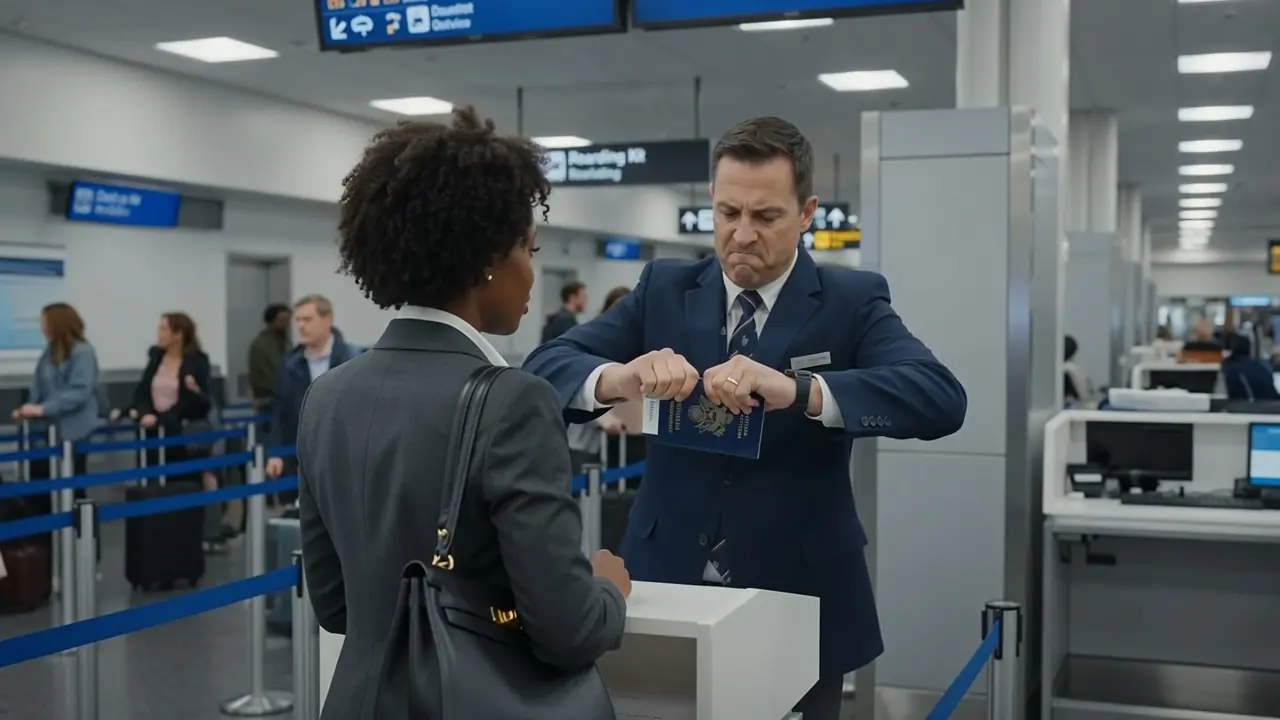
At thirty-eight, Naomi was the founder and chief executive officer of Carter Meridian Capital, an investment group specializing in transportation, infrastructure, and technology. She had built the company from a rented office above a dry cleaner in Detroit, beginning with two employees and a loan no major bank wanted to approve. Fifteen years later, Carter Meridian managed billions in assets across three continents. Yet Naomi still kept the rejection letters from those first banks inside a drawer marked Reasons to Read Every Contract Twice.
That Friday morning, she was scheduled to fly to London for the final stage of Carter Meridian’s acquisition of Atlantic Crown Airways. The airline had struggled for years beneath debt, poor leadership, and growing complaints about customer service. Naomi’s group had already purchased a major voting position through a holding company and negotiated the terms of a controlling acquisition. If the final directors approved the agreement before noon, Carter Meridian would effectively control the airline by the end of the day.
Naomi did not view the deal as a trophy. Atlantic Crown employed more than twenty-two thousand people, operated routes serving communities other airlines ignored, and maintained valuable airport access that could not easily be replaced. The company was worth saving, but only if its culture changed with its finances. Naomi had spent six months telling the board that polished aircraft meant nothing if customers were humiliated before reaching the gate.
Her flight departed from Terminal Five at nine-thirty.
Naomi arrived more than two hours early because the merger documents required original signatures in London. Her dark blue passport rested inside a protective case with her boarding confirmation, legal letters, and the acquisition schedule. She had already checked in online, but a system error prevented the airline application from verifying her travel document. The message instructed her to present the passport at the priority service counter.
The terminal was crowded with families, business travelers, students, and passengers moving between long lines beneath bright digital screens. Atlantic Crown’s premium counter stood beneath a silver sign promising Exceptional Service at Every Journey. Three agents assisted travelers while a supervisor in a navy suit moved behind them, correcting small mistakes loudly enough for customers to hear. His name badge identified him as Richard Hale.
Naomi joined the priority line.
She wore a charcoal coat over a black silk blouse and tailored trousers, but the outfit carried no visible designer labels. Her hair was pulled into a neat low bun, and she wore small gold earrings that had belonged to her mother. Nothing about her appearance announced the size of her company or the acquisition waiting behind her boarding pass. She looked like what she was: a tired Black woman trying to reach a flight on time.
The traveler ahead of her was a white businessman carrying two silver cases. His ticket had been issued under the wrong middle name, and the agent spent nearly twelve minutes helping him correct the booking. Richard approached twice, smiled, and assured the man that Atlantic Crown valued his loyalty. Nobody asked him to step aside while the problem was reviewed.
When Naomi reached the counter, the young agent named Julia offered a professional smile.
“Good morning. May I see your passport?”
Naomi placed the document and boarding confirmation on the counter. “The application would not complete the verification.”
Julia scanned the passport twice.
The screen flashed red.
“I’m sorry,” Julia said. “The reservation appears to be restricted.”
“That may be connected to a corporate travel block. Please verify the authorization code printed beneath the booking.”
Julia began typing.
Richard appeared beside her.
“What is taking so long?”
“The reservation has an executive restriction,” Julia explained. “I’m entering the authorization.”
Richard looked at Naomi before looking at the screen.
His eyes moved over her coat, carry-on case, and plain shoes. The assessment lasted only a second, but Naomi recognized it. She had seen that look inside banks, hotels, boardrooms, and luxury stores. It was the moment someone decided how much respect she deserved before hearing her name.
“This is the priority counter,” Richard said.
“I am aware,” Naomi replied.
“General assistance is in the next section.”
“My ticket is priority class.”
Richard held out his hand. “Let me see it.”
Julia passed him the boarding confirmation.
He examined the document and frowned. “This booking is connected to a restricted corporate account.”
“Yes,” Naomi said.
“Whose account?”
“Carter Meridian Capital.”
Richard looked at her again.
“And your relationship to that company?”
“I am traveling on its behalf.”
“That was not my question.”
Naomi rested one hand on the counter. “The account authorization is printed on the document. Your employee was entering it before you interrupted her.”
Julia lowered her eyes.
Richard’s mouth tightened. “Ma’am, fraudulent use of corporate travel accounts is a serious matter.”
Several passengers nearby turned toward the conversation.
Naomi kept her voice even. “Then verify the account before making another accusation.”
“I have not accused you of anything.”
“You questioned whether I belonged in this line, redirected me without checking my ticket, and implied the reservation may be fraudulent.”
“I am following procedure.”
“No procedure requires public humiliation.”
Richard’s posture changed when he realized people were watching. Instead of lowering his voice, he stood straighter and adopted the formal expression of someone preparing to display authority. He took Naomi’s passport from the counter and turned it over slowly.
“This passport does not explain how you obtained access to an executive booking,” he said.
“My name explains it.”
“Naomi Carter.”
“Yes.”
Richard gave a quiet laugh. “And you expect me to believe you are connected to Carter Meridian?”
Julia glanced sharply toward him. She clearly recognized the name, though she seemed uncertain whether the woman standing before her could truly be the well-known executive whose company appeared in financial news. Naomi noticed her hesitation but did not blame her. Richard’s confidence had transformed a routine verification into a public performance.
“Enter the authorization code,” Naomi said.
Richard ignored the request. “Do you have a company identification card?”
“Yes.”
“Show it.”
Naomi opened her leather case and placed a Carter Meridian executive credential beside the booking. Her photograph, title, and security number appeared beneath the company seal.
Richard picked it up.
He bent the card slightly between his fingers.
“These are easy to manufacture.”
Naomi stared at him. “You have my passport, executive identification, ticket, and authorization number.”
“And a reservation valued at more than twelve thousand dollars.”
“Is the price the reason you believe it cannot be mine?”
A woman waiting at the neighboring counter lifted her phone.
Richard noticed the movement. “No recording is allowed at the service desk.”
The woman lowered the device slightly but did not stop.
Naomi extended her hand. “Return my passport.”
“We are not finished.”
“You have refused to perform the verification. Return my property, and I will speak with airport security and another representative.”
Richard looked toward a uniformed airline security employee near the entrance to the premium area. The man began approaching, though his expression showed more confusion than urgency.
“Ma’am,” Richard said, “you need to lower your voice.”
Naomi had not raised it.
Julia attempted to intervene. “Mr. Hale, the authorization screen is loading. Perhaps we can wait—”
“Step away from the terminal,” Richard ordered.
She obeyed.
Naomi looked directly into Richard’s eyes. “I said return my passport.”
He held it above the counter.
“Until ownership of this reservation is verified, the document remains with us.”
“That statement is false. You are an airline supervisor, not a government authority.”
Richard’s jaw hardened.
“People like you enter premium lines expecting intimidation to replace documentation,” he said quietly.
The words were low enough to create uncertainty about whether everyone heard them. Naomi heard them clearly. So did Julia, whose face changed immediately.
“People like me?” Naomi asked.
Richard looked toward the gathering passengers. “People who create conflict when procedure does not give them what they want.”
Naomi extended her hand again. “Give me my passport.”
“Step away from the counter.”
“No.”
Richard turned toward the security employee. “Remove her from the premium area.”
The officer stopped several feet away. “Sir, has she threatened anyone?”
“She is refusing instructions.”
“I am requesting the return of my passport,” Naomi said.
The officer looked at Richard. “You should return the document unless law enforcement has requested it be held.”
Richard’s face reddened.
He had expected immediate obedience, and the officer’s refusal made him appear smaller before the crowd. Naomi watched pride replace judgment inside him. It was the same transformation she had seen destroy executives who preferred being obeyed to being correct.
Richard gripped the passport with both hands.
Julia inhaled sharply. “Mr. Hale, don’t.”
He tore it down the center.
The sound was small.
Paper fibers separated beneath his hands, followed by the crack of the protective cover. Yet the entire terminal seemed to hear it. Conversations stopped, phones rose, and even the security officer stared in disbelief.
Richard dropped the two pieces onto the counter.
“Now you are not flying anywhere,” he said. “Step aside before security removes you.”
Naomi looked down at the destroyed passport.
Her photograph had been split across one edge. The visa pages inside were bent and torn, including documents needed for meetings in three countries over the following month. For a moment, anger moved through her so violently that she felt it in her fingertips.
She did not shout.
She did not reach across the counter.
She slowly picked up both pieces and placed them inside the protective case.
“You just destroyed a United States passport,” she said.
Richard attempted to preserve his expression. “You presented suspicious documentation.”
“You did not verify anything.”
“You were warned.”
Naomi closed the case. “You have confused authority with immunity.”
Richard pointed toward the terminal aisle. “Leave.”
Naomi looked at the phones recording them, the airline cameras above the counter, Julia’s pale face, and the security officer already speaking into his radio. Then she met Richard’s eyes again.
“You tore up the wrong woman’s passport,” she said. “In five minutes, you will understand exactly how expensive that mistake was.”
Richard laughed, but the sound lacked confidence.
Naomi removed her phone and called Evelyn Grant, Carter Meridian’s chief legal officer.
“Evelyn, I am at Atlantic Crown’s premium counter in Terminal Five. A supervisor named Richard Hale has deliberately destroyed my passport after refusing to verify my corporate booking.”
Silence followed.
Then Evelyn asked, “Are you physically safe?”
“Yes.”
“Are airport police present?”
“Not yet.”
“They will be.”
Naomi continued. “Notify the acquisition board. Invoke the conduct review clause and suspend final execution until we inspect the incident.”
Richard’s expression changed.
The clause allowed Carter Meridian to delay or restructure the acquisition if leadership failures created undisclosed regulatory, legal, or reputational risk. It had been included after Naomi discovered that Atlantic Crown’s internal complaint reports understated serious service problems. A public incident involving document destruction by a supervisor could affect the entire deal.
Richard stepped closer. “Who are you calling?”
Naomi did not answer him.
Evelyn spoke again. “The Atlantic Crown chairman is already at the airport. I will contact him now.”
“Send him to the counter.”
Naomi ended the call.
Richard folded his arms. “A telephone performance does not change what happened.”
“No,” Naomi said. “The cameras will do that.”
Airport police arrived within minutes.
Officer Lena Morales approached first, followed by another officer and a representative from airport operations. Lena asked everyone to remain where they were and requested identification from Naomi. Naomi handed her the torn passport inside its case.
Officer Morales stared at the damage. “Who did this?”
Richard spoke immediately. “She presented suspicious documents and became disruptive.”
“That was not my question.”
Richard hesitated. “I damaged it while preventing her from taking it before verification.”
Julia looked at him.
The security officer shook his head.
A passenger near the counter raised her phone. “That is not what happened.”
Another passenger spoke. “He tore it after she asked for it back.”
Several voices confirmed the same account.
Officer Morales turned toward Julia. “What did you witness?”
Richard looked at the young agent. “Remember that you are representing the company.”
Naomi saw fear cross Julia’s face.
The supervisor had likely controlled her schedule, performance reviews, and future promotions. Telling the truth could threaten her job if powerful people failed to protect her. Richard understood that, which was why he reminded her of the company before she answered.
Julia took a breath.
“Ms. Carter presented valid identification and an executive authorization code,” she said. “Mr. Hale stopped me before the system completed verification. She asked several times for her passport back.”
“And then?”
“He tore it.”
Richard’s face became hard. “You are misunderstanding the context.”
“No,” Julia said. “I am finally describing it.”
Officer Morales asked Richard to step away from the counter.
He refused at first, claiming responsibility for the premium area. The second officer explained that deliberate destruction of a passport could require investigation by federal authorities. Richard’s confidence collapsed another degree.
The authorization screen finished loading behind them.
A large message appeared across the terminal.
VERIFIED EXECUTIVE TRAVELER
NAOMI E. CARTER
CHIEF EXECUTIVE OFFICER — CARTER MERIDIAN CAPITAL
Beneath the identification line appeared another notice.
STRATEGIC OWNERSHIP REVIEW — ATLANTIC CROWN AIRWAYS
Julia turned the screen toward the officers.
Richard stared at it.
“No,” he whispered.
Naomi looked at him. “You could have read that six minutes ago.”
The airport operations representative asked whether she required medical assistance. Naomi declined. She requested documentation of the incident, preservation of all recordings, and instructions for obtaining an emergency passport.
Her London flight would depart without her.
The acquisition vote might also collapse.
Richard seemed to understand the scale of the consequences for the first time.
“Ms. Carter,” he said, “I was protecting the airline.”
Naomi looked at the torn passport. “From its future owner?”
“I did not know who you were.”
“That is the entire problem.”
He lowered his voice. “This can be resolved.”
“It will be investigated.”
“I apologize for damaging the document.”
“You are apologizing after reading my title.”
“I am apologizing because I acted too quickly.”
“You acted deliberately.”
Richard looked toward the cameras. “I was under pressure.”
“From whom?”
He had no answer.
The crowd shifted as several executives approached from the private lounge. Leading them was Jonathan Whitmore, Atlantic Crown’s sixty-three-year-old board chairman. Beside him walked Carter Meridian’s chief legal officer, Evelyn Grant, and two members of the acquisition committee.
Jonathan stopped when he saw Naomi’s passport.
His face went pale.
“Naomi,” he said, “what happened?”
She pointed toward Richard. “Your supervisor decided I did not belong at his counter.”
Jonathan looked at Richard. “Is that true?”
Richard straightened instinctively. “Mr. Whitmore, the traveler’s identity could not be immediately confirmed.”
“The screen confirms it now.”
“She was confrontational.”
Evelyn placed her tablet on the counter. “We have already received three passenger videos.”
Richard stared at her.
“The first recording begins before Ms. Carter raises any objection,” Evelyn continued. “It shows you redirecting her from the priority line despite her valid boarding status. The second captures your statement about ‘people like her.’ The third shows the passport being torn.”
Jonathan closed his eyes briefly.
The airline had spent years attempting to improve its public reputation. One supervisor had now created a crisis in front of dozens of passengers on the morning the board hoped to secure financial rescue.
Richard turned toward Naomi. “I made an error.”
“No,” she said. “Julia made an error when the scanner rejected the passport. You made choices.”
The distinction silenced him.
Jonathan asked airport police whether Richard was free to leave. Officer Morales said he needed to remain available while they contacted the appropriate federal service. Jonathan then removed Richard’s airline access badge.
“You are suspended effective immediately,” he said.
Richard stared at him. “You cannot suspend me in front of passengers.”
“You humiliated a passenger in front of them.”
“I have worked here for eighteen years.”
“Then you had eighteen years to learn how to return someone’s passport.”
Richard looked toward the employees behind the counter. None defended him.
He turned again to Naomi. “You are destroying my career over one difficult interaction.”
Naomi’s expression remained calm. “You believed you could destroy my passport because you assumed my career did not matter.”
“That is not fair.”
“No. What happened here was not fair.”
Airport police escorted Richard into a private office.
The terminal slowly resumed movement, but the atmosphere around the counter remained tense. Passengers still held phones, employees whispered, and Atlantic Crown representatives began receiving calls from journalists who had already seen portions of the video online.
Naomi looked toward Julia.
“You finished the verification despite being ordered to stop.”
Julia nodded. “I should have spoken sooner.”
“You spoke when it mattered.”
“I watched him treat other passengers that way.”
Naomi’s eyes narrowed. “How many?”
Julia described a pattern.
Richard regularly questioned Black travelers, immigrant families, elderly passengers, and people whose clothing did not match his idea of premium status. He demanded additional proof from some customers while offering patient assistance to others with similar booking problems. Complaints entered through the internal system rarely moved beyond his office.
Jonathan listened in silence.
Evelyn began taking notes.
Another employee joined them.
Then another.
A baggage specialist said Richard instructed staff to mark certain travelers as disruptive when they challenged unnecessary delays. A customer-service agent described being removed from premium shifts after objecting to his behavior. The airline’s service culture had not failed in one isolated moment.
The moment had exposed an established system.
Naomi looked toward Jonathan. “Your reports classified this terminal as low risk.”
He appeared ashamed. “The reports were incomplete.”
“They were filtered.”
“Yes.”
“By the same management structure asking us to transfer control today.”
Jonathan understood what she meant.
Carter Meridian’s acquisition agreement assumed that Atlantic Crown had disclosed all meaningful customer-service investigations and discrimination complaints. If branch-level reports had been altered or buried, the legal risk extended beyond Richard.
The final vote scheduled for noon was postponed.
Naomi spent the next four hours in an airport conference room with attorneys, airline directors, employee representatives, and compliance officers. She could not travel internationally without a replacement passport, but the London directors joined by secure video instead. What began as a delayed flight became a complete examination of the airline’s management culture.
The review uncovered forty-three complaints connected to Richard’s terminal over eighteen months.
Thirty-one had been closed without interviewing the passengers who submitted them. Several security reports contained language copied from one incident to another, including descriptions of travelers as “aggressive” despite recordings showing no threatening conduct. Employees who questioned those reports received reduced hours or unfavorable assignments.
Naomi did not use the discoveries as an excuse to abandon the deal.
Leaving would protect Carter Meridian’s reputation, but it would also threaten thousands of workers whose futures depended on the airline surviving. Instead, she proposed new acquisition terms.
Carter Meridian would complete the controlling purchase only if Atlantic Crown accepted immediate independent oversight. All customer complaints would bypass local supervisors, discriminatory service reviews would be reopened, and employees who reported misconduct would receive protection from retaliation. Executive bonuses would be suspended until the company met measurable service standards.
The board accepted.
At four-fifteen that afternoon, the final documents were signed electronically.
Carter Meridian Capital became the controlling owner of Atlantic Crown Airways.
Naomi stood beside the same counter where her passport had been torn when Jonathan made the internal announcement. Employees throughout the terminal watched from workstations and gates.
“This airline has new ownership,” Naomi said. “But ownership alone does not create change.”
She placed the two damaged passport halves on the counter.
“This happened because one employee believed dignity should be reserved for travelers he considered important. It continued because others feared the cost of correcting him, and because complaints disappeared inside a system designed to protect management from accountability.”
Julia stood several feet away, listening.
Naomi continued. “Nobody here will be punished for telling the truth about what happened today or what happened before today. But from this moment forward, silence will no longer be mistaken for professionalism.”
She did not announce Richard’s termination.
An investigation still had to follow proper procedure. Naomi had spent years criticizing leaders who decided outcomes before examining evidence, and she refused to repeat the same mistake simply because she was now the injured party.
The investigation lasted five weeks.
It confirmed that Richard repeatedly discriminated among passengers, destroyed Naomi’s passport intentionally, pressured employees to submit misleading reports, and retaliated against staff who challenged him. His employment was terminated, and the passport incident was referred to the appropriate authorities. He also became personally responsible for expenses connected to the emergency document process through a later civil settlement.
Two regional managers lost their positions for ignoring complaints.
Other employees received retraining or discipline based on their individual conduct. Naomi rejected the idea that one cruel supervisor explained the entire problem. A company large enough to employ Richard for eighteen years had to examine why his behavior became useful, protected, or invisible.
Julia was promoted to customer-integrity coordinator.
She initially refused because she feared colleagues would believe Naomi rewarded her personally. Naomi required her to interview with an independent panel and compete against qualified candidates. Julia earned the role through her knowledge of service procedures and willingness to describe where they failed.
Officer Morales helped Naomi secure an emergency passport that evening.
Naomi missed the original flight but reached London the following morning. She carried a temporary travel document and the broken passport inside her leather case. She kept it not as a souvenir of humiliation, but as evidence of what polite corporate reports often failed to reveal.
Three months later, Naomi returned to Terminal Five without advance notice.
She wore the same charcoal coat and carried the same black case. The premium counter had been redesigned so complicated verifications could occur in a private area rather than in front of waiting passengers. Signs clearly explained that airline staff could inspect travel documents but could not confiscate them without legal authority.
A middle-aged Black man wearing construction boots stood at the counter ahead of her.
His corporate ticket had triggered an authorization error. The agent did not question whether the reservation belonged to him. She invited him to sit, verified the account, and returned his passport with an apology for the delay.
Naomi watched without announcing herself.
Julia recognized her from across the terminal and approached.
“Better?” she asked.
“Better.”
“Not perfect.”
“Nothing involving people ever is.”
Julia looked toward the construction worker receiving his boarding pass. “Richard used to say premium service meant protecting wealthy travelers from inconvenience.”
Naomi adjusted the handle of her case. “Premium service should mean nobody has to display wealth before receiving respect.”
Julia nodded.
Near the security entrance, Atlantic Crown had installed a new employee statement selected by frontline staff rather than executives.
Verify documents. Never judge the person presenting them.
Naomi paused beneath it.
The sentence was simple enough to fit on one line, but the airline had needed years, forty-three ignored complaints, and one torn passport to understand it.
A young gate agent approached and offered assistance.
“Ms. Carter, would you like an escort to the lounge?”
Naomi smiled. “No, thank you.”
She preferred walking alone.
People still looked at her without knowing who she was. Some saw a Black woman traveling for business, others saw an executive, and a few saw only another passenger moving through a crowded terminal. Naomi could not control every assumption.
She could control what happened when assumptions entered the company she now led.
The broken passport remained inside her case as she walked toward the gate.
Richard had torn it because he believed the document belonged to someone without power.
By the end of that day, Naomi had gained control of the airline.
But the most important lesson was not that he had insulted the woman who could remove him.
It was that no passenger should need to own the airline before being treated like a human being.