“Get your hand off that railing. You don’t belong on this jet.”
The command carried across the sunlit tarmac with enough force to make several ground workers turn their heads. Adrian Vale stood at the bottom of the silver boarding stairs, one hand resting calmly on the metal rail while the enormous white jet towered behind him. He wore a charcoal-gray sweatshirt, matching travel pants, and simple dark sneakers, looking more like a tired passenger returning from a morning run than the billionaire owner of the aircraft.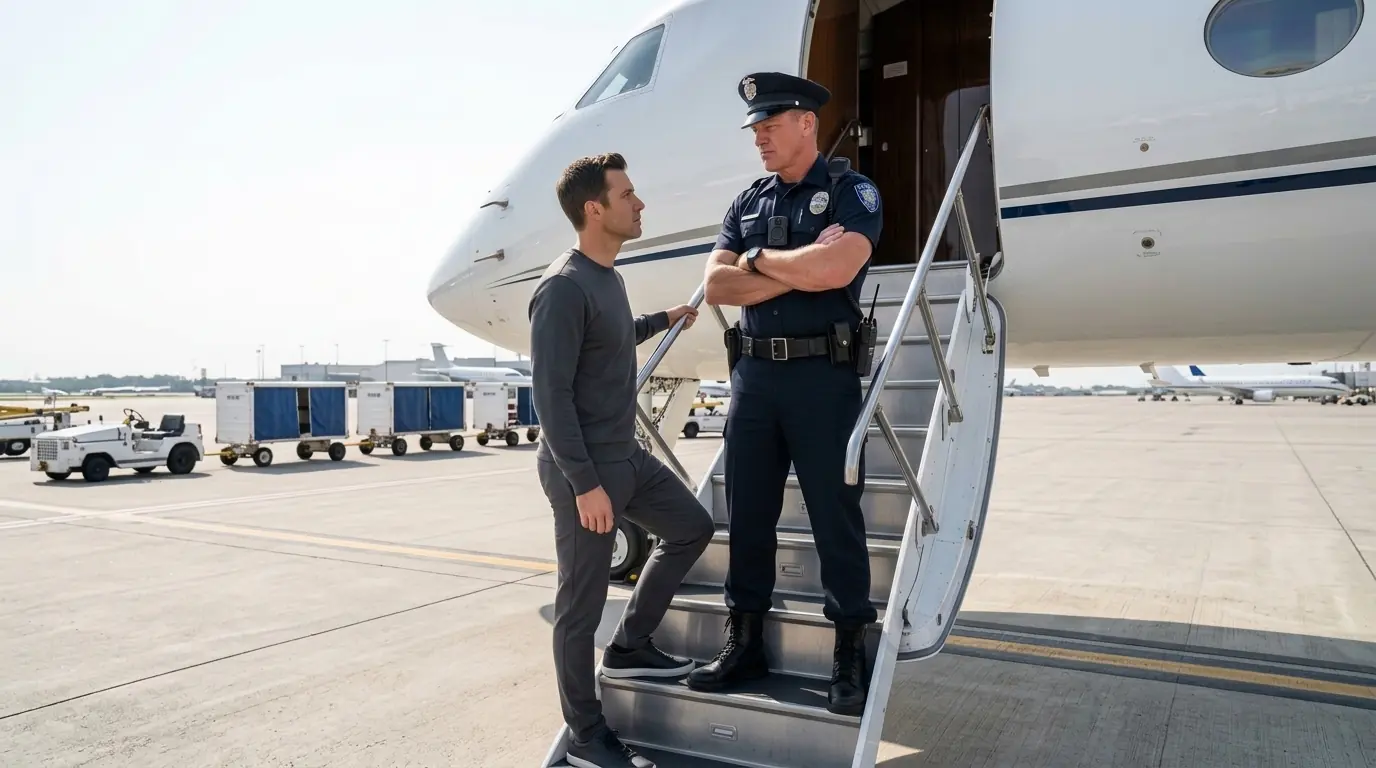
Airport Police Officer Mark Danner blocked the first step with his broad body. His muscular arms were folded across a fitted navy uniform, and his polished black boots were planted as if he intended to defend the plane from an armed invasion. “Move away before I remove you myself.”
Adrian looked past him toward the open aircraft door. “I’m scheduled to depart in twelve minutes.”
“You’re not scheduled for anything.”
“I suggest you check the manifest.”
Mark gave a humorless laugh. “I already know who is flying today. The owner is an important man, not some nobody wandering across a restricted apron in a tracksuit.”
Adrian tightened his hand around the railing. “Move aside before your uniform becomes the least of your problems.”
Mark stepped down until only one stair separated them. “Touch these steps again, and I’ll slam you onto the tarmac.”
Adrian slowly raised his phone. “Do it. Then explain to headquarters why you attacked the man who signs your paycheck.”
For a second, the only sound was the distant whine of an auxiliary power unit. Mark’s expression did not change, but his eyes flickered toward Adrian’s phone. Then his mouth curled into a contemptuous smile.
“That line might work at a nightclub,” he said. “It won’t work at an airport.”
The jet behind them was an Airbus ACJ350, one of fewer than two dozen configured at that level of private luxury. Its pearl-white fuselage carried no dramatic branding, only a small silver crest near the forward door. Inside were two bedrooms, a private office, a conference suite, a medical station, and enough secure communications equipment to operate a multinational company from thirty thousand feet.
Adrian had designed the aircraft to remain discreet.
That decision was now working against him.
The terminal belonged to Meridian Executive Aviation, a private facility separated from the main commercial airport by two miles of secure roadway. Wealthy passengers entered through a quiet glass building, completed immigration checks privately, and reached aircraft without walking through public gates. The entire experience was designed around privacy, speed, and restraint.
Mark Danner possessed none of those qualities.
He had worked airport security for seven years and had recently been promoted to senior operations officer. His position gave him authority over the tarmac surrounding Meridian’s private terminal, including power to stop unauthorized people and remove anyone who ignored safety instructions. The responsibility was legitimate.
His judgment was not.
Minutes earlier, Adrian had entered through the employee-side access door after walking from a nearby maintenance hangar. He had spent the morning inspecting a new aviation-software system and speaking privately with mechanics about recurring delays. He deliberately avoided announcing his visit because executives behaved differently when they knew the owner was watching.
The mechanics had spoken honestly.
Mark was doing the same.
Adrian had reached the aircraft stairs when Mark crossed the tarmac and ordered him to stop. No greeting, identification request, or neutral question came first. Mark saw an casually dressed man beside an expensive jet and decided the situation before gathering a single fact.
“Step away from the plane,” Mark repeated.
Adrian remained still. “What specific security rule have I violated?”
“You entered a restricted zone.”
“My badge opened the gate.”
“Badges can be stolen.”
“Then scan it.”
Mark ignored the suggestion. “Where did you get the access card?”
“From the company that issued it.”
“You think you’re clever?”
“I think you haven’t verified anything.”
The exchange drew the attention of a young ground coordinator named Elena Ruiz. She stood near the aircraft’s forward cargo door holding a tablet, watching the confrontation with growing concern. Elena had checked Adrian’s identity less than fifteen minutes earlier and knew exactly who he was.
She started walking toward them.
Mark saw her and pointed sharply. “Stay at your position.”
Elena stopped. “Officer, he is—”
“I said stay there.”
Adrian looked at her. “It’s all right.”
It was not all right, but Elena understood the instruction. She returned to the loading area while keeping her tablet ready. Mark interpreted her retreat as proof that his authority remained unchallenged.
“You heard the employee,” Adrian said. “She was trying to identify me.”
“She was trying to interfere with a security investigation.”
“You haven’t started an investigation.”
Mark stepped completely off the stairs. “You want to test me?”
“No. You are doing that yourself.”
The officer’s jaw tightened.
Adrian had encountered men like him in boardrooms, government offices, construction sites, and luxury hotels around the world. They relied on volume, uniforms, titles, or expensive surroundings to convince others that resistance was impossible. Most became increasingly aggressive when calm questions exposed how little evidence supported their certainty.
Mark reached toward Adrian’s wrist.
Adrian moved his hand away before contact.
The officer’s other hand dropped near the equipment on his duty belt. “Do not pull away from me.”
“You never told me I was being detained.”
“You are now.”
“For what?”
“Unauthorized access and failure to comply.”
“With an order based on what evidence?”
Mark leaned closer. “You don’t ask the questions here.”
Adrian studied the body camera mounted at the center of his uniform. A small red light confirmed it was recording.
“Make sure that stays on.”
Mark glanced down automatically. “You threatening me?”
“I’m protecting both of us.”
“I don’t need protection from you.”
“That may be the first correct thing you’ve said.”
At forty-two, Adrian Vale controlled an aviation and infrastructure empire valued at more than eighteen billion dollars. Vale Horizon Holdings owned cargo airlines, maintenance centers, software companies, luxury terminals, and one of the largest private airport-security contractors in North America. Meridian Executive Aviation was one of its subsidiaries.
So was Sentinel Aeronautical Security.
The name printed beneath the badge on Mark’s shoulder belonged to Adrian’s company.
Adrian had founded Vale Horizon twenty years earlier with a single aircraft-leasing contract and a borrowed office above a tire shop. His father had worked baggage operations at Chicago O’Hare, while his mother cleaned offices at night. Neither parent possessed wealth, connections, or influence.
They gave him something more durable.
They taught him to notice workers no one else saw.
Adrian grew the company by listening to mechanics, dispatchers, cleaners, pilots, and ground crews before listening to consultants. He believed aviation failed from the ground upward. A dishonest executive might damage profits, but an ignored technician could unknowingly place lives at risk.
That belief brought him to Meridian that morning.
Three anonymous complaints had accused security supervisors of humiliating employees, selectively enforcing access rules, and treating casually dressed passengers as potential criminals. Senior management dismissed the incidents as misunderstandings. Adrian wanted to see the culture himself before signing a five-year contract renewal worth more than four hundred million dollars.
Mark Danner was helping him decide.
A black terminal vehicle stopped nearby. The operations director, Gregory Shaw, climbed out with his phone pressed to one ear. He was a thin man in his fifties, dressed in a navy suit despite the heat, and his face already showed the panic of someone receiving bad news too late.
He hurried toward the aircraft.
“Officer Danner,” Gregory called. “Step away from that passenger.”
Mark turned halfway. “Sir, I’m handling an unauthorized individual.”
Gregory’s eyes moved to Adrian. “That is not an unauthorized individual.”
“He refuses to provide a valid explanation for being here.”
Adrian spoke without looking away from Mark. “He hasn’t asked for one he was prepared to believe.”
Gregory lowered his phone. “Officer, release the area immediately.”
Mark’s expression shifted from arrogance to irritation. “With respect, Mr. Shaw, operations does not override active security.”
“This is not active security.”
“I detained him after he attempted to board without authorization.”
Gregory moved closer and lowered his voice. “He owns the aircraft.”
Mark glanced toward Adrian and then back at the director. “You’re saying this man owns an ACJ350?”
“Yes.”
“That’s impossible.”
Adrian’s eyebrows rose slightly. “That seems to be your favorite conclusion.”
Mark looked him over again, searching for some visible symbol of wealth he had missed. There was no tailored suit, diamond watch, assistant, chauffeur, or group of executives surrounding him. Adrian’s sweatshirt carried no logo, and his phone was several years old because he disliked replacing equipment that still worked.
“You expect me to believe that?” Mark asked.
Gregory’s composure began breaking. “I expect you to obey a direct instruction.”
“You could be mistaken.”
The operations director stared at him. “About the owner of our parent company?”
Mark went silent.
Elena watched from beside the cargo door. Two mechanics had stopped behind a service truck, while a fuel supervisor stood perfectly still with a hose checklist in his hands. Nobody wanted to miss what happened next.
Adrian unlocked his phone.
He called one number.
The response came after a single ring.
“Mr. Vale,” said a woman’s voice through the speaker. “Are you aboard?”
“Not yet, Naomi.”
“Is there a delay?”
“Yes. Connect me to Sentinel headquarters, the Meridian board chairman, and corporate legal. Put everyone on the same line.”
Mark’s face hardened, but doubt had entered his eyes.
Within thirty seconds, three voices joined the call.
The first belonged to Rebecca Lawson, chief executive of Sentinel Aeronautical Security. The second belonged to Thomas Keene, chairman of Meridian’s board. The third was Daniel Cho, general counsel for Vale Horizon Holdings.
“Adrian,” Thomas said, “we were told there was an incident.”
“There is.”
“Are you safe?”
“I’m standing beside the aircraft.”
Adrian turned slightly so the phone faced Mark. “Rebecca, identify Officer Mark Danner’s employer.”
There was a short pause as a keyboard clicked.
“Officer Danner is employed by Sentinel Aeronautical Security, assigned to Meridian Executive Aviation.”
“Who owns Sentinel?”
“Vale Horizon Holdings owns one hundred percent of the company.”
“Who controls Vale Horizon?”
“You do.”
The words settled across the tarmac.
Mark’s folded arms slowly separated.
Adrian continued. “Who approved Sentinel’s current compensation structure?”
“You did, through the executive committee.”
“And whose signature authorizes the payroll facility?”
“Yours.”
Mark’s eyes moved toward the small silver crest on the jet. He finally recognized it as the Vale Horizon emblem.
The officer’s face lost color.
Adrian ended the speaker call only after asking legal counsel to preserve every recording connected to the encounter. He then placed the phone inside his pocket.
Mark swallowed. “Mr. Vale, I was following procedure.”
“No procedure told you what I could afford.”
“I was protecting the aircraft.”
“From its owner?”
“You were not dressed like—”
He stopped.
Adrian waited.
The unfinished sentence carried more meaning than a completed one could have.
“Not dressed like what?” Adrian asked.
Mark looked toward Gregory for help.
The operations director offered none.
“You entered from an unusual access point,” Mark said.
“My authorized badge opened the door.”
“You approached without an escort.”
“Owners and credentialed executives do not require escorts in this zone.”
“I had no way to know that.”
“You could have scanned the badge.”
Mark’s mouth tightened.
“You could have asked for identification,” Adrian continued. “You could have allowed Ms. Ruiz to speak. You could have contacted operations before threatening physical force.”
“I made a judgment call.”
“You made several. Every one moved away from evidence and toward humiliation.”
Mark looked around and realized the workers were watching. His embarrassment turned defensive.
“With respect, sir, wealthy people expect special treatment after the fact.”
Adrian’s expression became colder. “This has nothing to do with wealth.”
“You just called the board.”
“Because you threatened to slam me onto the tarmac after refusing every ordinary verification method.”
Mark straightened. “I never touched you.”
“You tried.”
“I was establishing control.”
“You had control of the staircase. What you wanted was control of me.”
Gregory stepped forward. “Officer Danner, surrender your access badge and duty credentials pending investigation.”
Mark stared at him. “You’re suspending me for protecting the jet?”
“I am suspending you for refusing operational confirmation, threatening an authorized passenger, and disobeying a direct order.”
“I want my union representative.”
“You will have one.”
Mark did not move.
Two other Sentinel officers approached from the terminal. Their supervisor, Captain Elaine Mercer, walked between them. She had been reviewing the body-camera livestream from the security office and already knew enough to act.
“Mark,” she said quietly. “Hand me your badge.”
He looked at her. “You know I was doing my job.”
“I know you rejected an electronic credential, interrupted identification from ground staff, and threatened force against a compliant person.”
“He refused to leave.”
“He had the right to remain.”
Mark removed the badge card from his belt with stiff fingers. He placed it in Elaine’s hand, followed by his radio and airport-access credential. The supervisor instructed another officer to escort him inside.
Before leaving, Mark looked toward Adrian.
“You set me up.”
Adrian’s voice remained calm. “I walked toward my aircraft. You supplied the rest.”
Mark was escorted across the tarmac.
No one applauded. Adrian would have disliked that. The scene had not been entertainment, and a suspended officer was not proof that the deeper problem had been solved.
He turned toward Elena.
“You tried to intervene.”
She nodded carefully. “Yes, sir.”
“Why did you stop?”
“He ordered me back, and officers have previously written employees up for interfering.”
“Previously?”
Elena looked toward Gregory.
The director lowered his eyes.
Adrian noticed. “How many times?”
“I don’t know exactly.”
“Estimate.”
“Maybe six complaints this year. Possibly more.”
Gregory cleared his throat. “Some were informal.”
“That usually means employees were afraid to put them in writing.”
No one answered.
Adrian delayed the flight.
He moved the meeting into Meridian’s conference suite and asked representatives from ground operations, maintenance, customer service, cleaning, catering, and security to attend. Managers were excluded from the first session so employees could speak without worrying about immediate retaliation.
The stories arrived slowly.
A Black pilot had been stopped three times while white pilots entered through the same access door without challenge. A maintenance technician wearing an old sweatshirt was forced to empty his bag on the pavement despite carrying a valid credential. A wealthy passenger’s Latino driver was detained because an officer assumed he was attempting to steal the limousine.
Mark was not involved in every incident.
That made the situation worse.
The behavior was cultural rather than individual.
Several supervisors rewarded aggressive stops because complaints from wealthy passengers were considered more dangerous than complaints from employees. Security officers learned that embarrassing the wrong billionaire could damage a career, while humiliating ordinary workers rarely created consequences.
Adrian listened for four hours.
He asked specific questions and took notes himself. He did not allow Gregory or Sentinel executives to explain away what employees described. Every complaint would be independently reviewed against badge records, camera footage, and incident reports.
By evening, Adrian made three decisions.
Gregory Shaw was placed on administrative leave for suppressing complaints. Meridian’s contract renewal with Sentinel was suspended. An outside civil-rights and aviation-safety firm received authority to review security practices across all Vale Horizon terminals.
Mark’s body-camera footage became central evidence.
It showed Adrian offering verification repeatedly. It recorded the officer refusing the badge scan, silencing Elena, and threatening to slam him onto the tarmac. Most damaging was Mark’s insistence that the casually dressed man could not possibly own the jet.
The investigation found twelve earlier complaints connected to Mark.
In one case, he forced a private chef to sit on the ground because the man’s catering uniform looked “unprofessional.” In another, he detained a young aircraft engineer after deciding her tool case appeared too expensive for her to own. Supervisors dismissed both incidents without reviewing complete footage.
Mark was terminated after a formal hearing.
He was not dismissed because he failed to recognize Adrian.
He was dismissed because recognition should never have been necessary.
Sentinel changed its procedures across thirty-one facilities. Officers were required to verify credentials before making assumptions based on clothing, luggage, vehicles, or perceived status. Employees received a protected channel for reporting intimidation, while supervisors faced automatic review for discouraging complaints.
Elena was promoted to ground-operations manager six months later.
When Adrian offered her the position, she hesitated. “I did stop speaking when he ordered me back.”
“You tried before you knew I was the owner.”
“I should have kept going.”
“Next time, you will.”
The ACJ350 finally departed shortly after sunset on the day of the confrontation. Adrian climbed the same staircase Mark had blocked hours earlier. The metal railing was warm beneath his hand.
Inside the aircraft, the crew had prepared dinner and opened the private office. Adrian ignored both. He sat beside a window and watched Meridian’s lights become smaller beneath the wing.
Naomi joined him after takeoff.
“Was the delay worth it?” she asked.
Adrian looked toward the clouds. “More than an on-time departure would have been.”
“You may lose the Sentinel contract.”
“We own Sentinel.”
“You know what I mean.”
He did.
Replacing management, retraining officers, and compensating affected employees would cost millions. Investors would question the public investigation, and competitors would use the incident to attack Vale Horizon’s reputation.
Adrian accepted every consequence.
A company’s values meant nothing when obeying them was inexpensive.
Months later, he returned to Meridian without announcement. He wore jeans, an old navy jacket, and the same dark sneakers. This time, a young security officer greeted him near the access gate.
“Good morning, sir. May I scan your credential?”
Adrian handed it over.
The officer checked the screen, matched the photograph, and returned the card. “Thank you, Mr. Vale. Your aircraft is at Position Four.”
No fear, humiliation, or dramatic recognition followed.
That ordinary professionalism satisfied Adrian more than an apology ever could.
Near the boarding stairs, Elena supervised a loading team. She smiled when she saw him and pointed toward the silver rail.
“Nobody blocking it today.”
“Almost disappointing.”
“I can arrange someone to threaten you for nostalgia.”
Adrian laughed.
He placed one hand on the railing and looked toward the aircraft door. The jet remained extraordinary, but ownership had never been the lesson.
Mark Danner had believed the worst mistake was threatening the billionaire who signed his paycheck.
It was not.
His real mistake was believing dignity depended on whether the man before him owned a jet, wore an expensive suit, or could call a board chairman with one touch. Adrian’s phone revealed power, but his rights existed before anyone knew his name.
Any authorized traveler deserved verification instead of humiliation.
Any employee deserved to speak without retaliation.
Any person standing calmly beside an aircraft deserved evidence to matter more than appearance.
Mark threatened to slam Adrian onto the tarmac because he believed a casually dressed stranger had no power to resist him.
Then one quiet call exposed the ownership structure, the suppressed complaints, and the culture hiding behind his badge.
The jet belonged to Adrian Vale.
The security company belonged to Vale Horizon.
But respect had never belonged to the officer to grant or withhold.
That was the lesson Adrian made certain every terminal learned long after the aircraft disappeared into the sky.