The summer heat of 1883 pressed against the frontier town of Oak Hollow, Colorado, until the wooden buildings seemed ready to split. Inside Whitaker Bakery, Emma Whitaker stood behind a flour-covered counter with a warm loaf crushed against her chest and a bruise darkening the edge of her jaw. Her father, Henry Whitaker, leaned over a legal contract with the desperate satisfaction of a man who had convinced himself that betrayal was practical. Across from him stood Jack Hawthorne, a towering mountain man whose buckskin pouch had just spilled gold coins across the flour.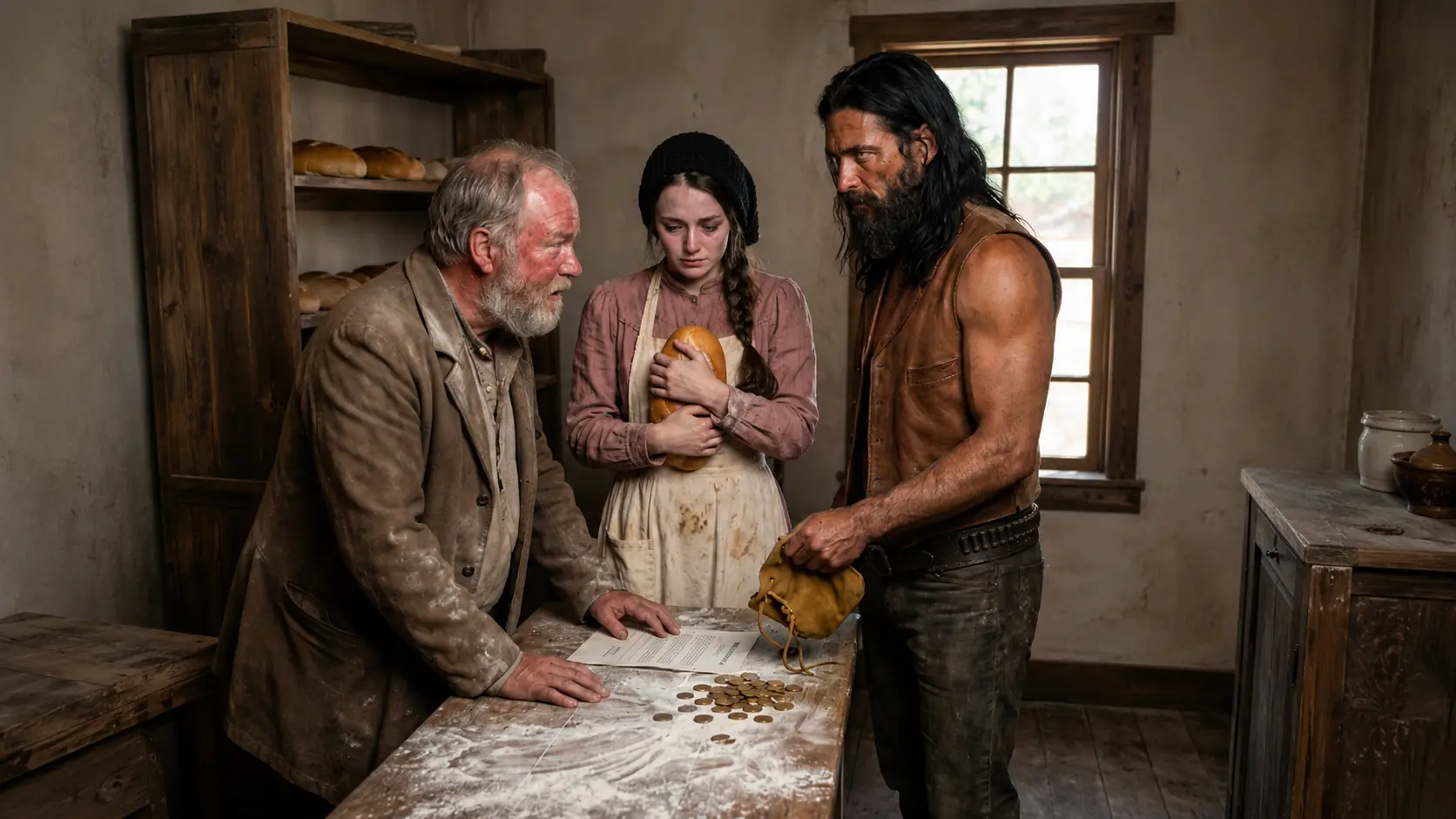
“Briggs owns my debt, so by Friday he owns you,” the baker father said, grinning at the gold.
“You signed me away like livestock,” the baker’s daughter whispered.
“Pay four hundred twelve dollars, or she leaves with Briggs.”
Jack’s gray-green eyes never left Henry’s face. “Count it. At sunrise she takes my name, and no man owns her again.”
The bakery went silent except for the faint crackling of the ovens. Henry stared at the gold as though each coin had fallen directly from heaven, while Emma stared at the stranger who had spoken of marriage as calmly as another man might discuss the weather. Jack had entered the bakery less than an hour earlier to buy two loaves for the long ride back to his mountain claim. Now he was offering his name to a woman he barely knew.
Henry pulled the nearest coins toward himself and began counting. He did not ask what kind of man Jack was, where he lived, or whether Emma wanted to marry him. His fingers moved quickly through the gold, lips silently forming numbers as relief replaced the shame in his eyes. Emma watched him and realized that her father cared more about clearing the debt than understanding why a stranger would intervene.
“You cannot decide this for me,” Emma said.
Henry looked up sharply. “I already decided when I signed Briggs’s papers.”
“That document has no legal right to exist. I am twenty-three.”
“Silas has the sheriff, the county clerk, and Judge Callaway. Legal right is whatever those men say it is.”
Jack rested one scarred hand on the counter. “Not after sunrise.”
Emma turned toward him. Up close, Jack Hawthorne looked even more intimidating than he had when he first entered the bakery. His long black hair touched the collar of his heavy coat, and his dark beard could not conceal the old scar near his jaw. Yet he had not once looked at her the way Silas Briggs looked at women whose debts gave him leverage.
“What happens after sunrise?” she asked.
“We marry at the magistrate’s office. The marriage is recorded through the territorial clerk, which overrides a county guardianship transfer involving an adult woman.”
“And after that?”
“You ride with me to my claim in the Gilpin Range.”
“To become your wife?”
“On paper first,” Jack replied. “Anything more happens only if you choose it.”
Henry stopped counting. “I don’t care what happens in the mountains as long as Briggs gets paid.”
Emma’s gaze moved slowly toward her father. There had once been a man inside Henry Whitaker who carried her to bed when she fell asleep near the ovens and saved the first sugared roll for her every Sunday. Her mother’s illness had hollowed him out, and Silas Briggs’s debt had filled the empty space with fear. Still, hardship did not erase the fact that he had signed away his adult daughter without telling her.
“You knew about the guardianship document,” Emma said to Jack.
“I suspected Briggs had prepared one.”
“How?”
“He used the same method in Larimer County.”
Emma saw something harden in his expression. “Someone you knew?”
“My sister.”
Henry pushed the counted coins into a neat pile. “There’s enough here.”
Jack did not acknowledge him. “Silas trapped my sister in one of his boarding-house contracts for two years. I have tracked his operations across three counties since she escaped.”
“And you came to Oak Hollow for him.”
“I came for evidence. Then I saw you.”
Emma looked down at the loaf she still held. The bread had begun to collapse beneath her fingers, its crust cracking against her apron. Only that morning, she had believed her choices were to surrender to Briggs or run with eleven dollars and forty cents hidden behind a loose brick. Now a mountain stranger was offering a third path, one secured not by romance or promises but by a specific weakness in territorial law.
Henry swept the gold into a flour sack. “There. The matter is settled.”
“No,” Emma said. “You do not get to say that.”
Her father froze.
“You signed my name without my knowledge. You handed me to a man who collects women the way ranchers collect cattle. You will take his payment because fear has made you smaller than the man my mother married, but do not call this settled.”
Henry’s face reddened. “I kept this bakery alive for you.”
“I kept it alive. I rose before four every morning. I mixed the dough, managed the accounts, served the customers, and protected your reputation while you borrowed from Briggs.”
“You ungrateful girl.”
Jack stepped between them before Henry could cross the counter. He did not touch the baker or raise his voice, but the room changed when his broad shoulders blocked Henry’s path.
“She is not yours to strike,” Jack said.
“This is my family.”
“You ended that claim when you sold her.”
Henry’s hand dropped to his side. He glared at Jack, then at Emma, but the anger could not hide his humiliation. Emma had seen him rage before, but never while another man stood close enough to stop him. For the first time, her father was forced to see that fear only worked when everyone agreed to be afraid.
Jack gathered the unsigned marriage papers he had obtained from the magistrate earlier that morning. He had apparently prepared for the possibility that someone in Oak Hollow might need legal protection from Briggs. Emma did not know whether to be grateful or suspicious. A man who predicted desperate marriages was not necessarily a safe man, even if he opposed someone worse.
“Sunrise,” Jack said. “The magistrate opens at eight.”
Emma looked at the bakery shelves, the ovens, and the narrow staircase leading to the room where she had slept since childhood. Every corner contained part of her life, but none of it felt like hers anymore. Her father had placed a price on her freedom, and a stranger had paid it.
“I will meet you there,” she said.
Henry laughed bitterly. “You think marriage to a mountain animal is freedom?”
Emma held his gaze. “No. I think leaving you is.”
She packed that night while Henry drank alone in the kitchen. Two dresses, her mother’s silver thimble, a leather journal, the eleven dollars and forty cents, and a small photograph taken when the Whitaker family still looked happy. Emma left the bakery before dawn and did not wake her father. She placed the keys beside the flour ledger and walked into the cool morning carrying everything she still trusted.
Jack waited outside the magistrate’s office in a clean shirt with his beard trimmed and his hat held respectfully in both hands. Two saddled horses stood near the hitching rail, one a calm brown mare with a white mark above her nose. Jack looked surprised when Emma arrived, as though part of him had expected her to change her mind.
“You came,” he said.
“I said I would.”
“You can still leave.”
“And go where?”
“Anywhere you choose. I will give you enough money to reach Denver if that is what you want.”
Emma studied his face. “Would you still confront Briggs if I refused?”
“Yes.”
“Then why offer marriage?”
“Because confronting him may take years. You need protection today.”
The clerk opened the office at eight, complaining about the heat before it had properly begun. The ceremony took less than twenty minutes. There were no flowers, guests, or soft words, only legal questions spoken in a narrow room that smelled of dust and ink. Emma answered each one clearly.
When the magistrate asked Jack whether he accepted Emma Whitaker as his lawful wife, his voice did not hesitate. When Emma was asked the same question, she looked at the man she had known for less than two days and said yes. The clerk signed as witness, pressed the territorial seal into the paper, and recorded the exact time as 8:22 on Friday morning.
Emma Whitaker became Emma Hawthorne.
At ten, Silas Briggs entered the bakery expecting to collect her. Emma was already several miles outside Oak Hollow, riding toward the foothills beside her new husband. She did not see Silas throw the guardianship papers across the counter or hear Henry explain that a mountain man had paid the debt. She only knew the road ahead climbed toward a world she had never seen.
Jack rode slightly in front, close enough to help but far enough not to crowd her. He did not demand conversation or behave as though marriage entitled him to familiarity. When the trail narrowed, he warned her about loose stones and allowed the mare, Clover, to choose her footing. Emma’s hands gradually stopped trembling around the reins.
“What will people believe when we reach your claim?” she asked.
“That I returned with a wife.”
“And what will you tell them?”
“The same thing.”
“That is not an explanation.”
“People in the mountains who survive winter usually learn not to waste breath on questions that do not concern them.”
Emma almost smiled. “And if they do ask?”
“I will say you chose to come.”
The answer settled something inside her. All her life, men had described decisions made for her as though she had made them herself. Jack did the opposite. He treated even a desperate choice as hers because she had been the one to speak it.
They stopped beside a creek at midday. Jack watered the horses, checked Clover’s shoes, and handed Emma dried meat without asking whether she was hungry. His movements were economical and precise. He wasted neither words nor effort.
“Why do you live alone?” Emma asked.
“Because the mountain is quiet.”
“That is not an answer.”
“It is the answer I have.”
She accepted it for the moment. Jack had not asked about the bruise on her face, though he had noticed it inside the bakery. His silence did not feel indifferent. It felt like permission to tell him only when she was ready.
They reached the cabin after dark. It stood beneath tall pines above a wide eastern meadow, built from heavy logs and riverstone. A stable leaned against one side, and the sound of a creek came from somewhere beyond the trees. The structure was larger and cleaner than Emma expected, but there was no softness inside it.
Jack lit an oil lamp and showed her the supplies, stove, water bucket, smokehouse, and root cellar. He opened a door at the rear of the cabin, revealing a small room with a cot, window, and wooden latch. The space had been emptied and swept.
“This is yours,” he said.
“And where do you sleep?”
“The loft.”
Emma tested the latch. “You prepared this before today.”
“I cleared it after hearing Henry speak to the dry-goods merchant.”
“You were certain I would accept?”
“No. I wanted the room ready if you did.”
Emma looked at him across the doorway. “Thank you.”
“You do not owe me gratitude.”
“I owe you more than that.”
“No,” Jack said. “You owe me honest work according to the arrangement we discussed. Cooking, managing supplies, and helping maintain the cabin. Nothing else.”
“And when I want to leave?”
“I take you wherever the road is safe.”
Emma entered the room and closed the door. She listened for his footsteps to approach, but Jack climbed to the loft without testing the latch or speaking again. For the first time in years, she slept with a barrier between herself and an angry man.
Habit woke her before four. The cabin was cold, and the fire had burned down to red coals. Emma rebuilt it, examined the cast-iron stove, ground coffee, and began testing the kitchen as if it were another unfamiliar oven. By the time Jack descended from the loft, the room smelled of coffee and cornmeal.
She handed him a tin cup. He drank without speaking.
“You are not conversational before sunrise,” Emma observed.
“Neither are you.”
“That may be the first thing we share.”
Jack sat at the table. “I am checking the trap lines. I will return before noon.”
“I found beans and salt pork.”
“You do not have to cook.”
“I know.”
Something shifted around his eyes, almost a smile. “There is a bear near the northern tree line. Do not go past the creek alone.”
“Does the bear know I am legally married?”
“No.”
“Then I will stay near the cabin.”
The first cornbread she baked came out dark on one side because the mountain stove burned hotter than the bakery oven. Emma examined the failure, adjusted the wood, and made another. Jack returned carrying two rabbits and stopped when he smelled the bean soup simmering over the fire.
He washed his hands and ate silently. Halfway through the bowl, he looked at Emma.
“This is good.”
“It is only beans.”
“It is the best meal I have eaten in six years.”
“That tells me more about your cooking than mine.”
For the first time, Jack laughed. The sound was brief, rough, and unfamiliar to him, as though laughter were a tool he had not used recently. Emma looked down at her bowl so he would not see how much the sound affected her.
Their first week developed a quiet rhythm. Jack left before sunrise to inspect traps, cut wood, or hunt. Emma cleaned, organized supplies, and relearned baking at high altitude. They ate together in the evening, then occupied opposite sides of the fire while he read and she wrote in her journal.
On the fifth night, Jack looked up from his book. “You check the front door before going to bed.”
Emma’s hand stopped above the latch. “Old habit.”
“You do it three times.”
“My father drank more after my mother died.”
“You do not need to explain.”
“I know the door is secure.”
“Check it anyway.”
She turned toward him. “Does it bother you?”
“No. A latch is made to be checked.”
The simplicity of the answer nearly undid her. Henry had always interpreted fear as accusation and caution as disobedience. Jack treated her vigilance as something reasonable, even when he did not understand its origin.
Two riders appeared on the eighth morning. Jack saw them from the window before Emma heard the horses. One was Delbert Crane, the large, flat-faced man who delivered collection notices for Silas Briggs. The other wore a fine coat and carried a leather document case.
“Stay behind me,” Jack said.
Emma picked up the rifle from the wall. “I will stand beside you.”
Jack looked at her, then nodded. “Behind the door frame, then.”
They stepped onto the porch as the riders entered the yard. The lawyer introduced himself as Garrett Cole and announced that Silas Briggs had filed a county claim challenging Emma’s marriage. He held up the guardianship document signed by Henry Whitaker.
Jack rested one hand near his gun belt. “What time did your client attempt to execute that document?”
Cole frowned. “The collection appointment was at ten.”
“The marriage was filed at 8:22.”
“The guardianship predates the marriage.”
“It involved an adult woman who was neither present nor informed. More importantly, your county court has no authority over a federally recorded territorial marriage.”
Cole opened his mouth, but Jack continued.
“Write Judge Aldridge at Fort Mercer. Ask whether Silas Briggs wants the legality of his guardianship contracts examined by a federal court.”
Delbert shifted in his saddle. “Briggs does not fear judges.”
“He should fear this one.”
Cole looked past Jack toward Emma. “Mrs. Hawthorne, you may still return voluntarily. Mr. Briggs is willing to overlook this mistake.”
Emma stepped into full view. “Tell Silas the only mistake was believing paper made me his property.”
“You do not understand the trouble you are creating.”
“I understand exactly.”
Cole replaced the document inside his coat. “This is not finished.”
Jack’s voice lowered. “Then come back with a federal order, or do not come back.”
The riders left without another word. Emma waited until they disappeared below the trees before lowering the rifle. Her hands were shaking, but she had not allowed the men to see it.
“Judge Aldridge,” she said. “Is he real?”
“Yes.”
“And you have written to him?”
“For three years.”
Jack returned the rifle to the wall. He explained that Briggs had targeted his sister, Clara, to pressure him into selling mineral rights attached to the mountain claim. Clara had signed what she believed was a six-month employment contract. Hidden language allowed Briggs to renew it indefinitely while adding fees that prevented the debt from shrinking.
Jack eventually helped Clara escape, but Briggs never obtained the claim. Since then, Jack had gathered records, names, and examples of the lender’s methods. Emma’s guardianship document was the clearest proof he had seen.
“So helping me was not charity,” she said.
“No.”
“It was revenge.”
“Partly.”
Emma appreciated the honesty. “Good.”
Jack studied her. “Good?”
“I would distrust a man who claimed he had no personal reason to fight this hard.”
The first letter from Henry arrived two weeks later. He wrote that Briggs had closed the bakery’s credit at the mill and pressured several customers to stop buying from him. Henry believed Silas intended to take the business as punishment for Emma’s escape. The final sentence read, I do not know what to do.
Emma read it twice. Her father had never admitted helplessness, even when his decisions endangered them both. The words stirred pity, but not enough to make her return.
“He wants Briggs to hurt him until I feel guilty,” Emma said.
“Briggs wants that,” Jack corrected. “Your father may simply be frightened.”
“He signed me away.”
“Yes.”
“You are not supposed to defend him.”
“I am not. I am separating his weakness from Briggs’s intention.”
Emma folded the letter. “Can we protect the bakery?”
“Only Henry can challenge the interference directly.”
“Then write to Aldridge. Put every action on record.”
Jack did so that evening. Emma added her own statement, carefully describing the debt, guardianship transfer, marriage, and attempted collection. She wrote without softening her father’s role or exaggerating Briggs’s threats.
A federal land agent named Thomas Mathers arrived three weeks later. He carried correspondence from Judge Aldridge and explained that Emma’s case was not isolated. Federal investigators had identified three other adult women placed under guardianship through debt agreements, along with several labor contracts that functioned as permanent servitude.
“We need your sworn testimony,” Mathers said.
“What happens to the other women?”
“If the contracts are proven coercive, they may be voided.”
“May?”
“The law moves carefully.”
“It moves carefully when women are trapped and quickly when men collect money.”
Mathers held her gaze. “Yes, ma’am.”
Emma gave him three hours of testimony. She included exact dates, words, names, and the time stamped on the marriage certificate. When she finished, Mathers looked at her with new respect.
“You will make a strong witness.”
“I have spent years remembering details because forgetting them was dangerous.”
After Mathers left, Jack stood beside her on the porch. “That was brave.”
“It was necessary.”
“Those can be the same thing.”
The relationship between them changed slowly. Jack began riding beside Emma rather than ahead of her when they visited the neighboring Calhoun homestead. She stopped latching her bedroom door every night, though he never commented. Their hands occasionally touched while passing cups or tools, and neither withdrew as quickly as before.
Emma learned that Jack hummed when splitting wood and reread the same three books because he owned no others. Jack learned that Emma spoke to bread dough when frustrated and saved every scrap of cloth because waste offended her. She taught him to knead properly, and he taught her to shoot without closing one eye.
The mountain became colder as September approached. Emma perfected the sourdough after four failed attempts, adjusting the water, heat, and rising time until the loaf emerged golden and firm. Jack tasted the first slice and looked genuinely astonished.
“That is right,” he said.
“It took long enough.”
“You do not die here now.”
Emma stared at him. “Was the bread the only danger?”
“No.”
The answer remained between them.
A letter from Judge Aldridge arrived with a summons. Silas Briggs had challenged the marriage before the territorial court, arguing that Emma lacked legal capacity because the guardianship existed before the ceremony. Aldridge ordered Emma and Jack to appear at Fort Mercer with the original marriage certificate.
They left the following morning. The journey took three difficult days through changing weather and steep trails. Emma’s back hurt, her fingers blistered, and the thought of speaking before a federal judge frightened her more than she admitted.
At Fort Mercer, Briggs’s lawyer treated her like an ignorant young woman rescued by a manipulative stranger. Judge Aldridge asked Emma to explain her understanding of the legal circumstances on the morning she married. She stood straight and answered without looking toward Jack for reassurance.
“My father signed a document transferring guardianship of a twenty-three-year-old adult woman without her knowledge or consent,” Emma said. “I understood that document to be unlawful. I entered a marriage voluntarily before Silas Briggs attempted to execute his claim.”
The lawyer rose. “She was under financial duress.”
“People make legal decisions under financial pressure every day,” Aldridge replied. “Your client’s entire business depends upon it.”
The judge reviewed the timeline. The marriage had been recorded at 8:22, while Briggs’s collection attempt occurred after ten. More importantly, the guardianship document failed to establish incapacity, consent, or legitimate cause.
“The counterclaim is denied,” Aldridge announced. “The marriage stands. Emma Hawthorne is a legally independent married adult, and Silas Briggs possesses no claim over her labor, residence, or person.”
The stamp struck the paper with a small, final sound.
Emma did not cry until she and Jack were outside the courthouse. She stood on the steps holding the certified ruling while tears moved silently down her face. Jack waited without touching her.
“I thought I would feel different,” she said.
“How?”
“Free.”
“You have been free since you walked out of the bakery.”
“Then why did I need a judge to say it?”
“Because men like Briggs confuse permission with truth.”
Emma looked at him. “And what do you confuse?”
Jack was silent.
“Kindness with practicality,” she answered for him.
They returned to the mountain before the first snow. Emma placed the ruling above the fireplace beside her mother’s photograph. For the first time, the cabin felt unquestionably like home.
The federal case against Briggs continued. Investigators contacted the other women and discovered forged guardianship filings, manipulated labor agreements, and predatory loans across several territories. Briggs offered financial settlements if all criminal referrals were withdrawn.
Mathers brought the offer personally. The amount promised to Emma exceeded anything she had ever imagined owning. It could have purchased the bakery, land, and a comfortable house in town.
“What do the other women want?” Emma asked.
“I have not asked them yet.”
“Then you should.”
“Judge Aldridge considers your testimony the anchor of the case. Your decision carries weight.”
Emma looked toward the certified ruling above the fire. “Tell him no.”
Mathers leaned forward. “Mrs. Hawthorne, trial involves risk.”
“So does allowing Briggs to continue under different language.”
“The payment could change your life.”
“He already changed my life. I will not let him purchase the meaning of what he did.”
Jack said nothing, but pride filled his eyes.
“Tell Aldridge the anchor holds,” Emma continued. “We proceed.”
The other women also rejected the settlement. One who had previously refused to testify came forward after hearing of Emma’s decision. With four detailed statements and years of financial records, the prosecutor prepared criminal charges.
On Christmas Eve, a final letter arrived. Silas Briggs had entered a guilty plea to fraudulent guardianship practices, coercive labor contracting, and predatory lending across three territories. His businesses would be dissolved, his assets reviewed for restitution, and he would be permanently barred from lending, labor contracting, or property transfer operations throughout the six territories under Aldridge’s jurisdiction.
At the bottom, the judge had written: The anchor held, Mrs. Hawthorne. Well done.
Emma walked outside beneath a sky crowded with stars. Snow covered the mountain, reflecting silver light across the meadow. Jack joined her in the doorway and read the letter over her shoulder.
“This covers Larimer County,” he said quietly.
“Your sister’s contracts too.”
“Yes.”
The word carried six years of anger, guilt, and patience. Emma did not tell him to forgive himself because forgiveness was not hers to demand. She simply stood beside him until his breathing became steady.
When they returned inside, Jack stopped her near the fire. He placed one warm hand against her cheek, touching her with such careful restraint that the gesture felt more intimate than a kiss. Emma covered his hand with hers.
“You gave me your name when I needed protection,” she said.
“You made it worth carrying.”
“This was supposed to be a legal arrangement.”
“It still can be.”
Emma stepped closer. “Do you want it to be?”
Jack’s guarded expression finally opened. “No.”
“Neither do I.”
He kissed her gently, leaving her enough space to pull away. She did not. The fire moved behind them, and the scent of rising bread filled the cabin while snow settled over the quiet mountain.
Months later, Emma received another letter from Oak Hollow. Henry wrote that the bakery remained open and that Briggs’s collapse had restored his access to the mill. He did not ask her to return. For the first time, he apologized without excuses.
Emma answered that she forgave the frightened man he had become but could not forget the choice he made. She told him she hoped he would become someone her mother would recognize again. Then she signed the letter Emma Hawthorne and felt no conflict in the name.
Jack and Emma held a second wedding the following spring, this time because they wanted one. The Calhouns stood as witnesses, Clara Hawthorne traveled from Pueblo, and mountain flowers covered the table where Emma placed three loaves of sourdough. There was no magistrate, legal threat, or deadline.
Before the ceremony, Jack offered to return the freedom he had once protected.
“You can leave today and keep every dollar of the restitution,” he said. “No one will question it.”
Emma smiled. “You still confuse kindness with practicality.”
“I wanted you to hear the choice.”
“I choose the mountain.”
Jack’s eyes softened. “The mountain?”
“The cabin, the bread, the creek, the unbearable winters, and the man who built me a room with a latch before he knew whether I would come.”
He took her hands.
Emma had once been sold on paper for a debt of four hundred twelve dollars. A mountain man placed gold on a bakery counter and offered her his name, but he never demanded her obedience in return. In the months that followed, she learned that freedom was not merely escaping one cruel document.
Freedom was speaking before a judge without lowering her eyes. It was helping other women challenge the papers used against them. It was turning down money when accepting it would allow the guilty man to continue.
Most of all, freedom was choosing where to stay after every door had finally opened.
Emma chose Jack Hawthorne, not because he had purchased her debt, but because he was the first man who never believed paying it entitled him to own her.