The bank vice president struck the match in front of him. Not in anger, not in panic, just calmly, the way a man lights a cigarette he has smoked a thousand times before. The old farmer sat across the desk in a wooden chair that creaked when he shifted his weight. He had walked into First Settler's Trust of Logan County, West Virginia that morning with a folder under his arm and a question on his lips.
Now the folder was open on the desk between them, and the vice president was holding the original 1908 land deed in one hand and a lit match in the other. "Sir," the vice president said quietly, "this paper has no legal weight anymore. Whatever your family told you about it, that ended when the property was foreclosed in 1987. Holding on to an old document doesn’t change history."
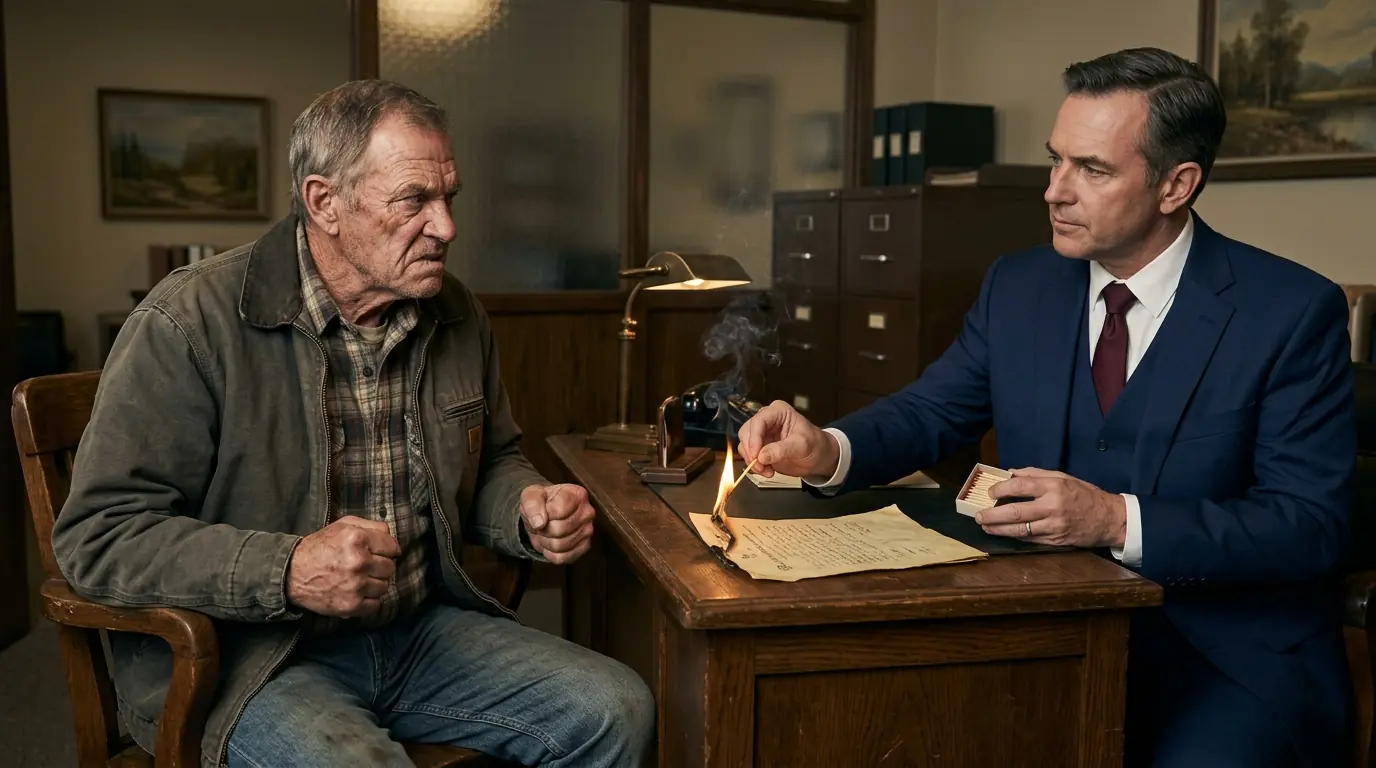 The farmer didn’t move. "That deed isn’t yours to burn." The vice president smiled—the kind of smile that wasn’t really a smile. "Then consider it a courtesy. So no one else has to disappoint you with the same news." He touched the match to the corner of the deed. The paper was old, dry, brittle. It caught quickly. The vice president dropped it into a metal waste basket beside the desk. The farmer watched it burn without standing, without shouting, without reaching for it. When the flame died, the vice president brushed his hands together once and said, "Have a good day, Mr. Kums."
The old farmer stood slowly. He picked up his empty folder. He walked out of the office. He did not go home. He drove 41 miles south to the federal building in Charleston. The farmer’s name was Elias Kums. He was 73 years old, and his family had owned the same 312 acres in the hollow outside Logan, West Virginia since 1908. His great-grandfather, Josiah Kums, had bought the land from a coal company that was selling off surface rights it didn’t think were worth holding. Josiah paid $1,840 in cash and walked out of the company office with a hand-drawn deed that named him as sole surface owner forever.
For nearly 80 years, the Kums family farmed the surface, raised cattle on the upper pasture, and lived simply in a wooden house Josiah’s son had built in 1922. Then, in 1986, Elias’s father took out a small loan against the farm to pay medical bills after a stroke. The loan was for $14,000. He died 11 months later before the second payment came due. The bank foreclosed in 1987. Elias was 36 years old at the time. He stood in the courthouse hallway and listened to a clerk read out the auction terms. He had no money to bid. He had no lawyer. He went home, packed two suitcases, and moved his mother into a rented house in town. He thought the farm was gone. For 36 years, he believed it.
Then, in October of last year, his mother passed away at the age of 94. While cleaning out her closet, Elias found a wooden box he had never seen before. Inside the box were three things: the original 1908 deed signed by Josiah Kums, a 1986 letter from a lawyer named Whit Pendry, and a single page torn from a county ledger book. Elias didn’t understand what any of it meant, so he took it to the only person in the family who might: his nephew Garrett, who worked as a paralegal in Huntington.
Garrett read the documents twice. Then he picked up the phone. "Uncle Eli," he said, "the foreclosure in 1987 was on a parcel that didn’t include the original 1908 grant. The bank foreclosed on a smaller boundary. The 312 acres your great-grandfather bought—most of it was never in the loan." Elias didn’t understand at first. Garrett explained slowly. The 1986 loan paperwork referenced a 1962 county survey which had drawn the farm’s boundary at 187 acres. The 1908 deed described 312 acres. The difference—125 acres along the northern ridge—had never been included in the mortgage. It had simply been forgotten on paper. And those 125 acres, Garrett told him, sat directly on top of one of the largest untapped natural gas formations in central Appalachia. The bank had been leasing mineral rights on that land to an energy company since 2009.
Elias drove to the bank the next morning. The vice president burned the deed in front of him 40 minutes later. Elias parked outside the federal building in Charleston at 2:14 in the afternoon. He sat in his truck for 10 minutes before walking inside. He didn’t have an appointment. He didn’t know who to ask for. He walked up to the front desk and told the security officer, "I need to report a banker who burned my family’s deed about 2 hours ago." The officer looked at him for a long moment. Then he picked up a phone. Forty minutes later, Elias was sitting in a small conference room across from a special agent from the FBI’s Charleston field office. Her name was Agent Mara Liddell. She was 41 years old and had been investigating banking fraud in Appalachia for six years. She listened to Elias for 38 minutes without interrupting. He told her everything: the 1908 deed, the 1987 foreclosure, the wooden box his mother had hidden, the 125 acres that were never in the loan, the lease payments to the energy company, and the match.
When he finished, Agent Liddell asked one question. "Mr. Kums, do you have copies of any of the documents from the wooden box?" Elias reached into his coat pocket and pulled out a folded envelope. "My nephew made copies of everything before I went to the bank. He told me not to bring the originals." Agent Liddell nodded slowly. She opened the envelope and read each page carefully. When she finished, she stood up. "Mr. Kums, I need you to wait here. I’m going to make some phone calls."
The 1986 letter from the lawyer Whit Pendry was the document that mattered most. Whit Pendry had been a small-town attorney in Logan in the 1980s. In May of 1986, three months before Elias’s father’s stroke, Pendry had written a private letter to Josiah Kums’s son, advising him that the family’s surface rights extended significantly beyond the boundary recognized by the 1962 county survey. Pendry had quietly compared the 1908 deed to the 1962 survey and discovered the 125-acre discrepancy. He had advised the family to file a formal correction with the county. The family never did. Three months later, the stroke happened. Eleven months after that, Elias’s father was dead, but Pendry had also sent a copy of his letter to the county assessor’s office requesting an internal review. That copy had been filed. It had sat in the assessor’s archive for 38 years. The single page Elias’s mother had hidden, the one torn from the county ledger book, was a 1987 internal memo confirming that the assessor’s office had received Pendry’s correction request and had failed to act on it before the foreclosure.
The bank had foreclosed on 187 acres in 1987. Then in 2009, the bank had quietly leased mineral rights on the full 312 acres to an energy company, including the 125 acres they had never owned. The lease payments had been deposited into a bank-controlled escrow account for 15 years. The knock came on the bank’s front door at 9:02 on a Tuesday morning: three federal agents, one supervisor from the FBI’s Charleston Field Office, two attorneys from the US Attorney’s Office for the Southern District of West Virginia. A search warrant signed the night before by a federal magistrate. The vice president who had burned the deed was named Carlton Bream. He was 56 years old and had worked at First Settler’s Trust for 22 years. He met the agents in the lobby. He tried to smile. The smile didn’t work. "Can I help you with something?" Agent Liddell handed him the warrant. "Mr. Bream, we have a warrant for the bank’s records relating to foreclosure case 1987 FC000034 and all subsequent mineral rights leases on the affected property. We also have questions about the destruction of evidence at this branch yesterday afternoon."
Carlton’s face went still. "I have no idea what you’re referring to." Agent Liddell turned to one of her agents. "Take him to the conference room, please." The agents began removing filing cabinets. Computers were imaged. The metal waste basket, still containing ash from the burned deed, was photographed, bagged, and entered into evidence.
By the end of the day, the FBI had seized 14 boxes of records, six computer hard drives, and the entire 1987 foreclosure file. The bank’s headquarters in Charleston issued a press release that evening saying it was fully cooperating with federal authorities. Carlton Bream was placed on administrative leave. The investigation took 11 months. What the FBI found was not just the Kums case. Between 1985 and 2015, First Settler’s Trust had foreclosed on 47 properties in Logan and Boone counties. In 16 of those cases, the bank had foreclosed on parcels described by the most recent county survey rather than the original land grant. In 11 of those cases, the actual land grant included acreage that had never been part of the loan. In nine of those 11 cases, the bank had subsequently leased mineral rights on the full grant, including the acreage they had never legally owned. Total escrow payments collected on land the bank did not own: $34.6 million.
Carlton Bream was charged with destruction of evidence, obstruction of a federal investigation, and conspiracy to commit wire fraud. Two former bank presidents were charged with conspiracy to commit wire fraud and money laundering. The energy company that had leased the rights was placed under a separate civil investigation. The bank itself entered a deferred prosecution agreement and agreed to pay $58 million in restitution to affected families. Elias Kums was the lead complainant. The federal hearing in Charleston lasted four days. Elias sat in the gallery for most of it. He wore a clean shirt and the same coat he had worn to the bank the day Carlton burned the deed. His nephew Garrett sat beside him. On the third day, Elias was called to testify. He walked to the witness stand slowly. He sat down. The federal prosecutor asked him to describe what had happened in Carlton Bream’s office. Elias spoke for 11 minutes. Calm, steady, no embellishment.
When the prosecutor was done, the defense attorney stood. He was a well-dressed man from a firm in Pittsburgh. He smiled the same smile Carlton had smiled. "Mr. Kums, isn’t it possible you simply misunderstood what happened? That the document Mr. Bream destroyed was a copy, not an original?" Elias looked at him for a long moment. "My nephew made me bring copies and leave the originals at home. The paper your client burned was the original 1908 deed signed by my great-grandfather Josiah. And how can you be certain of that? Because I held it in my hands every night for two weeks before I walked into that bank. I knew the feel of it. I knew the watermark. I knew the way the ink had faded on the corner where my great-grandfather’s thumb had rested when he signed it." The defense attorney didn’t ask another question. He sat down.
Carlton Bream was sentenced to seven years in federal prison. The two former bank presidents received four years each. The energy company settled its civil case for $19 million. The Kums family received $4.1 million in restitution, the full value of the 15 years of mineral lease payments collected on the 125 acres that had never legally belonged to the bank, plus interest, plus a federal civil penalty payment. The 125 acres were formally transferred back into Elias Kums’s name. The 187 acres that had been properly foreclosed on in 1987 remained with the bank’s successor entity. Elias did not sue to recover those. When Garrett asked him why, Elias said, "My father borrowed that money. He didn’t pay it back. That part was honest. The other part wasn’t." Garrett didn’t argue.
In the spring after the sentencing, Elias drove out to the northern ridge of the family land for the first time in 36 years. The road was overgrown. The fence posts his grandfather had set were still standing, leaning slightly, gray with weather. The wooden gate at the entrance had fallen off its hinges decades ago. Elias stepped over it. He walked up the ridge slowly. His knees weren’t what they had been at 36. He stopped twice to rest. At the top he sat on a flat stone his great-grandfather had used as a marker. From there he could see the whole valley, the creek bend at the bottom, the old farmhouse roof in the distance, the line of pines along the southern boundary. He didn’t cry. He didn’t smile. He just sat there and breathed. In his coat pocket was a small envelope. Inside the envelope was a thin layer of ash scraped carefully from the waste basket in Carlton Bream’s office and released to him by the FBI after the trial concluded. He held the envelope in his hands for a long moment. Then he opened it and let the ash drift out into the wind on the ridge, the same ridge his great-grandfather had walked in 1908 with $1,840 in his pocket and a hand-drawn deed under his arm. The ash disappeared into the grass. Elias closed the envelope, folded it, put it back in his coat pocket, and walked back down the ridge. He didn’t look back. Some things don’t need watching to know they lasted .