By midnight on October 28, 1969, Walter Hayes could see the flames from nearly three miles away.
At first he refused to believe they belonged to his farm. He was driving home from the veterinarian in an old Chevrolet pickup, his injured heifer secured in a borrowed livestock trailer behind him, when the horizon ahead turned orange beneath a clear black sky. Then he heard sirens cutting across the fields, and something deep inside him understood before his eyes were willing to accept it.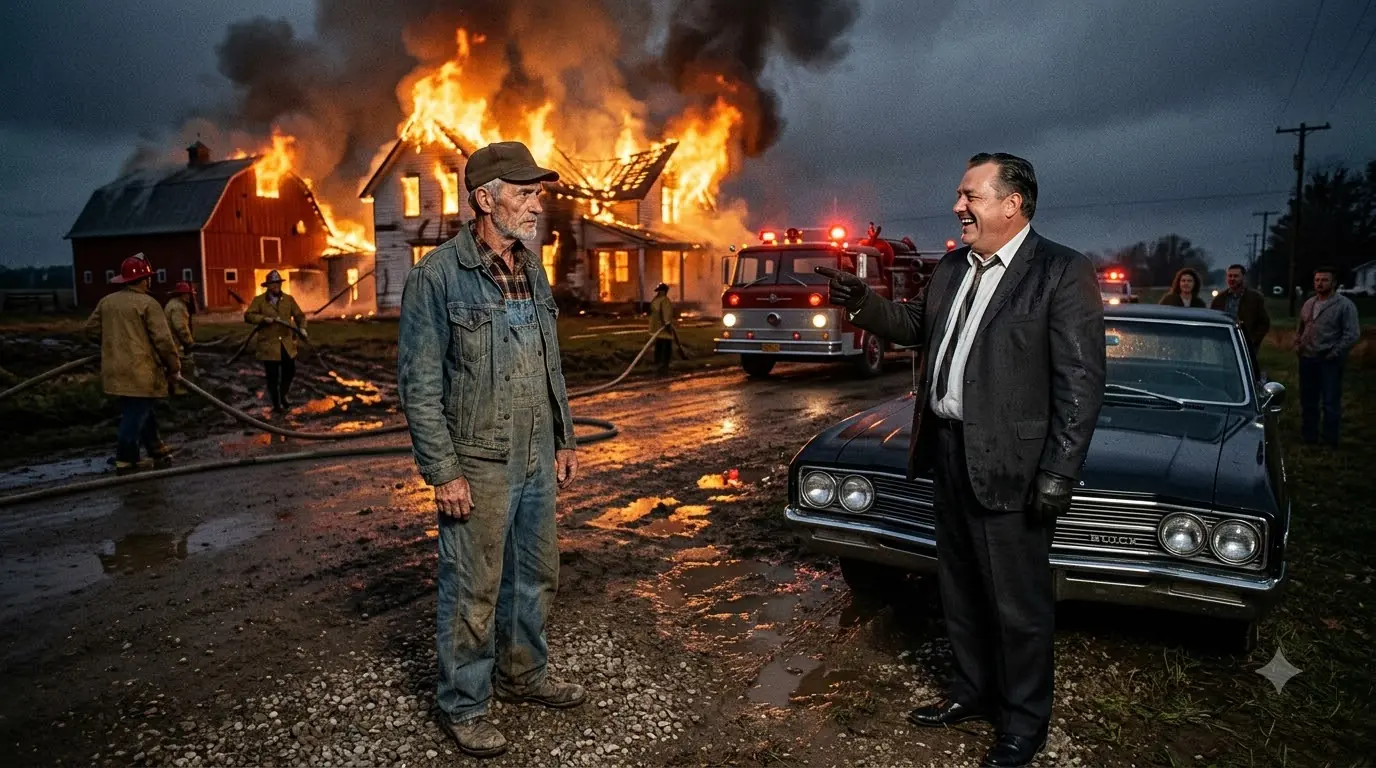
Walter pressed harder on the accelerator.
The pickup rattled violently as he took the final curve.
Then he saw the house.
His house.
Flames had already swallowed the rear porch. The grain shed was almost completely gone, the barn roof was collapsing, and sparks rose through the night like thousands of burning insects. Firefighters ran through the yard dragging hoses while water collected in black puddles along the roadside.
Walter stopped the truck across from the farm.
For several seconds he could not move.
His father had begun building that house in 1918, the year Walter was born. The front room had been added when Walter was six, the upstairs bedroom when he was eleven, and the porch after his mother complained that every decent farmhouse needed somewhere to sit during a summer storm. Walter had married his wife, Margaret, beneath the elm tree beside that porch.
Now the tree itself was burning.
Walter opened the truck door.
Someone shouted for him to stay back.
He did not hear who.
He walked until a firefighter caught him by the arm.
“Mr. Hayes, you can’t go in there.”
Walter stared toward the second-floor window.
“My wife’s photographs.”
The firefighter tightened his grip.
“I’m sorry.”
Walter stopped.
Margaret had been dead nine years.
Her photographs were inside.
So were Walter’s father’s carpenter tools, his mother’s Bible, a wooden cradle that had belonged to three generations of Hayes children, and the dining table where Walter had eaten nearly every supper of his life.
The roof collapsed.
Walter watched without speaking.
Behind him, someone laughed.
It was not a loud laugh.
Not a joyful one.
More like the short breath of a man who had finally seen a difficult problem solve itself.
Walter turned.
Charles Whitmore stood beside a polished black Buick parked on the opposite shoulder.
The bank manager wore a dark suit beneath a heavy overcoat, although it was almost midnight and the farm stood nearly nine miles outside town. His silver hair remained neatly combed. Mud had barely touched his polished shoes.
Walter looked at him for a long time.
Charles noticed.
He walked closer.
“Terrible thing,” he said.
Walter said nothing.
Charles glanced toward the burning house.
“Old properties can be dangerous. Wiring dries out. Rats damage insulation. One spark inside those walls…”
Walter’s eyes moved to the Buick.
Then to Charles.
“You got here fast.”
Charles stopped.
“What?”
“Fire trucks are still arriving.”
Another engine appeared down the road.
Walter looked at it.
“You’re already here.”
Charles’ expression barely changed.
“The bank has property interests in this area. Someone telephoned me.”
“Who?”
Charles looked toward the flames.
“I don’t remember.”
Walter studied him.
Charles smiled.
“You should be worrying about more important things tonight.”
Walter looked back at the house.
“I am.”
Three months earlier, Charles Whitmore had been the kind of man Walter barely thought about.
Pine Ridge First County Bank had handled agricultural loans throughout the region for decades. Walter’s father had banked there. Walter had banked there. When Walter needed a new tractor in 1964, he borrowed $18,000 through the bank and signed a standard agricultural note secured partly against the farm.
By 1969, Walter owed only $11,300.
He had never missed a scheduled payment.
Charles Whitmore knew that.
He also knew something Walter did not discover until later.
His farm had become the most valuable obstacle in Pine Ridge County.
That summer, First County Bank announced an $8 million development project along State Highway 17. The plans included a shopping center, a motel, a gas station, restaurants, and several commercial lots. The project was ambitious enough that local newspapers described it as the beginning of a new economic era for Pine Ridge.
The bank had quietly purchased nearly three hundred acres around Walter’s property.
But the map contained a problem.
Walter’s sixty-four acres sat between the highway and much of the land behind it.
A narrow dirt road crossed the Hayes farm from east to west. To Walter, it was simply the road his father had built for moving wagons between pastures. To Charles Whitmore, it was the cheapest possible entrance to the development.
Without it, contractors would need to build an access road nearly six miles around a rocky hill.
That would cost hundreds of thousands of dollars.
Charles arrived at the farm in July carrying blueprints.
Walter met him beneath the porch.
Charles spread the plans across the hood of the Buick.
“The bank is prepared to offer twenty percent above current agricultural value.”
Walter looked at the number.
It was more money than he had ever possessed.
Then he looked toward the hill behind the house.
Margaret was buried there beneath a cedar tree.
His parents were buried fifty yards away.
“No.”
Charles smiled as though Walter had misunderstood.
“Mr. Hayes, I don’t think you appreciate the offer.”
“I appreciate it.”
“You’re seventy-one years old.”
“So I’ve been told.”
“You live alone.”
“Yes.”
Charles tapped the check figure.
“This could make the rest of your life very comfortable.”
Walter folded the map.
“My life is comfortable.”
Charles’ smile thinned.
“You could move into town.”
“I don’t want to.”
“Buy a modern house.”
“Don’t need one.”
Charles stared at him.
Walter handed back the plan.
“No.”
The bank manager left without argument.
That should have frightened Walter more than anger would have.
One week later, he received a letter.
The bank would no longer extend his agricultural payment schedule through the harvest season. The remaining loan balance was due within sixty days.
Walter read the letter twice.
For years, agricultural accounts had been adjusted around planting and harvest because everyone understood that farmers did not earn money evenly throughout the year.
Walter drove directly to the bank.
Charles invited him into his office.
Walter placed five years of payment receipts on the desk.
“I’ve never missed.”
“I know.”
“So why change it now?”
“Policy.”
“What policy?”
“Internal lending standards.”
Walter stared at him.
Charles opened a drawer.
He removed another document.
A land-sale agreement.
“If liquidity is a concern, we can resolve everything today.”
Walter read the first line.
“You forgive the loan if I sell.”
“Yes.”
“You said policy changed.”
“It did.”
“Only for people whose land you want?”
Charles leaned back.
“That accusation won’t help you.”
Walter slid the agreement across the desk.
“No.”
For the second time, Charles smiled.
This time Walter understood the smile.
The bank was not asking anymore.
Within weeks, new charges appeared.
An account review fee.
A property inspection charge.
Mandatory insurance adjustments.
Risk assessment fees.
Administrative penalties.
Walter brought each notice into the kitchen and arranged them across the table.
Individually, none seemed catastrophic.
Together, they transformed the debt.
$11,300 became nearly $14,000.
Then $16,700.
Then $19,800.
Walter returned to the bank.
Charles showed him the total.
“You cannot invent debt because I won’t sell you a road.”
Charles folded his hands.
“Every charge is authorized.”
“Where?”
“In your account terms.”
“Show me.”
Charles’ expression changed slightly.
“We don’t conduct legal arguments at the counter.”
Walter stood.
“No.”
Charles frowned.
“No what?”
“No foreclosure.”
“That isn’t your decision.”
Walter looked at him.
“It isn’t yours either.”
Walter went home and began keeping everything.
Receipts.
Envelopes.
Loan statements.