The summer drought had turned Asher Patterson’s six hundred acres into a field of brittle stalks and drifting dust. For seventy-three days, no meaningful rain had fallen across Blackwood County, Iowa, and every gust of wind made the dead corn rattle like dry bones. At fifty-eight, Asher had survived failed harvests, machinery breakdowns, and the death of his wife, Sarah, but this disaster carried a different threat. The sky was destroying the crops while Oak Haven Fidelity Bank waited below like a predator watching a wounded animal.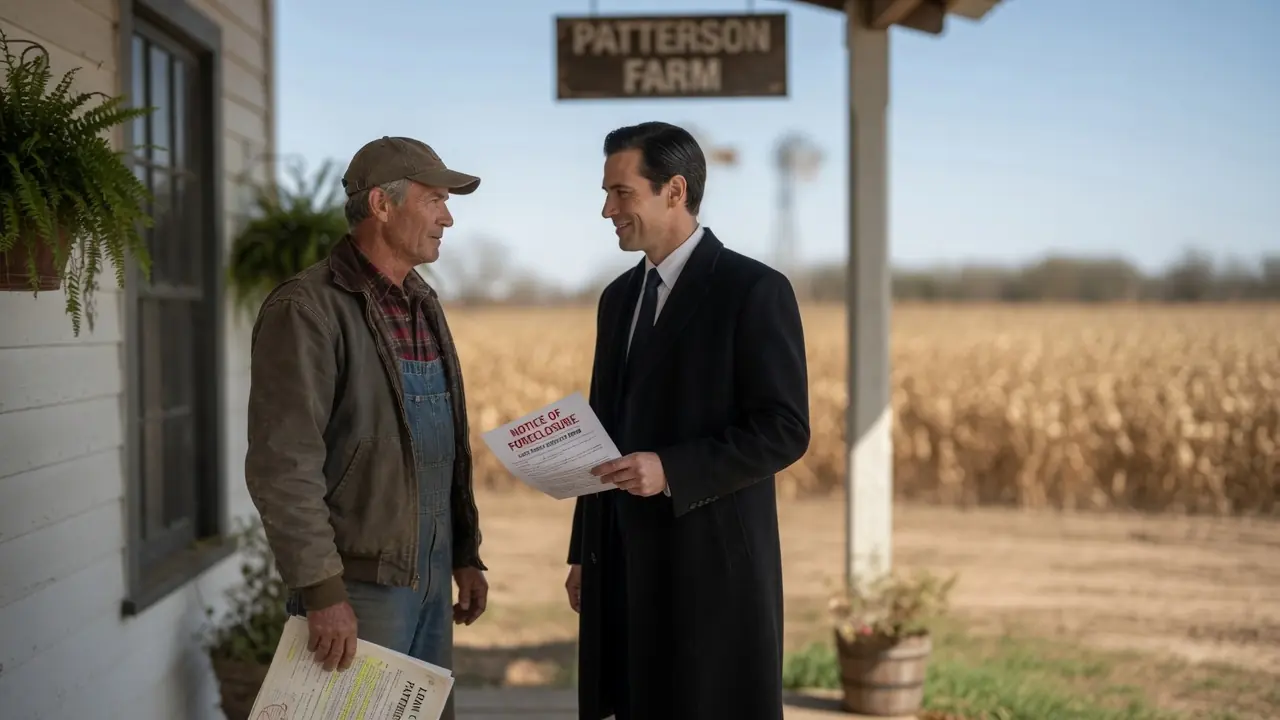
Asher was a third-generation farmer with a broad, work-hardened build, sun-darkened skin, short graying hair, and sharp gray eyes that noticed details other men ignored. His grandfather had cleared the first section of the property with horses, and his father had expanded it using a secondhand tractor that spent more time broken than running. Every barn door, drainage trench, and fence post carried a family story. Selling the farm was not a financial decision to Asher; it would be the destruction of a living record.
The drought had already claimed several neighboring properties. Silas Abernathy, who owned four hundred acres beyond Asher’s southern fence, lost his land after borrowing heavily to install an irrigation system that became useless when the reservoir dried up. At the foreclosure auction, the bank sold Silas’s tractors, tools, dining table, and church truck while his family watched. Regional vice president Thomas Granger stood beside the auctioneer in an expensive suit, studying every sale with the satisfaction of a man watching numbers move in his favor.
“Tragic,” Thomas remarked when he found Asher near the edge of the crowd. “But modern agriculture rewards the farmers who adapt.”
“Silas adapted,” Asher replied, watching his neighbor sit with his head bowed. “He adapted himself straight into a loan designed to take his land.”
Thomas smiled as though Asher had made a childish observation. He handed him a glossy business card and mentioned that the interest rate on Patterson Farm’s mortgage would reset within weeks. Oak Haven had recently purchased the county’s old community bank and was offering what Thomas called an agricultural relief package. The program promised lower payments, fresh operating cash, and a single consolidated loan.
Asher placed the card in his pocket without thanking him.
During the following month, Thomas visited nearly every struggling farmer in Blackwood County. He arrived in a black luxury SUV, shook hands beside kitchen tables, and described the refinancing contract as a lifeline created for rural families. William Hayes signed it, the Miller brothers signed it, and even stubborn old Raymond Henderson signed on the hood of Thomas’s vehicle. Few people read beyond the pages marked with bright yellow tabs.
By September, Asher could no longer ignore his own numbers. His projected harvest was barely fifteen percent of what he needed to cover expenses, and Sarah’s long illness had emptied most of their savings before she died. Fertilizer bills, diesel costs, equipment payments, and property taxes waited regardless of the weather. Without refinancing, Patterson Farm would default before winter.
Asher drove into town on a Tuesday morning and entered Oak Haven’s renovated branch. The building’s marble floors, cold air-conditioning, and glass walls felt strangely luxurious beside the failing stores outside. Thomas greeted him with a wide smile and led him into a corner office furnished with polished wood and expensive leather. A thick stack of documents waited on the desk.
“I’m glad you came to your senses,” Thomas said. “This will keep the farm operating until the weather turns.”
The contract was nearly four hundred pages long. Three sticky notes marked the signature lines, and Thomas immediately offered Asher a black fountain pen. He explained that the rest was standard language written by the bank’s legal department in Chicago.
Asher did not touch the pen.
“I’ll take it home.”
Thomas laughed. “Nobody reads the entire contract, Asher.”
“I do.”
“The special rate expires Friday.”
“Then I’ll return Thursday.”
Thomas’s smile tightened, but he allowed Asher to leave with the documents. The banker assumed an exhausted farmer would become overwhelmed after a few pages and return ready to sign. He did not understand that Asher viewed complicated language the way he viewed a diesel engine. Every clause had a purpose, every reference connected to another part, and every hidden mechanism could be understood if a person refused to rush.
Asher cleared Sarah’s old oak dining table and began reading that afternoon. He used a legal dictionary, a magnifying glass, yellow markers, and an endless supply of black coffee. The first hundred pages contained the traps he expected: interest increases, equipment seizure rights, remote arbitration requirements, and penalties for even minor delays. The document was not designed to rescue farmers but to keep them alive only long enough for the bank to take everything they owned.
He continued through the first night.
By the second night, his eyes burned and the words blurred. He read each paragraph aloud to remain awake, tracing every cross-reference until he understood how the clauses worked together. Whenever exhaustion encouraged him to skip a page, he remembered Silas watching strangers carry his family’s dining table away. Asher kept reading.
At 3:14 on the third morning, he reached Addendum 7C.
The section applied to historically chartered agricultural parcels like Patterson Farm, which had been deeded under an old state homestead law. Most of the language concerned obsolete zoning rules and legacy banking rights inherited when Oak Haven purchased the county bank. Buried on page 312 in unusually small print was a paragraph written decades earlier to prevent mass displacement during agricultural disasters.
Asher cleaned his glasses and read it again.
If the bank initiated foreclosure on a historically protected farm during a state-declared drought lasting more than sixty days, it assumed responsibility for a yield-severance payment. Before eviction or asset seizure, the bank had to pay the farmer the gross value of the property’s highest-producing harvest from the previous ten years. The payment was unconditional once foreclosure proceedings began.
Asher calculated his strongest harvest.
In 2012, Patterson Farm had grossed $1,245,600.
His hands trembled as he checked every definition. The clause was not merely a delay or temporary protection. If Oak Haven attempted to take his farm during the declared drought, the bank would owe him more than a million dollars before it could remove him.
There was one danger. The document required borrowers to initial the individual addendums, and a lawyer might later claim the old paragraph had been included accidentally. Asher wrote his initials beside the drought clause, then initialed every other page so page 312 would not appear unusual.
On Thursday morning, he returned to Thomas’s office.
The banker barely opened the contract. He checked the final signature, saw that the required pages had been initialed, stamped the agreement, and dropped it into his outgoing tray. Thomas joked that Asher must have enjoyed his bedtime reading.
“It was educational,” Asher said.
The relief funds arrived before noon.
For two years, Asher followed the agreement exactly. He made every payment on time, sold older equipment, reduced expenses, and placed what little cash remained inside a protected trust Sarah had created before her death. He knew the introductory interest rate would eventually disappear and the bank would triple his monthly payment. That was how Oak Haven planned to convert desperate borrowers into land acquisitions.
The strategy worked on Asher’s neighbors. William Hayes lost his acreage, the Miller brothers declared bankruptcy, and corporate holding companies began accumulating property near the proposed highway route. Thomas earned a promotion for expanding the bank’s regional land portfolio. At every auction, he repeated the same explanation: farmers who failed to adapt had no place in modern agriculture.
Asher remained quiet.
In the summer of 2018, another severe drought struck Blackwood County. The state Department of Agriculture declared a disaster after the dry period crossed sixty days. Creeks became narrow trails of mud, wells dropped, and the soil broke into hard plates beneath the sun. Asher pinned the official declaration beside his loan documents.
In September, his payment increased from $4,200 to $12,800.
Asher opened his ledger, wrote a payment amount of zero, and deliberately missed the deadline. Fifteen days later, an automated warning arrived. He ignored it and missed the next payment.
By November, the account was ninety days delinquent.
Oak Haven moved quickly because Patterson Farm bordered the planned highway extension and carried enormous development value. On a cold morning, a black SUV climbed the gravel driveway and stopped near the farmhouse. Thomas stepped out wearing a heavy wool coat over a tailored navy suit, carrying a foreclosure notice with the confidence of a man arriving to collect something already won.
Asher sat on the porch drinking coffee.
Thomas walked to the bottom of the steps. “You ignored our calls, our notices, and every opportunity to cure the default.”
“Morning, Thomas.”
“You have forty-eight hours to vacate. The bank is seizing the land, buildings, and machinery.”
Asher took another slow drink. “Are you officially initiating foreclosure today?”
Thomas looked irritated by the question. “The papers are already filed. Patterson Farm belongs to Oak Haven now.”
Asher rose and reached inside his canvas jacket.
He unfolded a copy of page 312 and handed it to Thomas. The banker glanced at the paper without concern until Asher pointed toward the fourth paragraph. Thomas read the first line, then the second, and the confidence began draining from his face.
“This is legacy language,” he said. “It doesn’t apply.”
“You signed the contract.”
“It’s an obvious clerical mistake.”
“You called your lawyers comprehensive.”
Thomas looked at Asher’s initials beside the paragraph. “You knew this was here.”
“I read what you asked me to sign.”
Thomas folded the paper sharply. “You owe this bank nearly two million dollars.”
“And because you filed during a declared drought, your bank owes me $1,245,600 before touching one fence post.”
Thomas’s face reddened. “You planned this.”
“You planned to take the farm. I planned to understand how.”
The banker threatened litigation, fraud investigations, and immediate asset seizure. Asher listened without reacting. When Thomas finally stopped, Asher lifted his coffee cup and nodded toward the SUV.
“You have forty-eight hours to deliver the check,” he said. “Drive safely.”
Thomas returned to Des Moines in a panic.
Oak Haven’s corporate lawyers immediately searched for a way around the clause. They argued that it had been copied from an obsolete agreement and did not reflect the bank’s intent. Chief legal counsel Ricky Sterling proposed having the court dismiss it as a drafting error.
Then he saw Asher’s initials.
The bank’s attorneys understood that Asher had read, acknowledged, and relied on the paragraph. Worse, Thomas had initiated the foreclosure while the drought declaration was active, satisfying the exact condition written in the contract. Oak Haven had not merely handed Asher a weapon; its own vice president had activated it.
The bank refused to pay.
Instead, it froze Asher’s operating accounts, pressured suppliers to cancel his credit, and warned local companies against conducting business with him. Corporate executives expected isolation and financial pressure to force him into surrender. They believed a farmer could not survive a lengthy fight against a billion-dollar institution.
Asher had prepared for that too.
His emergency funds were protected under Sarah’s trust, his pantry was stocked, and his heating came from wood cut on his own land. He drove to a fading strip mall in town and entered the office of Samuel Higgins, a sixty-five-year-old attorney known for chaotic white hair, battered suspenders, and a career that had once included major corporate litigation in New York. Samuel looked at the foreclosure notice and groaned.
“You signed their loan and stopped paying?”
“Yes.”
“Then they’re going to bury you.”
“Read page 312.”
Samuel found the clause, read it twice, and slowly began smiling.
“You found a poison pill inside their own contract.”
“They’re calling it a mistake.”
“They’ll argue no reasonable bank intended to accept this risk.”
“Can they win?”
“Only if we cannot prove they knew Addendum 7C existed.”
Samuel searched old court records for days. He eventually discovered a Nebraska foreclosure case from four years earlier in which Oak Haven had relied on another paragraph from the exact same addendum. The bank had used the historical language to block a farmer from protecting his property through bankruptcy. Ricky Sterling himself had argued that every part of Addendum 7C was enforceable.
Oak Haven had used the section as a sword.
Now it wanted the court to pretend the shield beneath it was an accident.
The hearing took place inside a federal courtroom in Des Moines. Oak Haven arrived with senior attorneys, junior associates, organized binders, and digital presentations. Asher wore the gray suit he had last worn at Sarah’s funeral and sat beside Samuel with his weathered hands folded calmly on the table.
Sterling spoke first.
He described the clause as an outdated relic accidentally inserted during a document merger. He accused Asher of exploiting a harmless drafting mistake to demand an irrational payment. According to the bank, enforcing the paragraph would reward manipulation and create a result no lender would knowingly accept.
Samuel stood when Sterling finished.
He presented the Nebraska case.
The courtroom became silent as the judge read Oak Haven’s earlier argument insisting that Addendum 7C was intentional, binding, and essential to the rights inherited from regional banks. Samuel explained that an institution could not aggressively enforce one paragraph against a farmer, then reject the next paragraph when it imposed responsibility on the bank.
“They knew the addendum existed,” Samuel said. “They preserved it because it gave them power. They simply assumed no farmer would read far enough to find the part that limited that power.”
The judge denied Oak Haven’s request to remove the clause.
The bank was prohibited from evicting Asher or seizing any property until the full $1,245,600 severance payment was made. Thomas sat behind the legal team, staring at the floor. Sterling remained motionless as the ruling destroyed the strategy he had promised would work.
Asher passed the attorneys without celebrating.
“I’ll expect the check,” he said.
Oak Haven made one final attempt to escape payment. Its executives ordered a forensic audit of Asher’s 2012 harvest, hoping to prove that the million-dollar total had been exaggerated. Auditors examined fuel purchases, grain tickets, equipment logs, fertilizer records, tax forms, and historical weather reports.
After three days, the lead auditor announced he had found a contradiction. Asher’s final corn delivery showed unusually low moisture and no drying charge, even though other farms in the county had harvested wet grain. The auditor accused him of bribing the grain inspector or falsifying the weight record.
Asher calmly opened another box.
Inside was a state calibration certificate for the cooperative’s moisture meter and handwritten records from the retired grain inspector. The 2012 crop had been damaged by hail that stripped leaves without breaking the stalks. Asher had left the ears standing for several extra weeks, allowing dry prairie wind to reduce the moisture naturally.
He had saved money by using patience instead of propane.
Every bushel was legitimate.
The audit confirmed that Patterson Farm’s 2012 gross yield was exactly what Asher had claimed. Oak Haven had exhausted its legal arguments, financial pressure, and accusations. The bank had spent thousands trying to prove Asher dishonest and instead created an independent record of his accuracy.
Several weeks later, Oak Haven’s chief executive arrived at the farmhouse.
He sat across from Asher at Sarah’s oak table and placed a cashier’s check between them. The amount was $1,245,600. The foreclosure had been withdrawn, and the bank acknowledged that the land remained Asher’s.
“You won,” the executive said.
Asher did not touch the check.
“No,” he replied. “You met the terms for my farm.”
Samuel placed twenty-one folders on the table.
Each contained the contract of another Blackwood County farmer who had signed Oak Haven’s agricultural relief package. The drought declaration remained active, and most borrowers were approaching default under the same interest-rate increases. If the bank foreclosed on them, Addendum 7C would trigger again.
The executive looked at the folders. “What do you want?”
“Every loan restructured at a fair fixed rate,” Asher said. “No balloon payments and no foreclosures based on the artificial rate increase.”
“That would cost us millions.”
“So will twenty-one severance claims.”
Asher also demanded that Silas Abernathy’s farm be returned. Oak Haven claimed the property had been sold, but Samuel had already traced the buyer to a subsidiary controlled by the bank. Silas would be allowed to repurchase it for the principal amount owed before the foreclosure.
The executive accused Asher of extortion.
“Extortion is using a drought to take family land,” Asher replied. “This is your contract.”
For the next hour, the banker signed the restructuring documents.
When the final page was complete, he closed his portfolio and left without shaking hands. Samuel leaned back and told Asher he had saved the entire county. Asher finally picked up the cashier’s check and folded it carefully.
“I bought them time,” he said. “They still have to farm.”
A low rumble rolled across the fields.
Asher opened the front door and found heavy clouds gathering above the property. The first raindrop struck the porch railing, then another hit the dusty driveway. Within seconds, rain poured across Patterson Farm, darkening the dry earth and releasing the rich smell of soil that had waited months for water.
Asher stepped into it without a hat.
Beyond the southern fence stood the land Silas would soon recover. Beyond that were farms whose families would receive fairer terms because one man had refused to trust yellow signature tabs. The bank had arrived expecting an exhausted farmer who would beg for mercy.
Instead, it found a patient man who had read all four hundred pages.
Thomas believed power lived in expensive suits, corporate lawyers, and the ability to seize property. Asher understood that power could also live in a small paragraph, handwritten initials, and the discipline to notice what arrogant people assumed everyone else would ignore.
Oak Haven came to take his farm.
Its own fine print forced the bank to protect it instead.