Elias Coleman walked into Blue Ridge Community Bank on a clear Thursday afternoon with a cane in his right hand and a thick envelope tucked inside his dark overcoat. The bank stood in Rowan Oak, Virginia, polished and quiet, with bright lights, glass walls, and marble floors that made every footstep sound too loud. He paused just inside the entrance, not because he was unsure, but because at seventy-eight, he had learned to take a breath before entering rooms that might decide to judge him. The envelope in his coat held documents for the Coleman Engineering Future Scholars Fund, a scholarship program he had spent years building for young Black engineers who needed more than encouragement to reach the future.
Elias was not dressed like the kind of man people expected to see in the priority banking line. His overcoat was clean but worn at the cuffs, his shoes had been polished too many times to hide their age, and his gray hair sat close to his head beneath a simple flat cap. His cane was made of dark wood, smooth from years of use, not decoration. He looked like a grandfather, a retired worker, perhaps a man trying to stretch one payment through another month. He did not look like the owner of a high-level corporate account connected to millions in private assets and restricted financial transfers.
That was exactly why Elias preferred to come in quietly. He had spent a lifetime watching people change their posture when they learned what he had done, where he had worked, and how much money he controlled. Before they knew, they saw age, skin, clothing, and cane. After they knew, they suddenly found respect in their voices, softness in their eyes, and urgency in their service. Elias had never trusted respect that had to be purchased with proof.
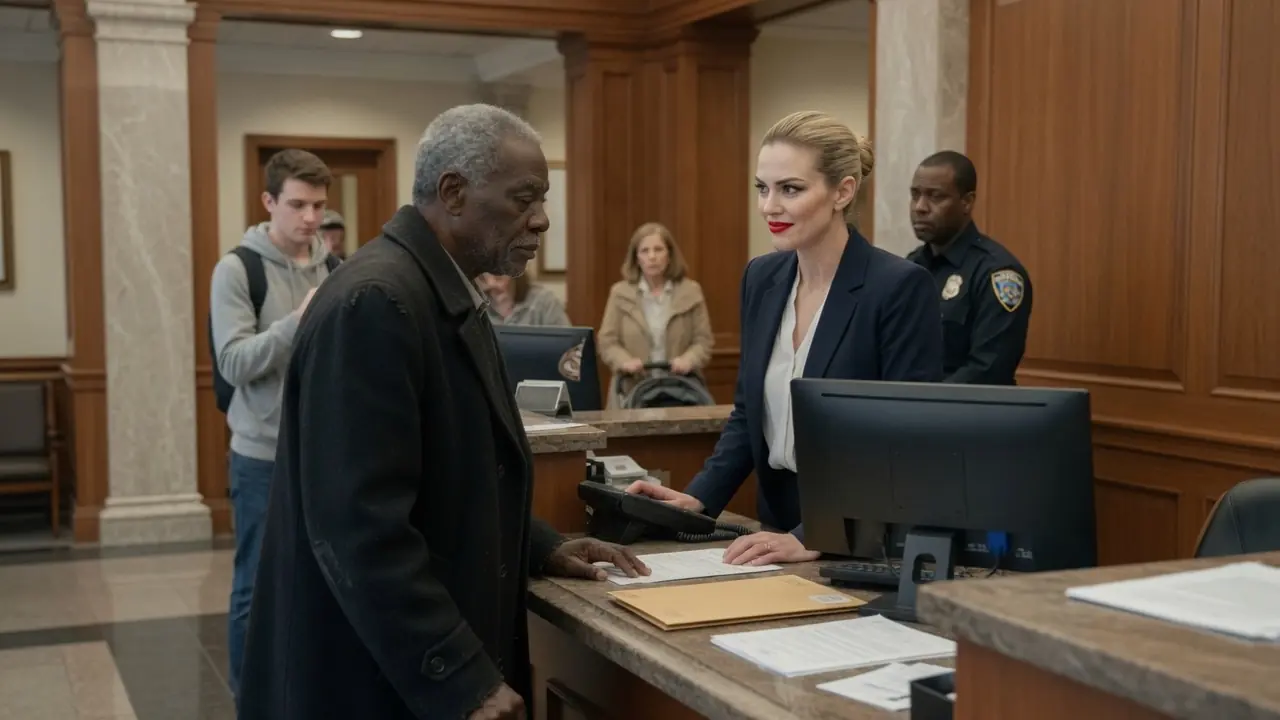
He moved toward the priority service counter because that was where the bank had told him to check in. A woman in her early thirties stood behind the teller station, her blonde hair pinned in a tight bun, her navy blazer pressed neatly over a white blouse. Her nameplate read Megan Lively. She was helping no one at the moment, but when Elias approached, her smile stiffened before he even spoke.
“Good afternoon,” Elias said. “I was told to check in here for a private account transition.”
Megan looked him up and down, beginning at his shoes, stopping briefly at his cane, then returning to his face with a kind of polite coldness Elias recognized immediately. Her smile did not reach her eyes. “Sir, people like you don’t belong in the priority line,” she said. “Step aside.”
The words cut cleanly through the lobby. A few customers lifted their heads. A man filling out a deposit slip slowed his pen. Near the ATM, a young Black man in a gray hoodie pulled one earbud from his ear and looked over with his eyebrows drawn together. Elias felt the old familiar heat rise in his chest, not surprise, not even anger at first, but exhaustion.
He had been hearing versions of that sentence his entire life. Not always in those exact words, not always from behind a bank counter, but the meaning had been the same. You are in the wrong place. You must explain yourself. You do not belong until someone above me says you do. Elias rested both hands calmly on the top of his cane and looked at Megan without blinking.
“I’m here to handle my business,” he said. “Same as everyone else.”
Megan gave a small laugh that was too sharp to be mistaken for humor. “I’m sure. And I’m sure you also have an appointment with private services.”
“I was told to bring these papers and check in at this window.”
“By who?”
Before Elias could answer, Megan leaned slightly to the side, looking past him toward the regular line. “You can wait over there,” she said, pointing. “That line is for standard customer service.”
Elias did not move. “This is not a standard transaction.”
Megan’s eyes narrowed. “Sir, you don’t get to decide that.”
The young man near the ATM lowered his phone. A woman with braids standing beside a stroller watched quietly, one hand tightening around the handle. The lobby had not erupted, but it had shifted. People could feel when public humiliation was being performed. Some looked away because they did not want to be involved, while others watched because they knew exactly what was happening.
Elias removed the thick envelope from his coat and placed it on the counter. “My name is Elias Coleman. I have documents connected to a corporate account transition and a foundation transfer.”
Megan did not touch the envelope at first. She looked at it the way someone might look at a suspicious package left on a bench. “Corporate account transition,” she repeated, her voice rising enough for nearby customers to hear. “That’s what they all say now.”
Elias’s jaw tightened once. “They?”
“People trying to access accounts that aren’t theirs.”
The young man in the hoodie stepped closer to the deposit slip table. “Man, she ain’t even looked at his papers.”
Megan’s eyes flicked toward him. “This is a private banking matter.”
A security guard near the entrance noticed the tension and walked toward the counter. He was broad-shouldered, wearing a dark uniform, his expression already arranged into suspicion before he asked a single question. “Is there a problem here?”
Megan straightened behind the counter as if grateful for backup. “This gentleman is trying to access restricted services without proper verification.”
Elias turned his head slowly toward the guard. “I have not been asked for verification yet.”
The guard looked at Elias, then at the envelope, then back at Megan. “Sir, maybe you should step aside while we figure this out.”
“I am standing where I was instructed to stand,” Elias said.
Megan crossed her arms. “He’s refusing to leave the priority window.”
“I’m refusing to be dismissed before anyone reads my documents.”
A few soft murmurs moved through the lobby. The woman with the stroller shook her head, barely. The man with the deposit slip glanced at the guard, then looked down again. Elias had lived long enough to know that most witnesses preferred discomfort over courage. Still, he appreciated the young man in the hoodie, who stayed close, watching with a face that said he understood too much.
Megan finally snatched the envelope from the counter and pulled out the top sheet. She scanned it for less than five seconds before rolling her eyes. “This seal looks copied.”
“It is not.”
“These signatures don’t match what I expect to see.”
“You have not checked the system.”
She ignored that and held up the page with a smirk. “We get a lot of people trying to pull stunts. Fake transfers, fake inheritance documents, fake corporate letters. You’d be surprised.”
“At my age,” Elias said, “very little surprises me.”
Megan leaned forward, lowering her voice just enough to pretend kindness while keeping it loud enough to sting. “Sir, if you need help with a simple deposit or check cashing, someone in the regular line can help you. But this is private services. We can’t let just anyone access upper-tier accounts.”
That word landed heavily. Anyone. Elias heard the meaning underneath it, as clear as if she had printed it on paper and slid it across the counter. Behind him, the young man in the hoodie said, “That’s foul.” The guard glanced at him, but this time he said nothing.
Elias placed his ID on the counter. “Run my name properly.”
Megan picked up the ID between two fingers, typed his name with visible annoyance, and watched the screen load. Her expression remained smug for the first few seconds. Then something flickered in her eyes. Not fear, not yet, but confusion.
She clicked another page.
Elias watched the change begin.
Megan’s mouth tightened. “Your ID doesn’t match what I expected.”
“What did you expect?”
She did not answer. “Where did you say you got this envelope?”
“I didn’t say. You never asked.”
A small murmur moved through the line. Megan’s face flushed, and instead of slowing down, she became sharper. “This system shows a corporate-level client with your name, but obviously there’s an error.”
“Why is it obvious?”
Megan looked at the screen, then back at Elias. “The profile photo is older.”
“I am older.”
“The account history is unusual.”
“It is mine.”
“The client background doesn’t match.”
Elias leaned slightly forward. “Doesn’t match what?”
Megan opened her mouth, then paused, realizing she had walked near the truth too quickly. But pride, once publicly invested, often refuses an exit. She lifted her chin and said, “The man attached to this account looks like he belongs in private services.”
The lobby went still.
Even the guard shifted uncomfortably.
Elias’s fingers tightened around the cane, not because he was weak, but because memory sometimes needed somewhere to go. He remembered being told he could not try on a jacket in a Richmond store when he was twenty-two. He remembered men calling him “boy” in rooms where his calculations kept their projects alive. He remembered presenting engineering solutions that were ignored until a white colleague repeated them. He remembered smiling through disrespect because the work mattered more than the insult, until one day he realized silence had a cost too.
“What does belongs mean?” Elias asked.
Megan’s eyes flickered. “It means people don’t just wander in off the street and claim restricted accounts.”
“I did not wander in. I was invited.”
“By a call center representative who clearly made a mistake.”
The young man in the hoodie shook his head. “She scared to click the next page.”
Megan snapped, “Sir, this does not concern you.”
“It concerns everybody watching you treat him like a criminal.”
The guard stepped toward the young man. “Keep your voice down.”
Elias turned slightly. “No. Let him speak. He has been listening better than the people paid to help me.”
The guard stopped.
Megan reached for the desk phone. “I’m calling my supervisor and security support. If these documents are false, this becomes a serious issue.”
Elias did not raise his voice. “And if they are true?”
She hesitated.
He continued, “If they are true, Miss Lively, then what does this become?”
Her fingers froze on the phone.
For the first time, Megan looked unsure. She turned back to the monitor and clicked the next tab. The screen brightened. Her eyes moved across the information once, then again, slower. Her face drained of color so quickly the woman with the stroller whispered, “Lord.”
The computer showed what Megan had refused to believe. Elias Coleman. Primary account holder. Retired strategic engineering consultant. Former U.S. Defense Engineering Division. Authorized corporate partner. Private asset tier verified. Net worth: high seven-figure range. The scholarship fund paperwork matched the account transition request exactly.
Megan’s hand slipped off the mouse.
The young man in the hoodie leaned forward. “What it say?”
Megan did not answer.
Elias did not gloat. He simply stood there, steady and quiet, watching panic replace confidence on the face of the woman who had called him a fraud before reading his name. That was the strange cruelty of moments like this. People expected him to enjoy being proven right, but he never did. He only felt tired that proof had been required in the first place.
Megan clicked another tab, desperate for escape. “This must be a system error.”
“A system error?” Elias asked.
“Yes. Sometimes profiles merge, data gets mislabeled, old records—”
The guard, staring at the screen from an angle, muttered, “That doesn’t look like an error.”
The young man in the hoodie let out a humorless laugh. “Now the computer lying too?”
Megan’s lips trembled. “This says you’re attached to the Atlantic Defense Initiative contract.”
Elias’s voice turned firm. “That is not information you need to say out loud in a public lobby.”
Megan slapped one hand over her mouth, realizing what she had nearly revealed. The supervisor phone was still in her other hand, but she was no longer calling to remove Elias. She pressed the internal line with shaking fingers.
“Mr. Sanders,” she said, voice thin. “I need you at window three. Immediately.”
The lobby buzzed now, no longer with uncertainty, but with recognition. People whispered to one another, and every whisper seemed to press against Megan’s shoulders. She had wanted the room to watch Elias shrink. Instead, the room watched her realize she had insulted someone whose account sat far above her authority.
A door opened at the back of the branch. Mr. Sanders stepped out wearing a crisp navy suit, moving quickly with the irritation of a supervisor expecting a difficult customer. “What’s the problem here?” he asked.
Megan turned toward him, pale. “It’s him.”
Sanders looked at Elias and froze. His entire posture changed. His shoulders pulled back, his face sharpened with immediate recognition, and his voice dropped into respect.
“Mr. Coleman,” Sanders said, hurrying around the counter. “I apologize. We were not informed you had arrived. We have a private office prepared for clients at your level.”
The young man in the hoodie whispered, “Oh, she messed up bad.”
Every customer saw the power flip. The security guard stepped back. Megan lowered her eyes. The woman with the stroller looked at Elias with a mixture of sadness and pride, as if she wished this moment had not been necessary but was grateful he had stood through it.
Sanders turned to Megan. “Why was Mr. Coleman kept at the counter?”
Megan swallowed. “I didn’t know he was—”
Sanders cut her off. “That is not an answer.”
Elias lifted one hand. “Let her finish.”
Megan looked at him, startled.
Elias’s face remained calm. “Say what you didn’t know.”
Her throat moved. “I didn’t know he was a private client.”
“And before you knew that,” Elias asked, “what did you think I was?”
Megan’s eyes filled with panic. “I thought the documents might be fraudulent.”
“Because you reviewed them?”
She said nothing.
“Because my ID failed?”
Still nothing.
“Or because I walked in looking like an elderly Black man you assumed did not belong here?”
The words settled over the lobby with devastating clarity. No one laughed. No one shifted. Megan lowered her head, and for the first time since Elias approached the counter, she looked less arrogant than cornered by the truth.
Sanders turned to Elias. “Mr. Coleman, please accept the bank’s apology. I will personally handle your transaction in the executive suite.”
Elias did not move. “I was not looking for special treatment.”
“Of course.”
“I was looking for equal treatment.”
Sanders closed his mouth.
Elias looked around the lobby, letting his eyes pass over the customers, the guard, the young man, the mother with the stroller, and finally Megan. “When I was young,” he said, his voice carrying without force, “my father told me that some people can hurt you without ever touching you. A tone can do it. A look can do it. A decision made before you speak can do it.”
The young man in the hoodie nodded slowly. “That’s real.”
Elias continued, “I have lived long enough to see doors open because of money, titles, and reputation. But a man should not need any of those things to be treated with dignity in a bank lobby.”
Megan’s chin trembled, but Elias did not mistake tears for repair. Regret under pressure was only the beginning. Understanding had to come later, and it had to cost something.
Sanders bowed his head slightly. “You’re right, sir.”
“I came here today,” Elias said, “to move funds for a scholarship program. Ten students this year, maybe more next year. Young engineers who deserve doors that open before the world teaches them to expect locks.”
The lobby remained silent.
“If the staff managing that money cannot see the dignity in a Black man before they see the number attached to his account, then this bank has a problem bigger than my paperwork.”
Sanders looked at Megan, then back to Elias. “I understand.”
“No,” Elias said gently. “Understanding is easy when everyone is watching. Practice is harder.”
Sanders nodded, accepting the correction. “Then we will practice it. Starting today.”
Megan finally spoke, her voice barely above a whisper. “Mr. Coleman, I’m sorry.”
Elias looked at her for a long moment. “What are you sorry for?”
She swallowed. “For assuming.”
“Assuming what?”
“That you didn’t belong.”
“And?”
“That your documents were fake because of how you looked.”
“And?”
Her face crumpled slightly. “For treating you like a threat instead of a customer.”
Elias nodded once. “That is closer to the truth.”
Sanders turned toward her. “Miss Lively, step into my office and wait for HR.”
Megan’s eyes widened. “Mr. Sanders—”
“Now.”
No one clapped. No one cheered. The room was too heavy for that. Megan walked away from the counter with slow steps, the silence following her more sharply than laughter would have. The guard looked down at the floor, ashamed. The young man in the hoodie folded his arms, watching until the office door closed.
Sanders gestured toward the side hall. “Mr. Coleman, whenever you are ready.”
Elias turned to the young man. “What’s your name?”
The young man straightened, surprised. “Malik.”
“Thank you for speaking up, Malik.”
Malik shrugged, but his face softened. “Somebody had to.”
“More people should.”
Elias followed Sanders down the hall to the executive suite, a glass-walled room with softer lights, leather chairs, and a polished table. He had sat in rooms far grander than that one. He had advised leaders who controlled budgets larger than the entire bank’s regional portfolio. But luxury did not impress him. Today, what mattered was whether the bank could become worthy of the young people whose futures he was trying to fund.
Sanders closed the door carefully. “Please sit wherever you’re comfortable.”
Elias remained standing for a moment. “Before we process anything, I want clarity.”
“Yes, sir.”
“What happens to Miss Lively?”
Sanders took a breath. “There will be an internal review. Based on what I witnessed and what the lobby likely recorded, disciplinary action is certain.”
“Discipline is not enough.”
Sanders nodded slowly. “What would you ask for?”
“Accountability, training, and a record. Not a quiet warning that disappears when customers stop paying attention. If she stays employed here, she needs to face what she did, learn from it, and never again hold a customer’s dignity hostage to her assumptions.”
Sanders wrote the words down. “I can commit to that process.”
Elias finally sat. “Good.”
They reviewed the documents carefully. The Coleman Engineering Future Scholars Fund would support tuition, housing, books, and living stipends for students pursuing mechanical, civil, and aerospace engineering degrees. Most of the first recipients were from small towns and underfunded schools across Virginia. Elias had read every application himself, marking pages with notes in his careful handwriting. He had chosen students who reminded him of the young man he once was: brilliant, under-resourced, underestimated, and stubborn enough to keep going.
Sanders looked at the transfer amount and tried not to show surprise. “This is extraordinary.”
“It is necessary,” Elias said.
“Yes, sir.”
“We lose too many good minds because nobody funds the bridge between talent and opportunity.”
Sanders nodded. “The bank will process this personally. I will oversee every step.”
Elias reviewed the tablet before signing. He checked each figure, each account number, each clause. Precision had been his discipline for decades. Mistakes in engineering could collapse bridges, delay systems, and cost lives. Mistakes in banking could quietly weaken families, businesses, and dreams.
When he finally signed, the tablet chimed softly.
“Transfer complete,” Sanders said.
Elias leaned back, not relieved, but satisfied. The money would move. The students would receive their chance. Something good had survived the ugliness of the morning.
Before he stood, Elias looked through the glass wall toward the lobby. “You know what troubled me most?”
Sanders followed his gaze. “Miss Lively’s behavior?”
“No.” Elias paused. “That troubled me. But what troubled me most was how familiar it felt.”
Sanders did not answer.
“I have been eighty kinds of qualified in my life,” Elias said. “Engineer, consultant, veteran, account holder, donor, advisor. But some people still need my résumé before they can find my humanity.”
Sanders lowered his eyes. “I’m sorry.”
“Sorry is a door,” Elias said. “Walk through it.”
When Elias returned to the lobby, the room shifted again. This time, not from judgment or panic, but from recognition. Customers looked at him with respect, though some also looked embarrassed by their earlier silence. The guard stepped forward and removed his cap slightly.
“Mr. Coleman,” he said, “I owe you an apology too.”
Elias stopped. “For what?”
“For assuming there was a problem because she said there was.”
Elias studied him. “Next time, watch the person being accused. Listen before you stand over someone.”
“Yes, sir.”
Malik approached from near the deposit table. “Sir, I just wanted to say again, that was powerful.”
Elias smiled faintly. “Powerful would have been not needing it.”
Malik nodded, absorbing that. “Still, I’m glad I saw it.”
“Then remember it,” Elias said. “Not because of who I turned out to be. Remember it because of who I was before the screen loaded.”
Malik’s expression changed, serious now. “I will.”
Outside, the Virginia afternoon was bright and mild. Elias walked slowly toward his old but well-kept Chevy, the cane tapping the sidewalk in a steady rhythm. He paused before opening the door and looked back at Blue Ridge Community Bank. Through the glass, he could still see movement inside—customers at counters, Sanders speaking to staff, Megan absent from her station. The building looked the same, but something inside had cracked open.
Elias got into the car and rested both hands on the steering wheel. For a moment, he did not start the engine. He thought of the scholarship students who would never know the exact battle that had happened before their funding cleared. Maybe that was good. Maybe the point of elders standing firm was so the next generation could walk into rooms with less weight on their shoulders.
His father’s voice came back to him then, low and steady from a porch many decades gone. Some folks don’t need a reason to disrespect you. They wake up already loaded. Elias smiled sadly, then whispered, “And some of us wake up anyway.”
A week later, Blue Ridge Community Bank sent him a formal letter of apology. Sanders called twice with updates. Megan Lively had been removed from frontline service pending review, and the branch had scheduled real customer dignity training with outside instructors, not a corporate slideshow people could sleep through. Elias listened, asked questions, and made it clear he would follow up.
The scholarship fund launched the next month. Ten students received letters that began with congratulations and ended with a promise: your future is worth investment. Elias attended the small ceremony in a navy suit his late wife had always loved. Malik was there too, invited after Elias learned he was studying community college mathematics while working nights. By the end of the ceremony, Malik had applied for the next scholarship cycle.
When Elias stood to speak, he did not mention Megan’s name. He did not describe every detail of the bank lobby. He simply looked at the young faces in front of him and said, “Never let someone else’s small imagination become the border of your life.”
The students applauded, but Elias saw more than applause. He saw shoulders straighten. He saw parents wipe their eyes. He saw young people who had been told to wait their turn begin to believe they could build their own doors.
Months later, Elias returned to Blue Ridge Community Bank. He wore the same overcoat and carried the same cane. A new teller greeted him with a professional smile, not trembling, not overly sweet, just respectful. “Good morning, Mr. Coleman. How may I help you today?”
Elias placed a simple deposit slip on the counter. “Just a routine transaction.”
“Of course.”
No one questioned his line. No one sneered at his clothes. No one treated his calm as suspicious. Behind the teller, a small framed statement had been added near the employee area: Dignity is not a premium service.
Elias saw it and said nothing, but his eyes softened.
As he turned to leave, he noticed an elderly man approaching the counter nervously, clutching a folded letter in both hands. The man’s coat was faded, his shoes worn, and his voice uncertain. The teller greeted him kindly and asked how she could help. Elias paused near the door long enough to watch the man relax.
Only then did Elias step outside.
The world had not been fixed. Elias was too old and too wise to believe one moment could repair everything. But one room had changed because he refused to shrink inside it. One bank had been forced to remember that dignity should never depend on a balance sheet. And ten young engineers were walking toward futures paid for by a man who had been called a fraud before the screen told the truth.
Elias opened his car door, then looked once more at the bank’s glass entrance. He did not feel victorious in the loud way stories sometimes demanded. He felt steady. He felt tired. He felt grateful that he had held his ground.
Megan Lively had looked at him and seen a man who did not belong.
The screen had shown his net worth, his credentials, and his power.
But long before the computer loaded, long before the supervisor rushed out, long before the lobby learned his name, Elias Coleman had already carried the one thing no bank could verify and no employee could take away.
He had carried his dignity in with him.