The developer's lawyer called early Monday morning. His first words were simple: "We have a problem."
He had built shopping centers, subdivisions, and commercial parks for 14 years. He was not the kind of man who panicked, but he was panicking now.
"The entire $30 million project is blocked."
"Blocked by what?"
"A strip of land. Twelve feet wide, half a mile long."
Silence.
"Who owns it?"
"A farmer."
"How much does he want?"
"He hasn't called back."
Then came the part nobody could believe. The farmer had bought that land in 2001 for $8,000.
A $30 million project was being held up because of 12 feet of land and one man who had waited 23 years for this call. His name was Gerald Marsh, and it all began at a bank auction almost nobody attended.
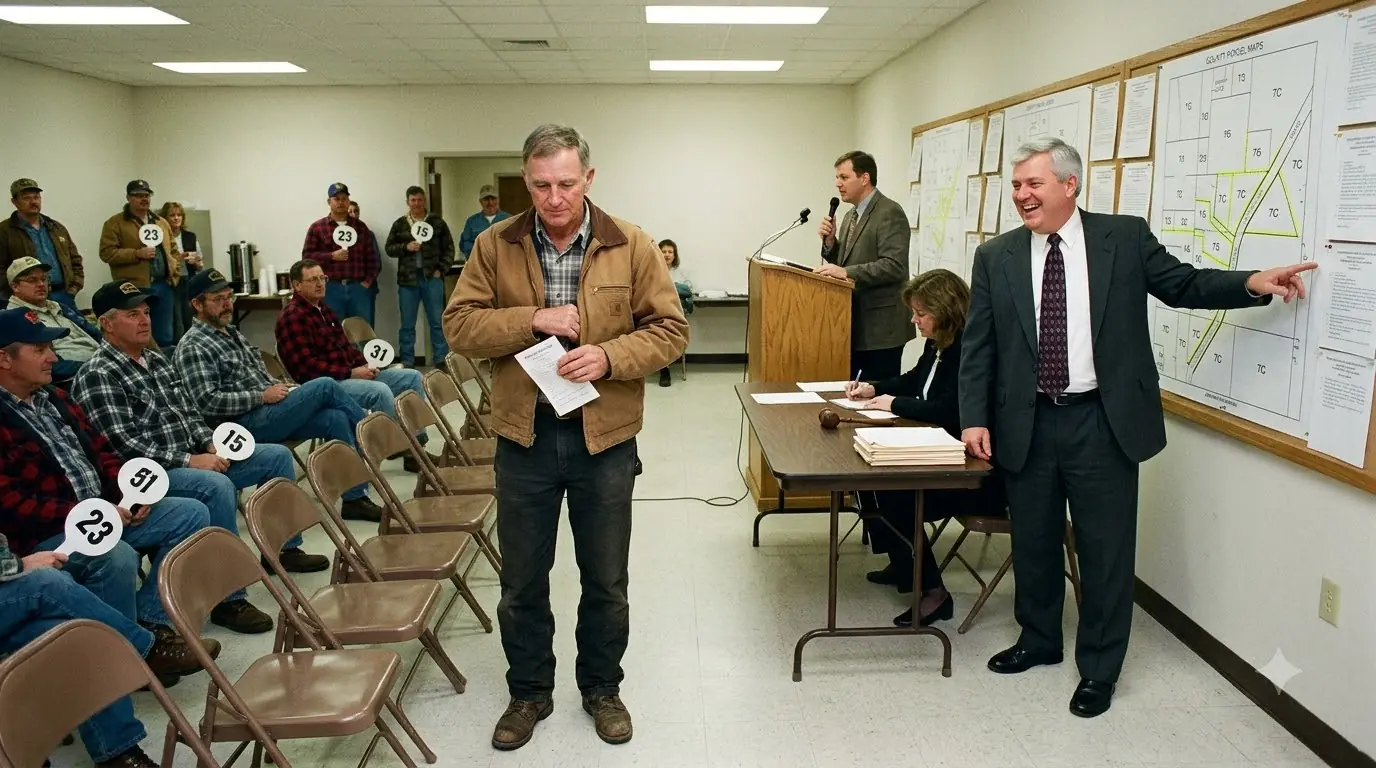
March 2001, Calloway County Bank. A folding table served as an auction desk, while four locals stood near the coffee pot just to watch.
The bank was clearing out foreclosed land. Then the auctioneer read the next listing.
"Parcel 7C, 12 feet wide, half a mile long. Opening bid, $5,000."
Nobody moved. He smirked.
"$5,000 for half a mile of grass. Anybody?"
A hand rose in the back. Clean shirt, work boots, 62 years old: Gerald Marsh.
"$5,000 to the gentleman in the back."
A voice near the coffee pot spoke up. "Six."
The auctioneer nodded. "$6,000."
"Looking for seven."
Gerald never looked up. "Eight."
The room turned. Before the hammer fell, branch manager Curtis Wade laughed loud enough for the room to hear.
"$8,000 for a 12-foot strip of nothing."
He looked straight at Gerald. "Some people collect problems."
A few people laughed with him. Gerald never looked up.
He signed the paper, folded the receipt, and placed it in his coat pocket. Because unlike everyone else in that room, he knew exactly what he had just bought.
To understand why Gerald Marsh paid $8,000 for a 12-foot strip of land, you have to go back to 1999. Not to a bank, not to a courtroom, but to the Calloway County Public Library.
Gerald had a habit most people never understood. Once a month, he drove to the library and read county records no one else cared about: old zoning maps, road surveys, easement filings, and infrastructure plans from decades earlier.
His wife Margaret called it homework. Gerald called it paying attention.
Then one October evening in 1999, he found something that made him stop turning pages. A county road expansion proposal from 1956.
State Route 9 was supposed to be widened. To do it, the county had surveyed a narrow 12-foot corridor along the eastern boundary.
The expansion was canceled in 1961. But one detail had never been cleaned up.
The corridor was never legally dissolved. It still existed on county records as a separate parcel of land: forgotten, unclaimed, still alive on paper.
Gerald read the filing three times. That night, he sat at the kitchen table and drew a map by hand.
Route 9, the corridor, the land around it. On one side sat scattered farmland; on the other side, hundreds of acres of flat open ground.
Cheap land, empty land, the kind of land developers notice before anyone else does. Gerald stared at the map for a long time.
Then he called his neighbor, Dale. "You remember that open land east of Route 9?"
"Sure," Dale said. "Nothing out there."
Gerald paused. "Not yet."
For the next 18 months, Gerald watched quietly and patiently. Every trip into town, he drove past that land.
He noticed survey flags, fresh tire tracks, and new fence stakes. Then, in early 2000, a survey crew appeared: two trucks, two full days.
They said nothing. Three months later, 40 acres were sold through an LLC with a Nashville address.
Six months after that, another 60 acres changed hands, then more. Gerald wrote every purchase down in a notebook Margaret had given him.
One night, she asked what he was tracking. "A pattern," he said.
"What kind of pattern?"