The developer's lawyer called at 7:12 on a Monday morning.
His first words were simple.
"We have a problem."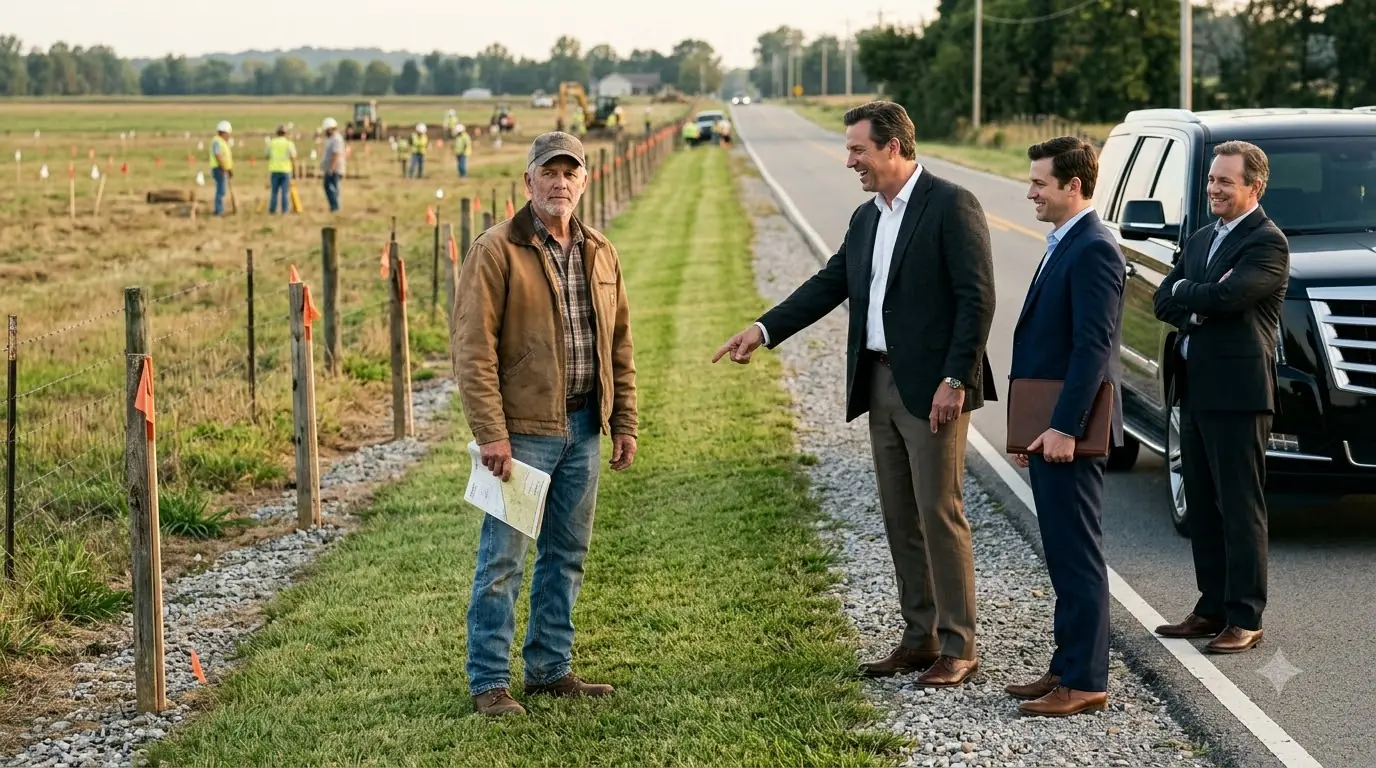
Nathan Granger stopped halfway across the kitchen of his Nashville home with a coffee cup in one hand and his phone pressed against his ear.
Nathan had spent fourteen years building shopping centers, subdivisions, medical complexes, and commercial parks across three states.
He had survived zoning fights, environmental reviews, financing problems, contractor bankruptcies, material shortages, lawsuits, and one tornado that scattered half a framing package across six acres of Tennessee.
He was not a man who panicked easily.
Robert Hale's voice made him nervous immediately.
"What kind of problem?"
"The access approval."
Nathan set down the coffee.
"What about it?"
"The county rejected the final submission."
"Rejected?"
"Technically, suspended."
Nathan walked toward the kitchen island.
"For what?"
Robert was silent for a moment.
Then:
"Title."
Nathan frowned.
"What title?"
"The eastern frontage."
"We own the eastern frontage."
"No."
Robert's answer came too quickly.
Nathan stopped moving.
"What do you mean, no?"
"There is a separate parcel between our property and Route 9."
Nathan stared through the kitchen windows.
Outside, his irrigation sprinklers moved slowly across a perfectly maintained lawn.
"How big?"
Robert exhaled.
"Twelve feet wide."
Nathan waited.
"That's it?"
"Twelve feet wide and approximately half a mile long."
Nathan almost laughed.
The sound never came.
"Robert, you're telling me a thirty-million-dollar development has been stopped by twelve feet of grass?"
"Yes."
"Who owns it?"
Another pause.
"A farmer."
Nathan closed his eyes.
"How much does he want?"
"We don't know."
"What do you mean, you don't know?"
"He hasn't returned the first two calls."
Nathan's fingers tightened around the edge of the counter.
"Who is he?"
"Gerald Marsh."
"How long has he owned it?"
Robert hesitated.
"Since 2001."
Nathan opened his eyes.
"How much did he pay?"
"$8,000."
For several seconds, neither man spoke.
Then Nathan asked the question every developer eventually asks when reality refuses to behave like a spreadsheet.
"How did nobody catch this?"
Robert did not answer immediately.
Because there was no answer that would make Nathan feel better.
Surveyors had reviewed the property.
Title companies had reviewed the acquisitions.
Engineers had drawn access roads.
Traffic consultants had designed signal timing.
Banks had committed financing.
County planners had reviewed concept packages for years.
And somehow, through every meeting and every revision, a strip of land twelve feet wide and roughly half a mile long had survived like a thread hidden beneath a rug.
Now someone had pulled it.
And the entire project was beginning to move.
"Find out what he wants," Nathan said.
"We are."
"No."
Nathan's voice hardened.
"Find out today."
Robert hesitated.
"There's something else."
Nathan felt the beginning of a headache.
"What?"
"The parcel isn't some accidental recent purchase."
"What does that mean?"
"It means Marsh appears to have bought it knowing exactly what it was."
Nathan's expression changed.
"How exactly?"
"He has owned it for twenty-three years."
"And according to county correspondence, he has rejected several purchase offers already."
Nathan stared at the phone.
"How many?"
"At least three documented ones."
"Amounts?"
"$80,000."
"$120,000."
"$250,000."
Nathan said nothing.
Robert continued.
"The last one was from us."
"Eight years ago."
That finally landed.
This was not a farmer who had just discovered he held a forgotten sliver of valuable ground.
This was a man who had been waiting.
Nathan asked quietly:
"How long has he known?"
Robert looked at the file open on his desk.
At a deed recorded in March 2001.
At old correspondence.
At handwritten notes in scanned county files.
Then he answered:
"I think he knew before he bought it."