Walter Hayes woke before sunrise on the first Monday of October and dressed more carefully than he had for any occasion in years. He chose a clean plaid shirt, his best brown jacket, and the leather boots he normally reserved for weddings and funerals. At seventy-eight, his deeply lined hands carried permanent traces of soil and machine grease, no matter how hard he scrubbed them. That morning, however, he wanted to look respectable when he collected the savings that were supposed to carry him and his wife through retirement.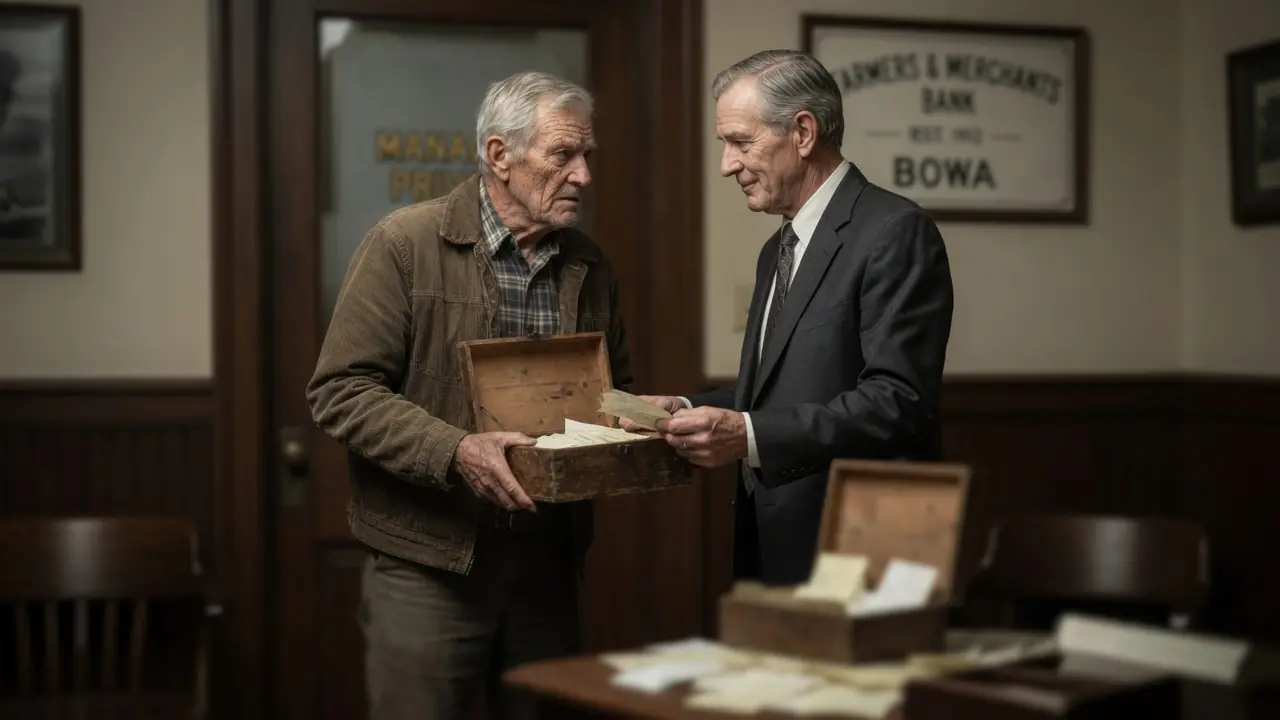
For fifty years, Walter had deposited money at the same bank in the small Iowa town where he had spent his entire life. Some deposits had been large after strong harvests, while others had been only a few dollars during droughts and difficult winters. He never considered the account a source of comfort or convenience; it was a promise to his future self that a lifetime of work would not end in dependence. Now his knees were failing, the farmhouse roof needed replacing, and he was finally ready to withdraw what he had saved.
His wife, Ruth, stood beside the kitchen counter preparing two sandwiches for the drive. She was seventy-six, with neatly tied silver hair, soft gray eyes, and the calm patience of someone who had survived every bad season beside him. Walter told her he would return before lunch with a certified check and a complete account statement. Ruth handed him the food and reminded him to bring home every piece of paperwork the bank provided.
“You still don’t trust computers,” Walter teased.
“I trust records people cannot quietly change,” she replied.
Walter kissed her cheek and stepped outside into the cold morning. His old pickup started on the second attempt, filling the yard with a familiar rattle before he turned onto the county road. Cornfields stretched across both sides of the highway, yellow and nearly ready for harvest. As he drove toward town, he thought about the first deposit he had made when he was twenty-eight years old.
Back then, Walter and Ruth had lived inside a rented house with a leaking roof and one working heater. Walter had sold two calves and walked into the bank carrying three hundred dollars in an envelope. A young teller named Richard Sloan helped him open a long-term savings account and praised him for thinking about retirement so early. Walter remembered Richard’s narrow face, confident smile, and careful signature at the bottom of the first deposit receipt.
Over the decades, Richard rose through the bank. He became assistant manager, then branch manager, and eventually the most powerful financial figure in the county. Walter continued making deposits without asking many questions because he trusted the institution and the man who had opened the account. Each transaction was accepted, stamped, signed, and entered into whatever system the bank used at the time.
The branch looked different when Walter arrived that morning. The original brick exterior remained, but glass doors, polished floors, and digital screens had replaced almost everything he remembered. Young employees worked behind counters without paper ledgers, while customers completed transactions on tablets. Walter waited patiently until a teller invited him forward.
“I’d like to close my savings account,” he said, sliding his identification across the counter. “I want the entire balance transferred into a certified check.”
The teller typed his name, date of birth, and identification number. Her expression changed after several searches. She asked whether the account might have been opened under a business name, but Walter explained that it had always been personal.
She searched again.
“I’m sorry, Mr. Hayes,” she finally said. “There is no savings account under your name.”
Walter assumed he had misheard her. “Try the old account system.”
“There isn’t another account listed.”
“I’ve been depositing here for fifty years.”
The teller looked uncomfortable. “Our records don’t show that.”
Walter felt the excitement drain from his body, replaced by a cold pressure behind his ribs. He leaned toward the counter and repeated his full name slowly, then gave her his farm address and the last account number he could remember. The teller tried every combination he offered, but the screen returned nothing.
“That isn’t possible,” Walter said.
“I understand this is upsetting.”
“No, you don’t. I’m not upset because I forgot where I put twenty dollars. That account contains my life’s work.”
Several customers began looking toward him. Walter lowered his voice, though anger made every word shake. He asked to speak with the branch manager.
The teller hesitated before calling the office upstairs.
A few minutes later, Richard Sloan entered the lobby.
Time had reduced his once-dark hair to slick gray strands and narrowed his body inside an expensive charcoal suit. His pale face carried deep lines around the mouth, but Walter recognized him immediately. Richard was the man who had opened the account, signed the early receipts, and spent decades greeting Walter whenever he entered the bank.
Relief rushed through Walter.
“Richard,” he said. “Thank God. Tell her there’s been a mistake.”
Richard stopped several feet away. His expression showed no recognition.
Walter reminded him of the first deposit, the old wooden teller counter, and the year a spring flood nearly destroyed the Hayes farm. He described how Richard had encouraged him to continue saving even when money was tight. Walter expected some memory to appear in the manager’s eyes.
Instead, Richard laughed.
It was not a gentle laugh of confusion. It was loud, dismissive, and cruel enough to draw attention from everyone in the lobby. Walter stood motionless while Richard shook his head as though listening to an old man invent a foolish story.
“You expect me to remember opening one account half a century ago?” Richard asked.
“I expect the bank to remember.”
Richard’s amusement disappeared. “The bank has no account under your name.”
“Then open the archived records.”
“There are no archived records available to customers.”
“I have the right to see where my money went.”
“You have the right to access accounts that exist.”
Walter stared at him. “You signed my deposit slips yourself.”
Richard stepped closer and lowered his voice. “Mr. Hayes, you are confused. I suggest you go home and speak with a family member before embarrassing yourself further.”
The statement struck harder than the denial. Richard was not simply claiming a technical error; he was using Walter’s age to make him appear unreliable. Customers watched from the waiting area as though he were an unstable old man creating trouble.
Walter demanded that Richard produce the bank’s historical ledgers.
Richard refused.
Walter struck the counter with his palm. “Fifty years, Richard. You took that money from my hands.”
The manager immediately signaled toward the security desk. Two guards approached, and Richard ordered them to remove Walter from the building. Walter protested, but the guards took him by the arms and guided him toward the entrance while Richard warned him not to return without legitimate account documentation.
Outside, Walter stood beside his truck with humiliation burning through him. People passed through the glass doors without meeting his eyes. For the first time in decades, he felt old in the way Richard had intended—confused, powerless, and easy to dismiss.
He drove home without eating the sandwiches Ruth had packed.
When he entered the farmhouse, she immediately understood something had happened. Walter removed his jacket, sat heavily at the kitchen table, and told her everything. He described the missing account, Richard’s laughter, and the guards leading him out in front of strangers.
Ruth listened without interrupting.
When he finished, she rose from the table and walked toward the basement door. Walter heard her descend the wooden stairs, move several boxes, and drag something across the concrete floor. A few minutes later, she returned carrying a dusty wooden chest.
She placed it in front of him.
“What is that?” Walter asked.
“Your account.”
Ruth opened the lid.
Inside were hundreds of yellowed deposit receipts arranged inside folders by year. The earliest papers were thin and brittle, carrying stamps from the bank’s original name. Later folders contained printed transaction forms, carbon copies, mailed statements, and deposit confirmations from every technological era the bank had passed through.
Walter touched the first folder with trembling fingers.
“You kept all of them?”
“Every one you brought home.”
“I thought we threw the old records away when we moved.”
“I threw away grocery receipts and appliance warranties. I never threw away proof of our future.”
They spent the afternoon spreading the documents across the kitchen table. Ruth had organized them chronologically, writing the year on every folder and making notes whenever the bank changed account numbers. There were receipts from years when Walter sold record harvests and years when he deposited only twenty dollars at a time.
Not one year was missing.
Most importantly, hundreds of receipts carried Richard Sloan’s signature. He had signed them first as a teller, then as an account officer, and later as branch manager. Walter recognized the same sharp curve beneath the surname on documents spanning decades.
His eyes filled with tears.
“All this time,” he whispered.
Ruth placed one hand over his. “Paper remembers what people choose to forget.”
Walter called Eleanor Brooks, an attorney he had known since she was a young lawyer helping local farmers with property disputes. Eleanor arrived that evening and spent several hours reviewing the receipts, stamps, transaction numbers, and signatures. She photographed every page before placing the originals inside protective sleeves.
“These are valid banking documents,” she said. “If the bank accepted these deposits, it has to explain where the account went.”
“What if they say the papers are fake?”
“Then they will have to explain how you forged fifty years of changing stamps, account systems, employee codes, and official signatures.”
Eleanor filed a petition demanding that the bank produce every surviving record connected to Walter’s identity and account numbers. The bank responded by claiming repeated computer upgrades had erased old data. According to its attorneys, the disappearance was unfortunate but ordinary.
The explanation did not satisfy the court.
An independent forensic specialist was appointed to examine archived databases, backup systems, migration files, and access logs. The bank argued that the search would be expensive and unnecessary. The judge replied that losing fifty years of a customer’s money was also expensive and far from ordinary.
The investigation lasted several weeks.
At first, the forensic specialist found only scattered references to Walter’s name. Then an obsolete backup revealed transaction identifiers matching several receipts Ruth had preserved. Additional searches uncovered fragments of the old account, including yearly interest calculations and balance transfers between earlier banking systems.
The account had existed.
That discovery alone should have ended the dispute, but the recovered logs revealed something worse. Walter’s account had survived every major system migration until only a few weeks earlier. It had not disappeared during a general upgrade decades ago.
Someone had deliberately deleted it.
The deletion occurred the day after Walter called the bank to ask what documents he would need for a full withdrawal. System records showed that an employee first flagged the unusually large balance, then sent an authorization request to the manager’s office. Several internal actions followed, ending with the account being removed from the active customer database.
Richard’s approval code appeared on the final authorization.
When Walter returned to the bank with Eleanor and a court order, Richard received them inside his private office. Only the two elderly men faced one another across the desk while Eleanor waited outside with the evidence team. Walter carried Ruth’s wooden box against his chest.
Richard looked at it with open contempt.
“Those old scraps won’t create money that never existed,” he said.
Walter placed one receipt on the desk. “Then explain why your signature is on every deposit.”
Richard glanced at the paper and pushed it back. “Anyone could have copied that signature.”
Walter opened the next folder. “For fifty years?”
The manager’s face tightened. “Take this box and leave before I have you arrested.”
Walter spread several receipts across the polished desk. “Call them. Your handwriting will tell the truth before you do.”
Richard stood suddenly. “You think a pile of old paper makes you powerful?”
“No,” Walter replied. “It makes you afraid.”
The office door opened, and Eleanor entered with the court-appointed investigator. Richard’s anger disappeared when the investigator placed a copy of the authorization logs beside Walter’s receipts.
Each transaction number matched.
Each bank stamp was legitimate.
Each manager approval led back to Richard.
During the first court hearing, Richard insisted he had never knowingly handled Walter’s account. Eleanor projected enlarged copies of the oldest receipts onto a screen and compared his historical signature with his current one. The same slanted capital letters, narrow loops, and unusual break between his first and last name appeared on document after document.
Richard changed his explanation.
He claimed that signing a deposit did not prove he remembered the customer. Eleanor agreed that memory was irrelevant. His signature proved the bank received the money.
The forensic specialist then explained the deletion process. Removing a long-standing account required multiple levels of access, including final approval from the branch manager. Richard’s credentials had authorized every decisive action.
Richard claimed someone must have stolen his password.
The specialist produced security records showing his personal access card entering the office minutes before the approval. A camera log confirmed that no other employee entered during the relevant period. Richard had been alone.
The courtroom became silent.
The bank’s attorneys attempted to separate the institution from the manager, describing his actions as unauthorized misconduct. Eleanor challenged that argument by presenting evidence that earlier internal audits had flagged unexplained adjustments connected to dormant accounts. Senior officials had ignored those warnings because Richard’s branch remained highly profitable.
Walter listened without celebration.
The money mattered, but each hearing forced him to relive the moment he had been laughed at and removed from the bank. Richard had known the truth before Walter entered the lobby. He had erased the account, waited for an old farmer to arrive, and then used public humiliation to make him doubt himself.
Ruth attended every hearing carrying the wooden box.
She sat quietly behind Walter, never asking for recognition. Whenever the bank challenged a transaction, she found the correct folder. Whenever Richard denied an old signature, she produced another decade of matching receipts.
The evidence formed a history of Walter and Ruth’s marriage.
One receipt represented money from their first successful soybean harvest. Another came from the year Ruth worked evenings at a school cafeteria while Walter rebuilt the barn after a fire. Several small deposits were made during the years they paid for their daughter’s college education.
Every piece of paper carried a sacrifice.
After reviewing the testimony, technical findings, and preserved documents, the court issued its ruling. Walter’s savings account was declared legitimate, and the bank was ordered to restore the full balance with all accumulated interest. Additional compensation was awarded for mishandling the funds, destroying records, and publicly removing Walter after he requested access to his own money.
Richard’s conduct was referred to criminal investigators.
Further examination revealed he had targeted several dormant or rarely accessed accounts belonging to elderly customers. Small balances were redirected into internal holding accounts where they could be concealed among administrative adjustments. Walter’s account was different because it had grown far larger than Richard expected.
The withdrawal request threatened to expose everything.
Rather than release the money, Richard erased the account and relied on Walter’s age, limited technological knowledge, and lack of immediate records. He assumed an elderly farmer would complain briefly, become embarrassed, and give up. He never imagined Ruth had preserved fifty years of proof.
Richard was removed from the bank before the criminal case concluded.
The institution issued a public apology, but Walter refused to attend the press conference. Executives invited him to stand beside them while they announced reforms and promised better protection for elderly customers. Walter told them dignity was not restored by placing the person they had failed in front of cameras.
He accepted only what the court awarded.
With the recovered money, Walter and Ruth repaired the farmhouse roof, replaced the unreliable heating system, and paid off the remaining debt on the farm. They placed most of the funds inside several insured accounts at different institutions. Ruth insisted on receiving printed statements every month.
Walter did not argue.
He also established a small legal-aid fund through Eleanor’s office to help older residents challenge missing records, unfair fees, and financial exploitation. He refused to put his own name on it. Instead, the fund was called the Paper Trail Project.
Months after the case ended, Walter carried the wooden box back to the kitchen table. The receipts had been returned from court inside protective sleeves, but the paper remained yellow, fragile, and marked by age. He ran one finger over Richard’s earliest signature.
For years, Walter had believed the bank protected his future.
Now he understood that Ruth had done it.
“You saved everything,” he said.
“I saved paper.”
“You saved my life’s work.”
Ruth smiled faintly. “You earned the money.”
“And you made sure no one could pretend I didn’t.”
Walter looked around the small kitchen where they had counted pennies, planned harvests, raised children, and survived bad seasons. Richard had possessed computers, security guards, expensive lawyers, and the authority to remove Walter from the building. Ruth had possessed an old wooden box and the patience to place one receipt inside it after another.
The box had won.
Not because paper was stronger than a bank, but because truth becomes difficult to erase when someone respects it enough to preserve every detail. Richard had believed he could rewrite Walter’s history with one command inside a computer system. He had not understood that fifty years of honest work had left evidence beyond his control.
A year later, Walter visited the farm field where he had earned the money from his first deposit. Ruth stood beside him while autumn wind moved through the dry corn. They were older, slower, and finally retired, though Walter still repaired fences whenever he became restless.
“Do you regret trusting that bank?” Ruth asked.
Walter considered the question.
“I regret trusting Richard,” he said. “But I don’t regret saving.”
He looked at her.
“And I’ll never regret trusting you.”
Ruth took his hand as they walked back toward the farmhouse. There was no crowd, no judge, and no applause. Only two people crossing land they had protected together for more than half a century.
The bank manager had erased Walter’s account and ordered him out as though his life’s work had never existed.
But every deposit carried a signature.
And every signature had been waiting inside the box Ruth refused to throw away.