In November of 1979, Augusta “Gussie” Tweedy stood outside the Argyle State Bank with her coat buttoned to the throat and a folded payment plan pressed flat inside her purse. The wind moved hard through the streets of Lafayette County, Wisconsin, pushing dead leaves along the curb and rattling the glass windows of the bank like loose teeth. Across the street, two men in seed caps watched her from beside a parked pickup, their faces carrying the same pitying curiosity she had seen everywhere since Garret walked out. They were waiting to see whether she would come out crying.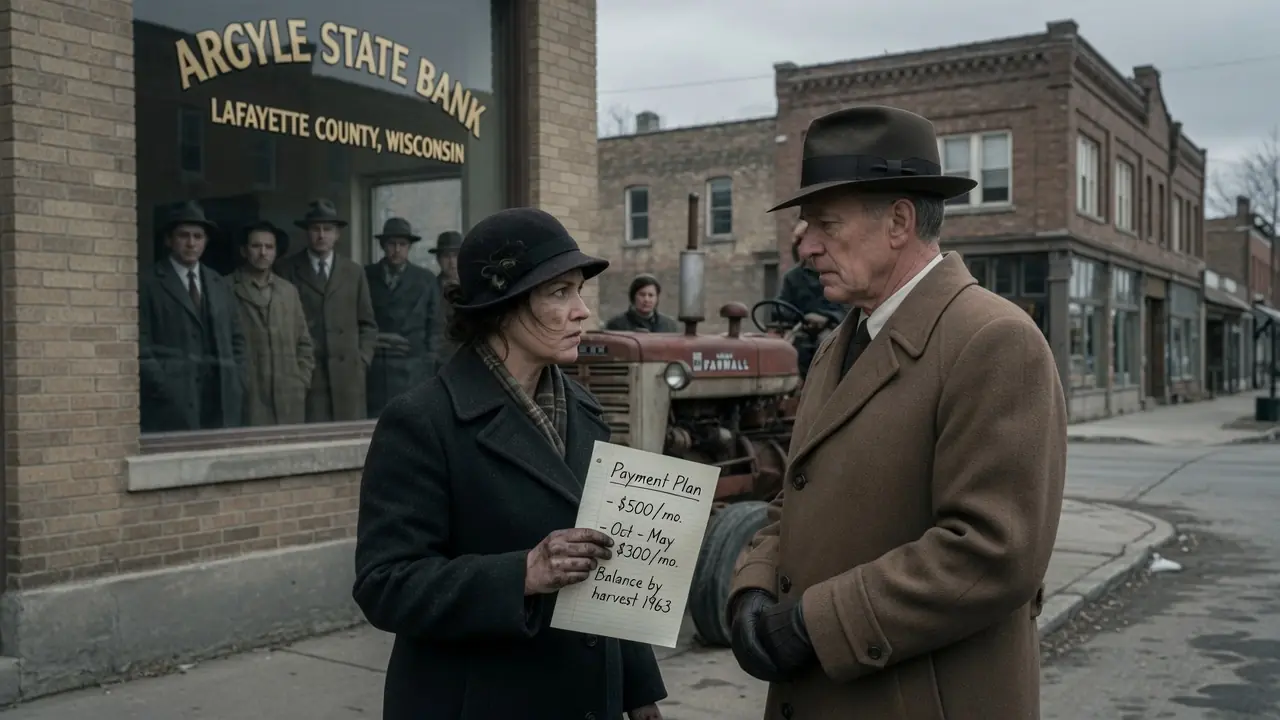
Gussie did not cry. She had done all the crying she meant to do the night she found Garret’s note on the kitchen table, written in his lazy hand beside the unpaid bills. He had gone to Sun Prairie with another woman, leaving behind a dairy farm, a herd that needed milking, a disassembled 1958 McCormick Farmall 460, and a debt of $72,000. The worst part was not the number. The worst part was finding her own name forged on the loan papers inside a boot box under the bed.
Inside the bank, Vice President Roelof Heggem Stoltenberg sat behind a polished oak desk, surrounded by pipe smoke and framed certificates. He did not rise when Gussie entered. He only adjusted his tie, looked at her handwritten plan, and smiled as if a child had brought him a school assignment. Gussie sat across from him with her hands folded, waiting for him to read.
He did not read past the first line. “Custom harvesting work,” he said, tapping the paper. “Gussie, this is a dairy operation loan, not a mechanical hobby fund.” His voice was soft, but it carried the smooth cruelty of a man who had never had to defend his own intelligence in a room full of people waiting for him to fail. “Garret himself couldn’t fix that tractor. What makes you think you can?”
Gussie looked at the paper under his finger. “Because Garret didn’t know what was wrong with it.”
Roelof’s smile thinned. “And you do?”
“Yes.”
He leaned back in his leather chair and studied her as if she had become interesting for the wrong reason. “You are one woman with a failing herd, a husband who left, and a note coming due next milk cycle. The bank needs $4,812 in interest by the deadline, and eventually, it needs all $72,000.” He slid the plan back toward her. “Sell before spring. Leave with dignity.”
Gussie took the paper and put it back in her purse. “Dignity is not something the bank gets to hand me on my way out.”
For the first time, Roelof’s expression hardened. “By spring, the auction sign will be at your lane.”
Gussie stood. “Then look carefully when you pass it, Roelof. It won’t be my farm they’re selling.”
She walked out before he could answer. The men across the street watched her come down the bank steps, and one of them lifted his chin toward the other with a smirk. Gussie crossed the road without looking at them, climbed into her rusted Ford pickup, and drove straight to Darlington Hardware. She had already sold seven cows that morning, each one’s name written on a separate envelope of cash.
At the hardware counter, Stanley Graber counted her bills three times. The pile of parts beside him smelled of cardboard, cosmoline, and cold metal: gaskets, bearings, piston rings, hydraulic seals, and machine steel. Behind her, men gathered near the stove and pretended to examine seed catalogs while listening to every word. Gussie could feel their amusement collecting in the room like smoke.
Stanley lowered his voice. “Gussie, Garret said that Farmall was scrap. He couldn’t get the timing set, and the hydraulic pump was shot clean through.”
Gussie held out her hand for the receipt. “Garret was wrong about many things.”
The men near the stove went quiet. Stanley looked at her hands, scrubbed clean but still dark with grease around the nails. Something in his face shifted from pity to uncertainty, but he said nothing else. He packed the parts into boxes and helped her carry them outside.
On the sidewalk, one of the men finally laughed. “You planning to pay the bank with old iron?”
Gussie stopped with one box in her arms and looked at him. “No. I’m planning to pay the bank with work.”
The laughter followed her pickup as she drove out of Darlington. It followed her past the feed mill, past the gas station, past the church where women would be discussing her over coffee by Sunday. It followed her all the way to County Road G, but it stopped at the lane because Gussie would not carry it inside with her.
That night, after milking, she went upstairs and opened the cedar chest at the foot of her bed. Beneath folded linens sat a locked metal box. Inside were notebooks from a life Garret had never known about. From 1962 to 1964, twice a week, Gussie had driven to Madison for agricultural mechanics classes while Garret believed she was attending sewing meetings.
She had been the only woman in that night class. The young men had laughed at first, but Mr. Abernathy, a retired Case engineer, had not. He taught her how to read engines, how to hear a bad bearing, how to measure tolerances, how to set ignition timing, and how to diagnose hydraulic failure by pressure and feel. He taught her that machines did not care whether the hands fixing them belonged to a man or a woman.
Gussie carried the notebooks downstairs and placed them on the kitchen table. The pages were yellowed, but her handwriting was clear. Diagrams of the C263 engine stared back at her like maps drawn for a future she had not known she would need. The $72,000 debt was an ocean, but the Farmall was a raft, and the knowledge in those notebooks was the way to build it.
Through December and January, the farm did not sleep much. Gussie milked before dawn, fed calves, cleaned stalls, handled the herd, and then worked on the tractor until her fingers ached too badly to close. She cleaned each part, measured each surface, replaced bearings, lapped valves, honed cylinders, and rebuilt the hydraulic system piece by piece. When the cold inside the barn turned cruel, she wrapped cloth around the metal tools so her hands would not freeze to them.
People still saw her in town, but less often. When she came to the hardware counter, she carried exact part numbers and spoke in specifications that made Stanley listen more carefully than before. The men near the stove stopped laughing loudly, but their whispers remained. A woman alone rebuilding a tractor still sounded like the beginning of a joke to them.
In late January, Garret’s older brother Thomas found her in the barn with a torque wrench in her hand. He stood in the doorway, snow on his boots, looking at the half-assembled engine. “Gussie,” he said sadly, “there’s no shame in selling.” She tightened the bolt to the exact number in her notebook before looking up. “The timing is next,” she said.
Thomas stared at her. He wanted an argument, a confession, maybe a collapse. Instead, she gave him the next step. He shook his head, turned, and walked back into the snow.
By early March, the tractor was whole. Gussie had painted the engine and frame in fresh International Harvester red, not for vanity, but because clean metal deserved protection. She filled the crankcase, connected the battery, checked the fuel, and climbed into the cold seat. For a moment, she placed both hands on the steering wheel and thought of her father, Olaf, who had taught her that a well-tuned engine sounded like a happy heart.
She turned the key. The starter groaned. The engine rolled once, twice, three times, then coughed hard enough to send white smoke from the exhaust. She adjusted the choke, tried again, and the Farmall caught.
The sound filled the barn. It was not the rough, angry clatter Garret had cursed at for years. It was deep, smooth, and steady. Gussie closed her eyes, listening to six cylinders firing in order, and knew the bank had just lost its first argument.
In April, she painted a sign and placed it at the end of her lane: Custom Hay Cutting and Baling, A. Tweedy, Inquire Within. Her first customer was Art Fielstad, an old bachelor farmer whose own tractor had failed two days before cutting. He did not trust her, but rain was coming, and desperation made him braver than pride. Gussie drove the red Farmall into his field while he stood at the fence with his arms folded.
By evening, forty acres were cut clean. The hydraulic lift worked smoothly. The engine never missed. Art paid her $560 in cash, counting it into her hand without the sarcasm he had carried that morning.
That summer, more neighbors called. Some did it quietly, as if hiring her was something they did not want discussed at the diner. Some claimed they were only giving her pity work. But when she showed up on time, finished clean, and charged fairly, the reason stopped mattering.
Every dollar from custom work went into the bank. Milk checks paid living expenses. Gussie wore out gloves, not excuses. When she walked into Roelof’s office with the first full interest payment, he accepted it without a smile.
In 1981, she bought a used New Holland square baler. In 1982, she worked sixteen-hour days through June and July, eating sandwiches wrapped in wax paper while sitting in the tractor seat. In 1983, a quiet teenage boy named Wendell Hawk began hanging around the machine shed after school, fascinated by the Farmall. Gussie recognized the hunger in his eyes, the same hunger she had once carried into that Madison classroom.
She taught him how to grease fittings, set points, listen for bad bearings, and respect a machine before forcing it. Wendell became her helper, then her apprentice. With him running the baler on the smaller jobs, her acreage climbed. The payments grew larger.
By then, the laughter in town had faded. Men at the hardware store began asking her what she thought about their own tractors. Stanley kept special orders ready behind the counter. Even Roelof’s face changed slightly each time she brought in another payment, though he never apologized.
The county was changing too. Farmers who had borrowed big in the late seventies began to feel the walls closing in. Interest rates climbed, milk prices weakened, land values fell, and auction signs started appearing on roads where proud men had once slowed their trucks to look down Gussie’s lane. The same banks that had encouraged expansion now demanded payments no harvest could cover.
Gussie watched it happen without pleasure. Vindication did not taste as sweet when it came mixed with neighbors losing land. She had never wanted men ruined so she could be proven right. She had only wanted them to stop assuming she was wrong.
In September of 1985, Gussie made the final payment. The receipt was stamped in purple ink: Payment in full. Balance $0. She sat in her pickup outside the bank for several minutes after leaving Roelof’s office, holding the paper in both hands. No music played, no crowd applauded, and no one came running into the street to confess they had underestimated her.
Still, the world had changed. The forged debt was gone. The farm was hers to keep. The tractor Garret had abandoned in pieces had paid back every dollar he left behind.
Two weeks later, a reporter from the Madison State Journal came to interview her. Gussie did not tell the story with drama. She gave facts, receipts, acreage numbers, repair costs, and the final bank statement. The reporter understood anyway.
The article ran on a Sunday. The headline called the Farmall the tractor that paid the debt. It named the $72,000 loan, the abandoned wife, the rebuilt machine, and the six-year road back to solvency. It also mentioned that many farms she had worked for were now in foreclosure or close to it.
After that, people looked at Gussie differently. At church, women who had pitied her lowered their eyes. Men who had laughed at the hardware stove nodded with a respect that arrived late but arrived all the same. Gussie accepted none of it as payment because respect was not what had saved her.
Work had.
Knowledge had.
The tractor had.
In the fall of 1986, she went to an auction on Roelof Stoltenberg’s own farm. His investments had collapsed, and the bank had forced him into early retirement. Gussie came to bid on hay rakes, not to gloat. She stood near the back of the crowd in a denim jacket while the auctioneer sold household goods from a table.
Roelof saw her and walked over with his hat in his hands. He looked ten years older. For a while, he watched the auctioneer instead of looking at her. Then he said, “I called you a dime chaser back in 1979. Said you were chasing dimes with broken iron.”
Gussie kept her eyes on the auction. “I remember the bank, Roelof.”
He nodded slowly. There was no forgiveness in her voice, but there was no revenge either. It was simply a ledger closing. He walked away, and Gussie left before the hay rakes came up for bid.
Years passed. Gussie never expanded wildly, never chased credit, and never let anyone talk her into borrowing against land she had fought too hard to keep. Wendell eventually came to work for her full time after studying mechanics himself. The Farmall remained the heart of the custom operation, maintained with a care that made its engine sound younger than its years.
The old milking barn stayed straight. The fields stayed planted. The house stayed warm. Garret’s name disappeared from conversations until he became nothing more than the man who left before the real work began.
One June morning in the new century, Wendell climbed onto the Farmall and turned the key. The C263 engine caught with the same strong rhythm Gussie had first heard in 1980. She stood near the barn door, older now, hands stiffened by work, watching the red tractor idle in the sunlight. To a banker, it had once been collateral. To Garret, it had been scrap.
To Gussie Tweedy, it had been freedom.
And as the engine carried its steady sound across the valley, she knew every mocked step, every cold night, every payment receipt, and every acre had been worth it. The farm was still there. The debt was gone. The woman they said could not save herself had done it with the same broken tractor they laughed at.