“The river doesn’t stay where you think it does.”
Maren Holloway said it from the wrong side of a barbed-wire fence on a cold Tuesday morning in April, with mud drying on the knees of her jeans and a green spiral notebook tucked beneath one arm. On the other side stood five adults around a folding table covered in site plans, survey stakes, tablets, and coffee cups, all of them looking like they had arrived in Montana prepared to measure everything that could be measured.
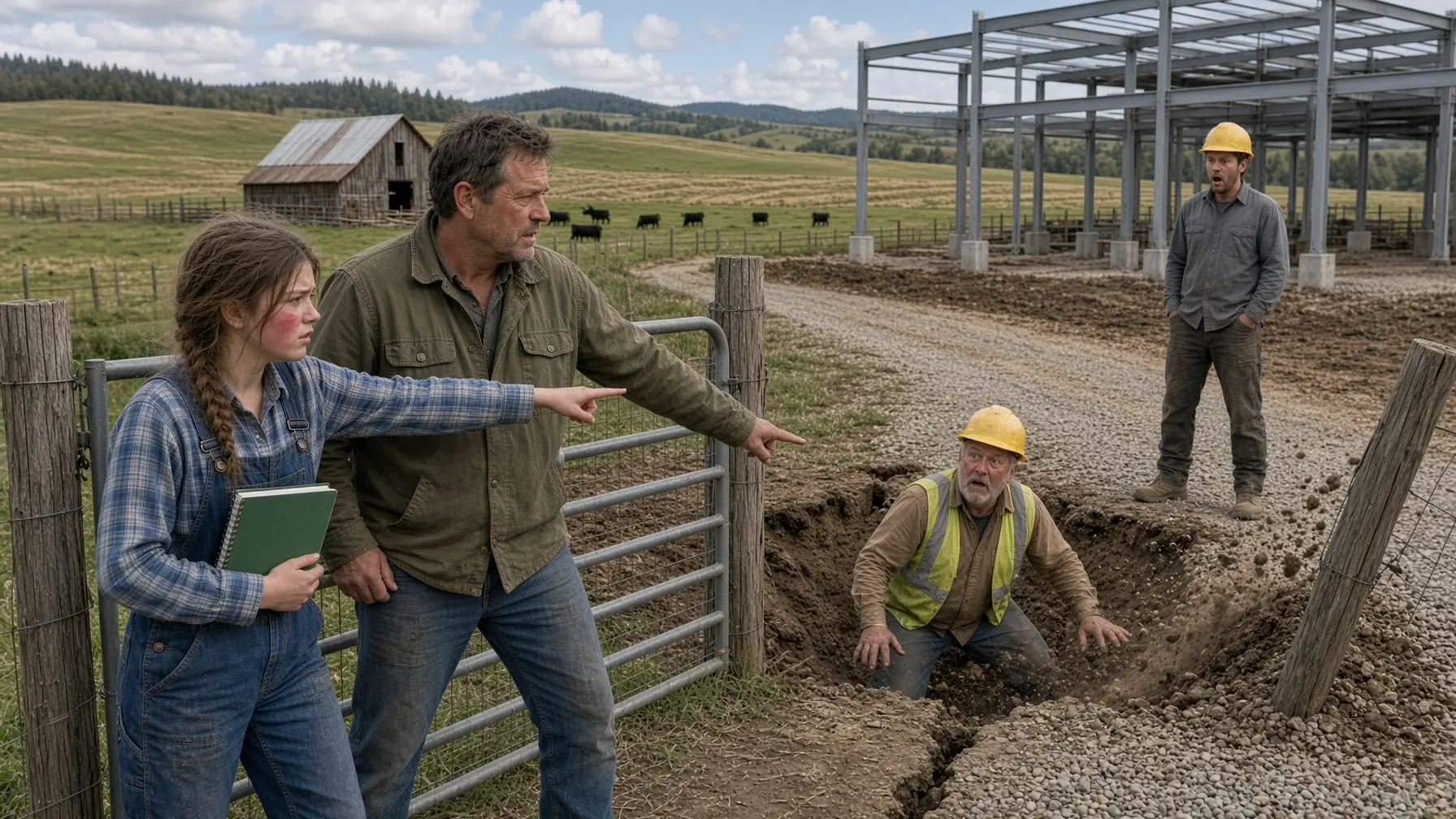
Lauren Castille, the woman who had introduced herself as the project manager for Continental Trust Bank, followed Maren’s gaze down toward the river bottom. “What do you mean?”
Maren pointed at a long rectangle on the plans. She could not read the lettering upside down, but she could see where the main building had been drawn, low on the old Pruitt place near the railroad spur. “That bottom moved twice in my grandfather’s lifetime. There’s an old channel under it. It curves through there, then runs toward our spring.”
The older man in the fleece vest glanced up from his tablet. The bank’s shield was stitched over his left breast. “We’ve got a geotechnical survey scheduled for next week. Test pits across the whole footprint. Appreciate the heads-up, though.”
He was not rude. That was what Maren remembered later.
He did not laugh in her face or tell her to go home. He smiled the way adults smiled at children who had said something earnest and harmless, and somehow that hurt worse.
“The pits won’t be in the right places,” Maren said. “The channel bends. It doesn’t run straight.”
The man’s smile held. “We use a licensed firm out of Billings. They know what they’re doing. The bank wouldn’t sign off otherwise.”
Maren looked at Lauren. Lauren’s expression was kinder, but it carried the same conclusion. Professional people had already been hired. Maps had already been drawn. The girl at the fence had offered a local story, and they had politely received it.
Maren slipped both hands into her jacket pockets. “Okay.”
She turned and walked north along the fence line.
Behind her, Lauren said something she could not hear. One of the younger men answered, and then came a small laugh. Not a cruel laugh. The kind of laugh people used when something was over.
Maren did not turn around.
That night, after feeding the cattle and helping her father repair a hinge on the calving shed, she climbed into the loft above the old barn and opened a wooden crate that smelled of dust, leather, mouse nests, and time. Inside were fifty-three years of her grandfather’s handwriting.
He had started keeping land notebooks in 1971.
There were no polished farm records in them. No neat accounting columns. One page might contain hay yield beside a note about a fox den. Another might list the date ice went out on a stock pond, followed by a sketch of a willow that had fallen across a creek. He recorded cattle behavior, frost dates, river marks, springs that weakened in August, birds that nested early, places where a tractor sank after three dry weeks, and the exact sections of fence that elk seemed determined to destroy every winter.