“Those tractors are sitting on bank property. I’ll seize every one before sunset.”
Thomas Werner raised the foreclosure order as nearly one hundred diesel engines rumbled across Daniel Cooper’s south field. Behind him, flatbed trucks continued backing into position, each carrying a brand-new John Deere 6155R wrapped in white protective covering. Daniel stood on the porch in a faded plaid shirt, dusty jeans, and work boots, holding papers that said the farm his family had worked for generations would belong to the bank in seventeen days.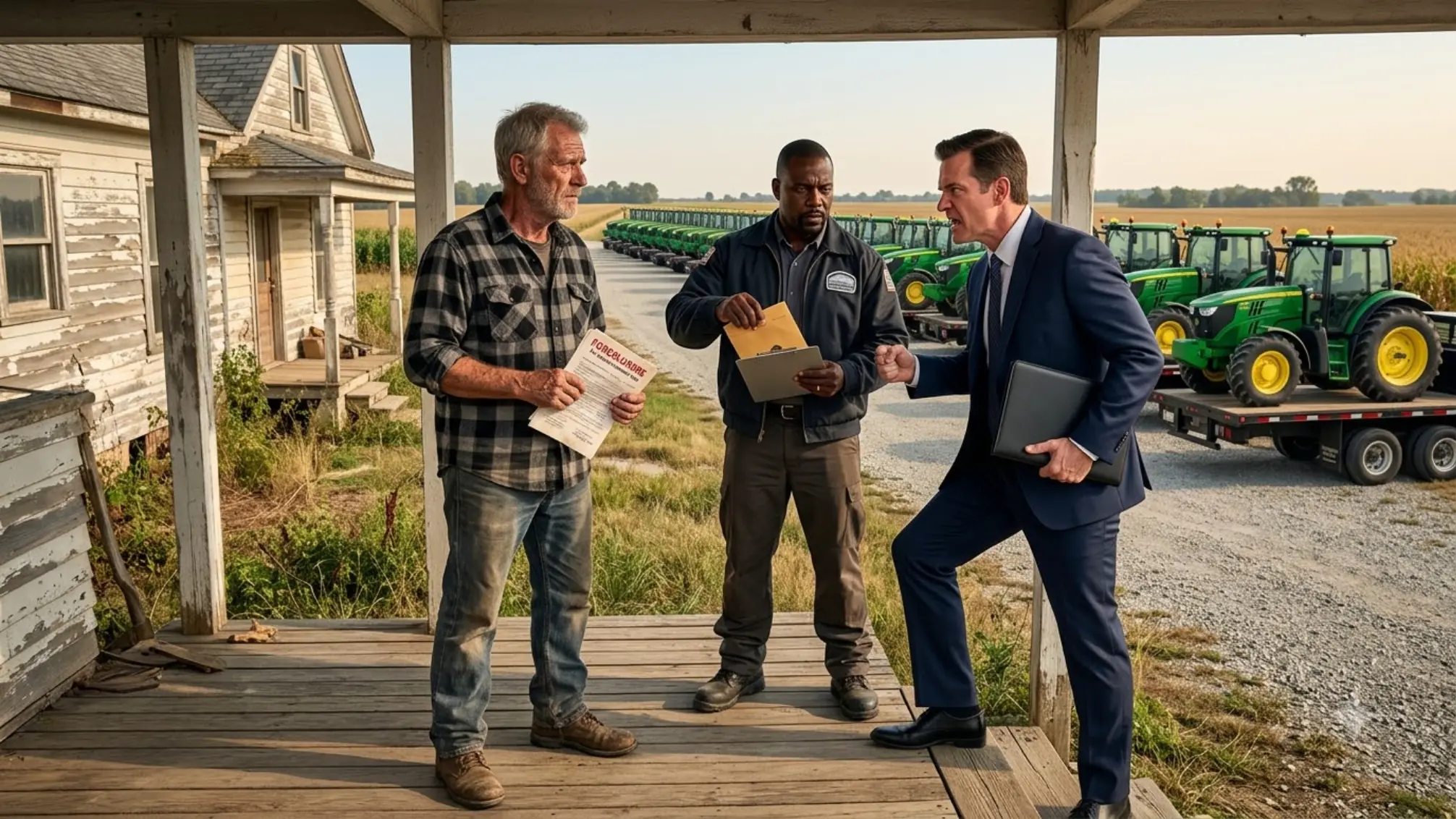
“Step onto my land again,” Daniel said, crushing the notice in one fist, “and you’ll leave with that order buried in your teeth.”
The lead delivery driver moved between them before Werner could answer. Marcus Hill was a broad-shouldered Black man in a dark transport-company jacket, and he carried a clipboard thick with purchase documents.
“Back away,” Marcus told the banker. “Every tractor was paid in cash and transferred to Mr. Cooper before you arrived.”
Werner stared past him at the rows of green machinery.
“Transferred by whom?”
Daniel tore open the sealed envelope the driver had handed him.
“Call your bank president,” he said. “Because the man who sent this convoy is coming to settle the farm himself.”
Seventeen days earlier, Daniel believed he had reached the end.
At sixty-three, he had spent his entire life on the same 240 acres outside Carterville, Illinois. He knew where rainwater gathered after a hard storm, which fence posts leaned every winter, and which section of the north field produced weak corn no matter how carefully he treated the soil. His father had taught him to drive a tractor there, and Daniel had imagined dying there long before he imagined losing it.
The foreclosure notice arrived on a Tuesday.
Daniel had missed several equipment payments after two poor harvests, rising fertilizer costs, and a medical bill connected to Martha’s surgery. He sold livestock, postponed repairs, and borrowed against the following season, but each solution only created another payment. By March, the bank claimed he owed $237,000, including accumulated interest and legal expenses.
The date printed at the bottom of the notice was March 31.
After that, the bank could take the house, barns, fields, and every remaining piece of farm equipment attached to the loan.
Daniel sat on his porch every morning with cold coffee and read the same pages as if a hidden sentence might appear between the legal paragraphs. None did. The result remained unchanged.
Sell the farm voluntarily.
Surrender it to the bank.
Or be removed through foreclosure.
On March 14, Daniel heard the first truck at 6:47 in the morning.
The sound did not belong to a neighbor’s pickup or grain hauler. It was deeper, heavier, and multiplied by engines stretching beyond the curve in the county road. Daniel stood from his chair and walked to the porch railing as the lead flatbed turned into his gravel driveway.
A brand-new John Deere tractor sat on the trailer.
Another truck followed.
Then another.
The convoy continued until the road behind them appeared filled with green-and-yellow machines wrapped in white coverings. Drivers communicated by radio, guiding the massive line toward Daniel’s property with the precision of a military operation.
Marcus Hill climbed from the first cab and approached the porch.
“Mr. Daniel Cooper?”
Daniel nodded.
“I have a delivery for you. One hundred John Deere 6155R tractors. Where would you like them unloaded?”
Daniel looked at him for several seconds.
“I didn’t order any tractors.”
Marcus checked the clipboard.
“Delivery address matches.”
“I can’t pay for one of those.”
“They’re already paid.”
“All of them?”
“Every unit.”
Daniel gripped the railing.
“How much are we talking about?”
Marcus looked toward the trucks.
“Depending on configuration, somewhere north of twelve million dollars.”
Daniel almost sat down on the porch floor.
His farmhouse, fields, barns, tools, and remaining equipment were worth less than one million combined. Someone had spent more than ten times that amount and placed every machine in his name.
Marcus removed a sealed envelope.
“This was included with the instructions. It says I’m to hand it directly to you.”
Before Daniel could open it, Martha’s car came racing into the driveway. She had finished an early shift at the town diner, spotted the trucks on the county road, and followed them home.
She stepped out without closing her door.
“Daniel, what is happening?”
“I don’t know.”
“Whose tractors are those?”
“Apparently ours.”
Martha stared at him.
Daniel opened the envelope.
Inside was one handwritten page.
The message explained that forty-two years earlier, Daniel had given a homeless young man work, food, and a place to sleep when everyone else turned him away. It said Daniel had taught him that kindness mattered more than money and that people deserved to be treated as though their lives held value even when they possessed nothing.
The tractors were fully paid.
There were no conditions.
The writer expected no repayment and wanted no public recognition.
The final sentence read:
You may not remember me, but I never forgot the day you made me believe I could become someone.
Daniel read the note twice.
Martha read it once and placed one hand over her mouth.
“Who was it?” she whispered.
“I don’t know.”
“You helped many people.”
“I don’t remember helping anyone who could afford this.”
The unloading process continued through the morning. Daniel directed the crews toward an empty forty-acre field south of the barn, where the tractors were placed in exact rows. Protective coverings rippled in the wind while polished wheels touched soil that had nearly been surrendered to the bank.
His neighbor Harold arrived and stopped his pickup in the middle of the driveway.
He climbed out slowly.
“Daniel, what in God’s name did you buy?”
“Nothing.”
Harold looked across the field.
“Those are new.”
“I know.”
“How many?”
“One hundred.”
Harold sat on the porch step.
“Who sends a man one hundred tractors?”
“Someone I helped in 1982.”
“You don’t know his name?”
Daniel held up the letter.
“He says I forgot him.”
Before noon, most of Carterville knew.
People parked along the county road to photograph the convoy. Rumors spread that Daniel had won a lawsuit, inherited hidden money, or joined an equipment-smuggling operation. One man claimed the tractors had been delivered to the wrong farm and would be removed by evening.
Thomas Werner heard the story at the bank.
He called Daniel immediately.
“Mr. Cooper, I understand several pieces of valuable equipment have appeared on the property.”
“One hundred tractors.”
“Were they purchased using borrowed funds?”
“No.”
“Are they titled in your name?”
“The delivery documents say they are.”
Werner paused.
“As your creditor, the bank may have a security interest in newly acquired farm equipment located on encumbered property.”
Daniel looked across the field.
“You’re saying you want them.”
“I’m saying we need to review the ownership structure.”
“You’re taking my farm in seventeen days, and now you think you own a gift someone sent me?”
“I did not say that.”
“You didn’t have to.”
Werner arrived less than two hours later carrying the foreclosure folder. He examined the tractors, purchase documents, and trust letter, then attempted to claim the equipment might be subject to the farm’s existing liens.
That was when the confrontation on the porch began.
Marcus, whose trucks had not yet all departed, stepped between the banker and Daniel. The transport documents identified the tractors as personal property transferred through a separate trust without connection to the farm’s operating loans.
Werner’s voice became less certain.
Daniel opened the anonymous letter and repeated that the sender intended to settle the farm himself.
“That sentence is not in the note,” Werner said.
“No,” Daniel replied. “But whoever sent twelve million dollars in equipment did not do it so you could steal the machines and keep the land.”
“You should be careful accusing the bank of theft.”
“You should be careful standing on my porch and claiming property you didn’t finance.”
Werner left after demanding proof that Daniel could repay the foreclosure debt. Daniel told him he would have it within the week.
When the final delivery truck disappeared down the road, silence returned to the property.
One hundred tractors remained.
Daniel and Martha walked between them as though moving through an impossible dream. Every machine carried a certificate of ownership, dealer invoice, and proof of payment.
“This is too much,” Martha said.
“One tractor would have stopped the foreclosure.”
“Who gives a hundred?”
“Someone who wanted to make sure the bank could never corner us again.”
Daniel began searching his past.
The note referenced 1982, when Daniel was twenty-one and newly married. He worked for his father’s struggling farm during a brutal summer drought. Grain prices were weak, money was scarce, and the family could barely afford the one employee they already had.
Daniel called his sister, old friends, and former neighbors.
No one remembered a worker whose life later became extraordinary. Martha searched photo albums and boxes containing old receipts, letters, and journals. Daniel visited the library and reviewed newspapers from the summer of 1982.
Nothing returned the missing name.
The tractors created an immediate solution even without the answer. Daniel contacted an agricultural-equipment broker, who confirmed he could sell several machines quickly. The bank halted the foreclosure after receiving proof that Daniel had already accepted an offer on three tractors worth far more than the entire debt.
Werner called with a suddenly respectful tone.
“Mr. Cooper, the bank is prepared to discuss a full payoff.”
“There is nothing to discuss.”
“We need to calculate final legal fees.”
“Send the number in writing.”
“We may also offer favorable terms if you prefer to preserve liquidity.”
“You had three months to offer favorable terms.”
“Circumstances have changed.”
Daniel looked toward the tractors.
“No. My circumstances changed. The bank is exactly the same.”
A certified letter arrived from Morrison Chen and Associates, a Chicago law firm representing the anonymous trust. The attorney confirmed Daniel could sell, lease, donate, or retain any tractors he chose. No repayment or public acknowledgment was required.
Daniel called the attorney, Richard Morrison.
“I need his name.”
“My client requested anonymity.”
“He gave me twelve million dollars.”
“He gave you equipment.”
“That does not make it easier.”
Morrison remained professional.
“My client said you would not remember him immediately.”
“Why?”
“Because helping him was a defining event in his life but an ordinary act in yours.”
Daniel stopped speaking.
That sentence disturbed him more than the mystery.
How could saving someone’s life feel ordinary enough to forget?
Six days after the tractors arrived, Martha found an old journal.
She sat at the kitchen table reading entries written in her neat handwriting from their first year of marriage. On a page dated July 1982, one sentence stopped her.
Danny brought home a stray today, a homeless boy named Marcus from Iowa. We cannot afford another worker, but Danny fed him and offered him the bunkhouse because he said nobody should sleep hungry when we have a spare bed.
Martha called Daniel into the room.
“Marcus Webb.”
The name returned before Daniel reached the table.
He saw a thin eighteen-year-old standing in the farm driveway with a damaged backpack. The boy’s jeans were torn, his face burned by the sun, and his hands trembled from hunger.
He had asked for work.
Daniel’s father could not afford another employee, but Daniel brought the boy inside and gave him soup and sandwiches. Marcus admitted his stepfather had thrown him from the house. He had traveled south from Des Moines, sleeping beneath bridges and in abandoned barns while searching for farm labor.
Daniel offered forty dollars a week, meals, and the old bunkhouse behind the barn.
Marcus worked harder than anyone Daniel knew.
He woke before dawn, remained in the fields until sunset, and learned machinery repairs faster than Daniel could teach them. When Daniel’s father announced they could no longer afford his wages, Daniel accepted a reduction in his own pay so Marcus could remain through harvest.
Marcus left in October after finding factory work in St. Louis.
Before leaving, he told Daniel that the job had saved his life.
Daniel answered that everyone deserved a chance.
Then four decades passed.
Daniel searched the name online.
The first result displayed a professional photograph of a silver-haired businessman in an expensive suit.
Marcus Webb, founder and CEO of Webb Technologies. Estimated net worth: $4.2 billion.
The company specialized in agricultural software, precision-farming systems, and equipment-management technology. Its foundation supported homeless youth and small farmers facing foreclosure.
Martha touched the computer screen.
“That’s him.”
Daniel studied the eyes.
The face had changed, but the intensity remained.
He called Morrison again.
“I know who your client is.”
The attorney said nothing.
“Marcus Webb.”
“I cannot confirm that.”
“Tell him I remember.”
Morrison’s voice softened.
“What would you like me to tell him?”
“That he owed me nothing.”
Daniel paused as his throat tightened.
“Tell him I am proud of him.”
Two days later, a package arrived.
Inside was an old Polaroid photograph of Daniel and Marcus standing beside a tractor in 1982. Both were covered in grease, and Daniel’s arm rested around the teenager’s shoulders.
A message appeared on the back.
This was the day I stopped believing I was worthless. You treated me like my future mattered before I had one. Everything I built started with that chance.
It was signed:
Marcus Webb.
Daniel held the photograph for a long time.
The tractors no longer looked like an extravagant gift.
They looked like forty-two years of gratitude made visible.
Marcus arrived the following Saturday in an ordinary Ford pickup. No security team followed him, and no luxury car announced his wealth.
He stepped from the truck wearing jeans and a blue work shirt.
Daniel recognized him immediately.
For several seconds, the two men remained apart, carrying too much history for an easy greeting. Then Marcus crossed the driveway and embraced him.
Both men cried.
“I’m sorry I stayed anonymous,” Marcus said later as they sat on the porch.
“Why did you?”
“I wanted you to accept the help before you felt obligated to reject it.”
“You sent one hundred tractors.”
“You needed the farm saved.”
“One tractor could have done that.”
Marcus looked toward the field.
“One chance could have saved me. You gave me more.”
He explained what happened after leaving Illinois. The St. Louis factory job paid enough for community college. He studied computer science, earned a scholarship, and eventually attended Northwestern University.
While working in technical support, Marcus realized software companies rarely understood farming. He built a simple program that helped small farms record expenses, yields, and equipment maintenance.
Farmers trusted it because Marcus knew their work.
Webb Technologies grew with precision agriculture. By 2019, thousands of employees worked across multiple countries, developing systems connected to modern equipment, GPS guidance, and crop planning.
Marcus never forgot Daniel’s bunkhouse.
“You gave me dignity,” he said. “Before you, every adult looked at me like trash that had learned to speak.”
Daniel shook his head.
“I gave you farmwork.”
“You called me an employee.”
“You were one.”
“You trusted me with machinery worth more than everything I owned. You introduced me to Martha as someone helping the farm, not a homeless boy you felt sorry for.”
Marcus’s voice broke.
“You made me believe I was allowed to become someone.”
He removed another envelope.
Inside was a certified check for two million dollars.
Daniel pushed it back.
“No.”
“The tractors protect the farm.”
“They already did more than that.”
“The money gives you freedom to help others.”
“I cannot accept this.”
Marcus held the envelope between them.
“You took a pay cut when you could barely afford food because sending me away might have put me back on the street. You did not ask whether helping me was financially reasonable.”
“That was different.”
“No, Danny. You needed little and gave much. I have much and am giving what I can.”
Daniel eventually accepted, not because Marcus convinced him he deserved wealth, but because he understood the gift carried a responsibility.
Daniel sold sixty tractors.
He kept forty to lease affordably to nearby farms and created the Second Chance Farm Fund with the sale proceeds and Marcus’s check. The fund paid debts, provided temporary operating capital, and supplied machinery to farmers facing foreclosure.
Eleven families remained on their land during the first six months.
Every family received the same note:
Someone helped me when I had nothing. When you are able, help someone else.
Daniel paid the bank in full.
Thomas Werner came to the farm carrying final discharge documents. His manner was formal but no longer commanding.
“The mortgage and all related liens have been released.”
Daniel signed.
Werner looked toward the tractors.
“Your benefactor was Marcus Webb.”
“Yes.”
“The billionaire.”
“The hungry boy.”
Werner lowered his eyes.
“I misjudged the situation.”
“You saw debt and assumed that gave you the right to decide what remained mine.”
“I followed bank policy.”
Daniel handed back the pen.
“Policy tells you what you are allowed to take. Character tells you when not to enjoy taking it.”
Werner left without answering.
Months later, Daniel told the story at the Southern Illinois Farm Bureau meeting. He described the convoy, the anonymous note, and the teenager he had almost forgotten.
He did not describe himself as heroic.
“I fed a hungry kid,” he said. “I gave him work because he asked for it and treated him like he mattered because he did.”
The audience stood for several minutes.
Daniel later spoke at a local high school. A student asked what lesson people should take from the hundred tractors.
Daniel considered the question.
“Kindness is never as small as it looks to the person receiving it,” he said. “You may forget helping someone because it cost you one meal, one afternoon, or one uncomfortable decision.”
He looked across the students.
“But they may build their whole life on the belief that one person saw value in them.”
Marcus created the Cooper Initiative through his foundation. It identified people who had helped others without recognition and later fallen into hardship themselves.
The initiative paid debts, supplied equipment, funded education, and preserved small businesses.
Daniel’s act continued moving through lives he would never meet.
A hungry teenager became a billionaire.
A billionaire saved a farmer.
The farmer saved eleven families.
Those families hired workers, paid medical bills, supported food banks, and helped others.
One spring morning, Daniel stood on the same porch where the foreclosure papers once lay. Forty John Deere tractors remained across the south field, waiting for lease assignments to neighboring farms.
Marcus stood beside him holding coffee.
“Did you ever think one sandwich would lead to this?” Marcus asked.
“No.”
“Do you regret not remembering me sooner?”
Daniel looked across the land.
“I regret that I thought what I did was too ordinary to matter.”
Marcus smiled.
“That is why it mattered.”
The bank had seen a poor farmer with seventeen days left.
The banker had seen one hundred assets waiting to be seized.
Marcus Webb had seen the man who once looked at a homeless boy and refused to see garbage.
The tractors were worth twelve million dollars.
The real gift had been given forty-two years earlier, in a farmhouse kitchen, when Daniel placed food before a hungry teenager and told him he deserved a chance.
Everything that followed was simply the harvest.