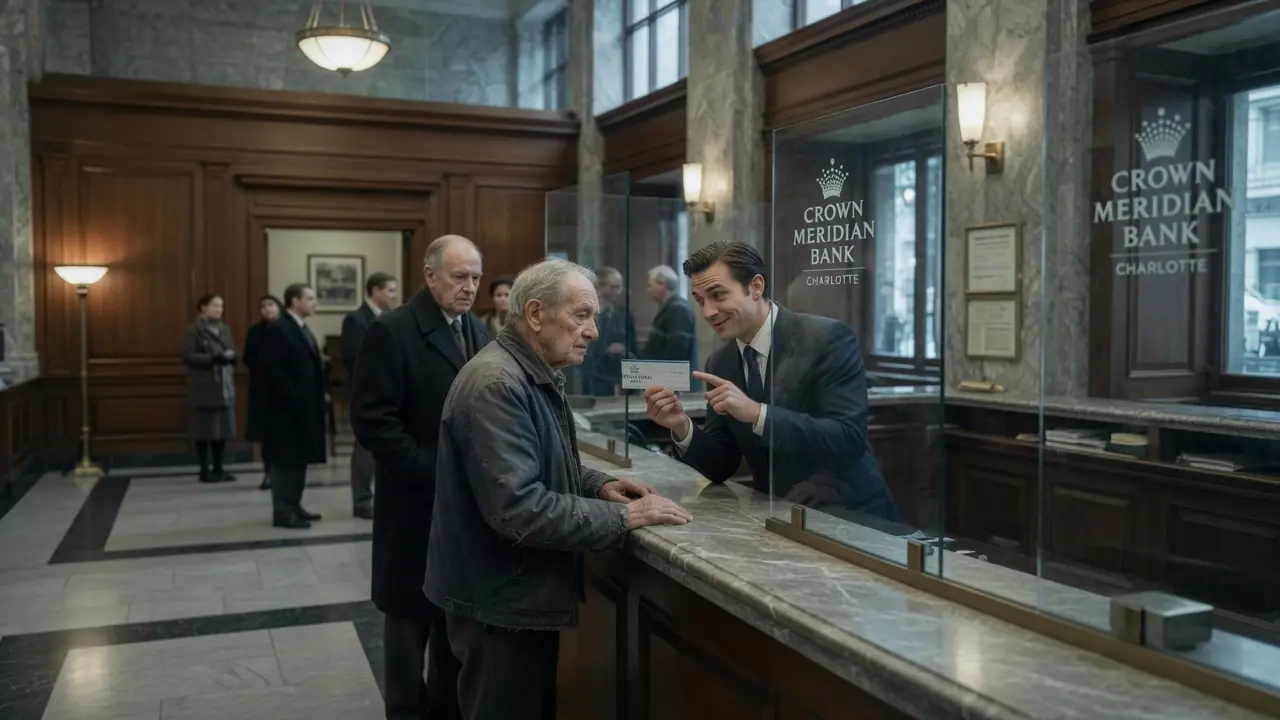
Walter Graham had not been inside Crown Meridian Bank for almost seven years. The branch stood in downtown Charlotte, polished and bright, with marble floors, brass signs, glass partitions, and soft leather chairs arranged beneath expensive lights. Men in suits moved through the lobby with quiet confidence, holding folders, phones, and coffee cups that cost more than Walter’s breakfast. He stepped through the revolving door wearing a worn navy jacket, faded jeans, and old brown shoes that had been repaired twice.
In his left hand, Walter held a thin envelope from the retirement office. Inside was a check that should have covered groceries, medicine, utilities, and the small monthly donation he still sent to the children’s hospital in memory of his late wife, Rose. But the number printed on that check was nearly half of what it should have been. Walter had read it three times at his kitchen table that morning, sitting beneath the old clock Rose had loved, hoping his tired eyes had made a mistake. They had not.
He did not come to the bank angry. Walter had lived long enough to know that anger wasted breath when patience could still solve things. He came with his documents carefully folded, his old bank card in his wallet, and a quiet hope that someone behind the counter would explain what had happened. At eighty-one, he still believed most problems could be solved if people sat down, listened, and treated one another like human beings.
The young banker behind the front counter was named Bradley Cole. He wore a crisp white shirt, a navy tie, and a smile that looked friendly only when important people were watching. Bradley was twenty-eight, ambitious, and convinced that the world was divided into those who mattered and those who wasted time. He had been at Crown Meridian for nine months, long enough to learn the bank’s systems, but not long enough to learn humility.
Walter waited in line with both hands folded over the envelope. Behind him stood Arthur Whitmore, a tall elderly man in a dark overcoat, silver hair combed neatly back, his face stern but quiet. Arthur had entered the bank only minutes after Walter, and though he recognized the old man immediately, he said nothing at first. He watched Walter’s bent shoulders, the careful way he held the check, and the faint trembling in his fingers.
Walter Graham had once built Graham Industrial Components from a rented workshop outside Charlotte. By the time he sold most of his stake, the company employed thousands across three states and supplied parts to half the manufacturing plants in the region. But Walter had never lived like a man chasing attention. After Rose died, he gave away more money than reporters ever knew, set up training grants for factory workers, and disappeared into a quiet neighborhood where he mowed his own lawn.
Arthur knew all of that. He also knew something else. Crown Meridian Bank owed much of its growth to the old Graham accounts, the Graham foundation, and the industrial clients Walter had introduced to the bank decades ago. Arthur Whitmore, once the chairman of Crown Meridian’s board, still held a lifetime advisory position and emergency review authority inside the institution. Bradley Cole, smiling behind the counter, had no idea who stood in front of him or behind him.
When Walter reached the counter, Bradley barely looked up. “How can I help you?”
Walter slid the check and a small folder through the opening beneath the glass. “Good morning. I received my retirement payment yesterday, but the amount seems wrong. It’s much lower than usual, and I hoped someone could check the account.”
Bradley picked up the check between two fingers as if it were something sticky. His eyes flicked over the amount, and a smirk pulled at one corner of his mouth. He glanced around the lobby, then looked back at Walter with amusement he did not try hard enough to hide.
“This is what you came in about?” Bradley asked.
Walter’s face stayed calm. “Yes, sir. That money matters to me.”
Bradley leaned back in his chair and laughed once, loud enough for the people behind Walter to hear. “Sir, this retirement check is barely worth the paperwork. You came all the way downtown because of this tiny amount?”
The lobby quieted.
Walter’s hands tightened slightly on the marble counter. A woman in a gray coat looked up from her phone. A businessman near the deposit table paused with his pen in the air. Behind Walter, Arthur Whitmore’s eyes narrowed, but he still remained silent, allowing Bradley one chance to correct himself.
Walter spoke gently. “It may look small to you, but it pays for my groceries and my medication.”
Bradley waved the check lightly. “I’m not saying it doesn’t matter to you. I’m saying the bank can’t stop everything because someone’s little monthly check feels disappointing.”
A flush moved across Walter’s thin face. He lowered his eyes for one second, not from shame, but from the effort it took to stay dignified. He thought of Rose, who used to squeeze his hand whenever someone mistook quietness for weakness. If she had been beside him, she would have lifted her chin and smiled in that dangerous way of hers.
Bradley sighed dramatically and tapped a few keys on his computer. “Name?”
“Walter Graham.”
Bradley typed slowly, then frowned. A deeper account file appeared, but he did not understand what he was seeing. The system showed layers of old trusts, closed industrial accounts, foundation references, and advisory markers that should have made him call a senior manager immediately. But Bradley, annoyed and impatient, focused only on the small retirement check in front of him.
“Well,” he said, raising his voice again, “it looks like your payment was processed. Maybe you misunderstood what you were supposed to get.”
Walter reached into his folder. “I brought the last six statements. It has always been higher.”
Bradley did not take them. “Sir, sometimes people your age get confused by numbers.”
Arthur moved one step forward.
Walter’s jaw tightened, but his voice remained soft. “I built a business reading numbers, young man. I know when one is wrong.”
Bradley laughed again, sharper this time. “Then maybe your business should have taught you how to keep enough money that one little check doesn’t ruin your morning.”
That was when Arthur finally spoke.
“Careful,” Arthur said.
Bradley looked past Walter and saw the tall old man in the black coat. “Excuse me?”
Arthur stepped beside Walter, not in front of him. “I said careful. You are speaking to a customer of this bank.”
Bradley’s expression shifted from mockery to irritation. “And you are?”
“Someone who heard enough.”
Bradley gave him a patronizing smile. “Then maybe you should wait your turn like everyone else.”
Arthur’s eyes stayed cold. “Everyone else is waiting because they are watching you humiliate an elderly man over money that belongs to him.”
Bradley’s cheeks colored. He glanced toward the lobby and realized more people were listening now. Instead of apologizing, he did what small men often do when exposed. He became louder.
“This is a private banking environment,” Bradley said. “I will not be lectured by two old men causing a scene.”
Walter turned to Arthur quietly. “It’s all right.”
“No,” Arthur said. “It is not.”
Bradley snatched the check off the counter and slapped his palm down hard beside it. “Take this little check and get out, both of you, before I call security to drag you from my lobby.”
The words echoed across the marble floor.
Walter did not move. His face did not break, but something in his eyes dimmed. For a man who had spent his life paying workers on time, funding scholarships, and helping others keep their dignity, being threatened over his own retirement money cut deeper than he wanted anyone to see.
Arthur reached slowly into his coat pocket and removed a black metal card. He placed it flat on the counter, directly in front of Bradley. The card carried no flashy logo, only a small Crown Meridian crest and the name Arthur Whitmore engraved in silver.
Bradley glanced down. His smirk vanished.
Arthur leaned forward. “Call security if you want, Bradley. Then explain why you threatened the man who built a billion-dollar company in front of the bank chairman.”
The lobby went completely still.
Bradley stared at the card, then at Arthur’s face. Recognition came slowly, then all at once. He had seen Arthur Whitmore’s portrait in the executive hallway during training, though he had never bothered to remember the name. Former chairman. Lifetime advisory authority. One of the few people whose call could bring the regional president to a branch within minutes.
Bradley swallowed. “Mr. Whitmore, I didn’t realize—”
“That is your problem,” Arthur said. “You did not realize who he was, so you decided he was no one.”
Walter looked down at the check still lying on the counter. “Arthur, there’s no need to make trouble.”
Arthur turned to him, and his hard expression softened. “Walter, you spent a lifetime making sure men who worked for you were paid with respect. You will not stand here and accept less from a bank that grew because you trusted it.”
A murmur moved through the lobby. Bradley heard it, and panic began replacing arrogance. He looked toward the side offices, hoping a manager might appear and rescue him from the moment. None came fast enough.
Arthur took out his phone and dialed.
Bradley lifted both hands slightly. “Mr. Whitmore, please. I apologize if my tone sounded disrespectful.”
Arthur’s eyes sharpened. “If?”
Bradley’s mouth opened, then closed.
Arthur spoke into the phone. “Elaine, this is Arthur Whitmore. I am at the South Tryon branch. I need the branch director, regional compliance, and customer accounts review at the front counter immediately.”
Bradley went pale. “Sir, that isn’t necessary.”
Arthur ended the call and put the phone away. “You threatened to throw out Walter Graham over a payment error. Necessary has already passed.”
Within five minutes, the branch director appeared from a glass office at the back. Her name was Elaine Mercer, a composed woman in her early fifties with sharp eyes and a reputation for keeping wealthy clients happy. When she saw Arthur Whitmore standing at the counter beside Walter Graham, her professional calm cracked for half a second.
“Mr. Whitmore,” she said quickly. “Mr. Graham. Please come into my office.”
Arthur did not move. “The apology begins here.”
Elaine looked at Bradley, then at the faces watching from across the lobby. She understood enough to know this had already become public. “What happened?”
Bradley tried to speak first. “There was confusion about a retirement payment, and the customer became—”
“No,” Arthur said.
Bradley froze.
Arthur looked at Walter. “Tell her.”
Walter hesitated. He hated public conflict. He hated watching a young man tremble, even one who had insulted him. But he also heard Rose in his memory again, telling him that kindness was not the same as silence.
“I asked why my check was lower than usual,” Walter said. “Mr. Cole read the amount, laughed, and said it was barely worth the paperwork. He said people my age get confused by numbers. Then he told both of us to leave before he called security to drag us out.”
Elaine’s expression became stone.
Bradley shook his head. “That’s not exactly—”
“It is exactly,” said the woman in the gray coat from the line. “I heard him.”
“So did I,” said the businessman near the deposit table.
Marcus, the security guard by the entrance, stepped forward with obvious discomfort. “Ms. Mercer, I was moving toward the counter because Mr. Cole signaled me. The customer was calm.”
Elaine closed her eyes briefly, then opened them. “Bradley, step away from the counter.”
“Ms. Mercer, I can explain.”
“Step away.”
Bradley stepped back, his face burning. The same lobby he had tried to use as a stage for Walter’s humiliation had become the room where his own character was being counted out loud.
Elaine turned to Walter. “Mr. Graham, I am deeply sorry.”
Walter nodded. “I would still like to know why my check is wrong.”
“Yes,” Elaine said. “Of course.”
She personally led Walter and Arthur into her office. Bradley remained outside under the watch of the entire lobby, no longer smiling, no longer powerful behind the glass. People returned to their banking slowly, but everyone kept glancing at him as if he had become a warning sign.
Inside Elaine’s office, Walter sat carefully in a leather chair, his folder on his lap. Arthur stood near the window, arms folded. Elaine logged into the account review system and began moving through records with focused speed.
The issue appeared after ten minutes.
A new automated account classification had mistakenly moved Walter’s retirement disbursement into a category that triggered an old withholding formula. The system had flagged a portion as reserve holdback because of a closed business account linked to his name decades earlier. It was a bank error, quiet and technical, but still deeply human in its consequences.
Elaine’s face tightened. “Mr. Graham, the payment reduction was our mistake.”
Walter let out a slow breath. “Can it be corrected?”
“Immediately,” Elaine said. “The missing amount will be deposited today, and I will reverse any fees or penalties caused by the shortage.”
Walter nodded, relief visible in the way his shoulders lowered. “Thank you.”
Arthur was not satisfied. “How many other retirees were affected by this classification?”
Elaine looked at him.
Arthur’s voice hardened. “Do not make me ask twice.”
Elaine looked back at the screen, then opened a report. Her silence grew heavy. “It appears there may be others.”
“How many?”
“Potentially one hundred and forty-three accounts in the region.”
Walter’s eyes widened. “One hundred and forty-three people had checks cut?”
Elaine’s mouth pressed into a line. “Possibly.”
Arthur stepped closer to the desk. “And if Walter had not come in today, would anyone have noticed?”
Elaine did not answer quickly enough.
Walter looked down at his hands. He thought of other elderly people sitting at kitchen tables, cutting pills in half, skipping groceries, calling children with voices they tried to keep cheerful. He had come for his own check, but the problem had grown larger than him.
“We need to fix theirs too,” Walter said.
Elaine nodded. “We will.”
Arthur’s gaze remained sharp. “Not quietly. Not eventually. Today.”
Elaine picked up the phone. “I’ll call regional compliance now.”
By lunchtime, Crown Meridian Bank was in motion. Emergency account reviews were ordered across three branches. The regional president called Arthur directly within twenty minutes. Walter’s missing funds were deposited before he left the building. But Walter stayed because he wanted to see the first report showing the other affected customers identified.
Bradley Cole sat in a conference room with HR, Elaine, and a compliance officer. His career did not end with shouting. It ended with a careful review of his conduct, customer complaints, recorded lobby audio, and witness statements. That was worse for him, because facts left less room for performance.
At two-thirty, Elaine asked Walter and Arthur to return briefly to her office. She looked tired now, not polished tired, but ashamed tired. “We identified the affected accounts. All corrected payments are being processed by end of day.”
Walter closed his eyes. “Good.”
Elaine turned to him. “Mr. Graham, I also want you to know Mr. Cole has been suspended pending termination review.”
Walter sighed softly.
Arthur noticed. “You pity him?”
“I pity anyone who learns respect only after losing something,” Walter said.
Arthur looked at his old friend with quiet admiration. “That is why people followed you.”
Walter shook his head. “People followed me because Rose made better coffee than I did.”
Elaine almost smiled, then grew serious again. “Mr. Graham, I hope this does not end your relationship with Crown Meridian.”
Walter looked around the office, at the polished desk, the framed awards, the glass walls that made everything visible but not always honest. “My relationship with the bank depends on what you do after I leave.”
Elaine nodded. “Understood.”
“No,” Walter said gently. “Do not understand it. Practice it.”
The sentence stayed with her.
As Walter and Arthur walked back into the lobby, several customers looked up. No one clapped. This was not that kind of moment. But the woman in the gray coat nodded to Walter with respect, and Marcus the security guard opened the door for him with both hands.
Outside, the cold Charlotte air touched Walter’s face. He stood on the sidewalk for a moment, breathing slowly. Arthur stepped beside him.
“You should have told Bradley who you were,” Arthur said.
Walter smiled faintly. “Then he would have respected the wrong thing.”
Arthur considered that. “The money?”
“The name,” Walter said. “The history. The power. None of that should be required before a man is treated decently.”
Arthur looked through the bank windows at Bradley sitting in the conference room, head bowed. “You still sound like Rose.”
Walter’s face softened at his wife’s name. “She would have disliked that young man.”
“She would have terrified him.”
Walter chuckled quietly. “Yes, she would have.”
They walked together toward the parking lot, two elderly men moving slowly but with the weight of lives fully lived. One had built a billion-dollar company and given much of it away. The other had helped shape the bank that had nearly forgotten its purpose. Neither of them looked powerful to anyone who measured power by speed, youth, or polished shoes.
But power had stood in line that morning.
Power had been laughed at.
Power had been told to leave.
And power had answered by protecting not only one old man’s check, but one hundred and forty-three others.
A week later, Walter received a letter from Crown Meridian. It included a formal apology, a detailed explanation of the payment error, and confirmation that all affected retirees had been reimbursed with interest. Elaine Mercer had signed it personally. Attached was another page announcing a new customer dignity policy for all branches, with mandatory training for staff.
Walter read the letter at his kitchen table under Rose’s clock. Then he folded it carefully and placed it beside her photograph.
“They fixed it,” he said softly.
The photograph, of course, did not answer. Rose smiled back from a summer long gone, wearing the yellow dress she loved and the expression that had carried him through most of his life. Walter touched the frame lightly.
“They made an old man feel small,” he whispered. “But only for a minute.”
The following month, Crown Meridian invited Walter to speak at an internal leadership event. He almost refused. Arthur told him he had no choice. Elaine asked him personally. So Walter stood before a room of bankers, managers, and executives in a simple gray sweater, holding no notes.
He looked out at the rows of polished professionals and smiled sadly.
“When I walked into your branch, I was not trying to be important,” Walter said. “I was trying to understand why my medicine money had changed.”
No one moved.
“The young man at the counter did not know my past. He did not know my accounts, my company, my foundation, or my friendship with Arthur Whitmore. And because he did not know those things, he thought I was safe to mock.”
Walter paused, letting the truth settle.
“That is the danger. Not that he failed to recognize a wealthy man. The danger is that he believed a poor man would have deserved less respect.”
Several faces lowered.
Walter’s voice stayed gentle. “If your kindness depends on the balance in an account, it is not service. It is worship of money.”
Afterward, people stood in silence before applauding. Walter did not enjoy applause much, but he accepted it for the people who had not been in the room, the retirees whose checks had been fixed, the customers who had been embarrassed quietly and never came back, the workers who had learned to swallow shame because arguing cost too much.
Bradley Cole’s name was not mentioned.
But everyone knew why they were there.
Months later, Walter returned to Crown Meridian Bank. This time, he wore the same navy jacket and the same repaired shoes. A new banker greeted him at the counter with a respectful smile, not exaggerated, not frightened, just human.
“Good morning, Mr. Graham. How can I help you today?”
Walter smiled back. “I’d like to deposit a check.”
“Of course.”
No one laughed. No one read the amount aloud. No one decided his worth before helping him.
Behind him, an elderly woman in a green coat clutched an envelope and looked nervous. Walter stepped aside after finishing and held the counter space open for her.
“They’ll help you,” he said gently.
She gave him a grateful look. “Thank you.”
Walter walked toward the door slowly. Outside, sunlight fell across the sidewalk, bright and clean after morning rain. Arthur waited by the curb, leaning on his cane beside a black car.
“Everything go well?” Arthur asked.
Walter looked back at the bank once. Through the glass, he saw the new banker listening carefully to the woman in the green coat.
“Yes,” Walter said. “Today it did.”
Arthur opened the car door for him. “Lunch?”
Walter smiled. “Only if you’re paying.”
Arthur snorted. “You built a billion-dollar company.”
“And you were bank chairman,” Walter replied. “So don’t pretend you’re broke.”
The two old men laughed as they climbed into the car. Behind them, Crown Meridian Bank kept its doors open, but something inside had changed. Not perfectly. Not completely. Institutions never became decent in a day.
But one morning, a young banker had laughed at a tiny retirement check.
And the old man he mocked had made the whole bank remember that dignity is never measured by the size of a payment.