The woman they called barren sat alone in the back pew every Sunday, with space on either side of her, until the new rancher stopped beside her and asked, “May I sit with you a while?”
Mara Ellis kept her eyes on the hymnal in her lap.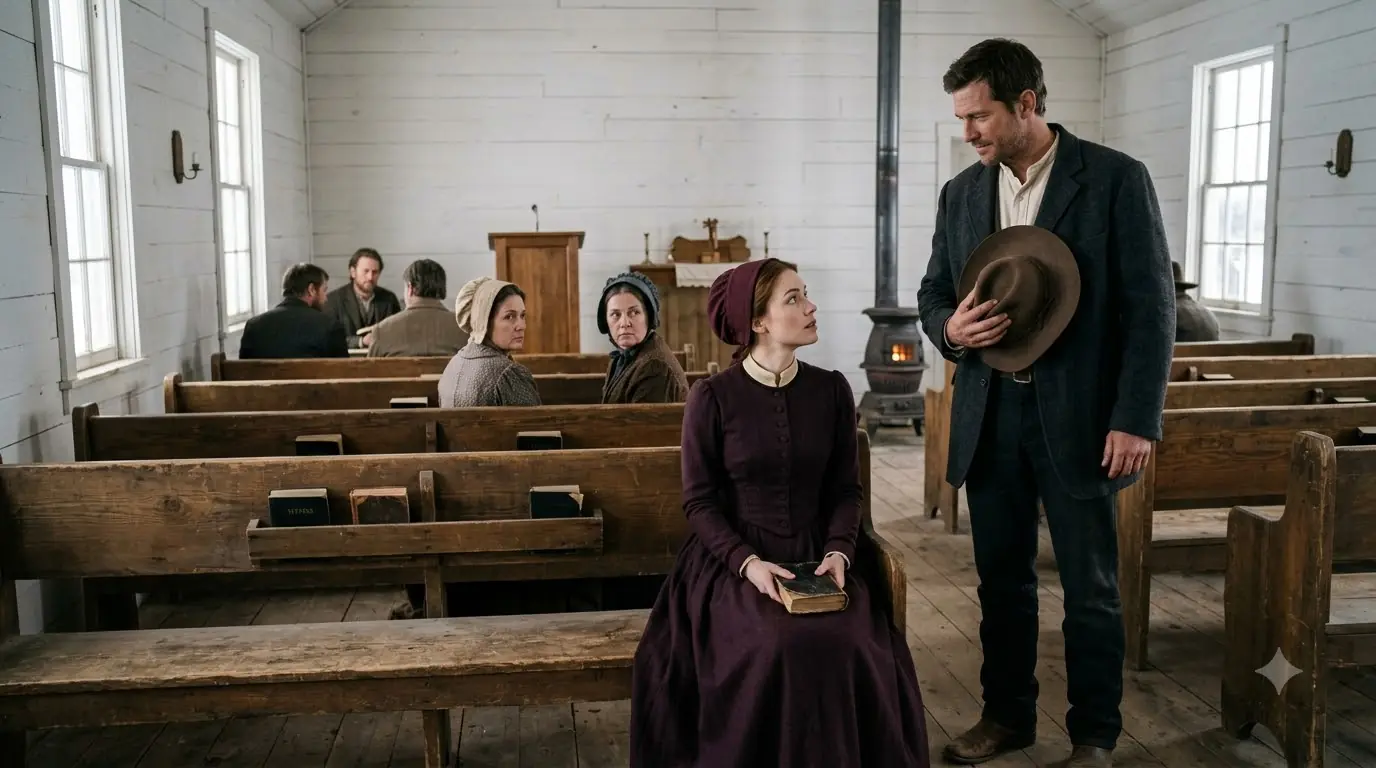
She had learned in two years of empty pew space that a stranger’s kindness was usually a mistake he had not discovered yet. She looked up anyway.
He was tall and weathered from another country, his hat already coming off his head.
Mara moved her skirt six inches, which was all the room there had ever needed to be. “There’s room,” she said. He sat.
Wesley Harrow sat near the front, his face turned toward the pulpit as though the back pew belonged to some other church entirely. Two rows up, the widow Pruitt turned to look, turned back slowly, and whispered something behind her glove to the woman beside her.
Doc Reeves sat a few rows behind Wesley, his eyes fixed on his hymnal, not turning at all. Mara kept her own eyes on the page and did not look up again until the hymn ended.
After the service, in the yard where the congregation stood in its clusters, old Henry Kessler caught the stranger’s sleeve. “You’re new, so I’ll tell you plain. That’s Wesley Harrow’s first wife. Six years married, never gave him a child. He set her aside as kindly as he could manage, but folks know why.”
The stranger settled his hat back on his head. “I know she was sitting alone.”
That was the end of it, as far as he seemed to be concerned. His name, Mara learned before the week was out, was Grant Sailor. He had bought the old Dunmore spread on the North Road, four hundred acres gone to seed under a man who had died owing everyone in three counties. The second Sunday, he sat with her again.
Grant stood on the other side of the churchyard path, his hat in both hands. “I know.”
Mara turned to face him squarely. “Then why?”
He looked once toward the church door, where two women had slowed to watch them, then back at her. “Because you were sitting alone.”
Mara looked down at the dust beside her boots. Grant let the silence hold before he turned the conversation to something that could stand in public. “I hear you keep a clean house and have a fair hand with a needle.”
Mara lifted her chin. “I hear a great many things about myself I never spoke.”
He turned his hat brim once between his hands. “This one I’d like to hire. Not here.”
She did not answer, but she did not walk away, either. Grant stepped closer to the churchyard fence, leaving the rail between them. “I bought the old Dunmore spread on the North Road. The land is good enough. The house isn’t.”
He described four bachelor hands and a dead man’s neglect, a place nearly as rough as a barn with a roof. The stove was smoke-blackened, shirts were going to rags, and the men ate badly with winter not far off. He laid a small iron key on the fence rail between them.
“I need a house made fit, Mrs. Ellis. Not gossip. Not pity. Work.”
“There’s a small cabin behind the kitchen garden,” he continued. “It locks from the inside, and the key would be yours.”
Mara looked at the key without touching it. Work, at least, could not be turned into a story about her body. A locked door was something else. A woman who had lost one house by another man’s word knew the worth of a key.
Grant kept his hand away from the key once he had set it down. “Mrs. Calder can come the first week if you want another woman at the place while things settle.”
Mara touched the key, but did not lift it yet. “I’ll want the wage in writing.”
Grant settled his hat against his chest. “Tuesday.”
Mrs. Calder had written that fall about a judge’s household two counties over that wanted a housekeeper by winter. It offered a clean slate bought with distance, but Mara had not yet answered the letter. She picked up the key instead and closed her hand around it. She started that week.
Mrs. Calder came the first Monday with her washing apron and stayed through the week, long enough for the town to grumble without calling it scandal. The cabin sat behind the kitchen garden, where the wind came softer off the hill. It held a narrow bed, a stove no larger than a wash barrel, one shelf, one chair, and a door that closed cleanly. Mara took the key from her pocket at the threshold.
Grant stayed on the path and let her open the door herself. That first night, she turned the key in the lock and stood listening to the click. It was a plain sound. It nearly undid her.
The kitchen at the Sailor place told her everything about the men who had lived in it. Bacon grease had gone rancid in a can nobody had emptied since spring. The stove drew so poorly that half the room stayed cold while the other half scorched. Four shirts had the same three buttons missing because nobody had thought to check whether the others were sound.
Mara set the stove right first, cleared the flue herself with a brush and a good deal of muttering, and had bread rising by the second day. The hired men were Otis, Beal, a boy called Sam who could not have been past seventeen, and an older man named Cully, who had worked cattle since before Mara was born. Within a week, they had taken to leaving their boots at the door. Nobody told them twice.
The floor she scrubbed made a man feel the shame of tracking it up. Mara noticed, against her own will, that Grant watched the kitchen without interrupting, seeing what changed and what still needed mending. He noticed that she never sat while the men ate. She stood at the stove with her plate in hand, eating on her feet even though nobody there had told her to.
One evening in the fourth week, Grant pulled a chair back from the table before she could carry her plate to the stove. “Sit before the work starts thinking it owns you.”
She stayed where she was, her plate balanced against her wrist. “I’m not company.”
He set the coffee pot down between two empty cups, plain as a period at the end of a sentence, and kept his hand on the handle. “I didn’t ask the work to sit.”
She sat.
Sunday pew, weekday chair, the cabin key in her pocket by day and turned in her own lock by night. It became a shape their days fell into without either of them naming it. Coffee was poured before she had to ask for it. The silence between them stopped being awkward sometime around the third week and became something closer to rest.
Cully’s granddaughter, a six-year-old girl named Elsie, came out with her father one afternoon to deliver a sack of seed potatoes. She would not leave the kitchen, trailing Mara from stove to table, fascinated by the bread dough. Elsie planted both hands in the flour Mara had set out for her. “Are you the lady who makes this house smell like Sunday?”
Mara’s hands stilled in the flour. Children were the wound itself, the thing the town’s whispering had always circled back to. Yet here was one looking up at her without a shred of that history in her round face. Mara pressed a ball of dough into the girl’s small hands and kept her voice light. “Only when the stove behaves.”
Later, out at the wagon, Elsie tugged her father’s sleeve loudly enough that Mara, latching the kitchen window, heard every word. “Papa, if everybody likes Mrs. Ellis’s bread so much, why does she sit by herself in church?”
Her father did not have an answer, or did not give one Mara could hear. Grant, coming in from the barn in time to catch the question, stopped with his hand on the doorframe and said nothing. He did not have an answer, either. Unlike the child, he understood exactly what that meant.
Three weeks later, after the last of the fall roundup was finished, Grant did what he had been putting off. He invited the neighboring men who had helped with the fence line and winter hauling to share a Sunday meal, the kind of plain hospitality a new rancher owed the men whose goodwill he would need through a hard season. A dozen men and their wives came. They ate at a table Mara had scrubbed pale, from plates washed twice, with bread she had baked that morning still warm enough to steam when cut.
The hired hands sat clean and mended and spoke like men who ate regular meals. The house, which had smelled of rancid grease and gone unswept for a week at a stretch when she first arrived, now smelled of yeast, wood smoke, and a home being kept. Everyone saw it. That was the trouble.
Mrs. Faraday, who meant no harm and did a good deal of it anyway, took Mara’s hand at the door as she was leaving. “It’s a shame a woman with such a gift for a home never had one last.”
Mara went still all the way through, holding a great deal in one place so it would not spill. She said nothing. She wore the smile she had practiced for two years. When the wagons had gone and the yard stood empty and the dishes were dried, she found herself still folding cloths that did not need folding because her hands needed something to do that was not standing still.
Grant found her there. He pulled out the chair. “Sit with me a while.”
She kept her eyes on the linens in her hands. “People will talk.”
He set the coffee pot between them. “They already do. I’d rather give them something honest to look at.”
That was the evening when what had grown between them stopped pretending it was only wages and Sunday pews.
Word came before the month was out that Wesley Harrow intended to marry again, this time to a nineteen-year-old girl from the next county. It was a good match by every measure the town used to measure such things. By the following Sunday, half the congregation knew, and Mara’s old story traveled with the news. It was freshened up and passed hand to hand like a coin everyone wanted to examine once more before it went out of circulation.
Wesley came calling on Grant that week, which surprised no one who understood what a man of his standing had to lose by leaving old talk unmanaged. He walked the yard admiring the fence line and the fattened cattle, easy as a man surveying property he still half believed he had some claim to judging. “You’ve done well by the Dunmore place,” he said. “A man in your position ought to think ahead, though. A spread this size wants sons. It wants a name to carry it.”
“I’d hate to see good land go to waste on account of a kindness that costs more than it pays,” Wesley added.
Grant kept working a knot from a length of rope without looking up. “You mean on account of Mrs. Ellis?”
Wesley shrugged easily. “I mean nothing unkind by it. I only know what I know.”
Grant set the rope down and met his eyes squarely. “Who proved she was the reason?”
Wesley’s mouth opened, then closed. After a moment, his face settled back into its usual ease. “A man knows his own household.”
Grant picked up the rope again and let the silence sit before he spoke. “You keep speaking as though a thing was proved. I haven’t heard one man prove it. I’ve only heard men say it.”
Wesley had no answer for that. He left with less ease in his step than he had arrived with, although his standing in town remained exactly where it had always sat.
The talk reached Mara sideways after that, not from Grant, who said little about the visit, but from a man at the feed store. He remarked, not unkindly, to another customer that a ranch the size of the Sailor place would want sons before long, and everyone knew Mrs. Ellis could not give a man that. Grant set his sack of grain down on the counter, unhurried. “Who proved it was her?”
The man had no answer. Nobody ever did. The story had been poured into its shape so long ago that no one thought to ask whether the mold had ever been true.
Sam repeated the feed-store story at supper, proud of his employer and too young to know when pride ought to be kept quiet. Cully let slip that Wesley had come calling. Mara found Grant alone at the corral that evening and gripped the top rail beside him. “You shouldn’t spend your standing defending me.”
“You’re new here,” she continued. “You need to trade with the neighbors and have men willing to lend a hand at branding time. I won’t be the reason you lose that before you’ve had the chance to earn it.”
Grant kept his eyes on the horses in the corral. “I’ll spend what I like defending what’s true.”
She shook her head slowly. “They’ll call you a fool.”
He set his hat down on the top rail, deliberate, and turned to face her. “Then let them say it where I can hear.”
He asked her to marry him that night in the yard, with no ring bought yet and no promise that the town would soften. He took both her hands before he spoke, as though the words needed steadying first. “I am not asking for children, Mara. I am asking for you.”
She looked toward the road that still could have carried her away. Then she looked back at the man who had kept choosing the empty seat beside her and closed her hands around his. “Then ask me again while I’m looking at you.”
Grant kept her hands in his. “Will you marry me, Mara?”
She looked at him while she answered. “Yes. I will.”
They married in December in the same church. Mara walked from the back pew with Grant beside her, not from any place of honor near the front. The front rows held more empty wood than witnesses. A few of Grant’s hired men came washed and stiff in their Sunday coats, and Mrs. Calder sat behind Mara with her gloves folded in her lap.
Several families who had praised the Sailor table found reasons to be elsewhere that morning. Cully stood as a witness, and Elsie threw dried flowers she had saved from summer because nothing else was blooming. The town did not soften. Some families that had traded eggs and milk with the Sailor place stopped coming by quietly.
A church sewing circle that had lately begun nodding Mara into the room stopped sending word. Wesley’s circle treated Grant, when they treated him at all, as a man who had made a poor bargain and ought to know it. Then winter came down hard, the kind that stops mattering who approves of whom. A blizzard in January took two of the Sailor cattle before Grant could get them under shelter.
That same week, Cully went down with a fever that kept him abed for eleven days. Mara nursed him herself, boiling broth thin enough to pass a throat too raw to swallow much, while stretching the winter stores to feed five men and herself on flour and salt pork that had to last until the roads opened. She kept the chickens alive through a cold snap that killed half of Faraday’s flock a mile away, moving them into the lean-to herself at night while Grant was out with the cattle. She mended whatever tore, which that winter was nearly everything, by lamplight after the men had gone to bed.
The cabin key now hung on a nail inside the main house door, since the whole home was hers to keep. By the second week of February, the flour was nearly gone and the grain for the stock was lower than Grant liked to admit. The nearest credit sat with men in Wesley’s circle, who ran both the mill and the feed store. They would have extended it readily enough to a Sailor who came asking properly, hat in hand.
Grant would not go. Mara found him at the kitchen table one night, the ledger open and his jaw set in a way she had come to know meant a decision already half made and disliked. He did not look up from the page. “There’s the gray stud. Elliot over in Miller’s Crossing has been asking after him since fall.”
“Good blood,” he continued. “I meant to stand him for spring breeding.”
Mara pulled out the chair across from him and sat. “And if you sell him?”
Grant closed the ledger. “We eat through March without asking Wesley’s men for a thing.”
He sold the horse two days later and told her only after it was done, with the money already spent on grain and flour hauled back from Miller’s Crossing in the wagon bed. Mara set down the shirt she was mending. “You should have told me first.”
She was not angry. The omission stung more than the loss. Grant turned his cup slowly on the table without drinking. “I didn’t want you carrying the weight of it before it was decided.”
She held his eyes across the table. “I’ll carry what’s mine to carry. That’s the bargain, isn’t it?”
He looked at her for a long moment, and something in his face agreed with her more thoroughly than words would have. It was the last time either of them decided anything of weight without saying so first. Neither named it as a rule between them. Both kept it from then on.
The worst came in the last week of February, when Sam took a kick from a spooked steer and broke two fingers and a rib. He could do no work for the better part of a month. That left four hands’ worth of labor to three men and a woman who had not yet understood why her breath came shorter in the cold. Mara took on the milking herself before dawn so Otis and Beal could be spared for the herd.
Grant found her once with one hand braced against the barn wall, catching her breath in a way that frightened him more than the blizzard had. He crossed the barn to her side. “You’ll tell me when it’s too much.”
She straightened and picked the pail back up. “I’ll tell you when it’s too much.”
It was not quite the same promise, and they both knew it. Neither pressed the point further. There was no one else to do the milking. By the time March loosened winter’s hold, they had come through it thinner and tired, but a working pair in every sense the word could hold.
It was somewhere in that exhausted quiet, after the worst of the cold broke, that Mara finally understood why her breath had been coming shorter. She was carrying a child. She sat with the knowledge for two full days before telling Grant, afraid in a way she had not let herself be afraid of anything in a long time. Six years of marriage and two years of talk since had made children the measure of everything she was and was not.
Some old, deep part of her feared what it would mean to prove them wrong only now, only like this, as though the town had been right to wait for proof before calling her worthy. When she told him, Grant did not reach for her belly. He took her hand first, plain and steady, and held it as though the child were not the first thing between them. “I married you before this. This doesn’t change what I already knew.”
It changed everything in town, though, the moment word got out, which it did within a month. Wesley had married the girl before spring planting. Now, hearing of Mara’s condition, he made a point of remarking to anyone who would listen that a woman’s failing did not always stay failed. It was his way of protecting the version of events in which the failing had been hers to begin with and not a lie built to spare him the asking.
Some people, rather than admit they had been wrong, found new ways to make the fault hers. After Wesley’s remarks reached the elders, the matter came to a head at a church meeting called to settle the talk before it split the congregation further. Wesley Harrow stood along the side wall with his new wife’s people, his gloves held in one hand. Old Doc Reeves sat near the front, his hymnal closed on his knee.
Mrs. Faraday, without unkindness this time, only a need to have the matter settled, asked him plainly whether he had ever had proof that Mara was the reason Wesley Harrow’s house stayed childless. The room went quiet before he answered because most of them already suspected the truth. Doc Reeves twisted his hat in his lap. He was an old man, and Mara understood even then that he was not cruel, only weak and ashamed of it.
Haltingly, he admitted that he had never examined her at all. Wesley had come to him with the story already finished, and Wesley was a man of standing. The easier thing, the thing that cost the doctor nothing, had been to let a rich man’s account stand unquestioned rather than ask a woman with no standing left to defend herself against it. No one accused Wesley aloud.
Every head in the room turned toward him instead, and for once his good coat did not help him. Grant stood beside Mara in front of the whole congregation that had spent two years making a study of her back. “You were willing to shame my wife when you thought her empty,” he said. “You don’t get to claim kindness now that she’s carrying.”
Mara found she did not need him to speak for her after that. She rose to her feet on her own, one hand resting where the child was, and said the thing she had wanted to say for two years but never had the room or standing to say. “I didn’t come here to prove I was fit to be a wife. I was one before any child came.”
Nobody in that room had an answer for that, either. Mrs. Faraday was the first to cross the room afterward and take her hand. It was not quite an apology, since the town was not yet in the habit of those, but it was near enough that Mara chose to accept it as one. Others were slower.
A few of Wesley’s circle never came around, and the sewing circle that had dropped Mara did not restore her that spring or the next. Grant lost, for a time, the trade of two families who found it easier to keep their custom with men who had not made a public spectacle of an old friend’s account. He never got the horse back or the breeding fees he might have earned from the gray. Some things, once spent, stay spent.
The paper Grant had written out that first autumn stayed folded in the bureau drawer after that. It remained there not because the house still needed a wage contract, but because neither of them forgot how respect had first been put in writing. Their first child was a girl. Two more daughters came in the years after.
Then twin boys arrived one stormy spring morning within a minute of each other. From the day they could crawl, the boys did little separately if they could help it. The Sailor place grew by slow measures: a wider garden, another milk cow, a smokehouse that stayed full through winter, and a kitchen table Grant had to lengthen twice. The house that had once held bachelor neglect became too full for silence.
One Sunday morning, years later, the back pew of that same church could not properly hold them all. Grant sat at one end with the youngest on his knee because there was nowhere else to put her. A hymnal dropped, was retrieved, and dropped again. One of the twins whispered something to the other that was not nearly as quiet as he believed it to be.
The eldest girl, old enough now to notice such things, leaned close to her mother during the opening hymn. “Mama, why do we always sit back here when there’s room up front, closer to the pulpit?”
Mara looked past her daughter to Grant, who had already turned as though he had known the question was coming before it was asked. She rested her hand over her daughter’s. “Because this is where your father first made room for me when there wasn’t any.”
The pew that had once held empty space on either side of her now could not hold all the life that had gathered there instead.