From across the street, it looked like a huge, tattooed man in a black leather cut had just charged into a crowd of kids outside a closed pawn shop on Route 66 in Tulsa, grabbed a seventeen-year-old by the arm, and yanked him away so hard the boy almost fell.
The boy shouted.
The crowd jumped back.
Somebody screamed, “Yo, get off him!”
Phones came up before anyone asked a question.
Mine did too.
My name is Sam Alvarez, and I owned the sandwich shop across the street from the pawn shop. Alvarez Cold Cuts had been on that corner for nineteen years, wedged between a laundromat and a check-cashing place, with a faded red awning and a bell over the door that stuck whenever the weather turned damp.
I had seen plenty from that window.
Teenagers cutting school.
Couples arguing beside the bus stop.
Men sleeping behind the dumpster when the shelter beds filled.
People laughing, crying, stealing, praying, and pretending not to need help.
I thought I knew the difference between trouble and rescue.
That afternoon taught me how wrong a man can be from thirty yards away.
It was early October, bright but windy, with dry leaves blowing along the curb and traffic humming down Route 66. I had been outside wiping mustard off my hands after fixing the sidewalk menu board, half listening to three kids argue near the closed pawn shop.
The pawn shop had been shut down for months.
Its windows were covered with dusty metal grates, and the old yellow sign still read Harlan’s Pawn & Loan, though nobody had pawned anything there since spring.
The kids gathered around it anyway.
Six of them, maybe seven.
Too young to be as hard as they were trying to look.
One boy stood slightly apart from the others.
Tall, skinny, brown-haired, white American, seventeen maybe, wearing a black hoodie with the sleeves pulled over his hands. His jaw was clenched like he wanted the world to swing first.
I noticed him because he looked angry in a quiet way.
Not loud angry.
Not showing-off angry.
The kind of angry that sits deep and waits for a reason.
Then I heard the Harley before I saw him.
That deep V-twin rumble rolled under the traffic like thunder trapped in a metal drum. It came fast, too fast for that block, then cut hard to the curb in front of the pawn shop.
The engine coughed once before dying.
The rider stepped off.
He was a big white American man in his early forties, maybe forty-three or forty-four, with a shaved head, a black beard threaded with gray, tattooed arms, heavy boots, and hands like busted hammers.
A scar cut through his left eyebrow.
His neck carried the words PRISON INK in thick black letters, like a warning label he had chosen not to hide.
His leather vest was worn at the seams. The back patch read MERCY ROAD MC. The front had grease stains, old road dust, and several small patches sewn near the chest.
One patch did not fit the man at all.
A tiny red toy wrench stitched over a name.
Eli.
I noticed it because it looked ridiculous on him.
Then he moved.
Fast.
Not drunk fast.
Not crazy fast.
Desperate fast.
He crossed three lanes of parked cars and shoved straight into the knot of teenagers at the corner. Two kids jumped back. One cursed. A girl dropped her soda.
The biker locked eyes on the boy in the black hoodie.
Then he grabbed him.
“Not you,” he said.
The boy twisted hard.
“Get your hands off me!”
The biker’s voice cracked like gravel under a boot.
“You are not doing what I did.”
Nobody understood that line.
Not then.
The crowd thought he was threatening the kid. A woman beside me whispered, “He’s going to hurt him.”
A delivery driver yelled that he had called the cops.
The boy’s friends started circling, puffed up and scared, while the biker planted himself between the teen and the corner like a wall made of leather, guilt, and engine heat.
I raised my phone.
The camera caught the worst angle.
The biker’s hand around the boy’s wrist.
The boy jerking back.
The other kids shouting.
The huge black vest.
The prison tattoo.
The fear on everyone else’s face.
It did not catch the brick in the boy’s other hand.
Not clearly.
It did not catch the older teenager near the pawn shop door whispering, “Do it, Eli. Quit being soft.”
It did not catch the way the biker’s eyes went straight to that brick before he moved.
It did not catch the fact that the boy had been seconds away from throwing it through the pawn shop window.
All my video showed was a terrifying man grabbing a teenage boy.
That was enough for the internet.
But before I posted anything, before the shouting grew into something worse, the boy finally looked at the man’s face.
Really looked.
And everything in him changed.
His mouth opened.
No sound came out.
For thirty seconds, Route 66 went quiet.
Because that was the moment the kid realized the man dragging him out of trouble was the father he had not seen in eight years.
The boy’s name was Eli Mercer.
I did not know that yet.
All I knew was that one second he was fighting like a cornered stray, and the next his whole body had gone still.
The brick slipped from his hand and hit the pavement with a dull crack.
His friends stopped shouting.
The biker loosened his grip immediately, but he did not let go completely.
Not because he wanted control.
Because Eli looked like his knees might fail.
“Dad?” the boy said.
The word barely came out.
The biker’s face broke.
That is the only way I can describe it.
Everything hard in him cracked at once, but not enough for the crowd to understand. To us, from across the street, he still looked dangerous.
To Eli, he looked like a ghost who had learned how to breathe.
“Yeah,” the biker said.
His voice dropped low.
“It’s me.”
Eli stared at him.
“You’re supposed to be gone.”
“I was.”
“You’re supposed to stay gone.”
The biker swallowed.
“I know.”
A police siren cried somewhere two blocks away.
The crowd reacted all at once.
One of the older boys near the pawn shop cursed and ran. Two others followed. The girl who dropped her soda picked it up and backed away fast.
The delivery driver pointed at the biker.
“I got you on camera, man!”
“So do I,” I muttered.
I should have stopped recording.
I did not.
The biker turned his head slightly, hearing the siren.
Then he looked back at Eli.
“You want to get cuffed on this corner?” he asked. “Because I can tell you exactly how that feels.”
Eli’s face hardened again, but the hardness was shakier now.
“You don’t get to talk to me like you know me.”
“I know where that window leads.”
“You don’t know anything.”
The biker glanced at the pawn shop.
His jaw tightened.
“I know that door. I know that glass. I know that stupid feeling in your chest when everybody’s watching and you think doing the wrong thing will finally make you feel like somebody.”
Eli’s eyes flashed.
“Shut up.”
“I know the sound a judge makes when he says eight years.”
That silenced him.
The siren grew louder.
The biker finally released Eli’s wrist and lifted both hands where everyone could see them.
“Your choice,” he said. “Run with them or walk with me.”
Eli looked down at the brick.
Then at the pawn shop.
Then at the man who had arrived like thunder and said the one sentence nobody else understood.
You are not doing what I did.
Eli stepped away from the brick.
The biker exhaled like he had been holding his breath for eight years.
The first police car pulled up moments later.
Officer Dana Ruiz stepped out, one hand near her belt, eyes moving quickly over the scene. She was a compact woman with sharp eyes and the kind of calm that told me she had seen panic turn stupid before.
“Everybody stay where you are,” she said.
The biker kept his hands raised.
“Officer,” he said. “My name is Wade Mercer. I’m not armed. I’m not resisting.”
At the name, Eli flinched.
Wade Mercer.
I did not know why it mattered yet.
Officer Ruiz looked at Eli.
“You okay?”
Eli’s throat worked.
“He didn’t hurt me.”
The delivery driver shouted, “He grabbed that kid!”
Wade did not argue.
That surprised me.
A man that big, with that many reasons to defend himself, simply stood there with his hands up and let the street think what it wanted.
Officer Ruiz looked at the brick on the ground.
Then at the pawn shop window.
Then at the scattered teenagers, most of whom had vanished in different directions.
“What happened?” she asked.
Eli stared at the ground.
Nobody answered.
I looked down at my phone.
The video was still open.
My thumb hovered near the share button.
It felt important.
It felt useful.
It felt like proof.
That is the lie a phone tells you when all you have is half the story.
Officer Ruiz took statements on the sidewalk.
Eli said little.
Wade said less.
The delivery driver talked too much.
I told her what I had seen, or what I thought I had seen. A biker arriving fast. Grabbing the boy. Shouting. The crowd reacting.
Officer Ruiz listened.
Then she looked toward my sandwich shop.
“You have cameras?”
“Yes.”
“Facing the street?”
“Yes.”
“Keep that footage.”
“I will.”
She nodded.
Then she turned back to Wade.
“You two know each other?”
Wade looked at Eli.
Eli looked away.
“He’s my son,” Wade said.
The words hit the sidewalk strangely.
Like something too heavy to fall cleanly.
Officer Ruiz looked between them, her face softening by one careful inch.
Eli muttered, “Not really.”
Wade took that without flinching.
“No,” he said quietly. “Not really.”
Officer Ruiz decided not to make an arrest that afternoon.
Maybe because the window had not been broken.
Maybe because Eli had stepped away from the brick.
Maybe because Wade stayed calm while everyone else kept talking.
Maybe because she understood what the rest of us did not.
Sometimes a man grabs a boy not to harm him, but to pull him back from the exact door that ruined his own life.
She gave Eli a warning.
She told Wade not to put hands on anyone again unless there was immediate danger.
Wade nodded.
“Yes, ma’am.”
Then she left.
The street began breathing again.
People drifted away, disappointed there was no better ending to film.
Eli stood with his hood up, face pale, eyes sharp with too many feelings fighting for the same small space.
Wade stood three feet away from him, hands open at his sides.
Neither moved.
I do not know why I spoke.
Maybe guilt had already started tapping on the inside of my ribs.
Maybe I saw the boy’s hands shaking.
Maybe I had been feeding that block too long to watch two broken people stand hungry in the wind.
“You both want to come inside?” I called.
They turned toward me.
“My shop,” I said, pointing at Alvarez Cold Cuts. “Coffee’s hot. Door’s open.”
Eli looked ready to refuse.
Wade looked ready to accept only because the boy might need it.
Finally, Eli walked first.
Wade followed, keeping distance.
That distance mattered.
At the time, I thought it was awkward.
Later, I understood it was respect.
Inside, I locked the front door halfway, flipped the sign to Closed, and turned up the heat.
Eli sat in the booth nearest the window, still watching the street like he might bolt.
Wade sat across from him but kept his hands visible on the table.
Again, I noticed that.
Both hands flat.
No sudden movements.
No reaching.
I brought coffee for Wade, hot chocolate for Eli, and two roast beef sandwiches because feeding people was easier than asking questions.
Eli stared at the hot chocolate.
“I’m not a kid.”
“I didn’t say you were,” I said. “But it’s cold out, and you look like you could use sugar.”
He did not touch it.
Wade wrapped both hands around the coffee mug.
His knuckles were scarred.
His fingers trembled slightly.
I glanced at the red toy wrench patch on his vest again.
Eli noticed me noticing.
His expression twisted.
“You still have that?”
Wade looked down.
For the first time, something like embarrassment crossed his face.
“Yeah.”
“I made that when I was eight.”
“I know.”
“It was stupid.”
“No,” Wade said softly. “It wasn’t.”
Eli looked away fast.
The silence stretched.
My phone buzzed in my pocket.
Once.
Twice.
Then again.
I had not posted the video yet, but the delivery driver had. Someone had been recording from another angle. Worse angle. Angrier angle.
The caption read: Ex-con biker attacks teenager outside Tulsa pawn shop. Cops let him walk.
I stared at it.
Wade’s face was clear.
Eli’s face was clear too.
The comments were already multiplying.
That man should be arrested.
Look at his neck tattoo.
Protect that kid.
Biker clubs are all the same.
Then a different comment appeared.
Wait. Is that Wade Mercer from Mercy Road?
Then another.
That man fixed my truck for free when my daughter was sick.
Another.
Mercy Road runs the youth garage on Peoria. They helped my nephew stay out of lockup.
Another.
That boy is Eli. Don’t talk if you don’t know.
I looked up from my phone.
Wade and Eli were staring at each other across the table.
“You said eight years,” Eli said.
Wade nodded.
“Yeah.”
“You were in prison that whole time?”
“Yes.”
“My mom said you chose to disappear.”
Wade closed his eyes.
“I did choose something. I chose wrong before I went in. That’s the truth.”
Eli’s jaw tightened.
“That’s not an answer.”
“No. It’s just where the answer starts.”
I busied myself behind the counter, pretending not to listen while hearing every word.
Wade took a breath.
“When you were nine, I robbed a pawn shop.”
Eli’s eyes flicked toward the window.
“That one?”
Wade nodded.
“It had a different owner then. Same building. Same corner.”
The boy’s face changed.
“That’s why you came.”
“That’s why I came fast.”
Eli looked down.
“I wasn’t going to do anything.”
Wade said nothing.
The silence made the lie collapse on its own.
Eli shoved the hot chocolate away.
“You don’t know what I was going to do.”
“I know what it looks like when a boy wants to prove he’s not scared.”
“Stop acting like you know me.”
Wade’s voice stayed quiet.
“I don’t know you the way I should.”
That hit harder than shouting.
Eli’s eyes flashed wet, but he blinked it away.
Wade leaned back, careful not to crowd him.
“I was twenty-six,” he said. “I was angry. Broke. Proud. Stupid. Your mom was working two shifts, and I kept telling myself I was going to fix things big.”
His mouth tightened.
“Then a man I thought was my friend told me there was fast money in that pawn shop. Said nobody would get hurt. Said we’d be in and out before anybody noticed.”
Eli stared at him.
“Did somebody get hurt?”
“No.”
The answer came fast.
Then Wade looked down.
“But that doesn’t make it clean. Fear hurts people too. A locked door hurts families. A sentence hurts a child who has to grow up explaining where his dad went.”
Eli’s hands clenched under the table.
“You never wrote.”
Wade’s face changed.
“I wrote every week.”
“No, you didn’t.”
“I did.”
“My mom never got letters.”
Wade swallowed.
“Maybe she didn’t want you to have them.”
Eli’s anger rose immediately.
“Don’t talk about her.”
“I’m not blaming her.”
“You are.”
“No,” Wade said. “I’m saying I gave her enough pain that she had the right to decide what got near you.”
Eli looked confused by that.
Maybe he had expected defense.
Maybe accusation.
Maybe anything except a man taking blame without trying to soften it.
“Your mother was a good woman,” Wade said. “Better than me by a mile.”
“She died when I was fourteen.”
“I know.”
Wade’s voice cracked.
“I was still inside.”
Eli stared at him.
“You knew?”
“My sister told me.”
“And you didn’t come.”
Wade’s jaw tightened.
“I wasn’t allowed.”
Eli laughed once, bitter and sharp.
“Convenient.”
Wade nodded slowly.
“Yeah. It sounds that way.”
“It is that way.”
“No,” Wade said. “It’s worse.”
Eli looked at him.
“Worse?”
“Because even if they had let me come, I wouldn’t have known how to stand in front of you. I had spent years practicing regret but not courage.”
The boy went still.
Wade rubbed his thumb along the coffee mug.
“When I got out, I came looking. Your aunt said you didn’t want to see me. She said you had already lost enough.”
Eli looked away.
“Aunt Sharon hates you.”
“She has reason.”
“You always say that?”
“When it’s true.”
Outside, a truck rolled past slowly, tires hissing over the street.
Inside, the old refrigerator hummed behind me.
Eli finally took the hot chocolate and drank.
A tiny thing.
But Wade saw it.
His shoulders lowered half an inch.
My phone buzzed again.
The video had spread across two local pages now.
The comments were turning ugly.
Someone had circled Wade’s neck tattoo in a screenshot.
Someone had posted Mercy Road MC’s garage address.
Someone wrote: Keep this man away from kids.
I felt sick.
I had not posted the video, but I had recorded. I had been ready to join the chorus.
And I had security footage.
Maybe the only footage that showed the brick, the older boys, the delivery truck, and Wade pulling Eli back before the window shattered and the police arrived.
I went to the back office.
My security system was old but reliable. I pulled up the feed from the camera above the awning.
There it was.
The whole thing.
Eli with the brick.
The older kid urging him on.
The delivery truck nearly clipping the curb.
Wade arriving, seeing both the brick and the boy, moving like a man who had run this nightmare in his head for years.
He grabbed Eli’s wrist.
He pulled him back.
The brick fell.
The pawn shop window stayed whole.
The boy stayed free.
I saved the clip to my computer.
Then I stood there for a long moment, staring at the screen.
It is a strange feeling, realizing the truth was available if you had only waited before deciding.
When I returned to the dining area, Wade was standing.
Eli was too.
The boy looked like he wanted to leave but did not know where to go.
“You need a ride?” Wade asked.
Eli scoffed.
“With you?”
“No. I can call Mercy Road. One of the women can take you if that feels better. Ruthie, maybe.”
Eli blinked.
“Ruthie still rides?”
Wade’s expression softened.
“Ruthie will ride after the rest of us are buried.”
For the first time, Eli almost smiled.
Almost.
Then the shop door rattled.
A woman burst in without waiting for me to unlock it fully.
She was late fifties, short, broad, gray-haired, wearing motorcycle boots and a purple Mercy Road hoodie under a leather vest. Her eyes went straight to Eli.
“Lord God,” she whispered.
Eli looked at her.
“Ruthie?”
She crossed the shop and stopped just short of touching him.
“You got tall.”
He tried to laugh, but it turned into something broken.
“You got old.”
“Still mean, though.”
That did it.
Eli’s face crumpled.
Ruthie opened her arms, and he stepped into them like a child who had been waiting years to be allowed.
Wade turned toward the window.
He did not intrude.
He stood there with his jaw locked and his eyes shining, letting someone else hold his son because he had not yet earned that right.
That was when I understood something about love I had missed from across the street.
Sometimes love is not grabbing.
Sometimes it is letting go after you have pulled someone away from danger.
Ruthie took Eli to the garage that evening.
Wade followed on his bike, far enough behind that Eli did not have to feel chased.
Before they left, I stepped outside with my phone in my hand.
“Wade,” I said.
He turned.
“I have security footage,” I told him. “It shows the whole thing.”
He nodded once.
“Good.”
“I can post it. Clear it up.”
He looked tired.
“Ask Eli first.”
That surprised me.
“He’s a minor.”
“He’s a person.”
I looked toward the car where Eli sat in the passenger seat, staring straight ahead while Ruthie adjusted the heater.
“Right,” I said quietly. “I’ll ask.”
Wade put on his helmet.
Then paused.
“People love a monster,” he said. “Makes them feel clean.”
He started the engine before I could answer.
The next morning, my shop phone rang before we opened.
Then my cell.
Then the business line again.
People had found us through the video.
Some asked if I had seen what happened.
Some wanted to know whether the biker came inside.
One woman told me I should be ashamed for serving criminals.
Another asked if the boy was safe.
The internet had done what it always does.
It had taken thirty seconds, sharpened it into a weapon, and passed it around until everyone felt righteous holding it.
At ten, Ruthie came in.
Alone.
She ordered black coffee and a turkey melt.
Then she sat in the corner booth like she owned it.
“You got the footage?” she asked.
“Yes.”
“You show it to Eli?”
“I wanted permission.”
She studied me.
“You learn quick.”
“Not quick enough.”
“No one does.”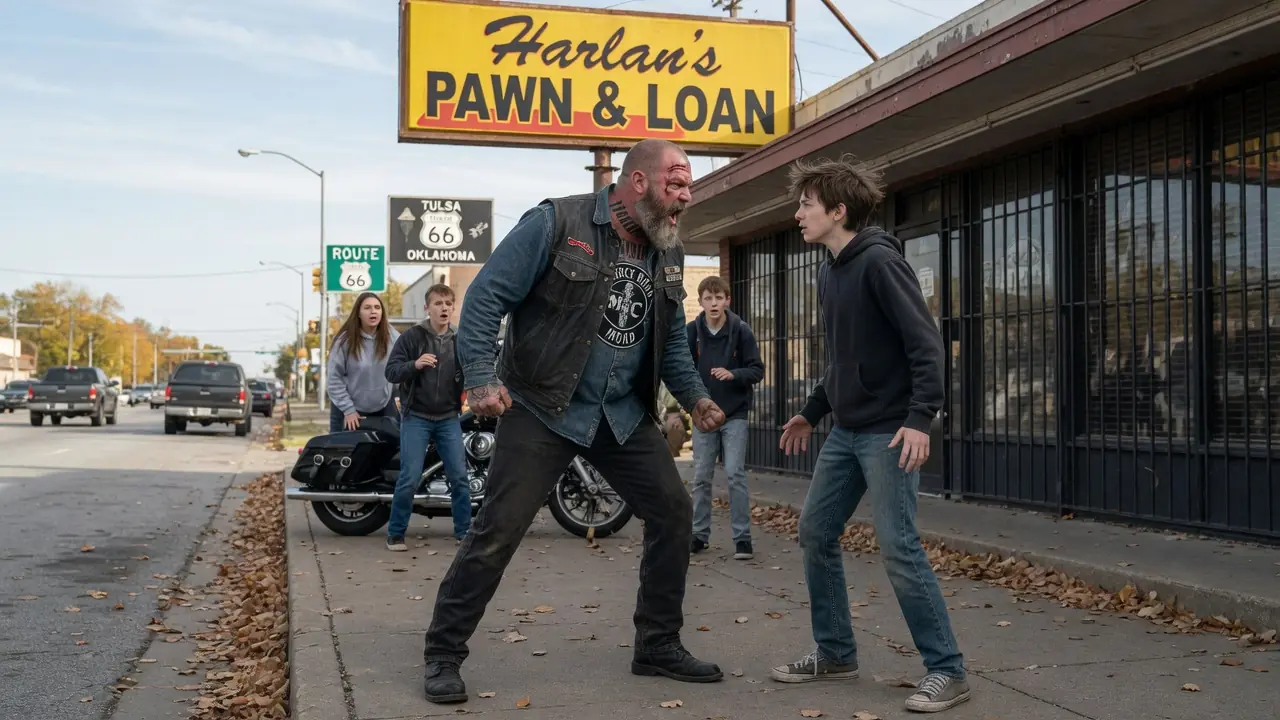
She sipped her coffee.
“Eli says post it. Blur his face if you can.”
“I can.”
“And say what happened. Plain.”
I nodded.
“How is he?”
Ruthie looked out the window toward the pawn shop.
“Seventeen.”
That was answer enough.
I blurred Eli’s face as best I could.
Then I posted the security footage from the sandwich shop account with a written explanation.
The man in the video is Wade Mercer of Mercy Road MC. The teenager is his son, Eli. The short clip circulating online does not show the full situation. The security footage shows Eli holding a brick outside Harlan’s Pawn, another youth pressuring him, and a delivery truck passing dangerously close. Wade pulled Eli back before he broke the window and before the situation became much worse. I was present and initially misunderstood what I saw. Please stop sharing the misleading clip.
I posted it.
Then I watched the correction travel slower than the lie.
Some people apologized.
Some deleted their comments.
Some said it did not matter because Wade still looked dangerous.
Some said once a convict, always a convict.
Then the Mercy Road comments came.
That man fixed my furnace.
That man kept my brother sober.
That man sat outside court with my nephew.
That man gives jobs to guys nobody else hires.
That man did time, came home, and spent every day making sure other boys don’t follow him.
By noon, a local reporter called.
By three, Wade’s garage had people leaving both hate and support.
By evening, someone started a page called Hands Before Judgment, using the still from my security footage where Wade’s hand pulled Eli back from the curb.
The image made me uncomfortable.
It was too neat.
Too easy.
Wade was not a symbol.
Eli was not a lesson.
They were a father and son standing in the wreckage of choices made long before the internet found them.
That night, I drove to the Mercy Road garage.
The clubhouse sat behind an old auto shop off Admiral Place, beneath a corrugated metal roof patched in three colors. Motorcycles lined the side wall. A basketball hoop hung crooked near the alley.
Inside, the place smelled like oil, leather, coffee, floor cleaner, and chili.
A dozen people looked up when I entered.
Conversation slowed.
Ruthie appeared from behind a shelf carrying a stack of paper plates.
“You the sandwich man?” she asked.
“Yes.”
“You brought food?”
“I brought apology sandwiches.”
She looked at the bag.
“Better than words.”
A few men laughed.
Wade sat near a workbench, cleaning tools that already looked clean.
Eli sat at the far end of the room with a plate in front of him. He had not eaten much.
I walked over slowly.
“Eli,” I said, “I’m sorry.”
He did not look at me.
“For filming?” he asked.
“For thinking I understood what I was seeing.”
That made him glance up.
His eyes were red, not from crying right then, but from the exhaustion after it.
“You posted the real video,” he said.
“Only after I almost helped the wrong one spread.”
He shrugged.
Teenagers can make forgiveness look like boredom when it is really self-protection.
“Whatever.”
I accepted it.
Wade set down a wrench.
“Don’t make him carry your guilt.”
The words were not cruel.
They were instruction.
I nodded.
“You’re right.”
Ruthie shoved a paper plate into my hand.
“Eat. Then if you still feel sorry, help stack those donated coats.”
So I did.
That was my first lesson in Mercy Road justice.
Guilt was allowed.
Drama was not.
Usefulness mattered more than tears.
Over the next few weeks, I learned who Wade Mercer really was.
Not from him.
From everyone else.
Wade had grown up four blocks from that pawn shop. His father left early. His mother cleaned motel rooms until her hands swelled. Wade learned engines from a neighbor and anger from everywhere else.
At twenty-six, with a wife, a son, debt, and pride bigger than sense, he decided one bad night could solve everything.
It did not.
The robbery was clumsy.
The police caught him within hours.
Nobody was physically hurt, but Wade never used that as a defense. He said fear counted. He said the old owner’s wife had cried so hard in court that he still heard it sometimes.
He took a plea.
Eight years.
Eli was nine.
Before Wade went away, Eli gave him a plastic red toy wrench from a play set. Wade had once promised to teach him to fix engines, and Eli said, “Take this so you remember.”
Wade carried it into intake until officers made him surrender it.
Years later, in prison, he traded favors for a scrap of red fabric and stitched the toy wrench patch himself.
It was crooked.
Childish.
Almost silly.
He sewed Eli’s name under it and kept it inside his vest after release.
He could not keep the toy.
So he kept the promise in the only way he could.
In prison, Wade learned mechanics properly.
He got sober.
He joined a program for men trying not to return.
After release, he helped build Mercy Road MC with three other former inmates and one retired counselor who believed men needed structure after prison more than slogans.
They repaired motorcycles.
Then cars.
Then lives, accidentally at first.
A kid came asking for work.
Then another.
A mother came asking if they could talk sense into her son.
A judge asked if their garage could take two boys for community service.
Mercy Road became the place angry young men got sent when nobody knew what else to do with them.
Wade never preached.
Despite Ruthie’s jokes, he was bad at speeches.
He just handed boys tools and said, “Fix what you can reach.”
Eli had no idea.
To him, Wade was a missing father with a prison sentence and a tattoo.
He did not know about the letters.
He did not know about the program.
He did not know Wade had gone to every school event he could stand outside without being asked to leave.
He did not know Wade once sat in his truck across from Eli’s middle school graduation and cried because he was not allowed inside.
Some absence is chosen.
Some absence is punishment that keeps echoing after the sentence ends.
Eli still had the right to be angry.
That was what Wade kept saying whenever anyone defended him too hard.
“He gets to hate me,” Wade told Ruthie one night when I was stacking coats in the corner.
Ruthie snorted.
“He gets to be mad. Hate will rot him.”
“Then I’ll stand far enough away that he can spit it out when he’s ready.”
That was how Wade loved his son.
Not cleanly.
Not easily.
But with discipline.
Eli stayed around the garage because Ruthie gave him no graceful way to leave.
She put him to work sorting donated tools, then cleaning spark plugs, then checking tire pressure on an old pickup Mercy Road was fixing for a widow.
At first, he acted bored.
Then annoyed.
Then interested despite himself.
The first time Wade tried to show him how to loosen a rusted bolt without stripping it, Eli snapped, “I know how to do it.”
Wade stepped back immediately.
“All right.”
Eli struggled for five minutes.
Then eight.
Then twelve.
Finally, without looking at him, he muttered, “What was the thing you were going to say?”
Wade handed him a different wrench.
“Use steady pressure. Don’t fight the metal. Persuade it.”
Eli scoffed.
“Sounds stupid.”
“It works.”
It did.
The bolt gave.
Eli stared at it.
Wade smiled, small and careful.
Eli looked away, but not before I saw the corner of his mouth move.
That was how healing started.
Not with hugs.
With a rusted bolt.
The internet faded, as it always does.
People moved on to the next outrage, the next clip, the next stranger to punish from a distance.
But Eli and Wade had to live after the comments stopped.
Eli still had court diversion paperwork because Officer Ruiz had documented the brick. Mercy Road helped him get into a youth accountability program instead of formal charges.
Wade attended the first meeting but sat in the back.
Eli did not speak to him in the hallway afterward.
Wade still waited until Ruthie drove the boy home.
Aunt Sharon came to the garage once.
She was Eli’s mother’s sister, the woman who had raised him after Heather died. She arrived in scrubs after a twelve-hour hospital shift, looking exhausted and defensive.
Wade stood when she walked in.
She crossed her arms.
“I don’t forgive you.”
Wade nodded.
“I know.”
“I’m not here for you.”
“I figured.”
“I’m here because Eli slept six hours last night for the first time in weeks.”
Wade’s face changed.
Sharon looked away quickly.
“He talks about the garage.”
Wade said nothing.
“He asked about his mother yesterday,” she continued. “Not angry. Just asked.”
Wade swallowed.
“That’s good.”
Sharon’s eyes filled, but she blinked it back.
“Don’t make me regret letting this happen.”
“I won’t.”
“You don’t know that.”
“No,” Wade said. “But I’ll spend the rest of my life trying not to.”
Sharon stared at him for a long time.
Then she nodded once and left.
I watched from near the coffee pot, pretending I had not heard.
Ruthie caught me listening and threw a rag at my head.
“Stack cups if you’re gonna eavesdrop.”
Three months after the pawn shop incident, Mercy Road hosted an open garage day.
They called it Second Turn.
Wade hated the name.
Ruthie chose it anyway.
The idea was simple: teenagers, parents, former inmates, social workers, mechanics, and neighbors could come by, eat hot dogs, learn basic car maintenance, and sign up for after-school training.
I donated sandwiches.
My wife said I was overcompensating.
She was right.
But overcompensating is sometimes just the first honest step toward repair.
The old pawn shop owner’s son came too.
That surprised everyone.
His name was Harold Harlan Jr., and he had inherited the building after his father died. He had kept it closed because he could not decide whether to sell it or reopen.
He stood outside the garage for ten minutes before Wade saw him.
The room went quiet.
Wade walked over slowly.
“Mr. Harlan.”
Harold looked older than Wade, though probably not by much.
“I heard about your boy,” Harold said.
Wade’s jaw tightened.
“Yes, sir.”
“Heard you stopped him.”
“Yes, sir.”
Harold looked toward Eli, who was showing a younger kid how to check oil.
“My father was afraid after that night,” Harold said. “Did you know that?”
Wade closed his eyes briefly.
“Yes.”
“He stopped trusting people.”
“I know.”
Harold’s voice was not cruel.
Just heavy.
“I hated you for a long time.”
Wade nodded.
“I earned it.”
Harold looked around the garage.
Then at the Mercy Road banner.
Then back at Wade.
“My father also believed a man could become more than the worst thing he did.”
Wade’s eyes opened.
Harold reached into his jacket pocket and pulled out a small envelope.
“The pawn shop building is sitting empty,” he said. “I don’t want to reopen it. Too many memories. But if your group wants to use it for youth training, I’ll lease it cheap.”
Wade stared at him.
Ruthie whispered, “Holy mercy.”
Harold held out the envelope.
“Don’t make me regret it.”
Wade took it with both hands.
“I won’t.”
The room remained quiet.
Then Eli stepped forward.
He had heard enough.
“That’s the place?” he asked Wade.
Wade turned.
“Yes.”
“The place you robbed?”
“Yes.”
Eli looked at the envelope.
Then at the garage.
Then at the street beyond.
“What would we make it?”
Wade’s voice was rough.
“I don’t know. Maybe a classroom. Tool library. Somewhere kids can come after school.”
Eli looked toward the old Route 66 block.
“The window’s still cracked on the side.”
Wade nodded.
“Yeah.”
Eli shoved his hands into his hoodie pockets.
“We should fix that first.”
Nobody spoke for a moment.
Then Ruthie muttered, “Well, hell. Somebody write that down before men start pretending they planned it.”
People laughed.
Wade did not.
He was looking at his son with the expression of a man watching a locked door open from the inside.
The old pawn shop became the Mercy Road Youth Garage six months later.
The same window Eli had nearly broken was repaired first.
He helped install the glass.
Wade stood beside him, holding the frame steady.
Neither of them said much while they worked.
At one point, Eli reached for the wrong tool.
Wade handed him the right one without comment.
Eli took it.
Their fingers brushed.
Neither pulled away quickly.
It was not forgiveness.
Not yet.
But it was contact without anger.
For them, that was a beginning.
The opening day drew half the neighborhood.
Officer Ruiz came.
Harold Harlan came.
Aunt Sharon came.
Kids from the diversion program came.
Even the delivery driver who had posted the first viral video showed up, though he stayed near the back looking uncomfortable.
I was there too, setting trays of sandwiches on a folding table beneath a banner that read: Fix What You Can Reach.
Wade stood near the entrance, looking like he would rather rebuild an engine blindfolded than give a speech.
Ruthie shoved him forward.
“Talk, Prison Neck.”
He glared at her.
She smiled sweetly.
He cleared his throat.
“I did eight years because I thought one wrong night could solve a hard life,” he said.
The crowd quieted.
“It didn’t. It made my life harder. Made my wife’s life harder. Made my son’s life harder.”
Eli stood near the repaired window, staring at the floor.
Wade continued.
“This building used to be proof of the worst thing I ever did. Then, one afternoon, my son almost made it proof of the worst thing he ever did.”
His voice cracked.
“He didn’t. Not because of me only. Because a lot of people stepped in after. Officer Ruiz. Ruthie. Sharon. Sam. Harold. Mercy Road.”
He looked at Eli.
“And because he chose to step back.”
Eli’s jaw tightened.
Wade swallowed.
“This place is for that moment. The step back. The second turn. The chance before the glass breaks.”
Silence held for a second.
Then applause rose.
Not loud at first.
Then stronger.
Wade stepped away quickly, embarrassed.
But Eli moved.
He walked to the front before anyone expected it.
Ruthie’s eyebrows shot up.
The boy stood beside his father, hands in his hoodie pocket, face pale but determined.
“I was going to throw the brick,” Eli said.
The room went still again.
“I told people I wasn’t. But I was.”
Wade lowered his head.
Eli looked at the repaired window.
“My friends said it would prove something. I don’t even know what. That I wasn’t scared. That I wasn’t soft. That I didn’t care.”
He laughed bitterly.
“I cared. That was the whole problem.”
His voice trembled.
“I cared that my mom died. I cared that my dad was gone. I cared that everybody looked at me like I was one bad day away from becoming him.”
He glanced at Wade.
“And I hated him because I thought if I hated him hard enough, maybe I wouldn’t miss him.”
Wade covered his mouth with one hand.
Eli kept going.
“When he grabbed me, I thought he was trying to control me. Then I saw his face.”
He swallowed.
“He was scared. Not of me. For me.”
The room was silent enough to hear the soda cooler hum.
Eli looked at the crowd.
“So yeah, he yelled. Yeah, he grabbed my wrist. But he didn’t drag me into trouble. He dragged me out of it.”
He turned to Wade.
“I’m still mad.”
Wade nodded.
“I know.”
“I still don’t know how to do this.”
“Me neither.”
Eli took a breath.
“But I’ll come on Saturdays.”
Wade’s face broke again, just like it had on Route 66.
Only this time, nobody mistook it for rage.
The applause that followed shook the old pawn shop walls.
I stood near the sandwich trays with tears in my eyes, thinking about how close I had come to helping the world punish the wrong part of the story.
A year later, the Mercy Road Youth Garage was open four days a week.
Kids came after school to learn oil changes, brake pads, tire repair, basic welding, and how to stay in a room long enough for anger to cool.
Eli became one of the best students.
Not because he was naturally patient.
He was not.
But because he understood what impatience could cost.
He and Wade were not magically healed.
That would be a lie.
They argued.
They went quiet.
They stepped around old pain.
Some weeks Eli called him Dad.
Some weeks he called him Wade.
Wade accepted both.
Every Saturday morning, they worked on an old red pickup Harold donated to the program. The truck barely ran at first. Its seats were torn, paint faded, engine stubborn.
Eli wanted to restore it.
Wade said it would take time.
Eli said, “Good.”
The red toy wrench patch remained inside Wade’s vest.
One day, I saw Eli touch it.
Just once.
They were standing near the truck, both covered in grease.
Eli lifted the edge of the vest and looked at the crooked patch with his name under it.
“You really kept it all this time?”
Wade nodded.
“Yeah.”
“It still looks stupid.”
Wade smiled.
“Yeah.”
Eli let the vest fall.
Then he handed Wade a real wrench.
“Here.”
Wade took it.
“Thanks.”
That was all.
But sometimes all is enough.
As for me, I still own the sandwich shop across from the old pawn shop.
Only now the view is different.
The building that once looked dead glows with lights in the afternoon. Teenagers lean over engines instead of street corners. Mercy Road bikes line the curb, and Ruthie yells at grown men like they are misbehaving schoolchildren.
The internet forgot about that day.
Of course it did.
The world always moves on from the people it nearly destroys.
But I did not forget.
I still have the first video on my phone, though I never posted it.
Sometimes I watch the first three seconds, just to remind myself how convincing a lie can look when it is made of truth cut too short.
A biker grabs a boy.
A boy shouts.
A crowd panics.
Phones rise.
That is not the story.
The story is eight years in prison.
A red toy wrench.
A dead mother.
A boy with a brick.
A father who knew exactly where that road ended.
A hand around a wrist, holding on like a lifeline.
I thought I was watching a dangerous man hurt a teenager.
I was really watching a father drag his son away from the edge of his own past.
And if there is one thing I learned on Route 66 that day, it is this.
A camera can catch the moment a hand closes.
But it cannot always tell you whether that hand is there to harm someone, or to keep them from falling.