“You’ve got seven hours, boy. Fix it, or I burn this place to the ground.”
The man who said it was not bluffing.
Caleb Ward knew that before the last word even settled in the air.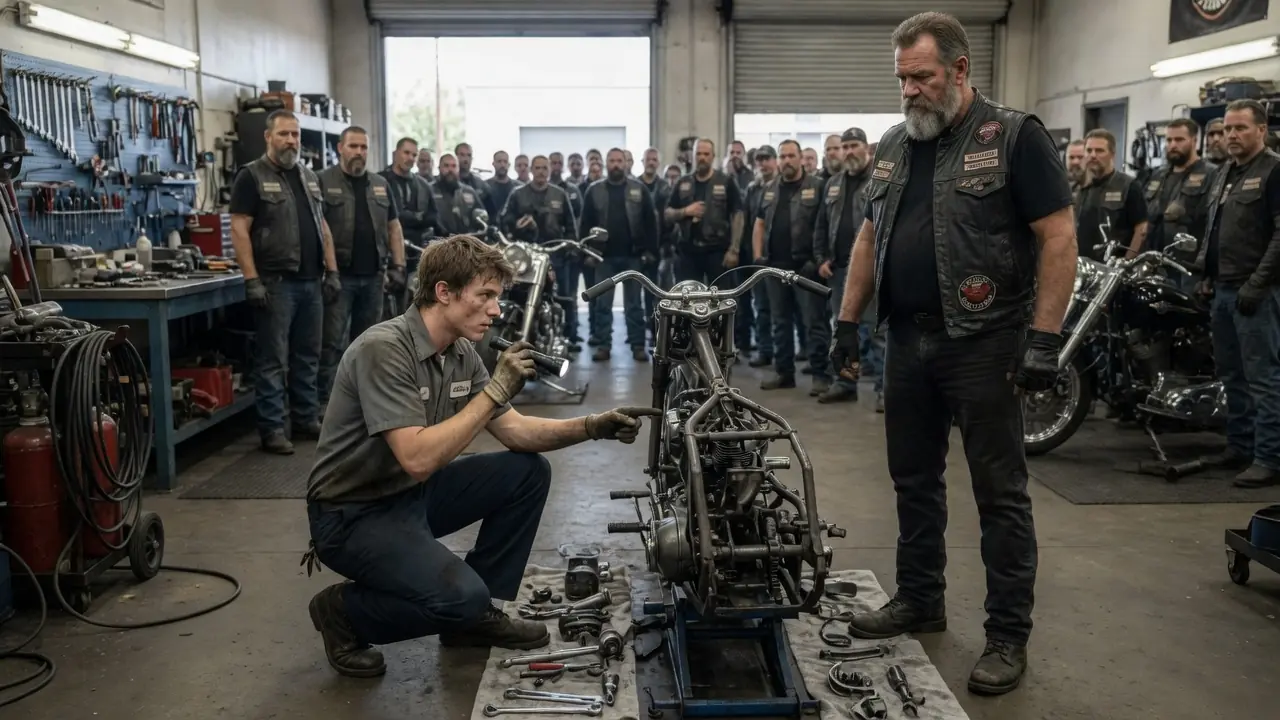
Some men threatened because they wanted to sound dangerous. Some men raised their voices because they needed the room to believe they were powerful. Silas “Grip” Henderson did neither. He spoke low, almost calmly, and that was what made every word feel heavier.
Grip stood six-foot-four, 260 pounds of controlled fury, in black riding boots and a leather cut that looked like it had been through years of heat, storms, and roads most people would never dare ride.
The patch on his back told the world who he rode with, but the Sergeant-at-Arms rocker beneath it told the people who understood such things that this was not a man who stood near power.
He enforced it.
Behind him, eight motorcycles sat in Caleb’s cracked parking lot beneath the rising Central Valley sun. Their chrome caught the light in sharp flashes. Their engines had been killed one by one, but the silence they left behind still seemed to vibrate inside the walls of Ward’s Garage.
And on the trailer behind the last bike sat a 1947 Harley-Davidson Knucklehead.
Even before Caleb touched it, he knew something was wrong.
The morning had started like every other morning at Ward’s Garage, which meant it started too early, too cold, and with coffee that tasted like regret.
Caleb had opened the shop at 6:40 a.m., the same way his uncle Raymond used to do. He unlocked the office first, flipped on the humming light above the desk, checked the appointment notebook, then walked through the bay counting problems.
Bay One had a 2004 Harley Sportster that needed a clutch adjustment and a brake bleed.
Bay Two had a half-disassembled Yamaha that belonged to a college kid who had promised to bring the rest of the money last Friday and had not shown up since.
Bay Three was empty but needed sweeping.
Bay Four was not technically a bay anymore, just a place where things got stacked because the lift had been unreliable since February.
The rent was due in eleven days.
The parts supplier had called twice that week.
The electric bill sat under a coffee mug on Raymond’s old desk like paper could disappear if Caleb stopped looking at it.
Caleb Ward was nineteen years old, technically the owner of Ward’s Garage, and practically the only employee. He had inherited the keys, the debt, the tools, the reputation, and the silence that filled the place after Raymond died.
His uncle had built Ward’s Garage over thirty years.
Every dent in the concrete floor had a story. Every tool on the pegboard had a place. Every customer who walked in had either known Raymond personally or knew someone whose bike Raymond had saved.
Raymond Ward had been the best frame man in the valley.
People said that like a fact, not a compliment.
He was the kind of mechanic other mechanics called when they ran out of guesses. The kind of man who could stand beside a motorcycle, tilt his head, listen to the idle for ten seconds, and tell you what was wrong before opening the toolbox.
He had raised Caleb more than anyone else had.
Caleb’s father had drifted out of his life before Caleb was old enough to remember the exact sound of his voice. His mother loved him, but life had bent her early, and working double shifts at a care facility in Fresno left her too exhausted to teach a boy how to become a man.
Raymond had done that.
At eleven, Caleb learned how to hold a wrench properly.
At twelve, he learned how to read a service manual without pretending he already understood it.
At thirteen, he learned the difference between fixing something and hiding a problem long enough to collect payment.
At fifteen, Raymond let him weld for the first time, then made him grind it off and do it again because “almost strong enough” was a phrase that had no business near a motorcycle frame.
At eighteen, Caleb was doing work that grown men trusted.
At nineteen, Raymond was dead, and Ward’s Garage was his.
The shop was still breathing, but barely.
Caleb was underneath the Sportster at 7:15 that morning, tightening a clutch cable and trying not to think about the rent, when he heard thunder.
Not weather.
Engines.
Not one motorcycle.
A line of them.
A convoy.
He froze under the bike, wrench in his hand, and listened.
The sound rolled toward the shop from the county road, deep and heavy, the kind of sound you did not just hear in your ears. You felt it in your chest. You felt it in your teeth. You felt it in the glass of the old office window.
Caleb slid out from under the Sportster and stood slowly.
Through the open bay door, he counted.
One bike.
Two.
Five.
Eight.
They pulled into the lot like a slow tide of steel and leather. No one rushed. No one revved for show. The riders entered as if the parking lot had been waiting for them all morning and knew better than to object.
Then the engines cut, one after another.
The silence that followed was worse.
Caleb wiped his hands on a rag that was already too dirty to help.
The last rider remained seated for a moment after everyone else dismounted. He was on a black Road King with wide bars, heavy bags, and not a single unnecessary decoration. Then he swung one leg over and stood.
Silas Henderson.
Grip.
Caleb had never met him, but he had heard the name.
Most people in the Central Valley motorcycle world had.
Grip was not famous in the way public men were famous. His name did not float through newspapers or social media. His reputation moved in garages, clubhouses, late-night phone calls, and the pauses that came after someone said, “You don’t want Grip involved.”
He walked across the lot and stopped three feet from Caleb.
Close enough to make Caleb look up a little.
Caleb suspected that was intentional.
“You Ward?” Grip asked.
His voice was low. It did not need volume.
“Caleb Ward.”
Grip looked at his face, then at his hands, then past him into the shop.
“Raymond Ward’s nephew.”
“That’s right.”
“Heard Raymond was the best frame man in the valley.”
The words hit Caleb in a place that was still tender.
People kept saying was.
Raymond was.
Raymond used to be.
Raymond could have.
Eight months had passed, and Caleb still sometimes expected his uncle to come through the office door holding a coffee and complaining about customers who thought YouTube made them mechanics.
“How long you been turning wrenches?”
“Since I was eleven.”
Grip nodded once.
“Eight years.”
He turned slightly and gestured toward the trailer at the rear of the convoy.
Two younger riders moved immediately, their nervous energy almost visible. They unlatched the trailer ramp and began rolling down the motorcycle strapped inside.
Caleb’s breath caught despite himself.
A 1947 Harley-Davidson Knucklehead.
Original lines. Old paint. Real wear. Not some showroom restoration polished into lifelessness, but a motorcycle that had lived for decades. The tank still wore deep, aged paint that time had softened but not erased. The engine cases looked original. The frame had the dark, honest character of old steel that had seen heat, rain, road grime, and thousands of miles.
It was beautiful.
It was also wrong.
Caleb could not name it yet, but the bike sat wrong.
A mechanic learns a kind of second sight after enough years. Not magic. Not instinct exactly. More like pattern recognition so deep it happens before language.
The knucklehead did not look broken in an obvious way.
It looked slightly dishonest.
“That’s a forty-seven,” Caleb said.
“Yes, it is.”
“Where has it been?”
Grip’s jaw shifted once.
“Five shops. San Jose. Fresno. Bakersfield. Sacramento. Modesto.”
He paused.
“Five shops in four months.”
Caleb looked at the bike.
“What did they say?”
“Too far gone. Strange tracking. Frame fatigue. Steering problem. Old steel. Bad history. They all had different words for the same answer.”
Grip stepped closer.
“They couldn’t fix it.”
A thick-necked rider with gray in his beard stood near the parked bikes with his arms crossed. He watched Caleb as if waiting for him to say the wrong thing.
Grip continued.
“One of them said it wasn’t worth fixing.”
The silence after that sentence was not empty. It was loaded.
Caleb understood then that this was not just a motorcycle.
It meant something.
Maybe to Grip.
Maybe to someone dead.
Maybe to the club.
Maybe all three.
“I’m sorry,” Caleb said.
Grip’s eyes sharpened.
“I don’t need sorry. I need someone who can work.”
Caleb nodded once.
“Raymond told Iron Jack you were the best he ever trained,” Grip said. “Iron Jack told me that is the only reason I’m standing in your lot instead of someone else’s.”
Iron Jack.
Caleb had heard that name once before, years ago, when Raymond was speaking on the shop phone in a voice that told Caleb not to ask questions. Iron Jack Crowley was spoken of in the valley the way old mountains were spoken of. Not loud, but permanent.
Grip let the name sit for a moment.
Then he said, “You’ve got seven hours. If it rides clean by three this afternoon, we talk about the rest of the business.”
“And if it doesn’t?” Caleb asked.
He needed to hear it.
Grip looked at him without expression.
“You don’t want to find out.”
The gray-bearded rider near the bikes made a sound that was not quite a laugh.
Caleb looked at the knucklehead.
He thought about the bills on Raymond’s desk.
He thought about the rent due in eleven days.
He thought about the sign above the bay door that still said Ward’s Garage, established 1991, and how it felt like a living thing he had been failing to keep alive.
He thought about Raymond, who had never turned away a motorcycle that could be saved.
“Get it off the trailer,” Caleb said. “And everybody who doesn’t have a tool in his hand stays outside the bay.”
For a second, nobody moved.
Then Grip nodded.
“Do what he said.”
The knucklehead rolled into the bay at 7:42 a.m.
Caleb did not touch it right away.
He walked around it once.
Then again.
Raymond had taught him that.
Don’t touch it until your eyes have done their job. Your hands will tell you what your eyes missed, but only after your eyes have looked honestly.
Grip stood just outside the bay with his arms crossed. Two other riders stayed near the door. They did not hide the fact that they were watching.
Caleb made a decision.
He would pretend they were not there.
Not because he was fearless. His heart was running too fast, his mouth was dry, and his stomach felt like it had folded itself into something tight and useless.
But an audience never made a diagnosis better.
It only made the mechanic want to prove something.
And proving something was not the job.
Finding the truth was.
Caleb crouched near the front of the bike and examined the steering head. He looked at the welds, the geometry, the old steel around the junction. He stood, moved to the rear frame rails, crouched again, then checked both sides.
Something was wrong.
Not obvious.
Worse than obvious.
He picked up a clean rag and wiped the areas around the joints. Not because they were dirty, but because it gave his hands a reason to be there without telling everyone in the room what he was seeing.
The welds looked wrong in a way only a trained eye would catch.
From a distance, they looked acceptable. Not beautiful. Not Raymond-level. But passable. The sort of repair an average shop might look at and say, “Old bike. Old work. Nothing surprising.”
But close up, under angled light, the story changed.
The outer bead looked like strength.
The underlying work felt like deception.
Cosmetic strength over structural weakness.
Someone had not merely failed to repair this frame.
Someone had made it appear repaired while leaving the danger hidden where only the wrong moment would reveal it.
At road speed.
In a hard lean.
Under load.
Caleb stood.
He needed time to think.
He got seven seconds.
“Well?” Grip said.
Caleb turned.
“I need to ride it.”
Grip’s expression did not change, but the air did.
“Nobody rides that bike but me.”
“I need to feel how it tracks.”
“You see something?”
“I need to confirm what I see.”
Grip took one slow step into the bay.
“You’re telling me you want to ride my bike before you tell me what’s wrong with it.”
“I’m telling you that I don’t guess on frames,” Caleb said. “If I’m wrong, I need to know before I start taking it apart. I’ll keep it under twenty around the lot.”
Grip held his gaze.
Ten seconds passed.
Then fifteen.
Finally, Grip said, “Around the building. I watch you the whole time.”
“Fine.”
Caleb rolled the bike outside, started it, and rode it slowly around the property.
He did not need speed.
He needed sensation.
Even at low speed, he felt it.
A faint wrongness in the front end. Not a wobble exactly. More like the frame was whispering that it did not trust itself. A tiny flex where none should have been. A softness under steering load that felt like a hairline crack in bone.
He brought the bike back into the bay, killed the engine, and stood beside it with one hand resting lightly on the tank.
“You find something?” Grip asked.
Caleb looked at the motorcycle.
Then at the man.
“I need to ask you something first.”
Grip’s eyes narrowed slightly.
“Ask.”
“Who worked on this bike before those five shops?”
The question landed hard.
Not loud.
Hard.
One of the riders by the door shifted his weight. The gray-bearded man outside turned his head.
Grip did not move, but something changed in his posture.
“Why are you asking that?”
“Because what I’m seeing didn’t happen from age,” Caleb said. “It didn’t happen from storage, impact, or normal fatigue.”
Grip’s face went still.
Caleb continued.
“Somebody worked on this frame. Not to fix it. To hurt it.”
The bay seemed to shrink.
Caleb kept his voice steady.
“Three points. Steering head and both rear rail junctions. Whoever did it knew exactly where the stress would load. They made the work look good enough to pass a casual inspection, but not strong enough to survive real riding.”
Grip stared at him.
“You’re saying sabotage.”
“Yes.”
“You’re nineteen years old, and you’re telling me five professional shops missed attempted sabotage.”
“They were looking for mechanical failure,” Caleb said. “I was looking for the reason behind the failure. That’s not the same search.”
Grip said nothing.
Caleb picked up a flashlight from the workbench.
“Come look.”
Grip entered the bay fully.
Caleb crouched near the steering head and angled the light across the weld. In that beam, the lie became visible. The bead sat proud in the wrong way. The edge told a story the center tried to hide.
Grip crouched beside him.
For a long time, he said nothing.
“The rear points are the same,” Caleb said.
Grip stood slowly.
The first thing that entered his expression was not rage.
It was understanding.
The kind a man feels when a fear he has carried quietly becomes real.
“Can you fix it?” Grip asked. “Actually fix it.”
“Yes.”
“How?”
“I need to strip enough of the bike to access the frame properly. I’ll remove the false work, inspect the base metal, rebuild the welds correctly, document everything, and test it myself before you ride.”
Grip looked at him.
“Seven hours.”
“I know.”
“You’ll need help.”
“I work alone.”
“You’ll have two prospects to hand you tools and hold parts. They won’t touch the repair. They’ll do exactly what you tell them.”
Caleb thought about arguing.
Then he looked at the clock.
8:08 a.m.
He had six hours and fifty-two minutes.
“Fine,” he said. “Tell them not to talk unless I ask a direct question.”
For the first time, Grip almost smiled.
It did not reach his mouth, but it changed the shape of his eyes.
“Done.”
The disassembly began at 8:17.
Caleb worked fast, but never rushed.
Speed is not rushing, Raymond used to say. Speed is not wasting motion.
The two prospects were Danny and Rook.
Danny was tall and nervous, with quick hands and a face too young to hide what he was thinking. Rook was shorter, stockier, quiet, and better at following instructions than Caleb expected.
Caleb photographed everything.
Seat removed. Tank drained and set on a towel. Primary cover off. Controls disconnected. Every part placed in order, every fastener kept with its assembly.
Grip sat on a stool at the edge of the bay and watched.
He did not pace.
He did not speak.
He simply watched like a man who understood that interrupting the work might cost him more than patience.
By 9:46, Caleb had enough access to the three compromised points.
The truth was worse than it first appeared.
The welds were not merely bad.
They were staged.
A person with skill had hidden weakness beneath appearance. A person who understood motorcycle frames had made failure look accidental. A person who knew how steel behaved under stress had placed danger exactly where it would matter most.
Caleb felt cold despite the heat building under his welding jacket.
He was no longer fixing old fatigue.
He was undoing a murder attempt.
He checked the TIG setup twice. Tungsten. Gas flow. Filler rod. Ground connection. Everything correct.
Grip spoke for the first time in more than an hour.
“You sure?”
Caleb looked up.
“Yes.”
“About the sabotage?”
“Yes.”
“About the repair?”
Caleb paused.
Then he said, “When I’m done, I’ll ride it before you do.”
Grip held his gaze.
Raymond had taught Caleb that sentence too.
If you are not willing to ride what you weld, don’t weld it.
Grip nodded once.
“Then work.”
At 10:58, Caleb’s phone buzzed.
He ignored it.
It buzzed again.
Then again.
He was preparing the steering head for the first pass, and the work required his full attention.
The phone buzzed a fourth time.
He finally glanced at the screen.
Manny Reyes.
The name made his stomach tighten.
Manny ran a shop in Fresno. Shop number two on Grip’s list of five. Caleb knew him distantly, the way mechanics know one another through parts referrals, borrowed tools, and warnings about bad customers.
The text read:
Kid, don’t touch that bike. Send it back. Don’t ask questions. Just send it back.
Caleb read it twice.
Then he handed the phone to Grip.
Grip read it.
His face did not change, but his eyes did.
The slate color hardened into something colder.
“Keep working,” Grip said.
“Who’s warning me off?”
“That’s not your concern.”
Caleb looked at him.
“It is if I’m the one working on the bike.”
Grip stood.
The two prospects went still.
Caleb continued, voice calm but firm.
“Someone sabotaged your frame. Now someone is warning me not to repair it. That puts my shop in the middle of whatever this is. I’m not asking for club business. I’m asking if continuing this job puts this place in danger.”
Grip stared at him for a long moment.
Then he said, “The people who wanted that bike to stay broken did not know this shop was an option.”
Caleb absorbed that.
“Meaning?”
“Meaning you were not supposed to be part of the equation.”
“That doesn’t answer the danger question.”
“No,” Grip said. “It doesn’t.”
The honesty of that answer was almost worse than a lie.
Grip stepped closer.
“But I’ll tell you this. If you fix that bike right, Ward’s Garage has more protection than it has ever had. If you walk away now, you are still known to have seen too much.”
Caleb looked toward Raymond’s office.
The old desk.
The bills.
The note cards.
The faded photograph of Raymond standing beside Caleb at age twelve, both of them filthy and grinning next to a bike they had resurrected together.
He looked back at the Knucklehead.
Raymond had once told him that hard things do not ask permission before finding you. They arrive. Then you decide whether you are the man you claimed you would be when life was still easy.
Caleb picked up the torch.
“All right.”
The arc ignited with a hiss of white light.
From that moment, the world narrowed.
Welding does not forgive performance.
It does not care about fear, reputation, threat, hunger, debt, grief, or the number of men standing outside the bay.
The arc tells the truth.
Caleb removed the false work piece by piece. He cleaned what needed cleaning. He examined what the hidden metal revealed. He rebuilt the steering head first, carefully, slowly, with the controlled hand Raymond had drilled into him until mistakes became unacceptable not because they embarrassed him, but because they endangered people.
The first pass was clean.
The second was better.
The third settled into the joint with the kind of honest permanence that made Caleb’s chest loosen for the first time all morning.
He inspected it under magnification.
Good.
Not pretty for the sake of pretty.
Strong.
That mattered more.
“Steering head is done,” he said.
Grip checked the clock.
“Eleven twenty-two.”
“I know how clocks work.”
A faint sound came from outside the bay. Someone trying not to laugh.
Caleb moved to the left rear junction.
That one was worse.
Not because the damage was more extensive, but because the access angle was tight. He had to reposition the frame section twice. Danny held a light at a painful angle for nearly three minutes, teeth clenched.
“My arm’s shaking,” Danny said.
“Don’t let it.”
“I’m trying.”
“Try harder.”
Danny held.
Caleb ran the bead.
Perfect.
“Now you can move,” Caleb said.
Danny dropped his arm and shook it out like it belonged to someone else.
“That’s insane,” he muttered.
“You get used to it,” Caleb said.
By 11:51, the second point was done.
The third took longer.
His back ached. Sweat gathered under the welding helmet. His right hand remained steady, but his left shoulder had started to burn from holding position too long.
At 12:16 p.m., all three points were structurally repaired.
Caleb lifted his helmet and stared at the frame.
The lies were gone.
The new welds were clean, deep, and honest.
He stood too quickly, and pain ran up his back.
Raymond had called that the mechanic’s tax.
“Repairs are complete,” Caleb said. “Now I inspect. Then reassemble. Then test.”
Grip approached and looked at the welds.
He did not need a magnifying lens to see the difference.
“Raymond taught you that.”
“Yes.”
“What else did he teach you?”
Caleb wiped sweat from his forehead with the back of his wrist.
“He taught me a motorcycle carries the rider’s life in the frame. The engine only makes it go. The frame decides whether a man survives when things go wrong.”
Grip stared at the repaired joints.
“Would you ride it?”
“After inspection and reassembly,” Caleb said, “yes.”
The reassembly began at 12:39.
The shop had changed by then.
No one was casual anymore.
The men outside had stopped shifting and muttering. Phones had been used. More bikes had quietly arrived and taken positions around the property. Nobody announced it. Nobody asked permission.
Caleb noticed because he noticed everything inside his shop.
He kept working.
Tank back on.
Controls reconnected.
Primary closed.
Fasteners checked.
Cables adjusted.
Oil lines inspected.
The Knucklehead slowly became a motorcycle again.
At 1:18, someone knocked at the side door.
Not the bay door.
The office door.
Everyone froze.
Caleb looked at Grip.
Grip was already standing.
“Expecting someone?” Grip asked.
“No.”
Rook moved toward the door.
Grip said one word.
“Stop.”
Rook stopped.
Grip stood to the side of the door.
“Who is it?”
A male voice came through the wood.
“My name is Frank Duca. I’m looking for the kid working on the Henderson bike. I’m not armed. I need five minutes.”
Grip’s face went flat.
“How did you get past my people?”
“I came through the neighbor’s lot and over the back fence. I’m not here to cause trouble. I know who sabotaged that motorcycle, and you need to hear it before three.”
The bay went silent.
Grip looked at Caleb.
Caleb gave a small shrug.
Your call.
Grip opened the door.
Frank Duca was late fifties, solid, tired-faced, wearing a gray jacket and work boots. No club cut. No patches. But he carried himself like a man who knew this world and had survived by understanding when to speak and when to disappear.
His eyes went first to Grip.
Then to the Knucklehead.
Relief flashed across his face.
“You fixed it,” he said to Caleb.
“Talk,” Grip said. “You’ve got four minutes.”
Duca swallowed.
“The man who worked on the frame before the five shops was Victor Crane. Merced. He runs a welding shop behind the old machine yard.”
Grip did not move.
“Keep going.”
“Crane was told the work was authorized. He was told it came through proper channels. He was told to make it look like a repair.”
“Who told him?” Grip asked.
Duca hesitated.
It was brief, but the hesitation carried weight.
“I can’t say that name in front of the kid.”
Grip’s voice dropped.
“Say it.”
Duca looked at Caleb.
Caleb looked back.
Then Duca said the name.
Carl Briggs.
Caleb did not know it.
Grip did.
The proof was in the tiny tightening of his jaw before control returned.
“You’re sure?” Grip said.
“I’m sure. Crane told me after. He was scared. I think he wanted someone else to know in case things went bad.”
Duca looked at the bike.
“He knew what that frame would do at speed.”
Grip said nothing.
Caleb quietly picked up a torque wrench and went back to work.
This was not his politics.
This was not his war.
The bike still needed to be finished.
At 1:44, Caleb rolled the Knucklehead out of the bay.
“I’m testing it,” he said.
Grip looked at him.
“You said around the lot.”
“That was before I repaired deliberate sabotage. Twenty miles an hour won’t load the frame enough. I need the road. One mile each direction. Fifty on the straight.”
Grip stared at him.
“You really willing to ride it?”
“I already told you.”
Grip turned.
“Rook follows. Don’t crowd him.”
Caleb put on Raymond’s old helmet.
The inside still smelled faintly like old leather and machine oil.
He started the Knucklehead on the second kick.
The engine settled into that uneven, living rhythm only old Harleys carried, a sound modern bikes could imitate but never truly become.
He pulled onto the county road.
The first quarter mile told him the front was right.
The next half told him the rear was holding.
At fifty miles per hour, the repaired frame stayed steady, planted, and honest beneath him.
No flex.
No whisper.
No hidden lie.
The bike wanted to live.
Caleb brought it back at 1:58 p.m.
He cut the engine in front of the bay.
Grip was waiting.
“It’s clean,” Caleb said, pulling off the helmet. “Better than factory at the three points I touched. You can have any certified inspector verify it.”
Grip walked to the bike and put one hand on the tank.
He stood there a long moment.
Something passed through his face. Not fear. Not relief exactly.
The deep understanding of a man who realizes how close he came to dying without ever knowing.
“What do I owe you?” Grip asked.
Caleb thought about the lease.
The bills.
The fact that he could name any number and the men in this lot would probably pay it.
Then he thought of Raymond.
“Standard rate,” Caleb said. “Parts and labor.”
Grip looked at him.
“That’s it?”
“I don’t change my rate based on who’s asking.”
Grip studied him for a few seconds.
Then he made a phone call.
It lasted eleven seconds.
When he put the phone away, he said, “Iron Jack is coming.”
The lot changed again.
More bikes arrived.
Not eight now.
Dozens.
Then more.
By the time Iron Jack Crowley pulled into Ward’s Garage, Caleb stopped trying to count.
The old man came through the rows of motorcycles like water moving through stone.
He was in his mid-sixties, not as physically imposing as Grip, but somehow heavier in presence. Grip was a wall. Iron Jack was a foundation. The thing underneath the wall. The thing that had been there before the wall and would remain after it.
He entered the bay without hurry.
He looked at the Knucklehead first.
Then at Caleb.
“You’re Raymond’s nephew.”
“Yes, sir.”
“You fixed this.”
“Yes, sir.”
“Tell me what you found.”
Caleb did.
He spoke technically. Precisely. No drama. No speculation beyond the metal.
He explained the false appearance of repair. The compromised structural points. The likely failure under real load. The corrective work. The test ride. The documentation.
Jack listened without interrupting.
When Caleb finished, Jack was silent for ten seconds.
“You’re nineteen.”
“Yes, sir.”
“And you found what five shops didn’t.”
“They weren’t looking for the right thing.”
Jack’s eyes settled on him.
“What were you looking for?”
“The reason the bike was lying.”
Something in Jack’s face changed.
Just slightly.
He turned to Grip.
“I like this kid.”
Grip said, “I told you.”
Then Caleb asked the question he knew he might regret.
“The five shops,” he said. “Were they scared off, or did they genuinely miss it?”
Jack looked back at him.
“That is a sharp question for nineteen.”
“It’s a necessary one. If someone warned them away, that means someone knew the bike was coming and wanted the truth buried.”
Jack nodded once.
“Two missed it. Three saw enough to know they should stop looking.”
“Manny Reyes?”
“Clean,” Jack said. “Scared, but clean. He warned you because he didn’t want you dragged into this.”
Caleb absorbed that.
Jack reached into his cut and pulled out an envelope.
He handed it to Caleb.
Inside was a check made out to Ward’s Garage.
The amount was three times what Caleb had intended to invoice.
“This is too much,” Caleb said.
“No,” Jack said. “Your invoice will be standard rate. This is not payment. This is acknowledgment.”
Caleb thought of Raymond again.
Raymond would have argued.
Then he thought of the bills.
Of the lease.
Of the shop.
He folded the envelope.
“Thank you.”
Jack nodded.
“Now I have something to ask.”
Caleb looked at him.
“The Central Valley Network runs seven primary charter bikes that require trusted maintenance. Raymond handled that work for years. After he died, I did not send those bikes here because I needed to know whether the skill died with the man.”
Jack paused.
“Today answered that.”
Caleb felt the room shift around him.
“I want Ward’s Garage to become our primary mechanical service. Exclusive maintenance agreement. Guaranteed work. Guaranteed income. And protection.”
He let the last word sit.
“This is not charity. We do not trust our bikes to charity. We trust them to people who have earned it.”
Caleb did not answer immediately.
He understood what yes meant.
It meant survival.
It meant obligation.
It meant Ward’s Garage would no longer be a small forgotten shop struggling alone on a county road.
It also meant stepping into a world Raymond had known better than he had ever explained.
Jack waited.
Grip waited.
The whole bay seemed to wait.
Caleb remembered something Raymond had told him near the end, when the cancer had already hollowed his cheeks but had not taken the strength from his voice.
If Jack Crowley ever asks you for something, listen carefully. If the ask is honorable, the answer is yes.
Caleb held out his hand.
“Yes.”
Jack shook it.
The handshake was brief, firm, and final.
Then Caleb said, “There’s one more thing.”
Jack waited.
“I can write a technical report. If you want a legal path, the evidence is strong enough. Deliberate vehicle tampering with intent to cause serious harm.”
Grip’s eyes shifted.
A few men in the bay went very still.
Jack looked at Caleb for a long time.
“Raymond said something like that to me once,” he said. “Fifteen years ago.”
Caleb said nothing.
“I did not listen then.”
Jack looked toward the Knucklehead.
“I have thought about that mistake more than once.”
He turned back to Caleb.
“Write the report. Keep a copy. Give one to Grip.”
Caleb nodded.
He spent the next hour in Raymond’s office, writing everything by hand on a yellow legal pad.
Date.
Time.
Condition of motorcycle upon arrival.
Visual findings.
Repair steps.
Test results.
Professional assessment.
He wrote cleanly. No exaggeration. No softening. No words chosen to protect anyone.
The metal had told the truth.
He wrote what it said.
Halfway through the report, a man named Darnell Cross came through the side door.
He wore a Merced charter cut.
He asked Caleb to change the language. Not openly at first. He talked about misunderstanding. About negligence. About Victor Crane being a good welder who had been given bad instructions.
Then he said what he really wanted.
The report should say poor workmanship, not deliberate sabotage.
Caleb set down his pen.
“Get out of my shop.”
Cross stared at him.
“You need to consider what you’re saying.”
“I did.”
“Kid, you’re making enemies you don’t understand.”
Caleb stood.
“I don’t write reports based on fear. I write what I find.”
Cross’s jaw tightened.
“You’re nineteen.”
“And you’re standing in my uncle’s office asking me to lie.”
Silence.
Caleb pointed to the side door.
“Leave.”
Cross held his stare for several seconds.
Then he left.
Only after the door closed did Caleb’s hands begin to shake.
He let them shake.
Raymond had told him once the shaking after fear was not weakness. It was the body settling its accounts.
Then Caleb picked up the pen and finished the report.
At 4:57 p.m., he pulled down the bay door.
For the first time all day, he was alone.
He stood in the dimness of Ward’s Garage with the repaired Knucklehead behind him, the envelope in his pocket, and his uncle’s tools on the wall.
His body finally understood what the day had demanded.
His legs trembled.
His shoulders ached.
His hands throbbed.
He had been threatened, tested, watched, warned, pressured, and pulled into a conflict far larger than himself.
But the bike was safe.
The truth was written.
The shop still stood.
A knock sounded.
Caleb opened the bay door.
Grip stood outside.
“Jack wants you in the lot.”
Caleb followed.
What he saw made him stop.
The parking lot was full.
Not thirty bikes.
Not fifty.
More than two hundred motorcycles lined the lot and both sides of the road. Men stood beside them in silence. The late afternoon sun burned low across chrome, leather, dust, and the old sign above the bay door.
Ward’s Garage.
Iron Jack stood at the center.
When Caleb reached him, Jack said, “The man who ordered the sabotage is being informed of three things. His name is known. The technical evidence is documented. And the network is choosing the legal path.”
Caleb’s throat tightened.
“You’re going to the sheriff.”
“Through proper channels,” Jack said. “A retired investigator is already handling the documents. Your report is the foundation.”
Caleb looked out at the gathering.
“Why tell me?”
“Because you suggested it. And because Raymond suggested it once, and I ignored him. I won’t carry that weight twice.”
Jack turned toward the gathered riders.
He raised his voice.
“Ward’s Garage is now the Central Valley Network’s primary mechanical service.”
No one cheered.
No one clapped.
Instead, one engine started.
Then another.
Then another.
The sound rolled outward through the lot like thunder waking from the ground itself. Two hundred motorcycles came alive one by one until the whole valley seemed to vibrate with the sound.
Caleb stood in the middle of it, nineteen years old, grease under his nails, welding dust on his shirt, his uncle’s name above his head, and for the first time since Raymond died, he felt the shop breathe fully again.
Grip leaned closer so Caleb could hear him.
“You look like you’re going to fall over.”
“I’m fine.”
“You haven’t eaten since morning.”
Caleb paused.
That was true.
“I’m still fine.”
“There’s food at the clubhouse,” Grip said. “Jack wants you there.”
“Tonight?”
“You just became the primary mechanic for the Central Valley Network. The introduction happens tonight.”
“Can I say no?”
Grip looked at him.
“Not really.”
For the first time all day, Caleb laughed.
It was small.
But it was real.
“Give me five minutes.”
He went back into the bay.
The Knucklehead sat in the center of the floor.
Caleb walked to it and placed one hand on the tank.
He understood now why Grip and Jack had both done it. It was not ceremony. It was acknowledgment. A machine had nearly become a grave marker. Now it was whole again.
Caleb looked at Raymond’s tools.
“I did it right,” he said softly to the empty shop. “I found it. I fixed it. I didn’t bend.”
No voice answered.
But the shop felt less empty.
That night, Caleb rode in the convoy on a loaned Harley because, as Rook explained, “Nobody follows Iron Jack in a work truck.”
The Central Valley night opened around them.
Rows of bikes moved through the dark, steady and disciplined. Caleb rode near the front, not at the head, but close enough to understand that the placement meant something.
At the clubhouse, he shook hands with men who had known Raymond. Men who told quiet stories about emergency repairs, midnight welds, and the time Raymond refused triple payment because “a fair price doesn’t change after sunset.”
Manny Reyes found him near the back of the room.
The Fresno mechanic looked older than Caleb remembered from parts runs.
“I should have done what you did,” Manny said quietly. “I saw enough, and I looked away.”
“You warned me.”
“That was too little.”
“It was enough to prove you weren’t part of it.”
Manny looked at him.
“Raymond raised you right.”
Caleb nodded.
“Yes, he did.”
Before Caleb left, Jack found him one last time.
He handed him a small white card.
Caleb opened it.
The handwriting was the same as the note he had received three weeks after Raymond died.
Ward’s Garage is under the protection of the Hell’s Angels Central Valley Network.
Any debt owed by this shop to any party is hereby assumed and cleared by the network.
Caleb read it twice.
“The lease,” he said quietly.
“Paid,” Jack said. “Supplier balance too.”
Caleb could not speak for a moment.
The burden he had carried for eight months, the constant weight pressing behind every repair, every invoice, every sleepless night, shifted off his shoulders so suddenly that he almost did not know how to stand without it.
“Thank you,” he said.
Jack shook his head.
“Thank Raymond. He built the foundation. You stood on it.”
At 11:15 p.m., Caleb rode back to Ward’s Garage alone.
The valley was quiet beneath the stars. The county road stretched ahead of him, empty and silver in the moonlight. He parked in front of the shop and sat for a moment without moving.
Ward’s Garage looked small in the dark.
One old building.
Four bays.
A crooked sign.
A stack of history.
But for the first time in months, it did not look like something dying.
It looked like something waiting for morning.
Caleb unlocked the bay door and rolled it open. The Knucklehead still sat beneath the single overhead light. He turned the light on and stood looking at the bike.
Its frame was honest now.
Its weak points were gone.
The lie had been cut out and replaced with strength.
Caleb thought that maybe people were not so different.
Maybe grief left hidden breaks.
Maybe fear covered them with something that looked strong from a distance.
Maybe what mattered was whether someone took the time to find the truth beneath the surface and repair it properly.
He looked around the garage.
Raymond’s pegboard.
Raymond’s desk.
Raymond’s welder.
His own hands.
Tomorrow, Grip would come for the Knucklehead.
Next week, the first charter bike would arrive for service.
After that, more.
The bills would be paid.
The shop would live.
Caleb turned off the light, but before he closed the door, he looked once more at the sign above the bay.
Ward’s Garage.
Established 1991.
He whispered into the quiet, “We’re still here.”
Then he pulled the bay door down.
Outside, the night was cold and still.
Inside, the repaired motorcycle rested in the dark, carrying in its frame the evidence of one man’s malice and one young mechanic’s answer to it.
The work had held.
The truth had held.
And because Caleb Ward had refused to bend, so would the shop.