My father taught me one rule before he ever taught me how to read a balance sheet. “Emily,” he said, “people show you who they are when they believe you cannot hurt them.” I used to think that was a cold lesson for a child, especially from a man who owned half the glass towers in downtown Boston and still sat on the kitchen floor to help me build puzzles. But after my mother died, I learned that grief makes some parents protective and others careful. My father became both.
My name is Emily Hart, and for most of my life, people knew me only as Marcus Hart’s daughter when he allowed them to know me at all. Publicly, my father was the silent owner behind Hart Development, a company that controlled luxury buildings, hospital wings, nonprofit campuses, and enough commercial property to make powerful people answer his calls quickly. Privately, he was a man who still kept my mother’s old navy scarf folded in the top drawer of his dresser. He never remarried, never replaced her pictures, and never stopped looking at certain rooms like he expected Nora Hart to walk back into them.
My mother died when I was sixteen. The official story was simple, clean, and cruelly efficient: a rainy road, a failed brake line, a crash against a concrete barrier outside Providence. The police called it a mechanical failure, the insurance investigators agreed, and my father accepted the report with a stillness that frightened everyone around him. But I saw the way his hands tightened whenever Richard Vale’s name came up afterward.
Richard Vale had been a rising nonprofit executive back then, charming, handsome, and full of polished concern for sick children, struggling families, and donors with deep pockets. My mother had worked with him through the Hart Children’s Relief Fund, helping direct grants toward pediatric care and emergency housing. She believed in the foundation the way some people believe in prayer. Two weeks before she died, she told me over breakfast that she had found “numbers that didn’t have a home.”
I was sixteen. I cared more about an upcoming school dance than accounting irregularities. She kissed my forehead, smiled, and said, “One day, you’ll learn that missing numbers are sometimes louder than missing people.” Then she left for a meeting and never came home.
For twelve years, my father said very little about the crash. He sent me to college under my mother’s maiden name. He made me work internships where nobody knew my family owned the buildings I was auditing. He said inherited power was dangerous if I did not understand how people behaved around ordinary weakness. I thought he was preparing me to run Hart Development someday.
I did not realize he was preparing me to survive Richard Vale.
Six months before the gala, my father called me into his private office at the top of the Hart Building. The office overlooked the city, all steel, glass, and distance, but he stood by the window with an old file in his hand instead of sitting behind his desk. He looked older than he had the night before. That was the first thing I noticed.
“I need you to audit the Hart Children’s Relief accounts,” he said.
I frowned. “We have a full forensic team for that.”
“I don’t need a team. I need you.”
There was something in his voice I had not heard in years. Not command. Pain. He handed me a temporary ID badge under the name Emily Reed, junior compliance auditor, and told me the foundation was hosting its annual donor gala in our building in six months. Richard Vale would be there. So would his wife, Caroline.
“You want me to find stolen money,” I said.
My father’s eyes stayed on the city. “I want you to follow the money first.”
“First?”
He turned then, and the grief in his face made me stop asking the wrong question. “If you find what I think you’ll find, the money will lead somewhere else.”
Richard was exactly the kind of man rooms rewarded. He wore kindness like a tailored suit. He remembered donors’ children’s names, touched widows lightly on the shoulder, and gave speeches about compassion with perfect pauses before the applause. To volunteers, he was inspiring. To junior staff, he was casually cruel in ways that left no evidence.
Caroline Vale was harder to understand. She was beautiful in an expensive, tired way, always dressed in white or pale gold, always standing one step behind Richard at events. People called her elegant. I thought she looked like someone trained not to breathe too loudly. The first time our eyes met across the lobby, she went so still that I glanced behind me to see if someone else had entered.
She knew me. I felt it before I understood it.
The audit began with small irregularities. Vendor payments to shell companies. Grant disbursements delayed while administrative fees disappeared into consulting accounts. Sponsorship funds rerouted through three nonprofits that existed mostly on paper. Richard had stolen from sick children with the confidence of a man who had never been told no by anyone who mattered.
By the fourth month, I had enough to destroy him publicly. By the fifth, I found signatures that turned my anger into something colder. Several transfers from twelve years earlier matched the final projects my mother had been reviewing before her death. The same shell structures. The same legal language. The same initials buried inside authorizations.
I took the evidence to my father late one night. He read every page without speaking. When he reached the oldest transfer records, his face changed, not with surprise, but with confirmation. That hurt worse. He had suspected for years.
“Why didn’t you tell me?” I asked.
“Because suspicion without proof becomes poison,” he said. “And I would not let that poison eat your life before you had the strength to face it.”
“Did Richard kill Mom?”
My father closed the folder slowly. “I don’t know.”
It was the first time I ever heard Marcus Hart sound helpless.
The gala was supposed to be the final move. Two hundred donors, trustees, judges, politicians, and press-adjacent guests would gather in the Hart Building’s grand ballroom to celebrate Richard Vale’s humanitarian leadership. I would attend as Emily Reed, junior auditor, carrying a folder and a flash drive with enough evidence to force a board vote before midnight. My father’s private security team would wait in the building, ready to lock down records and prevent Richard from leaving with anything sensitive.
That was the plan.
Plans rarely account for public humiliation.
The evening began with champagne, gold lights, and polite laughter bouncing off marble walls. I wore a navy satin dress because it was simple enough for a junior employee and formal enough not to draw attention. Richard spotted me near the donor wall before I reached the trustees. His eyes dropped to the folder in my hand, then sharpened.
“Emily Reed,” he said loudly, smiling for the guests around him. “Our little auditor. I didn’t realize we were letting staff play dress-up tonight.”
A few people laughed.
I held the folder closer. “Mr. Vale, I need to speak with the board chair.”
His smile stayed perfect, but his hand closed around my elbow. “No, you need to understand timing.” He steered me toward the side corridor with enough force to bruise, still smiling at the room. “Come along. Let’s not embarrass ourselves.”
In the locked VIP lounge, the mask slipped. Richard shoved the door shut and reached for the folder. I twisted away, but he grabbed the strap of my dress, tearing one side loose at the shoulder. Pain flashed through my arm as I hit the edge of a glass table. My fingers scraped against broken crystal, and blood ran over my phone before I could stop it.
“You stupid little clerk,” he hissed. “Do you know what happens to people who threaten me?”
I stared at him, breathing hard, my torn strap hanging from my shoulder. “They call their father.”
He laughed once. “Your father?”
So I called mine.
Richard watched with bored cruelty as I pressed the number. He expected a small man. A confused man. A father who could be threatened. When Marcus Hart answered, I said only three words.
“I’m inside.”
Richard’s smile faded because he heard the change in my voice. He did not know what it meant yet, but powerful men recognize danger before facts arrive. I picked up the folder, pushed past him, and walked back into the ballroom with blood on my fingers and my dress torn at the shoulder.
Two hundred wealthy donors turned.
Richard followed behind me and laughed loudly enough for the room. “Ladies and gentlemen, forgive the interruption. One of our junior auditors seems to have mistaken herself for federal authority.” More laughter. Some guests looked amused. Some looked uncomfortable. Not one stepped forward.
Then the ballroom doors locked.
The sound was heavy, metallic, and final. Every conversation died in the same breath. A security guard near the entrance pressed a hand to his earpiece. Another appeared near the far doors. Then another. The orchestra missed a note, recovered, and then stopped entirely.
Richard looked around. “What’s going on?”
No one answered.
My phone vibrated in my bloody hand.
Inside.
The extraction team had arrived.
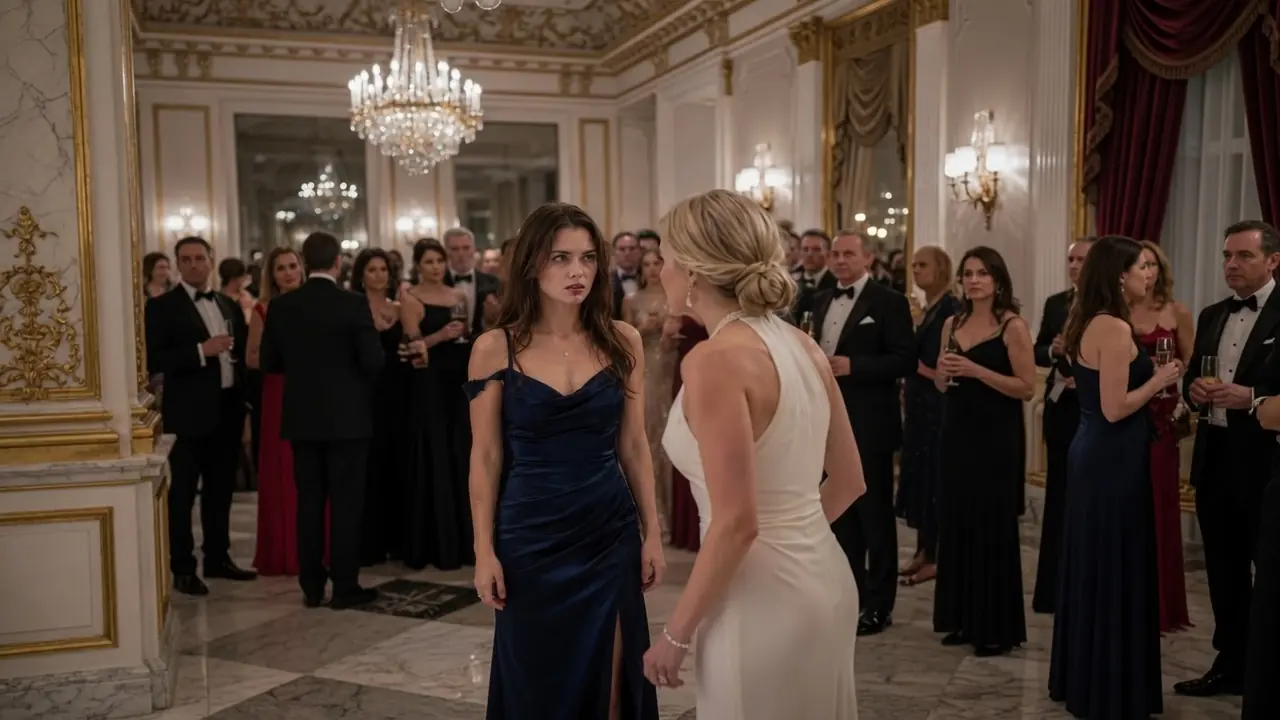
That should have comforted me. Instead, my eyes found Caroline Vale across the ballroom. She was standing near the champagne table in a white gown, staring at me with a look that made my stomach tighten. Not surprise. Recognition. Grief.
She walked toward me slowly while guests whispered around us. Richard noticed and moved to intercept her, but she did not stop. For the first time that night, maybe for the first time in years, Caroline Vale walked without checking whether her husband approved.
“That folder,” she said softly.
My pulse quickened. “What about it?”
Her voice cracked. “It’s incomplete.”
Richard’s head snapped toward her. “Caroline. Enough.”
She did not look at him. Her eyes stayed on mine, bright with tears. “It shows the stolen money. It shows the shell accounts. It shows the signatures.”
“Yes,” I said.
“But it doesn’t show why.”
The room seemed to grow colder. Richard stepped closer. “Stop talking.”
Caroline turned to him then, and the fear in her face changed into something that looked almost like freedom. “No.”
One word. It broke something open.
She faced me again. “Emily… did your father ever tell you why he personally chose you for this investigation?”
The silence became complete.
I thought I knew the answer. Richard stole from sick children. My father sent me to prove it. Simple. Clean. Finished. But nothing about Caroline’s face looked simple. It looked like guilt standing beside a grave.
“What do you mean?” I asked.
Richard lunged toward her. Security surged forward, blocking him before he could reach her. The guests gasped, several stepping back as if corruption were contagious. Caroline did not flinch.
Then she said the sentence that stopped the room from breathing.
“Your father didn’t send you here to expose Richard. He sent you here to find me.”
My bloody fingers loosened around my phone. Champagne glasses froze midair. Even the security guards seemed to pause. Richard’s face drained of color for the first time that night.
“Caroline,” he snapped. “Enough.”
But his wife was no longer his audience.
She was mine.
“What does my father have to do with you?” I asked.
Caroline’s lips trembled. “Your mother was my best friend.”
The words struck me harder than Richard’s hand ever could have. “No.”
“Yes,” she whispered. “Before Richard. Before all this. Nora and I worked together at the foundation. She was the first person who told me I could do more than smile at rich men and pour champagne for their egos.” A tear slipped down her cheek. “She trusted me.”
I could not move. My mother had kept many friends, but Caroline had never been a name in our house. My father had never mentioned her once.
Caroline looked at the folder in my hand. “Nora found the first thefts twelve years ago. It wasn’t just money. Richard was moving funds through the children’s relief program to pay off medical suppliers, judges, and private accounts tied to a development deal. Your mother knew if she exposed it, people far above Richard would fall with him.”
Richard shouted, “Lies!”
Security held him back as he struggled, his perfect tuxedo now wrinkled, his face twisted with panic. The donors who had laughed at me minutes earlier now stared at him like he had become something poisonous under the lights.
Caroline continued. “Nora came to me the week she died. She had proof, but not enough to survive in court. She asked me to copy internal records from Richard’s office. I was scared.” Her voice broke. “I was engaged to Richard then. I thought I loved him. Or maybe I loved the life he promised me.”
My throat tightened. “What happened?”
“I told him.”
The room blurred for one second.
Caroline pressed a trembling hand to her chest. “I told him Nora was asking questions. I thought he would explain. I thought there had to be some misunderstanding.” She sobbed once, then forced herself to continue. “That night, he came home calm. Too calm. He told me Nora was emotional, unstable, trying to destroy good work because she didn’t understand finances.”
I stepped closer, every part of me shaking. “And then she died.”
Caroline nodded. “Two days later.”
Richard’s voice cut through the room. “You have no proof.”
Caroline turned slowly toward him. “I do.”
For the first time, Richard looked truly terrified.
Caroline reached behind her neck and unclasped a diamond pendant. It was beautiful, heavy, and expensive, the sort of thing a husband bought when guilt needed decoration. She opened a hidden hinge beneath the stone and removed a tiny black memory card.
“I kept it,” she said.
Richard’s face collapsed. “Caroline.”
She held the card out to me. “Nora knew I was scared. She knew I might fail her. So she left me a message the night before she died, telling me where she hid copies of the files and who to trust if anything happened.” Caroline swallowed hard. “Richard found some of the files after the crash, but he never knew about the message. I hid it because I was a coward.”
I took the memory card with bloody fingers.
Caroline looked straight at me. “Your father knew I had something. He never knew what. He spent years trying to reach me, but Richard controlled everything: my phone, my accounts, my movements, my reputation. Marcus could not get me to talk.” Her eyes filled again. “So he sent you. Because he knew if I saw Nora’s daughter standing in front of me, bleeding because of the same man who destroyed her mother, I would finally stop being afraid.”
My chest felt hollow and full at the same time. My father had not told me because he did not know whether Caroline would break or run. He had sent me into Richard’s world with evidence, but also with my mother’s face.
Richard made one last mistake. He broke from security and reached for the memory card.
I stepped back, but Caroline moved first. She slapped him across the face so hard the sound cracked through the ballroom. Richard froze in disbelief. Caroline stood before him, shaking, but upright.
“You took Nora from her daughter,” she said. “You took my life and called it protection. You took sick children’s money and called it charity. You do not get one more thing.”
Security dragged Richard backward as he began shouting names, threats, promises, and accusations. Guests scattered as officers entered through the side doors. The judge who had been checking his phone lowered his head. The senator’s wife quietly stepped away from a man she had praised all evening. Everyone suddenly wanted distance from Richard Vale.
My father arrived ten minutes later.
The ballroom parted for him before anyone announced his name. Marcus Hart walked toward me with his face pale and his eyes fixed on the blood staining my hand. For one second, he was not the owner of the building, not the man whose signature controlled contracts and leases. He was just my father, seeing his daughter hurt.
“Emily,” he said.
“I’m okay.”
He looked at Caroline. The air between them carried twelve years of failed calls, unanswered letters, threats, grief, and waiting. Caroline lowered her eyes. “Marcus.”
My father’s voice was low. “Do you have it?”
She nodded toward the card in my hand. “Nora’s message.”
The name changed him. He closed his eyes once, and I saw the grief he had hidden from me for half my life rise to the surface. When he opened them, he looked older and somehow less alone.
We did not watch the video in the ballroom. My father ordered the gala ended, the guests escorted out after giving statements, and the foundation records seized. Richard was taken away still shouting that nothing would stick. Men like him always believed the world would bend at the last second. That night, it did not.
In my father’s private office, with my hand bandaged and Caroline sitting across from us like a woman awaiting sentencing, we played my mother’s final message.
Nora Hart appeared on the screen, slightly grainy, sitting in her car under a dim garage light. She looked tired but alive, and the sight of her made a sound break out of me before I could stop it. My father reached for my hand.
“Marcus,” my mother said in the recording, “if you are seeing this, then I failed to come home with the truth myself.” Her voice trembled, but only slightly. “Richard Vale is stealing from the foundation, but the theft is only one layer. The money is being used to hide illegal payments tied to hospital contracts and development approvals. I have copies, but I don’t know who I can trust yet.”
She looked down, then back up.
“Caroline knows some of it. She’s frightened. I don’t blame her. Richard has a way of making fear feel like love.” My mother’s eyes filled. “If something happens to me, do not let Emily grow up thinking silence is safety. But don’t let her burn her life down for revenge either. Teach her patience. Teach her proof. Teach her that truth survives longer than powerful men.”
My father covered his mouth with one hand.
Then my mother said, “And Emily, if you ever see this, my darling girl, I need you to know something. I was not careless. I was not afraid to come home to you. I loved you every second of my life, including the last ones.”
I broke then.
No courtroom victory, no arrest, no public exposure could have prepared me for hearing my mother speak directly into the years that had swallowed her. My father held me while I cried, his own shoulders shaking. Caroline sat across from us, tears running silently down her face, carrying the punishment of being alive with knowledge she had buried too long.
The investigation that followed lasted months. Richard’s accounts were frozen. His allies scattered, then turned on each other. The shell companies led to names my mother had once feared exposing: contractors, officials, lawyers, medical supply executives, and donors who had used charity as cover for greed. Richard was charged with fraud, conspiracy, obstruction, and eventually, after Caroline’s testimony and new forensic evidence from an old mechanic’s report, involvement in my mother’s death.
The brake line had not failed. It had been cut.
Caroline testified first before a grand jury, then in court. She did not ask forgiveness from me. I respected that more than if she had. She told the truth in full, even the parts that made her look weak, selfish, and afraid. She admitted she had warned Richard, admitted she had stayed with him afterward, admitted she had hidden Nora’s message for years because terror had become her daily language.
When the prosecutor asked why she finally came forward, Caroline looked at me from the witness stand.
“Because Nora’s daughter stood in front of me bleeding,” she said. “And I realized I had already lost twelve years to fear. I would not lose one more minute.”
Richard was convicted eighteen months after the gala. When the verdict was read, he did not look at Caroline. He looked at me. His face held the same cold disbelief I had seen in the bridal-suite stories women tell, in boardrooms, in locked rooms, in every place where controlling people discover someone has finally stopped obeying.
I did not smile. Victory is not always joyful. Sometimes it is simply the moment the weight shifts off your chest enough for you to breathe.
Caroline disappeared from public life after the trial. Not dramatically. Quietly. She sold the house Richard had used like a cage and moved to a small coastal town in Maine. Before she left, she asked to meet me at a café near the courthouse.
“I don’t expect forgiveness,” she said.
“I know.”
“I loved your mother,” she whispered. “And I betrayed her.”
I looked at her for a long time. “Both can be true.”
She nodded, accepting the wound without defending herself. That was the first honest thing between us that did not involve evidence.
I did not forgive her that day. I am still not sure forgiveness is the right word for what came later. But I stopped needing her to suffer in front of me. She had her own sentence, one no judge could shorten.
My father changed after the trial. Not completely. Men like Marcus Hart do not become soft overnight. But the silence in him loosened. He began telling stories about my mother again, small ones at first: how she hated black coffee, how she sang off-key in the car, how she once made him attend three pottery classes because she said billionaires needed hobbies that humbled them.
The Hart Children’s Relief Fund was rebuilt under a new board, with every transaction publicly audited. We renamed the grant program after my mother. The Nora Hart Pediatric Justice Fund now supports medical care, whistleblower protections, and emergency housing for families harmed by institutional corruption. My father said it was my decision. I said it was hers.
As for me, I kept the navy satin dress. The torn strap was repaired, but I asked the tailor to leave a small seam visible where the fabric had ripped. Not because I wanted to remember Richard’s hand on me, but because I wanted to remember the moment I called for help and stopped pretending I could fight monsters politely.
One year after the gala, I stood in the same ballroom where two hundred people had watched me bleed. The room looked different in daylight. Less glamorous. More honest. My father stood beside me near the stage, and behind us, a large photograph of my mother smiled out over the crowd.
This time, the guests were not donors trying to be seen. They were nurses, auditors, patients’ families, investigators, and children who had survived illnesses that money had once been stolen from. Caroline did not attend, but she sent a handwritten letter with no request for reply. It said only, Nora would be proud of you.
I folded it and placed it in my purse.
When I stepped to the microphone, I looked out at the room and thought about the girl I had been, sixteen years old, not listening closely enough when her mother spoke about missing numbers. I thought about the woman I became, standing with blood on her fingers while a corrupt man laughed. Then I thought about my father’s lesson.
People show you who they are when they believe power is not watching.
Richard showed us.
The donors showed us.
Caroline showed us, first in fear and then in truth.
And I showed myself.
I was not just Marcus Hart’s daughter. I was Nora Hart’s daughter too. And my mother had not raised a woman who would kneel to a powerful man’s lies.