Red warning lights pulsed between the server racks as twenty-two-year-old Marcus Reed stood face-to-face with Operations Director Grant Harlan. Behind them, technicians shouted across rows of glowing monitors while the emergency operations center beneath Dallas Meridian Technologies slipped deeper into chaos. Every screen showed the same expanding field of red nodes, each one representing another system that had stopped responding. Marcus could hear the cooling fans changing pitch, a sound no one else in the room appeared to notice.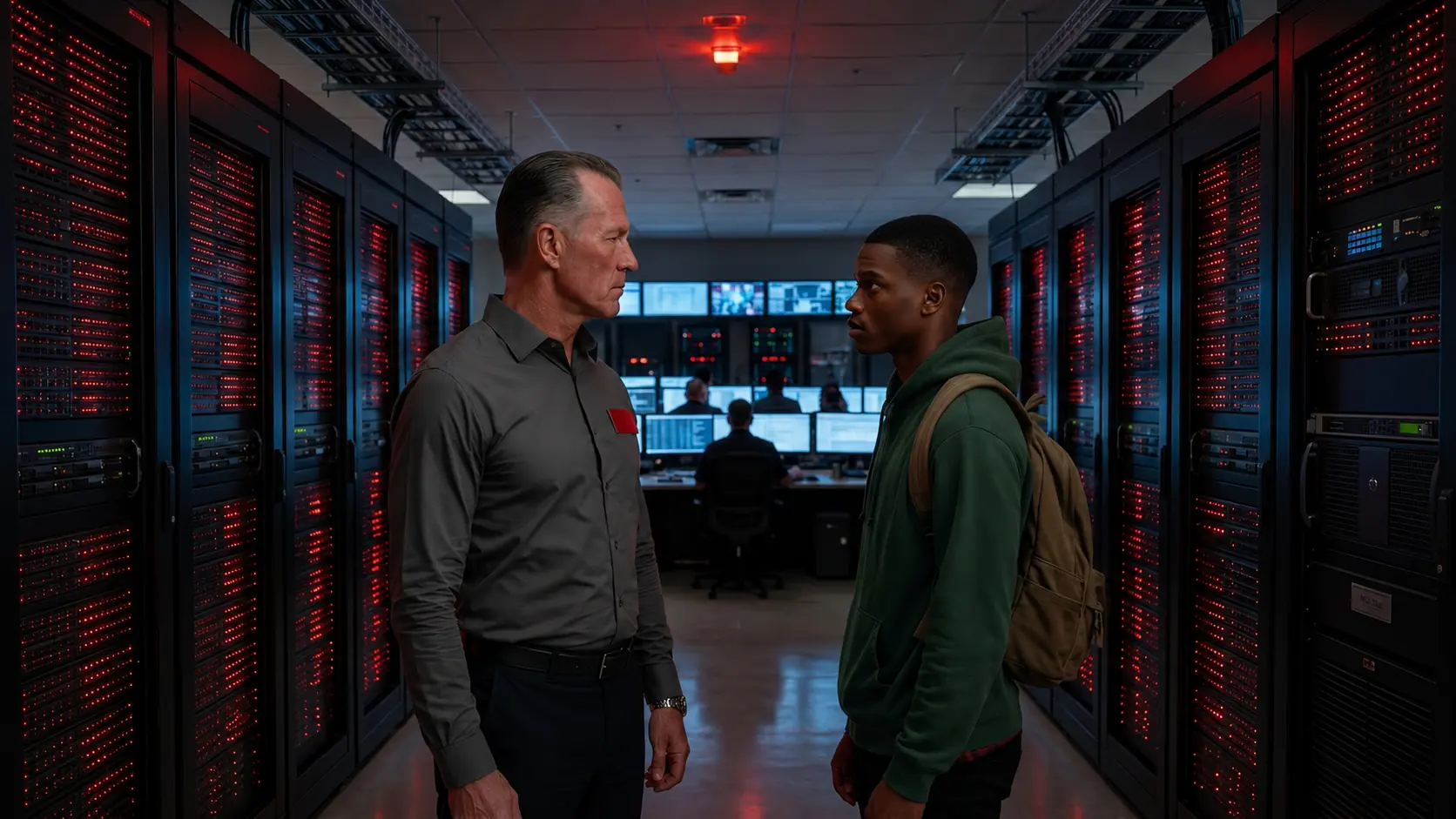
Grant lifted one hand toward the reinforced security door. His fitted gray shirt carried a red director’s badge, and his silver hair remained perfectly combed despite the alarms echoing through the room. “Security is already coming,” he said. “Walk out now, and I may decide not to have you arrested.”
Marcus did not move. “The primary cluster is thirty seconds from thermal shutdown.”
“You heard a few alarms and suddenly you’re an engineer?”
“I heard the backup fans reverse.”
Grant glanced toward the racks before looking back at him. “Fans don’t reverse.”
“These did.”
A senior technician called from the command floor. “Director, we just lost internal authentication!”
Another voice followed. “Cooling control isn’t responding!”
Marcus pointed toward the central server corridor. “That’s what I came to tell you.”
Grant seized the front strap of Marcus’s backpack. “You came because your mother let you through a restricted service entrance.”
“My mother didn’t let me through anything.”
“She cleans this building. You followed her downstairs and wandered into a room where people do real work.”
Marcus slowly removed Grant’s hand. “Your people are following a false recovery script. Every command they send is feeding the loop.”
The room fell quieter around them.
Grant’s eyes narrowed. “Who told you that?”
“The network did.”
Before Grant could answer, the lights flickered. A sharp electrical crack sounded behind the western rack, followed by a rising mechanical whine. Several technicians stood at once.
Marcus looked toward the ceiling alarm.
“Now you have four seconds.”
He dropped his backpack, pulled out a compact black device, and ran toward the central terminal.
Grant grabbed his shoulder.
Marcus turned, caught the director’s wrist, and redirected it without striking him. Grant stumbled against the edge of a server cabinet, more shocked than hurt. Two security officers entered through the rear door just as Marcus reached the central console.
“Stop him!” Grant shouted.
Marcus connected the device to an emergency maintenance port.
The terminal rejected it.
He entered a command manually, then another. The screen filled with lines of code while the security officers rushed through the aisle.
Three seconds.
Marcus disabled the automated recovery process.
Two seconds.
He isolated the corrupted cooling controller.
One second.
He forced the backup fans into local mode.
The mechanical scream vanished.
Across the operations floor, red warning panels stopped multiplying. Temperatures began dropping by fractions of a degree. Authentication remained offline, but the catastrophic shutdown had paused.
The security officers seized Marcus by both arms.
Grant pushed away from the server rack and straightened his shirt. “Get him on the floor.”
Marcus did not resist. “Don’t disconnect the device.”
“Do it,” Grant ordered.
A technician reached toward the cable.
“If you pull it,” Marcus warned, “the loop restarts.”
The technician froze.
Grant stormed closer. “You expect me to believe that piece of junk is holding together a billion-dollar network?”
“No,” Marcus said. “The code running through it is.”
The lead technician, Dana Cho, studied the central monitor. She was forty-one, methodical, and one of the few people in the room who had stopped reacting emotionally. “Director, he’s right. The maintenance port is bypassing the corrupted controller. Temperatures are stabilizing.”
Grant stared at her. “Then transfer the command to our system.”
“We can’t.”
“Why not?”
Dana enlarged a block of code. “Because our recovery software keeps overwriting it.”
Marcus looked toward her. “The attack isn’t trying to penetrate the network. It’s using your own emergency protocols to dismantle it.”
Grant’s expression changed for the first time.
“How would you know that?” he demanded.
Marcus glanced at the security officers holding his arms. “Because I found the vulnerability six months ago.”
Dana turned toward him. “Who are you?”
“Marcus Reed.”
Her eyes widened slightly. “Reed?”
Grant looked between them. “You know him?”
“I know the name.” Dana stepped closer to the terminal. “Someone submitted an anonymous vulnerability report in January. It described a recursive failure inside the automated recovery architecture.”
Marcus nodded. “You closed the report without testing it.”
Grant’s jaw tightened. “Anonymous reports are not accepted through internal channels.”
“It wasn’t anonymous. It included my name, phone number, test environment, and reproduction steps.”
Dana looked toward Grant. “The report was routed to executive review.”
Grant said nothing.
Marcus understood the silence immediately.
“You saw it.”
Grant turned toward the technicians. “Restore authentication.”
Dana did not move. “Director, did you reject the report?”
“Not now.”
“It is exactly now,” Marcus said. “Someone reproduced the vulnerability because you left it open.”
Grant stepped close enough that the security officers tensed. “You are in no position to accuse me.”
“I’m on my feet while your operations center is on life support.”
Grant pointed at the device. “For all we know, you caused this.”
Marcus laughed once, without humor. “There it is.”
“What?”
“The part where blaming the cleaning lady’s son feels safer than admitting you ignored him.”
Grant’s face reddened.
Dana interrupted before he could respond. “The attack has shifted.”
A new pattern appeared across the monitors. Previously isolated nodes began reconnecting through a secondary route. The temporary fix was losing control.
Marcus pulled against the officers’ grip. “Let me work.”
Grant folded his arms. “Absolutely not.”
Dana looked at the temperatures. “We have less than four minutes before the western cluster overloads.”
“My team will handle it.”
“Your team is locked out of the administrative layer,” Marcus said. “The attacker stole your recovery certificates.”
Grant turned toward Dana. “Is that possible?”
She studied the logs. “It already happened.”
The first server rack shut down.
Monitors across the room went black.
Marcus looked directly at Grant. “You can protect your pride or protect the network. You don’t have time for both.”
Dana spoke firmly. “Release him.”
Grant stared at her.
“That was not a suggestion,” she said.
The security officers hesitated, then loosened their grip. Marcus pulled his backpack toward the terminal and removed a second device, several cables, and a small notebook filled with handwritten diagrams.
Grant watched with open contempt. “That is your professional toolkit?”
Marcus connected the second device. “No. This is what I could afford after your company rejected my internship.”
Dana looked at him again. “You applied here?”
“Three times.”
Grant gave a dismissive sound. “Thousands apply.”
Marcus typed rapidly. “I scored first in your external systems challenge.”
Dana stopped moving. “That was you?”
“The winner was listed under a candidate number.”
Grant said, “The final selection considers more than test scores.”
“Yes,” Marcus replied. “Apparently it considers whether your mother scrubs the hallways.”
No one laughed.
Marcus entered the isolated administrative layer through a local hardware interface. He did not attempt to restore the entire network. Instead, he divided it into six smaller zones and severed the connections between them.
Dana watched the map change. “You’re fragmenting the architecture.”
“I’m starving the attack.”
“You’ll lose cross-site coordination.”
“We’ve already lost it. This keeps the damage from moving.”
Grant leaned over the console. “That violates every continuity procedure we have.”
Marcus continued typing. “Those procedures are what the attacker controls.”
A warning flashed.
UNAUTHORIZED HARDWARE SIGNATURE DETECTED.
Grant pointed at the screen. “Remove his device.”
Marcus slammed one hand over the cable before anyone could touch it. “That alert came from the attacker.”
“How can you know?”
“Because your internal system doesn’t call it a hardware signature. It calls it an external maintenance endpoint.”
Dana examined the language and nodded. “He’s right.”
Grant looked around the room and realized his authority was no longer enough to make everyone obey without question. The technicians were watching Marcus instead of him.
“Zone Three is clean,” Marcus announced. “Move emergency communications there.”
Dana relayed the order.
“Zone Five is compromised,” he continued. “Cut power at the rack level.”
A technician looked toward Grant.
Grant hesitated.
The temperature warning climbed.
“Do it,” Dana ordered.
Power disappeared from Zone Five. The attack lost another route.
Marcus isolated two additional clusters and rebuilt authentication using temporary local certificates. For the first time in sixteen minutes, operators regained control of several critical systems.
Then the building shook.
A muffled explosion rolled through the ceiling, and smoke began seeping beneath the western equipment-room door.
“Battery unit,” Dana said.
Marcus looked at the temperature map. “No. Cooling pump.”
Grant grabbed the emergency radio. “Fire response to Level Four.”
No answer came.
Marcus checked another screen. “Emergency communications are still routing through the compromised zone.”
Dana looked toward the sealed door. “If the cooling fluid ignited—”
“It didn’t.” Marcus unplugged one cable and handed the device to her. “Keep this connected. Don’t approve any automated recovery prompts.”
“Where are you going?”
“To reopen the pump manually.”
Grant blocked the aisle. “You are not entering a mechanical room during a fire event.”
“The servers will overheat before the response team reaches us.”
“You’re not trained for that room.”
Marcus pulled a folded identification card from his backpack and held it up. “Certified data-center mechanical technician. I worked nights maintaining this building for the subcontractor you fired last year.”
Dana took the card. “He has Level Three mechanical clearance.”
Grant stared at Marcus. “You worked here?”
“Six months. You passed me in the hall every morning.”
Grant had no response.
Marcus ran toward the mechanical door. Dana followed with a flashlight, while Grant and one security officer came behind them. Smoke thickened inside the corridor, but there was no visible flame. Water covered the floor beneath a ruptured coolant line.
Marcus stopped everyone at the threshold.
“Don’t step in.”
Grant nearly pushed past him. “It’s water.”
“It contains conductive additives.”
Marcus pointed toward an emergency disconnect mounted behind the flooded area. The automatic valve had failed halfway, leaving the pump trapped in a restart cycle.
Dana studied the system. “Can we shut it remotely?”
“The attacker locked the controls.”
Grant looked at Marcus. “Then what?”
“Someone crosses the maintenance frame above the floor and closes the valve manually.”
The steel frame was barely wide enough for one person’s boots. It ran above pipes and electrical conduits toward the far wall.
“I’ll do it,” the security officer said.
Marcus shook his head. “You won’t know which pressure release to open first. Close the valve under load and the line can rupture again.”
Grant stepped forward. “Tell me what to do.”
Marcus looked at him, surprised.
“You said there isn’t time,” Grant continued. “So tell me.”
“You’re heavier than the frame rating.”
Grant’s expression hardened. “Then stop enjoying this and solve it.”
Marcus removed his hoodie and backpack. “Hold the light.”
He climbed onto the frame.
Every step made the wet steel tremble beneath him. He moved slowly, placing his boots between cable brackets while smoke blurred the far end of the room. Dana called pressure readings from the doorway.
“Primary line at one hundred and forty percent.”
Marcus reached the release assembly.
The wheel would not turn.
“It’s seized,” he said.
Grant aimed the flashlight. “Can you break it?”
“If I break the stem, we lose the whole line.”
He pulled a short wrench from his back pocket and struck the valve housing twice. Rust and mineral buildup cracked loose. The wheel shifted.
“Pressure at one hundred and fifty-two,” Dana warned.
Marcus opened the release by a quarter turn. Coolant sprayed into the containment drain. The pressure reading began falling.
“Now the main valve,” Dana said.
Marcus leaned across the frame and forced the larger wheel closed. The restart alarm stopped.
Dana looked at her screen. “Pump is isolated.”
Marcus remained on the frame. “Switch to secondary cooling.”
Grant used the radio at his belt. “Operations, activate secondary system manually.”
A technician answered through static. “Controls won’t accept the command.”
Marcus closed his eyes for half a second.
“The attack still has Zone Two.”
Dana looked at him. “You said it was clean.”
“It was.”
A message appeared on her tablet.
WELCOME BACK, MARCUS.
Dana showed him the screen.
Grant saw it too.
The room became still.
“This is targeting you,” Grant said.
Marcus climbed back across the frame. “It knows my name because it accessed the January report.”
“Who had access?”
“Executive security, architecture, and whoever reviewed it.”
Grant’s face lost color.
Dana noticed. “What aren’t you telling us?”
Grant looked toward the smoke, then at Marcus. “The report was not simply rejected.”
Marcus waited.
“I forwarded it to Victor Saye.”
Dana’s expression sharpened. Victor Saye had been Meridian’s chief systems architect until the company dismissed him three months earlier for selling confidential research.
Grant continued. “He told me the vulnerability was theoretical. He said testing it would require shutting down the recovery network.”
“You gave him my report,” Marcus said.
“I gave it to the architect responsible for the system.”
“You gave the system’s weakness to a man you later fired for stealing company data.”
“I did not know what he was doing then.”
Marcus stepped close. “But you knew my report was real.”
Grant did not answer.
Dana’s tablet displayed another message.
FIVE MINUTES, MARCUS. LET’S SEE WHAT YOU CAN DO.
The words vanished and were replaced by a countdown beginning at 04:59.
Victor Saye was not merely destroying the network.
He was challenging the person who had discovered his flaw.
Marcus ran back to the operations floor.
The central screens now showed the countdown. Technicians whispered as it dropped past four minutes and thirty seconds.
Dana reached the terminal beside him. “What happens at zero?”
Marcus studied the network map. “The attack has reached the electrical-management layer.”
Grant stopped behind them. “Meaning?”
“He can shut off power to the entire complex.”
“We have generators.”
“He controls the transfer system.”
Dana looked toward the hospital-service indicator on a side monitor. Meridian’s complex did more than process corporate data. Its emergency network provided routing support for several hospitals, city-response systems, and regional utility controls.
“A full failure would spread beyond this building,” she said.
Marcus nodded. “That’s why Victor waited until today.”
Grant glanced toward the date displayed on the screen. Meridian was conducting a scheduled regional emergency-services migration. Multiple agencies were temporarily dependent on the operations center.
“Can you stop him?” Grant asked.
Marcus opened the notebook from his backpack.
Inside were diagrams of the same recovery architecture Victor had exploited. Marcus had drawn them months earlier while building a private simulation to prove his warning.
“I can make him think he won.”
Dana understood first. “Create a false electrical layer.”
“We mirror the controls into an isolated environment. When he triggers the shutdown, he destroys the simulation instead.”
Grant looked at the countdown. “Can that be built in four minutes?”
“No.”
“Then why are we discussing it?”
Marcus connected his devices again. “Because I built most of it six months ago.”
He opened a directory containing a complete virtual model of Meridian’s recovery network.
Dana stared at the files. “This is extraordinary.”
“This is the work your internship committee called insufficiently practical.”
Grant heard the accusation but did not defend himself.
The countdown passed three minutes.
Marcus deployed the simulation across the remaining clean zones. Dana redirected monitoring feeds while technicians rebuilt local connections according to Marcus’s instructions. Grant authorized every restricted action without argument.
For the first time, they worked as one team.
At two minutes, the false layer came online.
At ninety seconds, Victor detected the shift.
YOU’RE STILL CLEANING UP OTHER PEOPLE’S MESSES. JUST LIKE HER.
Marcus’s hands stopped above the keyboard.
Grant read the message. “Don’t let him provoke you.”
Marcus looked at him. “You said nearly the same thing.”
Grant absorbed the words without looking away. “Then I know exactly how ugly it sounds.”
The countdown reached sixty seconds.
Victor attempted to bypass the false layer. Dana blocked one route, but another appeared through an old maintenance account.
“Whose credentials?” Marcus asked.
Dana checked. “Director Harlan’s.”
Grant stepped toward the terminal. “Delete them.”
“Your account controls executive overrides,” Dana said.
“Delete it.”
“If we do, you lose all administrative authority.”
Grant looked at Marcus, then at the countdown.
“Do it.”
Dana removed the account.
Victor lost his final direct route.
The countdown reached ten.
Marcus held the simulated electrical system open like bait.
Nine.
Eight.
Seven.
The attack entered.
Six.
Marcus closed every connection behind it.
Five.
Victor triggered the shutdown.
Four.
The false network went black.
Three.
The real electrical system remained online.
Two.
Marcus captured the attack’s outgoing command path.
One.
The countdown vanished.
Every monitor in the operations center turned green.
For several seconds, no one moved.
Then the room erupted in relieved shouting.
Marcus did not celebrate. He traced Victor’s connection through three foreign relay systems, then discovered the physical origin at a commercial data facility less than twenty miles away.
Dana transmitted the location to federal investigators.
Grant stood silently beside Marcus.
“You saved the entire network,” he said.
Marcus closed his notebook. “Your staff helped.”
“I threw you out before hearing one sentence.”
“You heard enough to decide what I looked like.”
Grant removed the red director’s badge from his shirt.
Everyone nearby watched.
“I rejected your report,” he said. “I approved the architect who exploited it, ignored the evidence, and tried to have security remove the one person who understood the attack.”
Marcus looked at the badge in Grant’s hand. “What happens now?”
“I document everything.”
“That won’t change what you said about my mother.”
“No.”
Grant looked toward the rear corridor where Elena Reed stood beside a cleaning cart. She had entered unnoticed during the final minutes, still wearing her navy maintenance uniform and rubber gloves. Her eyes moved from her son to the man who had insulted him.
Grant approached her.
“Mrs. Reed, I owe you an apology.”
Elena’s expression remained calm. “My son is the one you humiliated.”
“I owe both of you one.”
“You didn’t insult him because he lacked ability. You insulted him because you thought my job placed a ceiling over his.”
Grant lowered his eyes.
Elena continued, “There is nothing shameful about cleaning this building. The shame belongs to the man who could walk through spotless halls every day and never see the people making them possible.”
No one spoke.
Grant placed his badge on the command desk and contacted corporate security himself.
Victor Saye was arrested before sunrise. Investigators found stolen architecture files, attack scripts, and a copy of Marcus’s original vulnerability report on his systems. The evidence proved that Victor had used Marcus’s research to construct the attack after Grant dismissed the warning.
The company’s board suspended Grant pending investigation.
He did not contest the decision.
Three days later, Meridian’s chief executive invited Marcus to the headquarters conference room. Dana sat on one side of the table, while Elena sat beside her son wearing the same cleaning uniform she had worn for twelve years.
The executive offered Marcus a full-time cybersecurity position, a signing bonus, and funding to complete his engineering degree.
Marcus read the contract.
Then he placed it back on the table.
“You want me now because I saved you publicly.”
The executive shifted uncomfortably. “Your qualifications are undeniable.”
“They were documented before the attack.”
Dana smiled faintly.
Marcus continued, “I’ll accept under three conditions. First, you create an independent channel for vulnerability reports so executives cannot bury them. Second, technical internships remove names, addresses, and family-employment information during initial review.”
“And the third?” the executive asked.
Marcus looked toward his mother.
“Every subcontracted maintenance worker receives the same emergency-access training and hazard protection as direct employees. The people cleaning your server rooms know more about what happens inside this building than most managers.”
The executive agreed.
Marcus joined Meridian as its youngest security engineer.
He did not take Grant’s office. He chose a desk on the operations floor beside the technicians who had fought the attack with him. His mother continued working at the complex, though Meridian offered her a supervisory position with full benefits and a salary that finally reflected her responsibilities.
Grant returned once after completing the investigation.
He had resigned permanently and came without his badge or tailored security shirt. Marcus found him outside the operations center, waiting beside the same reinforced door where he had ordered him to leave.
“I’m not asking for forgiveness,” Grant said.
“Good.”
“I came to tell you that I’ve begun speaking to security-management programs about bias in emergency decisions.”
Marcus crossed his arms. “You’re turning what happened into a lecture?”
“I’m using my failure as evidence.”
“That sounds better.”
Grant glanced through the window at the functioning operations floor. “You asked for five minutes.”
“You gave me five seconds.”
“And you saved us in four.”
Marcus shook his head. “No. It took six months of unpaid work, three rejected applications, and a lifetime of watching people underestimate my mother.”
Grant accepted the correction.
Before leaving, he looked toward the server racks. “For what it’s worth, you should have been operating this center long before that night.”
Marcus replied coldly, “I never needed your permission to be capable.”
Grant nodded and walked away.
Months later, the black device Marcus had connected to the emergency port was placed inside Meridian’s training room. A small plaque beneath it did not call him a hero or mention Grant’s humiliation.
It carried only one sentence:
The warning you dismiss today may be the knowledge that saves you tomorrow.
Marcus requested one addition.
Below the plaque, the company installed a photograph of the nighttime maintenance crew who kept the complex running long before executives arrived each morning.
Elena stood in the center.
The operations center never again referred to her as merely the cleaning lady. Her name appeared on emergency plans, safety committees, and the employee wall beside engineers, directors, and technicians.
On the night the network nearly died, Grant Harlan saw a young Black man in a hoodie and decided he did not belong near the servers.
He saw a worn backpack instead of the equipment inside it.
He saw a maintenance worker’s son instead of the engineer who had already mapped the system’s fatal weakness.
Marcus needed only five seconds at the terminal to stop the immediate collapse.
But the real victory came afterward, when the company was forced to confront why the only person capable of saving its most important network had been standing outside the door, repeatedly asking to be heard.