Claudine Hayes was 76 years old, blind since she was 48, but she never let that stop her from living independently.
Every morning, she walked the same path through Franklin Square, Georgia. 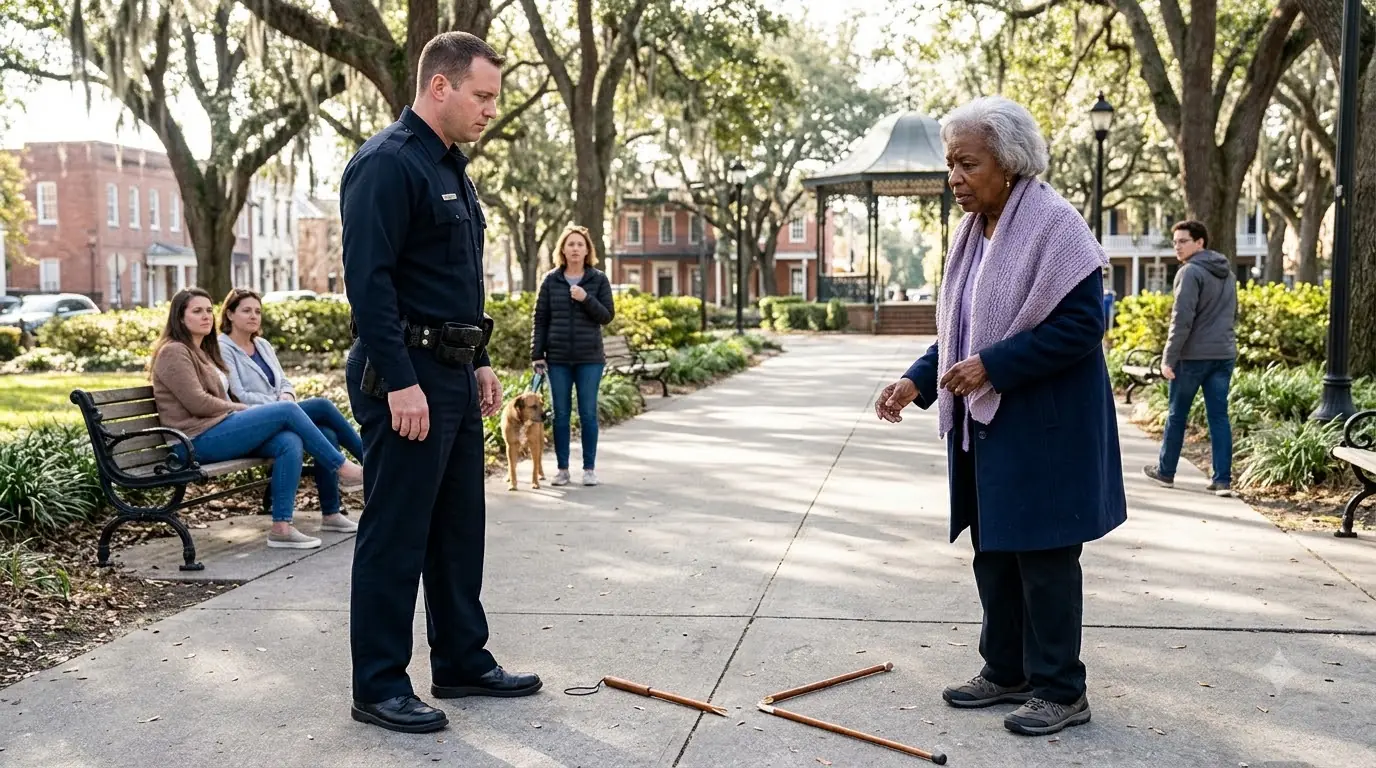
With a faded lavender shawl around her shoulders and her husband’s old wooden cane in her hand, she moved through the neighborhood with confidence.
The cane was more than a walking tool. It was a memory. Her late husband Theodore had carried it before passing away, and Claudine considered it a symbol of strength.
Most people in town knew her as the kind elderly woman who greeted everyone, helped at the food pantry, and walked through the park every morning.
But few knew her full story.
They didn’t know she was the mother of Malik Hayes, a former federal prosecutor who had spent years fighting for justice.
Claudine never used her son’s name for protection.
She believed respect should come from who she was, not who she knew.
That morning started like any other.
Until Officer Steven Klein appeared.
Claudine heard the heavy sound of boots behind her.
Not the sound of someone passing by.
The sound of someone approaching with authority.
"Ma’am."
The officer’s voice was cold.
Claudine turned toward him.
"Good morning, officer."
"You out here alone?"
She smiled politely.
"I walk this path every day. I know it well."
The officer looked at her cane.
"That might be part of the problem."
Claudine stayed calm.
She had lived long enough to recognize disrespect before it became open cruelty.
But then the officer reached for her cane.
"Let me see that."
Before she could react, his hand closed around it.
"Sir, please."
He pulled.
Claudine held on.
Then came the sound that changed everything.
Crack.
The wooden cane broke in half.
The cane that belonged to her husband.
The cane that helped her move through a world she could no longer see.
Officer Klein dropped the pieces at her feet.
"Next time, don’t get smart."
Then he walked away.
Claudine stood there silently.
People nearby watched.
Some looked uncomfortable.
Some whispered.
Nobody stepped forward.
She slowly bent down and picked up the broken pieces.
Her hands trembled, but she stood straight.
She did not scream.
She did not beg.
She simply walked home.
She placed the broken cane on her kitchen table and sat beside it.
For the first time in years, she felt something deeper than anger.
She felt invisible.
But someone had seen.
James Monroe, a 19-year-old man who worked at a coffee cart near the park, had recorded everything.
He had been afraid to intervene.
But he had pressed record.
The next day, James went to Claudine’s house.
"I’m sorry," he said.
He showed her the video.
She listened to every word.
Every insult.
Every second of the cane breaking.
When the video ended, she sat quietly.
"It’s not your fault," she told James.
Then she added:
"But it is someone’s."