“Pick that up.”
Arthur Crane’s voice cut across the boardroom like a blade. The cardboard box he had kicked from the edge of the table lay open on the black marble floor, spilling papers, pens, a framed photograph, and the last visible pieces of Victoria Hail’s office. The photograph had landed face-down beneath a leather chair, its glass cracked from the fall. Around the long mahogany table, twelve directors watched in silence, pretending they had not enjoyed the sound of her life scattering across the floor.
Victoria Hail did not bend down. She stood beside the table in a fitted white dress, one hand resting lightly on the chair back, the other holding a black folder against her side. Her face remained calm, almost too calm for a woman who had just been removed from the company she had saved. Outside the glass wall, New York City stretched beneath a gray afternoon sky, but inside the boardroom, the air felt colder than winter.
Arthur Crane sat at the head of the table like a king who believed the throne had been built for him personally. At seventy years old, he had silver hair, a polished watch, and the kind of smile that made cruelty look like confidence. He pointed again toward the mess at Victoria’s feet, one long finger trembling slightly with satisfaction. “I said pick it up,” he repeated.
Victoria looked down at the scattered papers, then back at him. “No, Arthur,” she said quietly. “You threw it down, so you can watch it stay there.” The room changed after that sentence. No one moved, but shoulders stiffened, eyes narrowed, and several directors glanced toward Arthur to see how badly he would react.
Arthur leaned back slowly. “That box is all your career is worth now.” A few men laughed softly, not because the line was clever, but because they wanted Arthur to know they were still loyal. Victoria heard every laugh and memorized every face. She had spent twenty years learning that powerful people often revealed themselves most clearly when they thought someone else had already lost.
The vote had happened thirty minutes earlier. By a narrow margin, the board had removed Victoria as CEO of Hailstone Global Holdings, the private infrastructure firm she had built into a multi-billion-dollar empire. The official reason was “loss of strategic confidence,” a phrase written by lawyers to hide ambition under clean language. The real reason was simpler: Victoria had refused to approve a merger that would have made Arthur and his allies rich while destroying thousands of workers’ pensions.
Arthur had expected her to fight during the vote. He expected anger, pleading, maybe even tears if the pressure landed correctly. Instead, Victoria listened as each director spoke, watched each hand rise, and nodded once when the final count was recorded. That calmness had irritated Arthur more than any outburst could have.
Now he wanted humiliation. He wanted the room to see her reduced from chief executive to discarded employee. That was why he had kicked the box. That was why he ordered her to pick it up, as if forcing her to kneel would make the removal feel complete.
The security officer near the door shifted uneasily. His name was Jordan Miles, a former Marine who had worked in corporate security for eight years and had never liked boardroom cruelty. He had been told to escort Ms. Hail from the building after the vote. But he had not been told the chairman would kick her belongings across the floor like trash.
Victoria’s eyes moved briefly toward him. Jordan gave the smallest shake of his head, not as refusal, but as apology. Victoria understood. In rooms like this, many people saw wrong happening and still had bills to pay. She did not blame him for standing where power had placed him.
Director Phillip Rowe tapped his pen against the table. “Security should proceed,” he said. “We have transition matters to discuss.” Victoria turned her head slowly toward him. Phillip stopped tapping. He had spent the last six months pretending neutrality while sending private messages to Arthur after every meeting.
Another director, Elaine Voss, crossed her arms. She was the only woman on Arthur’s side and the one who had once told Victoria privately that women in power had to be practical, not emotional. In Elaine’s language, practical meant surrendering to the men who already controlled the room. Victoria had never taken that advice.
Arthur gestured toward Jordan. “Escort Ms. Hail out.” Jordan took one step forward, then hesitated when Victoria placed the black folder on the table. The folder made a soft sound against the polished wood, but everyone heard it. It was the first thing Victoria had brought into the room that did not seem to belong to Arthur’s performance.
Arthur noticed it immediately. “What is that?” Victoria smoothed one hand over the folder’s cover. “Nothing you need to worry about.” Arthur laughed, but his eyes sharpened. “Still trying to sound important?”
Victoria looked around the table. “Before I leave,” she said, “there is something every person in this room should know.” Several directors shifted in their chairs. Arthur’s smile thinned, because the calm in her voice had become something else. It was no longer restraint. It was control.
“You have no power left in this room,” Arthur said. Victoria opened the folder. “Wrong,” she replied. “I own the shares, the evidence, and by sunrise, I will own every chair you are sitting in.”
For one full second, nobody understood what she had said. Then the first page slid from the folder and landed in the center of the table. It was a voting trust certificate dated eighteen months earlier, notarized and signed by three major minority shareholders whose names had never appeared together in public filings. Arthur stared at it, and for the first time that afternoon, his face lost color.
Victoria placed a second page beside the first. “Twenty-eight percent of preferred voting shares were transferred into a trust last year.” Her voice remained even. “A trust managed by my family office.” She looked at Arthur. “You thought those shareholders were too small to matter separately. You forgot what happens when ignored people join hands.”
Phillip Rowe leaned forward, his face tightening. “That is impossible.” Victoria turned another document toward him. “It is recorded, valid, and already confirmed by outside counsel.” She paused, then added, “You would know that if you had read anything that did not come from Arthur.”
Elaine Voss reached for the document, but Victoria’s hand settled over it first. “Careful, Elaine. That page is evidence.” Elaine withdrew her hand quickly. The young executive assistant in the corner, Maya Chen, finally lowered her tablet completely. Her eyes were wide, not with fear, but with the dawning recognition that the meeting had turned.
Arthur forced a laugh. “Even if that were real, it changes nothing. The vote is done.” Victoria nodded. “Yes. The vote is done.” She removed another sheet from the folder. “And every vote cast by directors who accepted undisclosed payments from Meridian Capital is now subject to immediate challenge.”
The room went silent again, but this silence was different. The first silence had been arrogance waiting for obedience. This one was fear learning its own name. Victoria laid out bank transfer summaries, encrypted message extracts, and internal compliance memos Arthur believed had been deleted.
Director Samuel Brent pushed back from the table. “What is this?” Victoria looked at him. “Your offshore account in the Cayman Islands received three payments totaling two million dollars after you agreed to support the merger.” Samuel’s lips parted, but nothing came out. Victoria slid another page toward him. “You used your daughter’s foundation as an intermediary. That was careless.”
Samuel’s hand began to tremble. Arthur slammed his palm on the table. “This is slander.” Victoria looked at him without flinching. “No, Arthur. Slander is spoken without proof. This is documentation.”
Arthur turned toward the company’s general counsel, Martin Bell, who sat near the far end of the table looking suddenly ill. “Stop this,” Arthur ordered. Martin did not move. Victoria looked at Martin next. “He cannot stop it, because he received the full evidence package at 8:00 this morning, along with instructions from outside counsel.”
Every face turned toward Martin. He swallowed hard and removed his glasses. “The documents appear authentic,” he said quietly. Arthur stared at him in disbelief. “You work for this board.” Martin looked down at the table. “I work for the company.”
That sentence cracked the room open. Victoria placed another document on the table, this one bearing Arthur Crane’s signature. “Six months ago, you instructed private counsel to create a side agreement with Meridian Capital, guaranteeing board seats and liquidation bonuses after the merger closed.” Arthur’s jaw tightened. “Standard negotiation.”
Victoria shook her head. “Not when the agreement required you to suppress pension risk reports and conceal worker liability from shareholders.” She turned the next page. “Not when you personally ordered the actuarial review buried.”
Elaine whispered, “Arthur, tell us that is not true.” Arthur did not look at her. Victoria noticed. Elaine noticed too. The boardroom no longer felt like a chamber of power; it felt like a room full of people realizing the floor beneath them had been removed.
Victoria’s mind returned briefly to the first time Arthur underestimated her. It was twelve years earlier, during a hostile acquisition meeting in Chicago. He had mistaken her for legal staff, handed her his coat, and asked whether the buyer had arrived. She had taken the coat, hung it neatly on the back of his chair, then sat at the head of the table and purchased the company before lunch.
Men like Arthur often forgot humiliation when they caused it. The people who survived it rarely did. Victoria had carried that memory, not as bitterness, but as instruction. Never warn arrogant people too early. Let them explain themselves completely.
Arthur stood. “This meeting is over.” Victoria looked up at him. “Sit down.” The command was quiet, but it landed with such force that Arthur froze. Several directors looked between them, stunned that anyone had spoken to him that way.
Arthur’s face reddened. “You do not order me.” Victoria’s expression remained calm. “I just did.” Then she looked at Jordan near the door. “Mr. Miles, nobody leaves this room until compliance officers arrive.” Jordan looked toward Martin Bell. Martin nodded slowly. Jordan stepped fully in front of the door.
Arthur stared at the security officer. “Move.” Jordan’s jaw tightened. “No, sir.” The answer was respectful, but final. For the first time in years, Arthur Crane gave an order and watched it fail.
Victoria turned to Maya Chen. “Maya, please connect the video conference.” Maya hesitated only a second before touching her tablet. The large wall screen flickered on, revealing three faces: Patricia Lowell from outside counsel, Marcus Ellery from the pension oversight committee, and Denise Shaw from federal regulatory enforcement.
A director near the center of the table cursed under his breath. Victoria glanced at him. “You may want to save your energy, Gregory. Your name appears in appendix four.” Gregory sank back in his chair, suddenly gray.
Patricia Lowell spoke first from the screen. “This meeting is being recorded pursuant to emergency governance review.” Arthur pointed toward the screen. “You have no authority here.” Patricia looked at him calmly. “Mr. Crane, your authority is currently under formal challenge based on evidence of undisclosed conflicts, bribery, and breach of fiduciary duty.”
Arthur’s mouth opened, but no words came. Denise Shaw leaned forward on the screen. “You are advised not to destroy documents, contact witnesses, or initiate retaliatory action against any employee.” Her tone was bureaucratic, precise, and devastating. “We have already secured electronic preservation orders.”
Victoria watched Arthur absorb the word already. That was the word that mattered. Everything he wanted to do next had been anticipated. Every escape route had been locked before he knew he needed one.
Phillip Rowe tried to stand. “I need to call my attorney.” Victoria looked at him. “You should. But you will make that call after the preservation notice is served.” Phillip sat back down slowly. His arrogance had drained into panic.
Elaine Voss looked at Victoria with something like betrayal. “You planned this.” Victoria met her eyes. “No, Elaine. I documented it.” Elaine’s face tightened, but she did not answer. There was no defense against the difference.
Arthur leaned over the table, his voice low and poisonous. “You think this makes you noble?” Victoria’s eyes finally hardened. “No. It makes me prepared.” She stepped closer to the head of the table, passing the scattered papers still lying on the floor. “Nobility had nothing to do with it when you tried to sell the company’s workers to cover your debts.”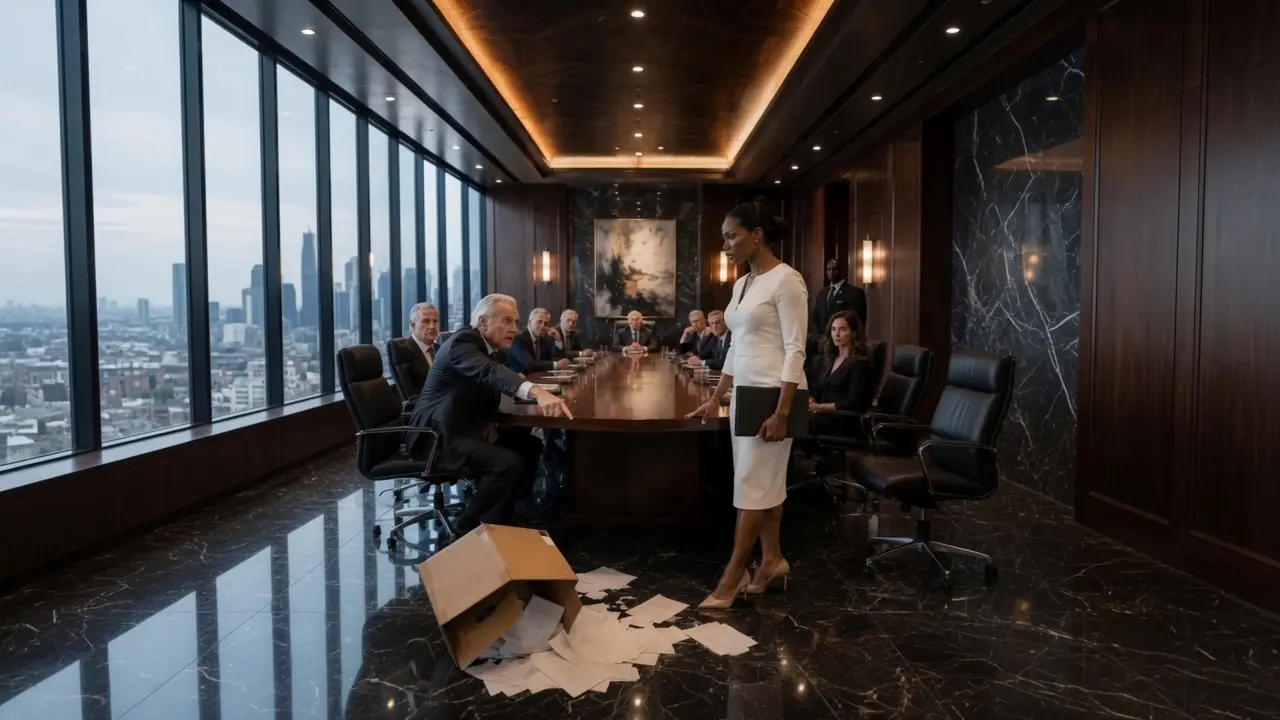
The room seemed to shrink around Arthur. Victoria opened the last section of the folder. Inside was a photograph of a warehouse floor in Ohio, filled with workers in blue uniforms. “Twenty-three thousand employees would have lost pension protection under your merger structure.” She placed the photograph in front of him. “You called it optimization.”
Arthur looked at the photo, then away. Victoria did not let him escape it. “Look at them.” Arthur’s jaw worked. “Do not lecture me about business.” Victoria’s voice sharpened for the first time. “Business is not theft just because you do it from a boardroom.”
Maya Chen’s eyes filled with tears in the corner. Her father worked at the Ohio facility. Victoria knew that because she knew the people Arthur called numbers. She knew the plant managers, pension analysts, warehouse supervisors, and night-shift clerks whose futures had been reduced to lines on a spreadsheet.
Martin Bell stood slowly. “Pending emergency review, I recommend immediate suspension of Arthur Crane’s chair authority.” Arthur turned on him. “Coward.” Martin’s face tightened. “No. I was a coward when I ignored the first red flag.” The admission landed heavily. “I am trying not to remain one.”
Victoria looked at the directors one by one. “You voted to remove me because you thought I was standing alone.” Her gaze paused on Samuel, then Phillip, then Elaine. “But every person you dismissed, every analyst you silenced, every assistant you ignored, every employee you treated like furniture, they all knew something. And eventually, they came to me.”
Arthur’s breath was shallow now. “You used staff against the board.” Victoria shook her head. “No. You abused staff until they trusted me more than they feared you.” Maya finally stood. Her hands trembled around her tablet, but she remained upright.
“I copied the meeting calendar changes,” Maya said. Every director turned toward her. Her voice shook, but she continued. “Mr. Crane’s office kept removing pension review briefings from board packets. I sent the originals to Ms. Hail.” Arthur stared at her as if seeing her for the first time.
Victoria nodded once at Maya, not with surprise, but respect. “Thank you.” Maya sat down, wiping her cheek quickly. The assistant they had ignored had become the first witness in the room brave enough to speak aloud.
Then Jordan Miles stepped forward from the door. “I also submitted a statement,” he said. Arthur turned slowly. “You?” Jordan nodded. “You asked security to remove an internal auditor from the building last month after she refused to surrender her laptop.” He looked at Victoria. “I escorted her out, but I also recorded the instruction.”
Arthur’s face twisted with fury. “You people are all replaceable.” Victoria looked at him with quiet pity. “That is why you are losing.” The sentence struck deeper than any insult. Arthur had spent his life believing people beneath him disappeared when dismissed. Now they stood around him as evidence.
The emergency vote began at 4:17 p.m. Under counsel supervision and based on the voting trust Victoria controlled, the board suspended Arthur Crane, Phillip Rowe, Samuel Brent, Gregory Whitman, and two others pending investigation. Elaine Voss kept her seat temporarily only because the evidence showed negligence rather than direct payment. The distinction did not comfort her.
Arthur refused to accept the decision. He shouted about lawsuits, betrayal, and legacy. He called Victoria ungrateful, dangerous, arrogant, and unfit. She listened without blinking, then gathered the documents back into the folder.
When he finally stopped, out of breath and red-faced, Victoria said, “Your mistake was believing I wanted your approval.” Arthur gripped the table edge. “You will regret humiliating me.” Victoria glanced at the papers still scattered on the floor. “Arthur, I did not humiliate you. I gave you an audience while you revealed yourself.”
Regulatory officers arrived within twenty minutes. They entered with document cases, tablets, and the calm efficiency of people who had done this before. Arthur’s office was sealed first. Then Phillip’s. Then the private board archive room Arthur believed only his assistant could access.
Reporters were already gathering outside by evening. Someone had leaked that an emergency governance crisis had erupted at Hailstone Global. Victoria did not speak to them yet. She stood alone for a moment near the boardroom windows, looking down at the city while investigators moved behind her.
Maya approached slowly. “Ms. Hail?” Victoria turned. Maya held the cracked framed photograph from the floor. It showed Victoria with her late mother on the day Hailstone opened its first New York office. The glass had broken, but the photo inside was unharmed.
Maya’s eyes lowered. “I’m sorry I didn’t pick it up sooner.” Victoria took the frame gently. “You picked up something more important.” Maya swallowed hard, then nodded. For the first time that day, Victoria’s expression softened.
By sunrise, Arthur Crane was no longer chairman. By noon, Meridian Capital had suspended merger discussions. By the end of the week, three directors resigned, two faced formal investigation, and the pension risk report Arthur buried became public. The workers in Ohio, Michigan, and Pennsylvania learned how close they had come to losing what they had spent decades earning.
Victoria was reinstated as CEO under emergency shareholder authority. The first thing she did was not hold a press conference. She flew to the Ohio facility and stood on the warehouse floor with the workers whose photograph she had placed in front of Arthur. She told them the truth without corporate poetry.
“Some people tried to trade your future for their bonus,” she said. “They failed.” The workers applauded, not because everything was fixed, but because someone had finally spoken plainly. Victoria looked out at their faces and felt the weight of what power was supposed to protect.
Back in New York, the boardroom changed. Arthur’s chair was removed, not dramatically, but permanently. Victoria ordered the long table refinished because the scratch from the day he slammed his hand on it remained visible. Maya was promoted into governance operations, where she could make sure no packet vanished quietly again.
Jordan Miles received a formal commendation and a raise. Martin Bell kept his position only after accepting an independent ethics monitor and publicly admitting that silence had nearly made him complicit. Elaine Voss resigned three months later, saying she needed time to reconsider her role in systems she once defended. Victoria did not stop her.
Arthur tried to fight for months. He gave interviews calling himself a victim of political theater. He hired expensive attorneys, blamed ambitious women, disloyal staff, and changing times. But documents did what anger could not undo. One by one, the facts remained standing after his speeches collapsed.
A year later, Victoria walked into the same boardroom for a meeting with a new board. The room looked different in small ways. More women sat at the table, more former operators, more people who had run factories, negotiated labor contracts, and understood companies were made of human beings, not only returns. The black folder was no longer in her hand.
Before the meeting began, Victoria looked down at the floor near the place where her box had landed. There was no trace of the scattered papers, the cracked glass, or Arthur’s shoe mark. But she remembered everything. Not with bitterness, but precision.
One new director asked if she needed a moment. Victoria smiled faintly. “No,” she said. “I already had it.” Then she sat at the head of the table, opened the agenda, and began the meeting.
Years later, people would tell the story as if Victoria destroyed the board in one brilliant afternoon. They loved the image of the black folder, the fallen box, the chairman’s face going pale. But Victoria knew the truth was less sudden and more powerful. Arthur had not been destroyed by one folder.
He had been destroyed by every person he ignored. Every assistant he dismissed, every auditor he threatened, every worker he reduced to a number, every woman he mistook for temporary. The folder had only carried their truth into the room where he thought truth could not reach him.
And Victoria never forgot the first words he said after kicking her life across the floor.
“Pick that up.”
In the end, she did pick something up. Not the papers he scattered. Not the humiliation he offered. She picked up the power he never realized she had been carrying all along.