In the spring of 1934, twelve-year-old Eli Callaway began digging holes around his grandfather’s old red barn outside Grover Falls, Nebraska. The barn sat on the edge of the prairie with nothing but open land stretching north and west, and every hard wind that crossed the county seemed to find that building first. Eli worked with a short-handled shovel, a sack of pine seedlings, and a seriousness that made the grown men laugh when they passed by. To them, he looked like a skinny farm boy decorating dirt.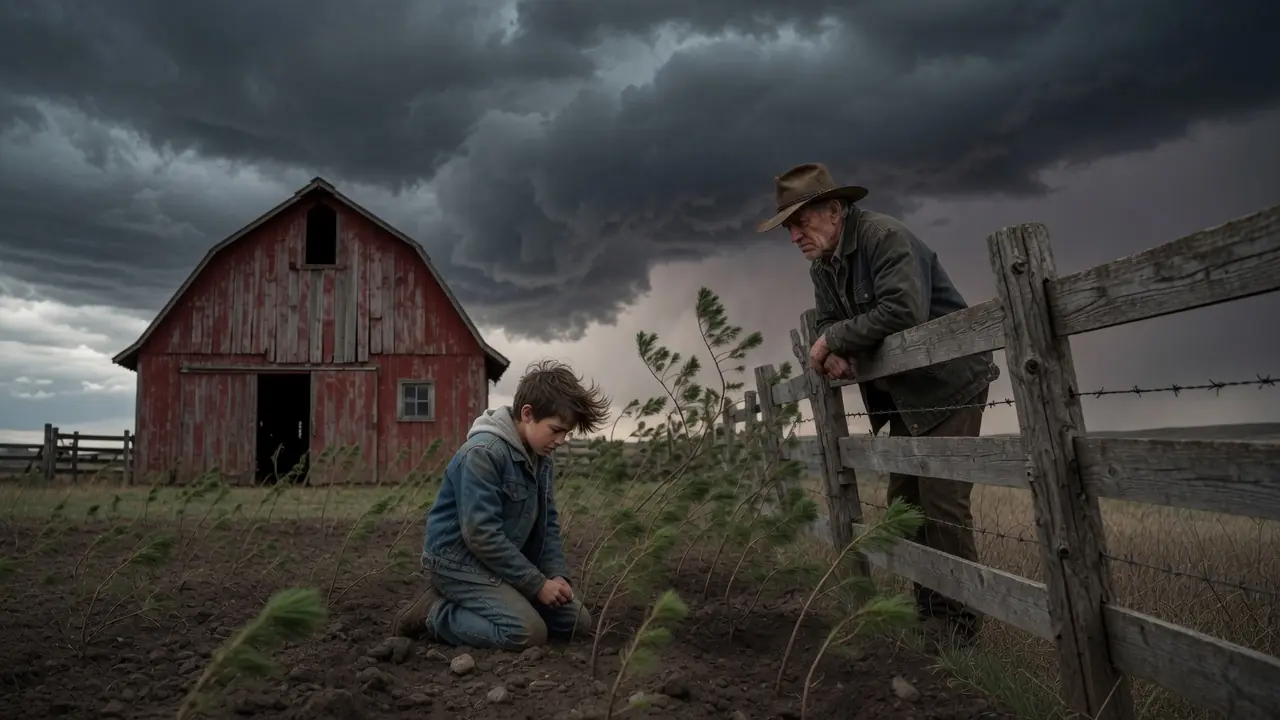
His grandfather, Amos Callaway, had owned that barn for forty years. It leaned slightly to the east, its red paint faded almost pink by sun and dust, but the beams inside were still strong. The barn held hay, tools, two milk cows, a pair of mules, and nearly every memory Eli had of his parents, who had died when he was seven. Amos was seventy-one now, stiff in the knees and slower than he used to be, but he still rose before dawn and treated the barn like it was part of the family.
Eli had noticed the wind before anyone told him to fear it. He noticed how snow curled around the corners of buildings in winter and how dust rolled low across the ground in summer. He noticed which fence posts stayed buried and which ones needed resetting every spring. Most of all, he noticed that every storm came from the same direction, pushing straight across the open prairie toward his grandfather’s barn like a hand trying to knock it down.
The idea came from a schoolbook nobody else wanted. It was an old agricultural bulletin his teacher, Miss Larkin, kept on a shelf beside cracked readers and outdated maps. The bulletin talked about windbreaks, rows of trees planted to slow the force of prairie wind. Eli read the same page again and again until the corners softened under his fingers. Then he walked home, stood behind the barn, and imagined a wall made not of boards, but of living trees.
He asked his grandfather for seedlings that night at supper. Amos looked up from his beans and cornbread, one gray eyebrow lifting. “Pines?” he asked. “Around the barn?” Eli nodded and explained the windbreak in careful words, showing with his hands how the trees would catch the wind before it struck the walls. Amos listened without laughing, which was one of the reasons Eli loved him most.
“Trees take years, boy,” Amos said gently. “Storms don’t wait that long.” Eli knew that was true, but he also knew something had to start before it could ever become strong. “Then I’d better start now,” he said. Amos studied him for a long moment, then reached for his coffee. “There’s a nursery over near Hastings that sells seedlings cheap. If you’re willing to plant them, I’ll find the money.”
By April, Eli had two burlap sacks of tiny pine seedlings resting in the shade of the barn. They were thin, fragile things, hardly taller than his forearm, with roots wrapped in damp cloth. Dale Mercer saw them first when he rode over to borrow a brace bit from Amos. Dale was an older farmer, broad-shouldered, thick-mustached, and proud of the fact that he had never trusted anything he could not hammer, plow, or sell by weight. He leaned on the fence and watched Eli kneel in the soil.
“What are you doing there, Callaway boy?” Dale called. Eli looked up, dirt on his knees and sweat on his forehead. “Planting pines,” he said. Dale looked from the seedlings to the barn and gave a short laugh. “Your grandfather needs hay stacked, not a boy’s foolish forest.” Eli went back to digging.
The remark traveled faster than the wind. By the next week, men at the general store were calling the seedlings Eli’s Christmas trees. Someone joked that Amos would have the prettiest barn in Grover Falls when the auctioneer came to sell it. A few women said it was sweet that the boy wanted to keep busy, but they said it in the same tone people used for children building forts from scraps. Eli heard most of it and answered none of it.
He planted the first row ten feet from the barn, spacing each seedling the way the bulletin instructed. Then he planted a second row, staggered behind the first, because the drawing in the book said wind moved differently when trees were not lined up like soldiers. His hands blistered, healed, and blistered again. Every evening after chores, he carried water from the pump in two dented buckets and poured it slowly around each little tree. He named none of them because naming things made losing them harder.
Dale Mercer stopped by often enough to make his opinion known. Sometimes he came for tools, sometimes for news, and sometimes, Eli suspected, just to watch the trees and shake his head. “A blizzard would roll right over those,” Dale said one afternoon. “Wouldn’t even slow down to notice.” Eli pushed soil around the base of a seedling and pressed it firm. “It will notice someday.”
Dale snorted. “Someday doesn’t feed cattle this winter.” Eli stood and wiped his hands on his overalls. “Neither does laughing at someone else’s work.” Dale’s expression sharpened, surprised by the boy’s answer. Amos, standing near the barn door, hid a smile under his mustache but said nothing.
Summer came dry and hard. The ground cracked in places, and the young pines browned at the tips. Eli carried water every morning and every evening, even when his arms trembled from the weight. Amos told him he could let a few go if it became too much, but Eli shook his head. “If I quit on them now, they won’t be there when we need them,” he said.
By August, the pines had taken root. They were still small, but they no longer looked like sticks pushed into the dirt. Their needles had deepened in color, and when the wind blew, they bent close to the ground and rose again. Eli liked watching that. It reminded him of his grandfather, who moved slowly but always stood back up.
The neighbors stopped talking about the trees as often, but they did not stop judging them. Dale Mercer told anyone who would listen that Eli was wasting good ground and better time. “A boy ought to learn the difference between farming and pretending,” he said one morning at the feed store. “Trees around a barn won’t stop Nebraska weather.” Men nodded because Dale said things with the confidence of a man who expected agreement.
In September, Amos hurt his hip slipping from the hayloft ladder. He did not break anything, but the fall left him limping badly for weeks. Eli took on more chores, feeding animals, hauling water, mending small breaks in the fence, and helping stack hay. Still, he watered the pines. Some nights he did it by lantern light while Amos stood in the barn doorway watching with a worried face.
“You’re working too hard for a boy your age,” Amos said one evening. Eli poured water at the base of the last tree. “I’m not just a boy,” he replied quietly. Amos looked at him, and sadness crossed his face because he knew exactly what loss had forced Eli to become. “No,” the old man said softly. “I suppose you’re not.”
By late October, the first hard frost silvered the grass. The pines stood in two uneven rows, still low and thin, but stronger than they had been in April. Eli packed straw around their bases, hoping to protect the roots. Dale Mercer rode by as he was working and stopped at the fence. The sky behind him had gone pale, and the wind was already carrying the first bite of winter.
“You think those little things are ready for snow?” Dale asked. Eli looked up from the straw. “No,” he said. “But they’re more ready than they were.” Dale’s mouth twisted. “That’s not much of an answer.” Eli tied the last bundle in place. “It’s the only honest one.”
Winter arrived early that year. By December, the roads around Grover Falls had frozen into ruts, and the wind began coming down from the north with a steady, bitter force. Eli watched the pines catch snow at their bases, small white drifts forming where the open ground had once stayed bare. It was not much, but it proved the bulletin right. The trees were slowing something.
Then came the storm warning. A rider from town brought word that a major blizzard was building fast, larger than anything the county had seen in years. Farmers began tying down doors, moving animals closer to shelter, and stacking extra wood near their stoves. Dale Mercer rode past the Callaway place the morning before the storm hit and saw Eli checking the pine rows with a rope in his hand. The older man stopped, his face red from cold.
“Still playing with trees?” Dale called. Eli stood between the barn and the pines, his coat whipping around his thin frame. “I’m tying the weak ones together so they don’t snap.” Dale laughed, but there was tension behind it now. “Eli, those little pines won’t stop a blizzard — you wasted spring decorating dirt.” Eli looked back at the barn, then at the darkening sky. “They’re not decoration. They’re a wall before the wind arrives.”
Dale’s eyes narrowed. “Your grandfather needed hay stacked, not a boy’s foolish forest.” Eli pulled the rope tight around two bending trunks and tied a square knot. “When the storm hits, you’ll wish your barn had one too.” The words hung between them, sharper than anything Eli had ever said to an elder. Dale stared at him, then turned his horse without answering.
The blizzard struck after midnight. Wind slammed into the farmhouse so hard the windows rattled in their frames. Snow came sideways, not falling but flying, driven across the prairie with a force that erased the yard within minutes. Eli woke to the sound of the barn door groaning. Amos was already pulling on his coat beside the stove.
They could not reach the barn at first. The wind pushed them back twice before they made it halfway across the yard, holding a rope tied between the house and the barn door. Snow stung Eli’s face like thrown sand. He kept one mittened hand on the rope and one arm over his eyes. When they finally reached the barn, Amos shoved the door open just wide enough for them to slip inside.
The animals were nervous but not panicked. The milk cows shifted in their stalls, the mules stamped, and the chickens muttered from the corner, but the barn itself was standing firm. Eli listened. The wind still roared overhead, but the west wall did not shake the way it had in past storms. Outside, beyond the wall, the young pines were taking the first blow.
All night, Eli and Amos stayed in the barn. They checked the animals, reinforced a loose latch, and spread extra hay. Several times, Eli climbed to the loft window and looked toward the pine rows, but snow blurred everything into gray. He could only see dark shapes bending together in the storm. They looked small, but they were still there.
By morning, Grover Falls had vanished beneath drifts. Fence lines were buried. Roads disappeared. The Callaway barn stood in a curved pocket of calmer snow, with deep drifts piled against the pine rows instead of against the barn doors. Eli pushed open the east door and stared. The trees were bent, battered, and half buried, but they had caught the snow like hands catching a falling weight.
Amos came up beside him and placed a hand on his shoulder. He did not speak for a while. Then he said, “Well, I’ll be.” Eli smiled for the first time in two days, but he did not brag. He only walked carefully to the first row of pines and brushed snow from their branches.
The news from neighboring farms came slowly. Dale Mercer’s barn roof had been partly torn away. Two other farmers lost hay stacks to the wind. Several sheds had collapsed under drifts that formed where there was no shelter to break the storm. No one in Grover Falls was untouched, but the Callaway barn had come through better than any of them.
Dale arrived the next afternoon, leading his horse through deep snow. He looked older than he had two days before. His coat was crusted white, his face raw from wind, and pride seemed to hang from him in torn pieces. Eli saw him from beside the barn, where he was clearing snow away from the smallest pines.
Dale stopped at the fence. For once, he did not call out a joke. He looked at the barn, the sheltered hay, the calm animals moving inside, and then at the battered rows of pine seedlings holding the drift. His mouth opened, but nothing came out at first. Eli waited.
Finally, Dale said, “My west wall split.” Eli lowered his shovel. “I’m sorry.” Dale nodded, eyes still fixed on the trees. “Lost half my hay to the drift. Cattle near broke the gate from panic.” He swallowed hard. “Your barn took the wind better than mine.”
Eli did not answer quickly. He knew this was not just an admission about boards and snow. Dale Mercer was a proud man, and pride did not step down easily, especially in front of a twelve-year-old boy it had mocked. “The trees helped,” Eli said. “They didn’t stop the storm. They slowed it.”
Dale gripped the fence rail with gloved hands. “I called them decoration.” Eli looked at the bent pines. “I remember.” Dale’s face tightened, but this time not with anger. With shame. “I was wrong.”
Those three words changed something in the cold air. Eli had imagined proving Dale wrong many times, usually with a sharper answer than he would ever dare say aloud. But now that the moment had arrived, he felt no joy in it. The storm had not chosen only proud men to punish. It had struck everyone, and being right did not make damaged barns easier to fix.
“My grandfather says being wrong is cheaper if you admit it early,” Eli said. Dale looked at him, surprised. Then, slowly, he gave a tired laugh. “Your grandfather says better things than I do.” Eli smiled a little. “Usually.”
Dale stepped through the gate and walked toward the pine rows. He crouched awkwardly beside one of the bent trees and brushed snow from its needles. “They’re still alive,” he said. Eli nodded. “Most of them.” Dale looked toward the open prairie beyond the farm. For the first time, he seemed to see not empty land, but wind with a direction.
“Could you show me how you planted them?” Dale asked. Eli stared at him. “You want to plant pines?” Dale’s jaw worked as if the question embarrassed him. “I want my barn standing next winter.”
Eli looked toward Amos, who had come to the barn door and was watching quietly. The old man nodded once. Eli turned back to Dale. “You need two rows. Not straight across from each other. Staggered. And you have to water them even when it looks foolish.”
Dale removed his hat and ran a hand over his gray hair. “I can do foolish if it works.” Eli almost laughed. “It does not work fast.” Dale looked at the damaged horizon beyond the Callaway land. “Fast has not done much good for me lately.”
In the weeks that followed, Dale Mercer became a different kind of visitor. He came not to mock, but to ask questions. How far apart? How deep? What kind of mulch? Which side of the barn? Eli answered with the patience of someone who had learned from books, weather, and sore hands. Dale listened, sometimes awkwardly, but he listened.
By spring, half of Grover Falls wanted pine seedlings. Men who had laughed at Eli now came by with notebooks, measuring twine, and embarrassed expressions. Eli could have reminded each of them what they had said. He did not. He simply showed them where the wind had stacked the snow and where the barn had stayed clear.
Dale brought the first wagonload of seedlings to his own farm in April. He asked Eli to come help mark the rows. When Eli arrived, he found Dale waiting with a new short-handled shovel leaning against the fence. “Figured a man ought to have the right tool if he’s going to learn from a boy,” Dale said. Eli took the shovel and looked at the open ground west of Dale’s barn.
They worked side by side all morning. Dale dug slowly but carefully, and Eli checked each hole before the seedling went in. At noon, Dale’s wife brought sandwiches, and they ate sitting on overturned buckets. Dale looked over the first row of pines and shook his head. “Never thought I’d say this,” he admitted, “but that looks like hope.”
Eli considered that. “It looks small.” Dale nodded. “Most hope does at first.” The two of them sat in silence after that, looking at the tiny trees and the great open prairie beyond them.
Years later, people in Grover Falls would remember the blizzard of 1934 for the barns it damaged and the lesson it left behind. Rows of pine windbreaks began appearing around farms across the county, first in crooked lines planted by men who pretended the idea had always made sense, then in stronger rows maintained by their sons. The Callaway barn became the place people pointed to when explaining why trees mattered on the prairie. Eli never liked being called a hero, but he did not mind being asked how deep to plant.
The pines around his grandfather’s barn grew taller each year. They thickened, darkened, and began to hum softly when the wind moved through them. Amos lived long enough to sit on a chair outside the barn and watch their tops rise above the roofline. Sometimes he would look at Eli, now older and broader, and say, “You started before the rest of us could see.”
Dale Mercer never forgot the day he asked a boy to teach him. He became one of Eli’s strongest defenders whenever someone dismissed a young idea because it came from a young mouth. At the feed store, if a man laughed too quickly at a child’s suggestion, Dale would lift one finger and say, “Careful. I once laughed at trees, and the trees saved a barn.”
And every winter after that, when the north wind came hard over the Nebraska prairie, it struck the pine rows first. The trees bent, whispered, and held. Behind them, the old red barn stood steady, not because the storm had been weak, but because one quiet boy had respected its strength before anyone else did.