Everett Crane was thirteen the first autumn he started planting sticks along Coldwater Creek, and almost everyone on the farms nearby thought he had lost interest in ordinary chores. Before school, while the sky was still gray and the cattle were only beginning to stir near the barn, he would carry a borrowed spade down to the muddy creek bank and dig narrow holes in the wet soil. He pressed willow whips into the ground one by one, spacing them carefully from the old pasture fence to the wide bend where the creek slowed in summer. To the neighbors, it looked like a boy wasting good morning hours trying to grow shade trees in the one place every farmer knew the water would eventually come and take them.
The Crane family farm sat in rural Casey County, Kentucky, where the land rolled soft in some places and dropped sharply toward the creek in others. Everett’s father, Dale Crane, raised cattle, kept a small tobacco patch, and worked the same ground his father and grandfather had worked before him. His mother, Ruth Ann, kept the farm books, fed four children, and could grow tomatoes in soil everyone else called tired. Everett was the second child, not the loudest, not the brightest on report cards, not the strongest in the barn, but he noticed things other people walked past.
His older brother Micah could rope calves faster than most grown men and had ribbons from county fairs pinned above his bed. His younger sister Lena could read two grades ahead and answer teachers before they finished asking questions. Little Ben followed everyone with a wooden stick pretending it was a rifle, a cane, or a horse depending on the hour. Everett, though, was the child who watched fence lines after storms, studied low ground after rain, and remembered which gate post leaned a little more each month.
On Sundays, after church and dinner, Everett often walked the edge of the farm alone. Dale once asked him why, expecting a boyish answer about rabbits, birds, or hiding from chores. Everett shrugged and said, “I like to see what changed.” Dale had laughed softly then, but later he found himself repeating the words in his head. A man who farmed long enough knew that noticing what changed was often the difference between saving a calf, a field, or a season.
Coldwater Creek had always worried Everett, though he did not say so at first. In summer it looked harmless, sliding brown and slow around the bend below the Crane pasture. In winter it sank low between muddy banks, collecting leaves, broken reeds, and the occasional lost feed sack. But after hard rain, it changed into something hungry, chewing at the edges of the bank, loosening roots, and pulling whole clumps of soil into the current.
Everett had watched the creek eat a little more of the farm each year. Not enough for his father to panic, not enough for anyone at the feed store to call it urgent, but enough for a boy who paid attention to feel uneasy. A fence post that had stood five feet from the bank when he was nine stood only three feet away by the time he turned twelve. The low pasture lost dark soil every spring, and each time Dale repaired the edge, Everett knew the water would come back when it was ready.
The idea came from his grandfather, Lester Bowen, during a summer visit in Bourbon County. Lester had worked for soil conservation most of his life and still carried folded pamphlets in his shirt pocket the way other men carried tobacco. One evening, he took Everett to see a neighbor’s damaged creek bank where the soil had collapsed in raw, ugly shelves. Lester stood with his cane pressed into the mud and said, “Water always looks like it wins fast, but roots win slow.”
That night, Everett read the booklet Lester gave him under the weak lamp beside his bed. It was about streambank stabilization using native vegetation, with plain drawings showing willow cuttings, root growth, and creek edges before and after planting. Most boys his age might have found it boring. Everett read it twice, then folded the corner of the page that showed how to press willow whips deep enough to survive winter.
When he returned home, he walked Coldwater Creek with new eyes. He saw the curve near the pasture gate, the soft edge where cattle sometimes stepped too close, the raw bank where spring water had sliced away another foot of soil. He imagined roots beneath the surface, holding in silence long before anyone could see them. The thought stayed with him through haying, through school starting, and through the first cold mornings of October.
Finally, he asked Dale for permission to work the creek bank. Dale stood in the barn doorway, wiping his hands on a rag, looking at the boy’s serious face. “What exactly are you doing down there?” he asked. Everett said, “Planting willows,” and when Dale asked why, the boy answered, “For the farm.”
That was not much of an explanation, but Dale had learned that Everett did not talk loosely. If Micah asked for a new rope, he wanted to show it off. If Lena asked for a book, she already knew the title, author, and price. If Everett asked for willow ground, he had likely carried the idea quietly for weeks before speaking.
“As long as your chores get done,” Dale said. “And don’t block the cattle path.” Everett nodded once, as if his father had granted him something much larger than muddy creek work. He paid for the willow whips himself with money he had saved from helping bale hay at the Atchison place. When the bundle arrived, tied in brown twine and looking like dead sticks, Ruth Ann raised her eyebrows but said nothing.
The first morning, Everett worked before breakfast. Frost silvered the pasture grass, and his breath came white in the air as he dug with a spade too large for his hands. He pressed the first willow whip into the mud, tamped the soil tight with his boot heel, then stepped three paces and dug another hole. By the time Ruth Ann called him from the porch, his gloves were wet, his boots were coated in mud, and twenty thin sticks stood along the creek like a row of poor decisions.
Old Gus Whitfield was the first neighbor to laugh. He drove by on his tractor, slowed near the fence, and squinted down toward the creek. “Boy,” he called, “you know that bank floods every few years, don’t you?” Everett leaned on the spade, nodded politely, and said, “Yes, sir.”
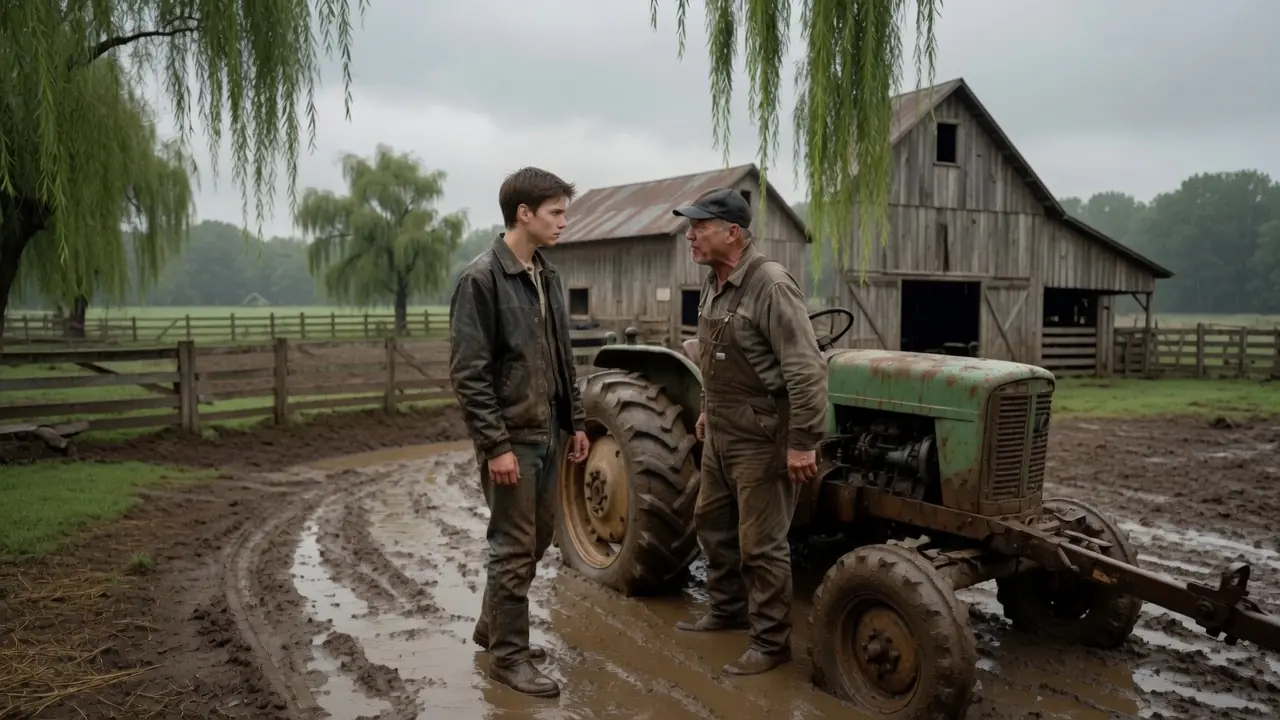
Gus laughed and shook his head. “Anything you plant there is liable to wash clear to Tennessee.” Everett did not argue. He only bent back down and pressed another willow cutting into the soil. Gus drove on, and by noon half the feed store had heard that the Crane boy was planting broom handles in the mud.
The teasing did not stop Everett, but it followed him. Harlan Beecham leaned on the fence one afternoon and asked if he was trying to start a creekside orchard. Micah told him he was wasting time on trees nobody needed. Even Lena, who usually defended Everett, asked why he cared so much about plants that looked dead before winter had even begun.
Everett rarely explained. He had learned that some ideas sounded foolish while they were still small. If he said the roots would hold the bank, people would ask how a thirteen-year-old knew more than grown farmers. If he said Grandpa Lester had taught him, someone would answer that every farm was different and that creeks did what they wanted.
So he kept digging. After school, he checked each whip, pressing loose soil back around the stems. After rain, he walked the line to see which had shifted. When cattle broke a temporary fence and trampled a dozen young cuttings, Everett spent an entire Saturday repairing the barrier and replanting what he had lost.
The first winter nearly beat him. A hard January freeze killed several whips outright, turning their tips brittle and gray. Ice formed along the creek and scraped bark from the lower stems when the water rose and fell. Everett stood in the snow one morning looking at the damage, feeling the kind of discouragement that does not shout but settles heavy in the chest.
Dale found him there and said nothing for a while. The cattle moved behind them, their breath steaming in the cold. “Lost some,” Dale finally said. Everett nodded, jaw tight, trying not to look like a child close to tears over sticks in the mud.
“Planting anything is a gamble,” Dale said. “Corn, calves, trees, children. You do what you can and find out later what took root.” Everett looked at him then, surprised by the kindness hidden inside the practical words. Dale clapped him once on the shoulder and walked back toward the barn.
Spring came wet and slow, and some of the willow whips surprised everyone by greening at the tips. Tiny leaves appeared where dead sticks had stood. Everett crouched beside them, touching the new growth with muddy fingers as if it might vanish. Not all had survived, but enough had to make the line visible.
By the second year, the willows began to look less like a boy’s odd experiment and more like something intentional. They grew unevenly, some tall and thin, some short and stubborn, but their roots were working below what anyone could see. Everett checked them the way other boys checked traps. He cut damaged stems, replanted gaps, and kept cattle from rubbing against the young trunks.
Still, most people ignored them. Farmers were busy with weather, markets, equipment, fences, family sickness, bills, and the thousand problems that arrived without waiting their turn. A few neighbors stopped joking because the joke had grown old. Others simply forgot the boy’s planting had ever been strange.
Everett did not forget. Every time rain raised the creek, he walked the bank and watched how the water moved through the young willow stems. Mud collected behind the roots. Broken leaves and straw caught along the base instead of racing downstream. The bank still wore away in places, but not as quickly, not as cleanly, not with the same helpless collapse he remembered.
The summer Everett turned fifteen was dry enough to make the whole county nervous. Pastures browned early, and cattle crowded the shaded spots before noon. Dale watched the sky more than usual, and Ruth Ann wrote feed costs into her ledger with a tighter mouth each week. Coldwater Creek shrank low between its banks, exposing cracked mud and stones that had been underwater in spring.
Then October came with rain. At first, everyone welcomed it. The first day smelled like relief, wet dust rising from the farmyard and tin roofs singing under steady drops. The second day was still welcome because ponds needed filling and the late pasture needed help. By the fifth day, the welcome had thinned.
By the eighth day, men at the co-op stopped joking about good moisture. The ground had taken all it could hold, and water stood in tire ruts, low fields, and ditches. Birds moved strangely, feeding higher than usual, and the creek turned brown and quick. Everett noticed the killdeer had abandoned the gravel near the bank three days before anyone used the word flood.
On the eleventh day, the county issued a flood advisory. Dale nailed the notice to the barn door, though everyone knew the creek better than any paper warning. That evening, the Crane family ate supper quietly while rain hit the roof in waves. Micah asked if the south pasture fence would hold, and Dale said, “We’ll know by morning.”
Everett could not sleep. He lay in bed listening to the storm and picturing the willow roots underground. He imagined them gripping mud, crossing each other beneath the bank, holding in darkness while brown water rose against them. Sometime after midnight, he got up, pulled on his coat, and stood at the back window until Ruth Ann found him.
“You can’t stop water by watching it,” she said softly. Everett did not turn. “No, ma’am,” he answered. But he stayed at the window anyway, because sometimes watching was all a person could do after doing the work early enough.
By morning, Coldwater Creek had become a roaring brown force. It had jumped its banks in four places east of the Crane farm. The low road was underwater, fence wire hung tangled with branches, and the creek carried pieces of someone’s shed roof past the bend. Dale and Micah went out before breakfast, and Everett followed without being told not to.
The farmyard was a mess of mud and standing water. Cattle bawled near the upper gate, restless from the storm. The old tobacco barn dripped from every edge, and the ground sucked at their boots with each step. As they reached the lower pasture, Dale stopped so suddenly Micah nearly walked into him.
The creek was out, but the bank had held. Water spread into the lowest edge of the pasture, yes, but the channel had not torn open the way it had on neighboring farms. The willow line stood bent and battered, leaves stripped, roots exposed in muddy places, but the soil behind them remained. The trees looked wounded, not defeated.
Everett stood very still. His hands were cold inside his gloves, and rain ran down the back of his neck, but he barely felt it. The willows were holding. Not perfectly, not magically, not like a wall, but like living hands gripping the farm from underneath.
Dale walked slowly along the bank, looking at exposed roots laced through the soil. He knelt once, pressed his hand against the muddy edge, and said nothing. Micah stared at the current, then at his brother. For once, the older boy had no teasing words ready.
By noon, the rain eased enough for neighbors to begin checking damage. Gus Whitfield lost sixty feet of bank along his north pasture. Fence posts were gone, the edge raw and sharp where the creek had bitten into it overnight. The Atchison place had wire and debris dragged two hundred yards downstream, and Rufus Dinkins lost part of a hay meadow he had spent twelve years building.
On Monday morning, Gus came to the Crane farm on his tractor. His boots were still muddy from his own ruined pasture, and his face looked older than it had the week before. Everett was near the cattle barn, carrying a coil of wire, when Gus climbed down and stared past him toward Coldwater Creek. No joke came from him this time.
Dale came out of the barn but did not speak. He seemed to understand that Gus had not come for him first. The older farmer walked across the muddy farmyard toward the willow line, with Everett following a few steps behind. The creek was still high, but calmer now, muttering through debris and foam.
Gus stood at the edge for a long time. He looked at the roots gripping the bank, the muddy trunks bent downstream, the pasture still mostly where it had been before the storm. Behind him, beyond the road, his own land lay torn open. Everyone knew it, and no one needed to say it.
Finally, Gus removed his cap. “I laughed when you planted those sticks, boy,” he said. Everett looked down at the mud on his boots. “They weren’t sticks, Mr. Gus. They were roots holding our land together.”
Gus swallowed and looked toward the cattle barn, then back at the creek. “My pasture tore away,” he said, voice rough. “But your land stayed standing.” Everett touched one muddy willow trunk, feeling how it flexed under his hand and still held firm. “Grandpa said a farm survives when you protect it before the flood.”
Gus repeated the words quietly, almost to himself. “A farm survives when you protect it before the flood.” He stared at the creek as if it had become a teacher he had ignored too long. Then he turned to Everett with a seriousness that made the boy straighten. “Where did you get these willows?”
Everett told him about the conservation nursery. Ruth Ann later gave Gus paper and pencil at the kitchen table, and Everett wrote down the name, the planting depth, and the spacing Lester had taught him. Gus folded the paper carefully and placed it in his shirt pocket like something valuable. Before leaving, he looked once more toward the creek and said, “Your grandpa knew a thing or two.”
That evening, Dale and Everett walked the willow line together. The sky had finally cleared, leaving the whole farm washed in pale gold light. Mud still covered the lower pasture, and broken branches lay against the fence, but the land was there. Dale stopped near the bend and looked at his son.
“I should have asked more questions,” Dale said. Everett shrugged, embarrassed. “I didn’t explain much.” Dale gave a quiet laugh. “No, you didn’t. But you saw something before the rest of us did, and you worked while we wondered.”
Everett did not know what to say to that. Praise made him more uncomfortable than teasing. He pushed mud around an exposed root with the heel of his boot. Dale watched him for a moment, then took the spade from the fence and helped pack soil back around the trunk.
In spring, Gus planted willows along his damaged bank. He did not make an announcement, and he did not pretend the idea had been his. When Harlan Beecham drove past and slowed near the field, Gus called out, “Ask the Crane boy how deep to set them.” Harlan laughed at first, then saw Gus was serious.
The Atchisons planted the year after that. Rufus Dinkins, who had lost part of his hay meadow, came by with a notebook and asked Everett about spacing near a bend where water moved faster. Everett answered carefully, not as a boastful boy but as someone passing along useful knowledge. Lester Bowen came to visit that summer and stood beside his grandson on the creek bank with tears shining in his old eyes.
The willows grew taller every year. Their branches leaned over Coldwater Creek, trailing leaves in summer and catching frost in winter. Birds nested there. Shade did come eventually, though that had never been the main purpose. The roots went deeper, wider, stronger, doing their quiet work beneath the surface while seasons changed above them.
Everett grew too. He stayed quiet, but people listened differently when he spoke. At the feed store, grown men who had once laughed at the sticks asked him what he thought about drainage, erosion, and fencing near wet ground. He never acted proud. He had learned from the willows that the strongest work often happened out of sight.
Years later, when Everett was old enough to run the Crane farm beside his father, children from nearby schools came to see the willow bank after a county extension agent used it as an example. They stood in clean boots with notebooks, looking at the creek, the trees, and the pasture that had survived more floods since that first great one. Everett showed them the exposed roots near the bend and explained how they held soil during high water.
One boy asked, “Did people think you were smart when you planted them?” Micah, now standing nearby with his own son on his hip, laughed before Everett could answer. Everett smiled faintly and shook his head. “No,” he said. “They thought I was planting sticks.”
The children laughed, but Everett looked toward the water with the same serious eyes he had carried at thirteen. “Sometimes the right thing looks foolish when the sky is clear,” he said. “That doesn’t make it foolish. It just means the storm hasn’t come yet.”
That became the lesson people remembered. Not because Everett made a speech, but because the farm itself kept proving him right. Each time heavy rain came, neighbors watched their creek banks more carefully. They planted sooner, fenced smarter, and asked older people questions before learning everything the hard way.
Dale Crane lived long enough to see his quiet son become the man other farmers called when water started worrying them. Ruth Ann kept the first nursery receipt in a box with family papers, beside birth certificates, land deeds, and old photographs. To her, the receipt belonged there. It marked the year Everett had begun saving something no one else understood was in danger.
Gus Whitfield never joked about the willows again. When he grew older and walked with a limp, he still drove his tractor slowly past the Crane farm and looked down at the creek. Sometimes he would stop, lean on the fence, and watch the leaves move in the current. If Everett was nearby, Gus would lift a hand but rarely call out.
Once, near the end of Gus’s life, Everett found him standing at the fence after a spring storm. The creek ran high but steady, curling around the willow roots with brown force. Gus’s own bank, now planted and thick with growth, had held that year too. He looked at Everett and said, “Your roots saved more than your farm, boy.”
Everett was no longer a boy, but he did not correct him. “Grandpa taught me,” he said. Gus nodded. “Maybe. But you were the one who listened before the water made everyone else listen.”
After Gus died, his family planted another line of willows near the cemetery road where rain cut across the ditch. Everett helped them, pressing the whips into wet soil with the same care he had used at thirteen. He thought of Lester, Dale, Ruth Ann, and all the people who had taught him without always knowing what lesson would matter most. He thought of roots underground, quiet and patient, holding what careless eyes could not see.
Coldwater Creek is still there, moving through Casey County the way creeks do, soft in dry weather and dangerous after rain. The Crane farm still keeps cattle near the upper pasture, and the old tobacco barn still leans a little more each decade but refuses to fall. Along the bank, the willows stand tall, scarred by storms and strengthened by them. Their roots hold the soil in a living grip beneath the grass.
And every time the water rises, the farm remembers what a thirteen-year-old boy understood before the grown men did. You do not wait until the flood comes to start saving the land. You protect it when people are still laughing, when the work looks small, when the sky is clear and the danger seems far away. Because a farm survives when you protect it before the flood.