Inside the lavish wedding barn of the Walker Ranch near Red Willow, Wyoming, more than two hundred guests fell silent as Ethan Walker stepped away from his furious bride. Abigail Carter stood near the banquet table in a flour-stained apron, clutching a silver platter of roasted meat and vegetables against her chest while laughter still echoed from Charlotte Bowmont’s cruel toast. Candles flickered between flowers, untouched glasses of wine, and plates filled with food Abigail had spent six weeks preparing. When Ethan extended his hand toward the humiliated cook, every rancher, railroad investor, and wealthy visitor in the room understood that the wedding was about to collapse.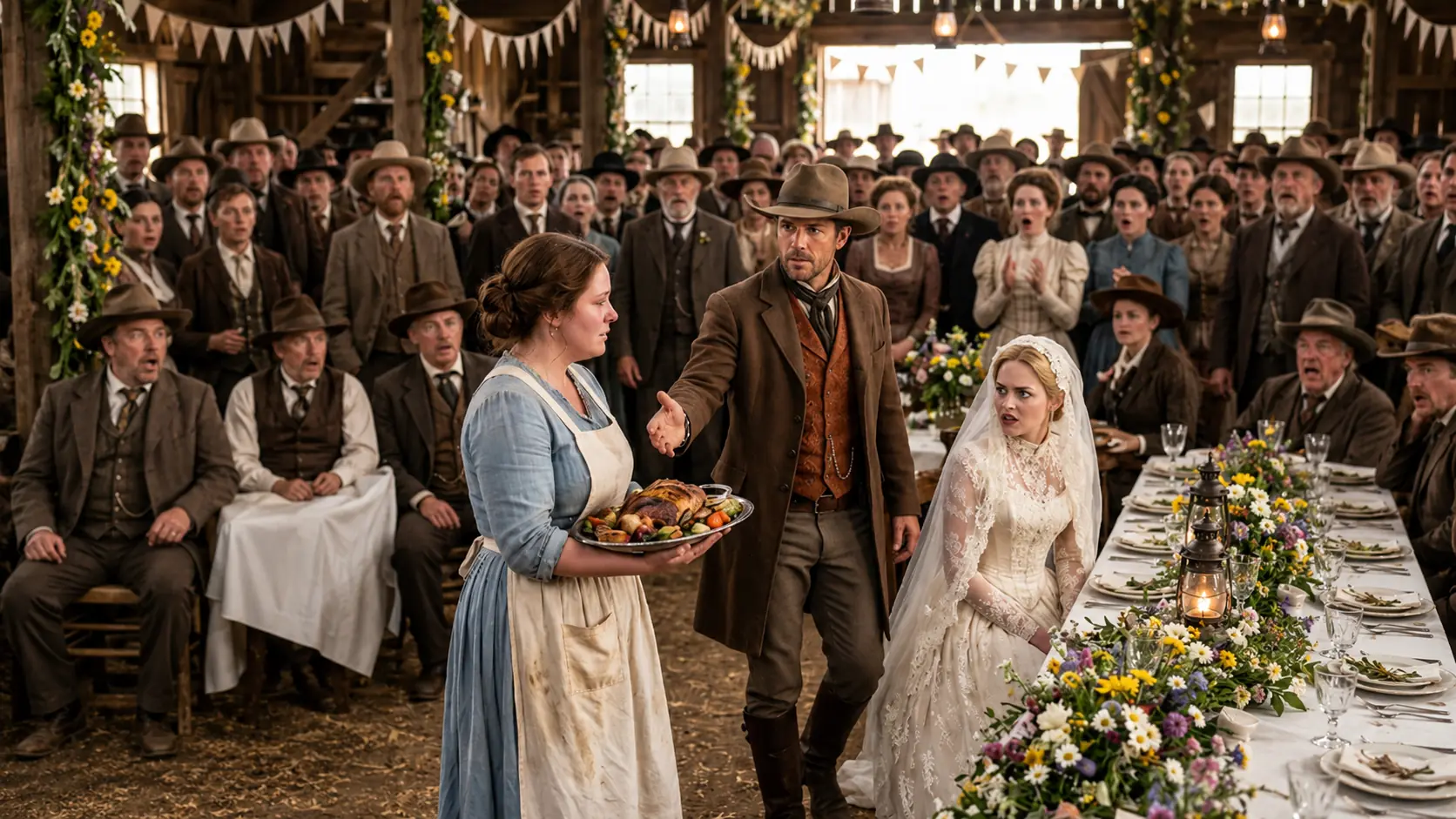
“She’s a fat kitchen widow,” the bride snapped, pointing at Abigail. “She belongs behind that door, not beside you.”
“I made your feast,” the wedding cook replied, struggling to keep her voice steady. “I never asked for your place.”
“Take her hand, and my family takes your land, your money, and every promise made today.”
Ethan never looked away from Abigail. “Then take it all. I won’t marry a woman who measures worth by weight and wealth.”
Six weeks earlier, Abigail had been standing beneath the leaking roof of her farmhouse when the letter from the Walker Ranch arrived. Her husband, Daniel Carter, had been dead for six years, leaving her forty struggling acres, a mortgage, and a house that seemed to develop a new weakness every winter. She survived by selling bread, pies, and preserved food to neighboring families, but the money rarely stretched far enough. The forty dollars offered for preparing the Walker wedding feast could repair the roof and prevent the bank from taking the property Daniel had left her.
Abigail accepted the position and arrived at the ranch carrying her knives, her mother’s cast-iron skillet, and a complete menu already organized in her mind. The ranch kitchen was larger than her entire home, with two wood-burning stoves, a stone hearth, a deep cold cellar, and wide tables suited for serious work. Standing alone in that room, she felt something inside her awaken. Cooking had never been merely labor to Abigail; it was the one language in which grief, patience, memory, and care could become something another person could hold.
Charlotte Bowmont entered before Abigail had finished unpacking. The bride was tall, elegant, and dressed in a pale traveling suit imported from St. Louis, with gloves that had never touched flour or wash water. She examined Abigail from head to toe with the cold, deliberate stare of someone evaluating a servant purchased for an unpleasant task. Before discussing the menu, Charlotte established the rule that would govern Abigail’s six weeks at the ranch.
“You are not to be seen by the guests,” Charlotte said. “Not during the ceremony, the meal, or the celebration.”
Abigail held her gaze. “I was hired to prepare the feast.”
“And that is all anyone needs to know. You will remain in this kitchen, speak only when addressed, and avoid drawing attention to yourself.”
The humiliation burned, but Abigail needed the money. She nodded, tied on her apron, and began working before Charlotte had left the room. The bride could hide the cook, Abigail decided, but she could not diminish the work itself.
For the first two weeks, Abigail labored almost entirely alone. She cured hams, prepared stocks, tested biscuit recipes, preserved fruit, and designed a four-tier cake decorated with handmade sugar roses and sweet peas. She rose before four each morning and worked until the evening light disappeared from the kitchen window. Every task carried the knowledge passed down from her mother and grandmother, women who had crossed hard country and kept families alive with skill no wealthy guest would ever think to praise.
One morning just after five, the back door opened while Abigail was kneading dough. Ethan Walker entered in dusty work clothes, his boots worn by real ranch labor rather than fashion. He introduced himself, poured coffee, and sat at the far end of the preparation table. Unlike Charlotte, he did not inspect Abigail’s body or speak to her as though she were part of the furniture.
“I won’t interfere,” he said. “This is your kitchen while you’re running it.”
“It belongs to your family, Mr. Walker.”
“The room belongs to whoever understands what needs doing inside it.”
Abigail continued working, uncertain how to respond. Ethan drank his coffee quietly and left after twenty minutes. He returned the next morning, then the morning after that, until his presence became part of the kitchen’s earliest rhythm.
Sometimes they sat in silence while dawn appeared through the window. On other mornings, Ethan asked questions about the work. He wanted to know why vinegar made piecrust flake, how Abigail could tell bread was ready by knocking against its bottom, and why she shaped every dinner roll by hand when guests would eat them in seconds.
“My grandmother said people can taste intention,” Abigail explained. “Food made carelessly fills the stomach. Food made with care reminds someone they matter.”
Ethan turned the coffee cup between his hands. “My mother said something similar.”
“She taught you to cook?”
“No. She tried. I was a poor student.”
Abigail smiled despite herself. Ethan noticed but did not make the moment uncomfortable. He simply asked another question and listened to the answer with his entire attention.
One afternoon, Charlotte brought Abigail a fashionable cake illustration from St. Louis. The drawing showed six unsupported tiers, delicate sugar columns, and decorations that would soften beneath the Wyoming heat. Abigail explained that the design could not remain standing through an outdoor July service. Charlotte’s face hardened as though the cook had challenged her authority rather than the laws of weight and temperature.
“You are being paid to make it possible,” Charlotte said.
“I am being paid to prevent your wedding cake from collapsing in front of two hundred people.”
“You will not tell me what can and cannot be done.”
Abigail placed the illustration on the table. “I will create something more beautiful, and it will survive the afternoon. That is my professional judgment.”
Charlotte stepped closer. “Do you understand what you are in this house?”
“I am the woman responsible for ensuring your guests remember the finest feast they have ever eaten.”
Ethan had entered through the back doorway without either woman noticing. After Charlotte departed, he remained beside the frame with his jaw clenched and his hat held tightly in one hand. Abigail immediately asked him not to confront his bride, knowing Charlotte would direct the consequences toward the person with less power.
“I won’t speak to her on your behalf if you don’t want me to,” Ethan said. “But you need to understand something.”
Abigail waited.
“You are not invisible in this house. Not to me.”
The words stayed with her long after Ethan left. She tried to dismiss them as the kindness of a decent man, but kindness had become so rare in her life that she could not stop hearing his voice. That night, she lay awake on the narrow cot behind the pantry, reminding herself that Ethan would soon marry another woman.
Their worlds were separated by more than money. Ethan owned thousands of acres, hundreds of cattle, and a respected family name. Abigail owned a leaking house, mortgaged fields, and kitchen tools wrapped in cloth. No amount of early coffee could change those facts.
Yet Ethan kept returning.
He told her about his mother, who had died twelve years earlier, and the father who built the ranch through drought, debt, and relentless labor. Abigail told him about Daniel, her late husband, who had been kind but careless with money and had left debts neither of them understood until after his burial. They did not speak like lovers. They spoke like two people who had gone years without being heard and had unexpectedly discovered a room where honesty felt safe.
Charlotte noticed.
One morning, Abigail heard the bride confronting Ethan in the corridor outside the kitchen. Charlotte accused him of spending more time with the cook than with the woman he was supposed to marry. Ethan replied that he took coffee in the kitchen because it was the quietest room in the house.
“She is hired help,” Charlotte said. “A fat widow from a failing farm who should cook the food and disappear.”
“Do not speak about her that way again,” Ethan answered.
His voice never rose, which made the warning more powerful.
The next morning, he entered the kitchen and acknowledged that Abigail had overheard them. She asked him to keep their relationship simple because she needed the job and could not afford to become the cause of conflict inside a wealthy family. Ethan accepted her request, but the silence between them changed. They both understood that something already existed between them, even if neither was willing to name it.
As the wedding approached, Abigail learned that Charlotte’s family had attached a business agreement to the marriage. The Bowmonts were working with a railroad company that wanted the Walker Ranch’s eastern grazing acres. Those pastures held water longer during dry summers and had supported the Walker cattle since Ethan’s father first settled the land.
Charlotte called the sale a practical wedding gift. Her father described it as the price of joining two influential families. Ethan saw it as surrendering the foundation of everything his parents had built.
One morning, he entered the kitchen looking more exhausted than Abigail had ever seen him. She poured his coffee without asking what was wrong. He sat quietly until she told him he could speak if he needed someone to listen.
“Charlotte believes land is only land,” he said. “She says the eastern acres can be replaced.”
“Can they?”
“No.”
“Then you already know your answer.”
“Knowing what is right and doing it are different things when two hundred people have been invited.”
Abigail stopped rolling dough. “Your father built this ranch. What would he tell you?”
“That the decisions a man makes to avoid disappointing others are the ones he carries longest.”
“Then listen to him.”
Ethan looked at her as though she had returned something he had nearly lost. He thanked her for listening and left before either of them said more. Abigail remained beside the table, understanding that the distance she tried to preserve was disappearing through a hundred quiet moments.
Charlotte’s resentment grew with every passing day. When wealthy friends visited the ranch, Abigail overheard the bride praising the food while mocking the woman preparing it. Charlotte described her as plain, substantial, and fortunately aware of her proper place. Her friends laughed, never realizing Abigail stood near the cellar stairs carrying a crate of preserved fruit.
Abigail did not confront them. Instead, she made herself a promise.
The wedding feast would be flawless.
Not for Charlotte, the railroad investors, or guests who would never know her name. Abigail would make it perfect because the work belonged to her. Every plate would represent her knowledge, her grandmother’s lessons, her mother’s skillet, and the six years she had survived after Daniel’s death.
On July 14, Abigail entered the kitchen at two in the morning. By sunrise, the bread was cooling in long golden rows, the hams were ready for carving, and fourteen pies waited inside the cellar. The four-tier cake stood in the center of the room, covered with ivory buttercream and delicate climbing flowers.
It was the finest thing she had ever made.
Charlotte appeared at noon wearing an elaborate ivory gown and lace veil. For one unguarded second, genuine admiration softened her face when she saw the cake. She admitted it was beautiful, but the warmth vanished as soon as her eyes returned to Abigail.
“I hope today gives you what you want,” Abigail said.
Charlotte stared at her. “Do your job.”
The ceremony took place without Abigail. She heard the fiddle music and the moment when two hundred guests became quiet, but she refused to imagine Ethan standing beside Charlotte and speaking promises he could never withdraw. She concentrated on temperatures, portions, sauces, and the order of service.
Course after course left the kitchen. Compliments returned through May, the ranch housekeeper. A cattleman from Laramie called the smoked ham the finest he had eaten in thirty years. A woman from Cheyenne demanded to know who had made the bread. Charlotte’s father praised the meal as proof of the Bowmont family’s standards.
When the cake entered the hall, Abigail finally sat beside the cold stove. Her entire body ached, and the edges of the room seemed softened by exhaustion. She had completed the work, earned the forty dollars, and survived six weeks inside a house where she had been ordered not to exist.
Then Charlotte began her toast.
The bride told the guests that many people had asked who prepared the feast. She described Abigail as a hardworking local widow who merely executed instructions created under Charlotte’s direct supervision. Every decision, Charlotte claimed, had come from her.
The first wave of laughter entered the kitchen through the wall.
Charlotte continued, describing Abigail as stout, plain, inexperienced, and ambitious only within the limits of a kitchen. She said women of Abigail’s type needed firm management and low expectations. Then she raised her glass and finished with two words delivered like a charitable blessing.
“Poor thing.”
More laughter followed.
Abigail sat completely still. She had prepared herself to receive no credit, but she had not expected Charlotte to steal the work and transform its creator into entertainment. Every plate in the hall carried Abigail’s labor, yet the woman who had done nothing was receiving applause for directing her.
May entered seconds later and found Abigail removing her apron. She begged her to stay, but Abigail began packing her knives and wrapping her mother’s skillet in straw. She intended to leave through the back entrance without giving the guests another reason to laugh.
Ethan entered before she reached the door.
He had heard Charlotte’s toast. His wedding coat remained buttoned, but his expression no longer belonged to a man celebrating. Abigail congratulated him and asked him to return to his guests.
“I am not going back in there,” he said.
“It is your wedding.”
“I cannot stand beside a woman who humiliates someone to make herself appear larger.”
“That is not my concern.”
“It became my concern when she used this ranch to do it.”
Abigail tightened her grip on the knife roll. “I agreed to remain invisible. She only reminded everyone of the arrangement.”
“That is not what you are.”
“It does not matter what I am.”
“It matters to me.”
The words stopped her, but she still moved toward the door. Ethan told her he needed five honest minutes in the only room that had felt honest for six weeks. Abigail recognized the pain in his face because it matched her own.
“Go back and face the hard thing,” she said. “You are not a man who runs.”
Ethan looked at her for a long moment. “What if the hard thing is not in that room?”
Abigail could not answer. She left the kitchen and began walking down the ranch road with her tools held against her chest. Behind her, Ethan returned to the banquet hall.
He approached Charlotte while the guests were still laughing. The bride expected him to restore order and continue the celebration. Instead, Ethan asked her to repeat what she had said about Abigail while looking directly at the woman who had created the feast.
Charlotte accused him of embarrassing her. Her father rose from the head table and warned Ethan not to jeopardize the land agreement. Railroad representatives watched with growing concern while every conversation in the barn disappeared.
Ethan looked across the tables at Abigail’s bread, hams, vegetables, pies, and extraordinary cake. He remembered six weeks of morning coffee, patient explanations, and a woman who placed intention into every task despite being treated as though she possessed no value. Then he looked at Charlotte and understood that marrying her would mean approving every cruel judgment he had witnessed.
He removed the white flower pinned to his coat.
“I will not spend my life beside someone who measures worth by weight, wealth, and social position,” he said.
Charlotte’s face twisted in disbelief. “This is about the cook?”
“No. This is about the person you revealed yourself to be.”
“My father’s money saves this ranch.”
“The ranch does not need saving if the price is becoming a man my father would despise.”
Charlotte threatened to destroy the land deal, withdraw every investment, and leave Ethan with debts he could not cover. He answered that she could take every promised dollar but would never take the eastern acres. When she called Abigail a fat kitchen widow again, Ethan stepped away from the bride’s table and ended the engagement in front of everyone.
Charlotte threw her wineglass against the wall.
Outside, Abigail had stopped walking when May came running from the ranch. The housekeeper told her Ethan had canceled the wedding and publicly defended her. Abigail insisted that he had acted because of Charlotte’s character, not because of the cook.
May took her arm. “He is standing in the wreckage of his entire future, and he asked for you.”
Abigail returned through the kitchen entrance. Ethan stood at the worktable with his sleeves rolled up and both hands pressed against the flour-dusted wood. His guests were leaving, the Bowmont family was threatening lawyers, and his financial arrangements had collapsed within minutes.
Yet when he saw Abigail, his first question was whether she was all right.
“No,” she finally admitted. “I spent six weeks creating the best work of my life, and she turned me into a joke.”
“She was wrong.”
“People still laughed.”
“They stopped when they realized what she had done.”
“That does not erase it.”
“No,” Ethan said. “But I will never ask you to pretend it was acceptable.”
Charlotte entered before they could continue. Her veil had shifted, and her controlled elegance had fractured beneath humiliation. She accused Ethan of choosing a servant over duty, then demanded that Abigail admit she had deliberately lured him away.
“I cooked your food,” Abigail replied. “I never pursued your fiancé.”
Charlotte looked at Ethan. “Tell me this is not about her.”
“It is about you,” he said. “It is about the land, the way you treat people, and every warning I ignored because disappointing your family seemed harder than betraying myself.”
For the first time, Charlotte’s anger faded. She admitted Ethan had never intended to surrender the eastern acres and that she had known the marriage was failing before Abigail arrived. Then she faced the cook.
“What you made today was extraordinary,” Charlotte said with visible difficulty. “I knew my speech was false while I was giving it.”
The admission did not repair the damage, but Abigail recognized that it had cost Charlotte something. She accepted the words without offering immediate forgiveness. Charlotte left the kitchen and departed the ranch with her family before sunset.
Ethan did not ask Abigail to stay. He told her only that the mornings they shared had shown him the difference between the life he was approaching and the truth he was abandoning. Abigail listened, then returned to her farm because neither of them was ready to build love from the ruins of a canceled wedding.
Eleven days passed.
Abigail repaired her roof with the forty dollars and accepted a lucrative offer to prepare a cattlemen’s dinner in Laramie. The guests who attended the Walker celebration had remembered the food, and for the first time, her name traveled with her work. More requests followed.
Ethan remained at the ranch, working without Bowmont money and refusing to mortgage the eastern acres. He did not send gifts, pressure Abigail, or use May to deliver romantic messages. He waited because he understood that choosing her publicly did not grant him a claim over her future.
Abigail finally wrote that she believed she had left something in the ranch kitchen. She returned at five on a Thursday morning and found a warm coffee pot beside a note in Ethan’s handwriting.
I searched the entire kitchen. Tell me what you left.
Ethan entered a moment later. They stood across the same worktable where their friendship had begun. Abigail admitted she had not left a physical object.
“What did you leave?” he asked.
“The part of me that remembered what it felt like to be seen.”
Ethan moved around the table but stopped before touching her. He told her the engagement had been wrong before she arrived, and that her presence merely gave him enough honesty to face it. Then he said he admired her work, strength, judgment, and the way she refused to make herself smaller for anyone.
“I am afraid,” Abigail admitted.
“So am I.”
“I am not a woman men choose.”
“I already chose honesty over an arrangement that was destroying me,” Ethan said. “But I am not asking you to reward that. I am asking whether you might let me know you beyond this kitchen.”
Abigail studied him. “I am opinionated, difficult, and particular about bread.”
“I have known that since the third morning.”
She poured two cups of coffee and told him to sit.
They married three months later in the yard of Abigail’s farmhouse. There were no railroad investors or two hundred guests, only May, several neighbors, and the cattleman whose recommendation had launched Abigail’s growing catering business. Ethan protected the eastern acres, while Abigail kept her farm and expanded its kitchen instead of surrendering her independence.
Charlotte had attempted to hide the cook behind a door, then humiliated her when the work became impossible to ignore. Ethan did not choose Abigail because she needed rescuing or because Charlotte’s cruelty made the widow appear virtuous by comparison. He chose her because six weeks of quiet mornings revealed a woman whose worth had always existed, whether wealthy guests recognized it or not.
Abigail had spent years feeding people who forgot to thank her. At last, she stood beside a man who understood that the warmest room in any home was not created by wealth, beauty, or status.
It was created by the person who filled it with care.