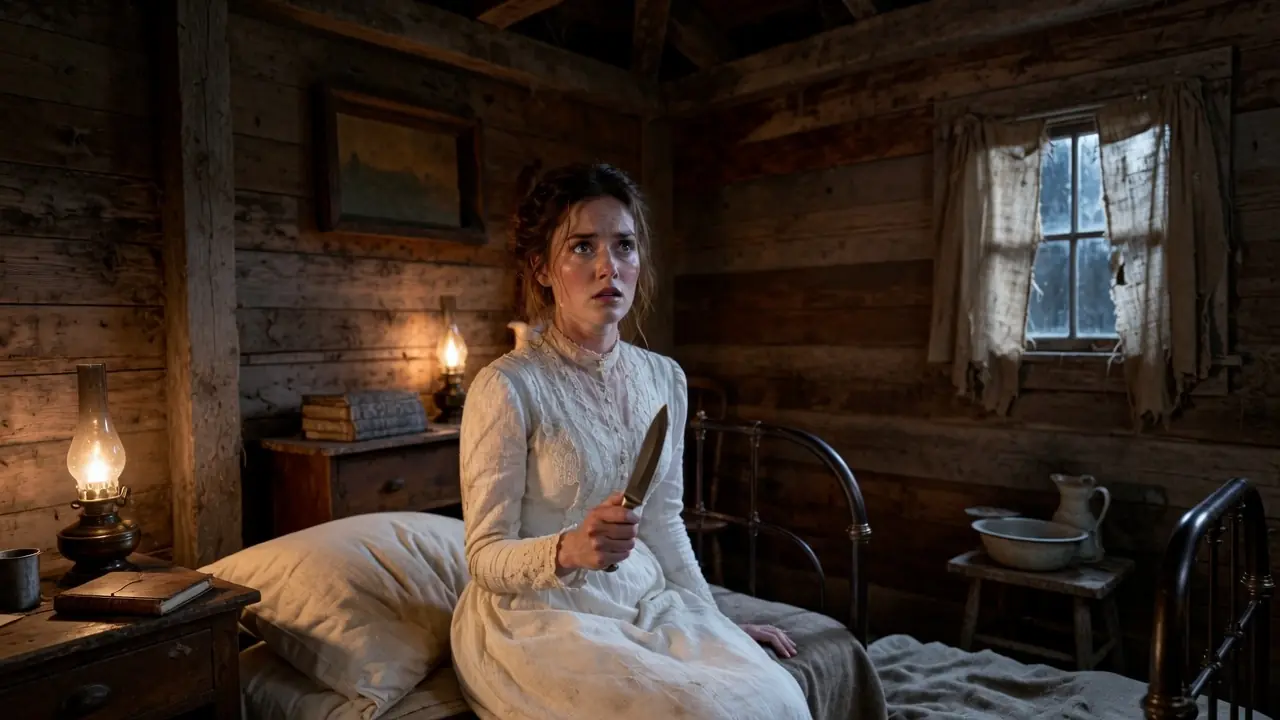
Nora Brennan’s voice was barely louder than the lamp flame hissing on the washstand, but it stopped Eli Brennan in the hallway as sharply as a rifle cocking in the dark. She sat on the edge of the iron bed in her dusty wedding dress, one hand pressed beneath the pillow, fingers wrapped around the cold handle of a kitchen knife. Outside the bedroom door, Eli’s shadow moved across the crack of lamplight, tall and silent. The Wyoming wind pressed against the cabin walls, and for one long moment Nora thought she had made the worst mistake of her life.
“I won’t,” Eli said through the door. His voice was low, rough from the cold and the long ride back from town, but there was no anger in it. “That chair isn’t there to trap you, Nora. It’s there so you know I won’t cross this door tonight.” Wood scraped once more against the floor as he pushed the chair firmly beneath the latch from the hallway side, not to lock her in, but to keep himself out.
Nora stared at the door until her eyes burned. Every lesson life had carved into her told her not to believe him. Men made promises softly when they wanted a woman to lower her guard, and then the door opened, the smile changed, the hand tightened. Her aunt had called fear a bad habit. Gideon Price had called it something he would cure after the wedding.
But Eli Brennan did not open the door. He did not test the latch, did not laugh, did not ask what kind of wife hid from her husband on their wedding night. He only stood outside in the narrow hallway, breathing quietly enough that she could hear the wind beyond him. Then he said, “The bed is yours. The room is yours. If you need water, knock twice and I’ll leave it outside.”
Nora’s hand stayed around the knife. “Why?” she whispered, though she wasn’t sure whether she meant the chair, the kindness, or the marriage itself. Eli was quiet for several seconds, and she imagined him standing there with one hand against the door, choosing each word as carefully as a man stepping over thin ice. “Because I asked for a wife,” he said at last. “Not a prisoner.”
Those words struck the place inside her where all her panic had gathered. She closed her eyes, and for one terrible second she wanted to cry so hard she might never stop. Instead, she swallowed the sound down the way she had learned to swallow everything. The knife remained beneath the pillow, but her grip around it loosened slightly.
That morning, Nora had still been Nora Whitfield, stepping off a train in Laramie County with a cracked leather satchel and a wedding dress already graying at the hem. The dress had belonged to a cousin who had married rich and died young, and Nora’s aunt had altered it with too much thread and not enough kindness. “A bride should suffer a little to look smaller,” Aunt Marion had said, pulling the bodice tight until Nora could barely breathe. Nora had smiled because smiling was safer than answering.
She had not come west for romance. She had come because staying in St. Louis meant marrying Gideon Price, a man who spoke to her as if every inch of her needed correction. He was wealthy enough to impress her aunt, respectable enough to fool neighbors, and cruel enough that Nora could feel his future in the weight of his hand on her shoulder. When he told her he would teach her obedience after the wedding, she understood that the word wife could become another name for property.
Eli Brennan’s letter had arrived through an agency, plain and practical, with no poetry and no lies. He was a widower, thirty-seven, owner of a small ranch outside Laramie, seeking a wife to share a household and steady work. He did not ask for beauty, charm, or softness. He wrote that loneliness was not a reason to marry, but it was sometimes the reason a man finally admitted he needed another human being at the table.
That sentence had saved her before she ever saw his face. Nora answered the letter with shaking hands, writing only what she could offer: literacy, house skills, bookkeeping, patience, and a willingness to work. She did not mention fear. She did not mention Gideon. She did not mention that she was running with just enough money for the train and one small satchel.
The wedding itself had taken less than ten minutes above a feed store. The justice of the peace smelled of tobacco and ink, and the room’s single window rattled in the wind. Eli stood beside Nora in a dark coat, his hands rough, his eyes serious, his vows spoken without flourish. He did not stare at her body, did not grip her hand too tightly, and did not smile like a man pleased with his purchase.
That frightened her more than greed would have. Greed was familiar. Cruelty had a shape she knew how to survive. Eli’s restraint gave her nothing to defend against, and that made her feel exposed in an entirely new way. When they reached his cabin after sunset, she waited for the moment his patience would end.
It did not. He carried her satchel inside, showed her the room, and stepped back from the doorway. “You can rest,” he said. “I’ll check the horses.” Then he left her alone.
Alone was the only thing she trusted. The room was simple, almost painfully clean, with an iron bed, a wool blanket, a washstand, and a narrow window facing the dark corral. Nora stood in the center of it until his footsteps disappeared from the porch. Then she went to the kitchen, found the knife, wrapped it in a handkerchief, and slid it beneath her pillow.
Now, hours later, the knife lay between her palm and the ticking, and Eli slept outside her door. She knew because after a long silence, the floorboards creaked, then settled. He had not gone to his own bed. He had dragged the hallway chair into place, sat down on the other side of the door, and made himself the barrier he had promised.
Nora did not sleep at first. Every sound became a warning: the wind, the horses, the soft pop of the stove cooling in the main room. But the door never opened. Eli never spoke again. Sometime near dawn, exhaustion finally pulled her under, her hand still touching the knife, her cheek wet against the pillow.
When she woke, sunlight lay pale across the wooden floor. The chair still sat outside the door, visible through the crack near the threshold. Nora listened and heard Eli moving in the kitchen, quiet and deliberate. There was no impatience in the sounds, no stomping, no slammed pans to punish her for the night before.
A soft knock came, two taps. Nora’s whole body went rigid. Eli’s voice followed, calm through the wood. “I made coffee. There’s biscuits too. I’ll leave a plate outside the door and go to the barn.”
Nora did not answer. A plate touched the floor outside. Then his footsteps moved away, crossed the cabin, and left through the front door. Only after the barn latch sounded did Nora rise, move the chair carefully, and open the bedroom door.
The plate held two biscuits, butter, and a small tin cup of coffee. Beside it lay a folded note written in a square, careful hand. You don’t owe me bravery before breakfast. Nora read it three times, then sat on the floor and ate with one hand covering her mouth, because kindness made hunger feel like grief.
By midday, she changed out of the wedding dress and into the plain brown skirt from her satchel. She folded the dress carefully and placed it on the peg, though part of her wanted to burn it. When she stepped into the kitchen, Eli was at the table repairing a leather strap, his hat beside his elbow. He looked up once, then lowered his eyes so quickly she almost missed the relief in them.
“Morning,” he said, though it was nearly noon.
“Morning,” Nora answered.
He gestured toward the stove without rising. “There’s more coffee if you want it.”
She nodded, grateful that he did not ask whether she slept, whether she feared him, or whether she still had the knife.
For the next week, they lived like two strangers learning the rules of a fragile truce. Eli gave her the bedroom and slept in the main room near the stove. Each night, he placed the chair beneath her latch from the hallway side and said, “Your door.” Each morning, he moved it away before breakfast and never once mentioned the knife.
Nora began to learn the cabin. She found the flour barrel, the chipped blue bowl, the broom with a loose handle, and the ledger where Eli recorded feed costs and cattle sales. His handwriting was careful, though not elegant, and his accounts were honest down to pennies. She understood numbers, and numbers calmed her because they told the truth without raising their voices.
Eli began to learn her silences. He learned not to stand too close behind her, not to reach suddenly, not to touch her shoulder to get her attention. When she dropped a cup after a pan clattered too loudly, he did not scold her. He picked up the broken pieces, set them on the table, and said, “One less cup to wash.”
The first time she laughed, it startled them both. It was a small sound, quick and frightened by its own existence. Eli looked at her then, not with triumph, but with something softer and more dangerous. Hope.
Two weeks after the wedding, a storm trapped them indoors. Snow pressed against the windows, and the sky turned the color of tin. Nora sat at the table with Eli’s ledger open while he mended a harness strap near the stove. The cabin was quiet, but not empty.
“You keep better books than most merchants,” she said.
“My wife taught me.”
Nora’s pencil stilled. It was the first time he had mentioned the woman before her without turning away.
“Her name was Ruth,” Eli said. “She could make numbers confess even when men tried to hide them.”
Nora looked at him carefully. “Did you love her?”
“Yes.”
The answer was immediate, honest, and free of apology. Nora thought she should feel smaller because of it, like a shadow standing where another woman had once lived. Instead, the truth steadied her. A man who could speak love without possession might be safer than she knew.
“She died three years ago,” Eli said. “Fever took her in four days.” He rubbed his thumb along the leather strap, not really seeing it. “After that, I kept the ranch alive and let the house go quiet.”
“I’m sorry,” Nora said.
He nodded. “So am I.”
That night, when he placed the chair outside her door, Nora opened it before he could walk away. Eli stepped back immediately, giving her space. She noticed that now, how quickly he made room for her fear. She held the knife in both hands, wrapped in its handkerchief.
“I should give this back to the kitchen,” she said.
Eli did not reach for it. “Do you want to?”
Nora looked down. The knife had been safety, then shame, then something she no longer knew how to name. “Not yet,” she admitted.
“Then keep it,” he said. “A thing that helps you sleep is not a sin.”
Her eyes burned. “You should be angry.”
“I have been angry plenty,” he said. “Just not at you.”
Before she could answer, he moved the chair into place again, gently this time, as if even the wood deserved tenderness.
The first letter came in February. Nora recognized Aunt Marion’s handwriting before she opened it, and the sight made her stomach turn. The words were sharp, perfumed with concern. Gideon Price was embarrassed. Family reputation had suffered. A woman could not simply run from an understanding.
Eli found her standing at the stove with the letter crushed in her hand. “Bad news?” he asked.
“My aunt says I behaved shamefully.”
“Did you?”
Nora looked up, startled.
Eli’s face was calm. “I’m asking you, not her.”
That question undid her more than any accusation might have. No one had ever asked Nora to define her own innocence. She sank into a chair and told him about Gideon, about the hand on her shoulder, the discipline, the way Aunt Marion treated marriage like a sale that had taken too long to close. The words came slowly at first, then all at once, and Eli listened without interrupting.
When she finished, his hands were folded so tightly his knuckles had gone pale. Still, his voice remained gentle. “Does Gideon know where you are?”
“I don’t know.”
“If he comes, he won’t enter this house unless you say so.”
Nora gave a bitter little laugh. “Men like him do not ask permission.”
Eli looked at the bedroom door, then back at her. “Then he’ll learn something new.”
Gideon arrived nine days later with Aunt Marion in a hired buggy, both of them dressed as though outrage required fine clothes. Nora saw them from the window and went cold from throat to fingertips. Eli was outside chopping wood. He set the ax down and stood between the buggy and the porch before Gideon had both boots on the ground.
“Mr. Brennan,” Gideon said, smiling like a man already forgiving an inferior. “I believe there has been a misunderstanding.”
Eli did not move. “There hasn’t.”
Aunt Marion stepped down, clutching her gloves. “Nora is confused. She belongs with family.”
From inside the cabin, Nora gripped the curtain. Family had become a word people used when they wanted to claim the right to harm you privately.
“She is married,” Eli said.
Gideon’s smile tightened. “A marriage can be challenged when a woman enters it under distress.”
Eli’s gaze hardened. “Careful. You may not like what she says caused the distress.”
Aunt Marion’s eyes flicked toward the window, and Nora stepped back before she could be seen.
Gideon tried to walk around Eli. Eli shifted once, calm and immovable, blocking him without touching him. “You don’t own the porch,” Gideon snapped.
“No,” Eli said. “But I own the land under it, and Nora owns the choice of whether to open that door.”
The words traveled through the cabin and found her where she stood shaking.
Nora looked toward the bedroom, toward the knife beneath the pillow, toward the chair that had stood outside her door every night as proof that a man could protect without claiming. Then she opened the front door herself. Eli half-turned, alarm flashing across his face, but he did not tell her to go back inside.
Gideon smiled when he saw her. “There you are.”
Nora’s knees nearly weakened at the old tone, the one that made her feel like a child caught stealing breath. But Eli stood beside her, not in front of her now, and that mattered. He was not hiding her. He was staying.
“I am Mrs. Brennan,” Nora said. Her voice trembled but did not break. “And I am not leaving.”
Aunt Marion made a sound of disgust. “After all we did for you?”
“You tried to hand me to a man I feared.”
Gideon’s smile vanished. “You ungrateful little—”
Eli took one step forward. “Finish that sentence carefully.”
The hired driver looked down at his reins, suddenly fascinated by the horses. Gideon seemed to realize there would be no easy performance here, no frightened woman dragged away while others pretended not to see. He adjusted his cuffs and forced another smile. “This is not finished.”
“No,” Nora said softly. “But it is finished here.”
After they left, Nora’s legs gave out. Eli caught her only because she reached for him first. The moment his arms came around her, careful and steady, she began to cry against his chest. He held her like something precious but not fragile, one hand warm between her shoulders, the other resting lightly at her back.
“I’m sorry,” she whispered.
“For what?”
“For shaking.”
His chin lowered near her hair. “Nora, you stood at your own door and kept it yours. Shake all you need.”
Spring came slowly to the Brennan ranch. Snow melted into mud, mud turned to grass, and the cabin began to hold sounds that had not lived there before. Nora sang sometimes when she cooked, though she stopped whenever she noticed Eli listening. She planted herbs near the kitchen window and repaired curtains Ruth Brennan had once sewn, whispering an apology to the woman whose home she was learning to share.
Eli stopped putting the chair under her latch in April. Not because he chose to stop, but because one night Nora opened the door and said, “Leave it in the hall.”
He looked at her carefully. “Are you sure?”
“No,” she said honestly. “But I want to learn what sure feels like.”
He nodded and left the chair beside the wall.
A week later, she asked him to sit with her before bed. They sat on opposite sides of the iron bed, fully clothed, hands folded like two nervous children. The lamp burned low, and the night outside was quiet. Nora could hear Eli breathing, slow and controlled, as if even his lungs were trying not to frighten her.
“You are very careful,” she said.
“With you, yes.”
“Does it tire you?”
He looked at her then, and the hurt in his eyes was not for himself. “Nora, I would rather spend a lifetime waiting at a door you open willingly than one night taking what fear gives me.”
She cried again, but differently this time. Not from terror. From the unbearable ache of being treated as if her will mattered. Eli did not touch her until she reached for his hand.
By summer, they shared the same room, though not every night and never without her saying so. The knife returned to the kitchen drawer. The chair remained in the hallway, no longer braced beneath the latch, but neither of them moved it away. It had become part of the story, strange and sacred in its own way.
In August, Nora found the old wedding dress in the bottom of her trunk. The hem was still gray with train dust, and the snapped pearl button hung loose near the waist. She carried it outside, and Eli followed without asking questions. They stood near the burn barrel as the sun lowered over the prairie.
“I thought this dress meant the end of me,” Nora said.
Eli looked at it. “What does it mean now?”
She touched the stained sleeve. “That I ran farther than fear thought I could.”
Then she folded the dress instead of burning it. “Not today,” she said. “Some things become proof if you keep them long enough.”
Their first true anniversary was not marked in town. Nora did not want a crowd, a speech, or a white dress. Eli cooked supper badly, and she laughed so hard he claimed the beans had been sacrificed for the sake of her happiness. After they ate, he took her hand and led her to the hallway.
The chair still sat beside the wall. Eli rested one hand on its back. “I thought about throwing this out.”
Nora shook her head. “Don’t.”
“It’s only a chair.”
“No,” she said. “It was the first time a door protected me because a man chose honor over power.”
Eli’s face changed, softening into something almost too tender to bear. “Nora.”
She stepped closer and placed her hand against his chest. His heart beat fast beneath her palm, and the knowledge comforted her. He was not made of stone. He had simply loved her gently enough to seem unshakable.
“I was so afraid of you that night,” she whispered.
“I know.”
“And you still stayed outside.”
“I promised.”
She rose on her toes and kissed his cheek, soft and brief. Then, because he did not move too quickly or take more than she offered, she kissed him again.
His arms came around her slowly, giving her time to stop him. She did not. She leaned into him, her cheek against his shoulder, and felt the warmth of the man who had waited until love became a place she could enter by choice. The cabin creaked around them, old wood settling into the night, no longer a trap, no longer a hiding place, but a home.
Years later, when people asked how Nora Brennan learned to trust her husband, Eli never told the story unless she wished it told. Nora sometimes did. She would smile at the chair by the hall wall and say, “On my wedding night, I begged him not to come in.” Then she would look at Eli, whose eyes still softened every time.
“And he didn’t,” she would say.
That was all some people heard. But Nora knew the whole truth. He had not come in, and because of that, one day, she opened the door.