The hydraulic hose failed for the fourth time while Eli Mercer was lifting a cultivator near the north field. One moment, the Case IH tractor was moving steadily across the dark Iowa soil, and the next, hydraulic oil sprayed beneath the rear housing as the implement dropped hard into the earth. Eli shut down the engine before the damaged line could empty the entire system. Then he sat in the cab, staring at the warning light and listening to the wind move through the young corn.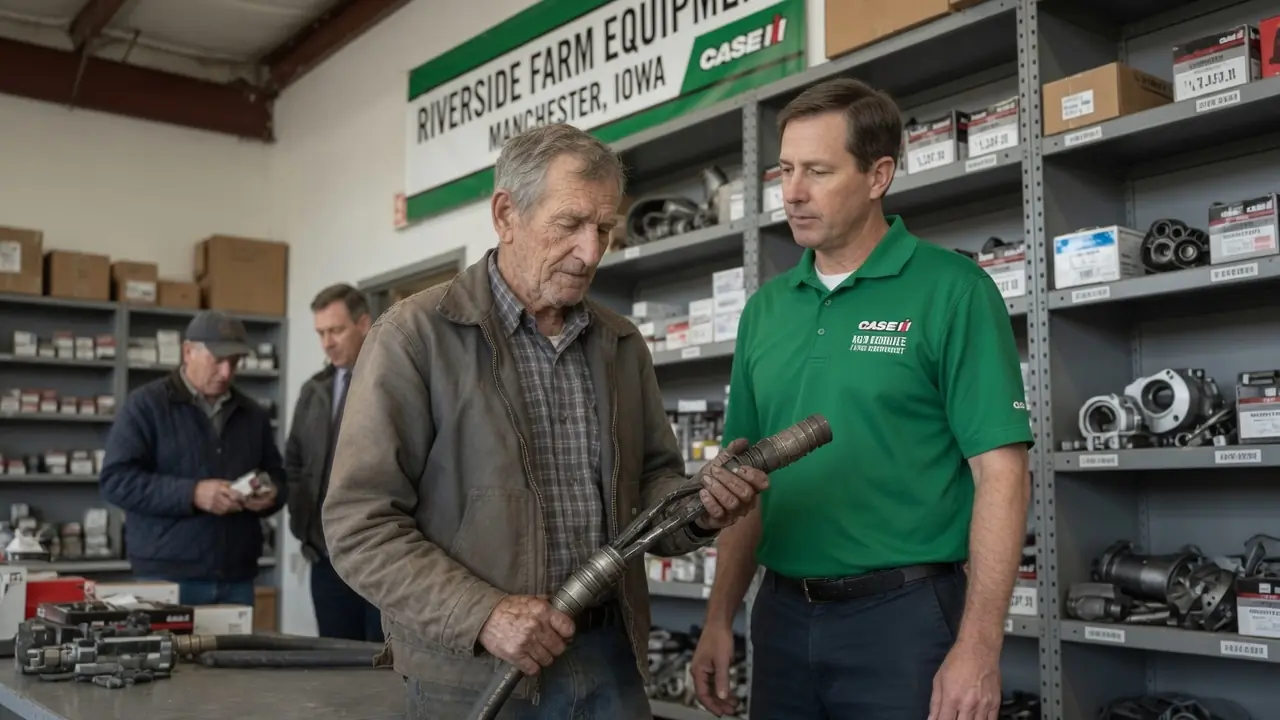
At seventy-two, Eli had spent nearly six decades around farm machinery. He could identify a failing bearing by sound, a weak fuel pump by rhythm, and a hydraulic restriction by the way a control lever resisted beneath his hand. He was not an engineer, and he never pretended to be one. But he knew when a repaired machine was suffering from the same unresolved problem.
The failed hose was less than three months old. Riverside Farm Equipment had installed it after the previous line ruptured in almost the exact location. That replacement had followed another, and the first failure had occurred only a year after Eli purchased the used tractor.
Each invoice described the problem as ordinary hose fatigue.
Eli did not believe it.
He climbed down, placed an absorbent pad beneath the leak, and examined the damaged coupling. The hose had split near the crimp where vibration and sudden pressure spikes placed the greatest strain on the metal fitting. A dark polished mark appeared along the bracket beside it, showing that the line had been flexing each time the three-point hitch moved.
The hose was not simply wearing out.
It was being punished.
Eli called his neighbor, Mason Clark, who arrived with a pickup and a long tow chain. They lowered the cultivator manually, disconnected it, and pulled the tractor slowly toward the barn. Mason complained about the machine for nearly the entire journey.
“Should have bought green,” he said.
“You say that every time something red breaks.”
“And one day you’ll admit I was right.”
“Your John Deere lost a transmission last fall.”
“That was different.”
“It was green when it happened.”
Mason laughed and continued driving.
Inside the barn, Eli removed the damaged hose and placed it beside the previous two lines he had saved on a workbench. The ruptures were nearly identical. Each one had split within inches of the same coupling, and every fitting showed the same evidence of repeated pressure impact.
His granddaughter, Nora, found him there after sunset. She was twenty-six, studying agricultural engineering at Iowa State, and spending the summer helping on the farm while completing a research project. Nora picked up one of the hoses and turned it beneath the light.
“This is not normal abrasion,” she said.
“That’s what I told Riverside.”
“What did they say?”
“That hoses fail.”
Nora studied the crimped end. “This section is receiving a pressure spike.”
“That was my thought.”
“Could be valve timing, a restricted return line, or movement in the bracket.”
“Or all three working together.”
Nora smiled. “You sound like an engineer.”
“I sound like a man who paid for the same hose four times.”
The following morning, Eli drove to Riverside Farm Equipment in Manchester. He carried the failed hose, the previous repair invoices, and several photographs showing the polished bracket mark. The dealership occupied a large metal building beside the highway, with new tractors displayed in a line along the gravel lot.
Inside, shelves held filters, belts, hydraulic fittings, and boxed parts arranged beneath bright fluorescent lights. Farmers stood near the service counter discussing planting delays, equipment loans, and the price of diesel. Eli waited quietly until service manager Grant Holloway finished a telephone call.
Grant was forty-eight, neatly dressed, and proud of knowing every official procedure in the Case IH service system. He had managed the department for seven years and measured competence through factory certificates, diagnostic computers, and approved parts numbers. He recognized Eli immediately and looked toward the hose with visible impatience.
“Again?” Grant asked.
“Again.”
“We installed the recommended replacement.”
“And it failed in the same place.”
Grant took the hose but barely examined it. “Hydraulic lines are wear items.”
“Four in less than two years?”
“You operate older equipment.”
“The tractor has fewer than five thousand hours.”
“Hours are not the only factor.”
Eli placed the photographs on the counter. “The line is striking this bracket, but the rupture happens after the valve closes. I believe the return circuit is trapping pressure.”
Grant glanced at the images. “Did you perform a pressure test?”
“I used my mechanical gauge.”
“Factory diagnostic gauge?”
“A gauge measures pressure whether it wears a factory sticker or not.”
Several farmers near the counter stopped talking.
Grant set the hose down. “What exactly are you asking us to do?”
Eli removed a small metal sleeve from his coat pocket. It had been machined from steel and contained an internal channel with two relief openings. The design was based on a pressure-dampening sleeve used on an older John Deere hydraulic circuit that Mason had shown him.
“I want this adapted between the line and the valve block,” Eli said. “It gives the trapped pressure somewhere to bleed before it reaches the hose coupling.”
Grant stared at the part.
“You copied this from a John Deere system?”
“I studied it.”
“This is a Case IH dealership.”
“Pressure does not care what color the tractor is.”
A few farmers laughed quietly.
Grant’s face tightened. “We will not install an unauthorized component copied from a competing manufacturer.”
“Then test the pressure spike and build your own.”
“The factory has not identified a design problem.”
“The factory does not farm my north field.”
Grant pushed the sleeve back across the counter. “If we modify that circuit and something fails, the dealership assumes liability.”
“You already repaired it four times without solving the cause.”
“We followed approved procedure.”
“And the approved procedure failed.”
Grant folded his arms. “Mr. Mercer, you are a farmer, not a hydraulic engineer.”
Eli looked at the manager for several seconds. He had heard similar words from bankers, sales representatives, and younger technicians who assumed experience became ignorance when it turned gray. He did not become angry.
He became certain.
“Will you document that you refused to inspect the modification?”
Grant laughed. “You want that in writing?”
“Yes.”
“Fine.”
The manager printed a service note stating that Riverside Farm Equipment declined to install or evaluate an unauthorized hydraulic modification derived from a John Deere design. He added that the dealership recommended replacing the hose with another approved Case IH part.
Eli read every line before signing acknowledgment of receipt.
Then he folded the document, picked up the damaged hose, and left.
Nora was waiting inside the barn when he returned. Eli placed Grant’s refusal beside the three failed lines and explained the conversation. She read the service note twice.
“He actually wrote ‘derived from a John Deere design,’” she said.
“He wanted to make certain everyone knew how foolish I was.”
“That may help us later.”
“If we are right.”
Nora looked toward the tractor. “Then let’s find out.”
They spent the afternoon testing the hydraulic circuit. Nora connected pressure sensors at three points while Eli operated the lift controls from the cab. Under slow movement, the readings remained within normal range. But when the cultivator reached full height and the control valve closed, pressure spiked sharply before settling.
The surge lasted less than a second.
It was enough.
The original hose routing placed the most vulnerable coupling directly in the path of that pressure impact. The bracket vibration worsened the strain, but the trapped surge caused the repeated rupture. Replacing the hose only reset the clock.
Nora recorded the readings.
“The sleeve might work,” she said. “But we should change the bracket too.”
Eli nodded. “A softer mount?”
“Rubber isolation and another half-inch of clearance.”
They built the first prototype that evening.
Eli machined a new steel body using his grandfather’s lathe, while Nora calculated the opening size needed to reduce the pressure spike without weakening normal hydraulic response. They installed the sleeve, replaced the bracket with a rubber-mounted support, and fitted a new high-pressure hose.
The following morning, they tested the circuit again.
The first lift produced a smaller spike.
The second produced less.
After adjusting the internal passage, the third test brought the pressure surge down to nearly half its original peak. The hose no longer snapped against the bracket, and the cultivator responded normally.
Eli did not celebrate.
A repair that worked for ten minutes was still only an idea.
He began a test ledger.
Every day, he recorded operating hours, outside temperature, implement weight, pressure readings, and visual inspection results. Nora created a spreadsheet, but Eli also wrote everything by hand because batteries failed and paper did not.
For twelve days, the system worked without trouble.
On the thirteenth day, Mason arrived carrying a damaged hose from his neighbor’s Case IH tractor. The rupture appeared near the same coupling. He placed it on Eli’s workbench beside the others.
“Word at Riverside is that you built a green part for a red tractor,” Mason said.
“Word travels quickly when people want to laugh.”
“Can you build another one?”
“For whose machine?”
“Calvin Reese.”
Eli knew Calvin. He farmed four hundred acres outside Delhi and had recently replaced two hydraulic lines on a Case IH tractor nearly identical to Eli’s.
“Did Riverside refuse him too?” Eli asked.
“They replaced the hose again.”
Nora looked at her grandfather. “We need permission and documentation.”
Mason smiled. “She really is an engineer.”
“She is a person who does not want us sued.”
Eli called Calvin and explained the modification carefully. He made clear that the part was experimental, unofficial, and not approved by the manufacturer. Calvin listened before answering.
“If it stops me paying Riverside another six hundred dollars, I’ll sign whatever paper Nora writes.”
They installed the second sleeve two days later.
Calvin’s pressure readings showed the same short surge. After the modification, it dropped by forty-seven percent. Eli gave Calvin an inspection checklist and asked him to call immediately if anything changed.
The repair held.
Within another week, three more farmers arrived carrying failed hoses. Each machine had a slightly different configuration, but all showed the same combination of trapped pressure and poor line support. Eli refused to build parts blindly. He inspected every tractor, measured every circuit, and adjusted each sleeve to match the system.
Nora numbered the modifications.
Mercer Sleeve 01 remained on Eli’s tractor.
Number 02 went to Calvin.
Numbers 03 through 05 went to farmers in Delaware and Buchanan counties.
By the twenty-eighth day, none had failed.
Grant Holloway heard about the repairs from a parts employee. At first, he dismissed them as temporary farmyard patches. Then a customer canceled a scheduled hose replacement after asking Eli to inspect his tractor.
Grant called Eli.
“You are installing unauthorized hydraulic parts on Case IH equipment.”
“I am repairing privately owned tractors with the owners’ consent.”
“You are creating a safety risk.”
“I have pressure records for every machine.”
“You do not have factory approval.”
“The factory has not returned any of my calls.”
Grant became quiet.
“You contacted Case IH?”
“Three times.”
“What did you send?”
“Photographs, pressure data, failure patterns, and the Riverside refusal notice.”
Grant’s voice hardened. “You included my name?”
“It was printed on the document.”
“This could damage the dealership.”
“The rupturing hoses are doing that.”
Grant ended the call without saying goodbye.
On day thirty-five, an independent repair shop in Independence contacted Eli. Its owner, Rosa Martinez, had seen two machines with identical failures and wanted to inspect the sleeve.
Rosa arrived carrying measuring tools, a notebook, and more questions than Grant had asked during four repair visits. She examined the pressure records, compared failed hoses, and watched the tractor operate through twenty lift cycles.
“This is not really a John Deere copy anymore,” she said.
“It started there.”
“You changed the passage geometry, mounting position, and relief rate.”
“The John Deere design showed me the principle.”
Rosa nodded. “Good mechanics borrow principles. Bad ones copy parts.”
She asked permission to build a version for a customer.
Eli agreed under one condition.
“Record everything.”
Rosa built two.
Both worked.
By day forty-three, five independent shops across three counties were using variations of the Mercer sleeve. Farmers began calling it the Iowa bleed fitting, the pressure saver, or simply Eli’s fix. Nora disliked every name because none described the system accurately.
“It is a pulse-dampening relief sleeve,” she insisted.
Mason continued calling it the green trick.
The growing attention brought problems.
One farmer installed a homemade version without pressure testing and drilled the opening too large. His hydraulic lift became slow and unstable. Grant used the incident as proof that Eli’s repair was unsafe.
Eli responded publicly at the cooperative meeting.
“I did not build that part, inspect that machine, or tell anyone to guess at the opening size,” he said. “A wrench can fix a tractor or ruin it. That does not make wrenches illegal.”
The cooperative asked Nora to present their documented procedure. She explained the pressure measurements, material requirements, installation clearances, and testing cycle. Farmers who expected a simple backyard trick instead saw fifty pages of readings and inspection notes.
Grant sat in the back row.
He asked no questions.
After the meeting, an elderly farmer named Howard Bell approached Eli. Howard had suffered burns when hydraulic oil sprayed across his arm during a hose rupture the previous year.
“Dealer called it bad luck,” Howard said.
Eli looked at the scar. “It should not have happened.”
“Can your sleeve guarantee it won’t?”
“No.”
Howard seemed disappointed.
Eli continued. “Nobody honest guarantees a machine will never fail. What I can show you is the pressure before and after the modification.”
Howard nodded. “That answer is why I trust you.”
On day fifty-one, a Case IH regional technical representative arrived at the Mercer farm.
His name was Andrew Collins, and unlike Grant, he wore work boots already stained with oil. He introduced himself, asked permission before touching the tractor, and spent nearly four hours reviewing every record.
Andrew brought portable factory diagnostic equipment.
His readings matched Nora’s.
The pressure spike appeared in the original configuration and fell after installation of the sleeve and revised bracket. Andrew inspected the failed hoses under magnification and photographed the repeated fracture pattern.
“Why did this not appear in our field reports?” he asked.
Eli looked at him. “Maybe because every report was labeled hose fatigue.”
Andrew did not defend the company.
“That is possible.”
He requested one of Eli’s prototypes for laboratory analysis. Eli agreed only after Andrew signed a receipt listing the part number, condition, and purpose of removal.
Andrew smiled when Eli read the entire form.
“You trust paperwork,” he said.
“I trust paperwork that says what both people agreed happened.”
Before leaving, Andrew walked through the barn and examined the row of failed hoses hanging from hooks. He counted eleven, including parts brought by neighboring farmers.
“This may be larger than one dealership,” he said.
“It already is.”
Grant learned of the visit the following day.
He drove to Eli’s farm without calling and entered the barn while Nora was organizing records. Eli stood beside the tractor holding a pressure gauge.
“You went around us,” Grant said.
“You refused the repair.”
“You should have allowed the dealership to reopen the case.”
“I asked four times.”
“After the first failure, we followed factory procedure.”
“And after the fourth?”
Grant looked toward the documented hoses. “You made me look incompetent.”
“No. You decided an old farmer could not understand pressure.”
“You copied another manufacturer.”
“I used a proven idea to solve a problem your approved part did not solve.”
Grant stepped closer. “If Case IH issues a bulletin, they will redesign it properly.”
“I hope they do.”
The answer confused him.
“You are not trying to own the design?”
“I am trying to stop hoses from bursting.”
“You could patent it.”
“Maybe Nora will.”
Nora looked up from the desk. “Only if the final design is truly original and useful.”
Grant stared at them both. He had expected greed, resentment, or a demand for recognition. Their lack of interest in defeating him left him with only the failure itself.
He left without apologizing.
On day sixty-two, Andrew called.
Laboratory testing confirmed that the modified sleeve reduced peak pressure without compromising normal hydraulic operation when installed to the correct specification. Case IH engineers had also discovered that a control-valve timing change introduced during a replacement-part revision increased pressure trapping under certain operating conditions.
The hose was not the true problem.
It had been the first part to surrender.
Case IH began drafting a temporary technical communication for dealers. The official repair would include a redesigned dampening fitting, an updated bracket, and a control-valve inspection.
“Will it mention our data?” Nora asked.
Andrew hesitated. “The internal engineering file will.”
“What about the dealer bulletin?”
“Probably not by name.”
Eli looked toward her. “Does that matter?”
“It matters that they know where it came from.”
Andrew answered carefully. “I know where it came from.”
Nora was not satisfied, but Eli understood how large companies protected themselves. A bulletin would speak in the language of engineering review, field analysis, and updated service procedure. It would rarely admit that a farmer with an old lathe had led them toward the answer.
Still, the tractors would be safer.
That mattered more.
Day seventy-three began with rain.
Eli drove to Riverside Farm Equipment carrying the original failed hose, Grant’s written refusal, and the first test ledger. He needed two filters and a hydraulic seal for another machine. He had no intention of confronting anyone.
The dealership looked different when he entered.
A printed technical bulletin lay beside every service terminal. Mechanics stood around one copy, discussing a new pressure-dampening fitting and revised hose-support bracket. On the counter rested a factory part nearly identical in principle to Eli’s sleeve.
Grant stood behind the service desk.
Their eyes met.
The conversation around them stopped.
Eli picked up the factory fitting and turned it in his hand. The machining was cleaner, the body shorter, and the internal passage carefully calibrated. It was not an exact copy, but the idea was unmistakable.
Grant stepped forward.
“That is the new approved repair.”
“So I see.”
“It came from the regional engineering group.”
“So I heard.”
Grant’s expression tightened. “Your version was still unauthorized.”
Eli placed the fitting beside the bulletin. “And yours is now required.”
Several farmers near the counter watched silently.
Grant looked at the old failed hose in Eli’s hand. “Why did you bring that?”
“I didn’t. It stays in the truck now.”
“You carried it inside.”
Eli looked down and realized he had brought the hose without thinking. Perhaps some part of him had wanted the moment after all.
Grant unfolded the technical bulletin.
It instructed dealerships to inspect affected tractors for pressure spikes, replace the original bracket, and install the updated dampening fitting. The language closely followed the procedures Nora had documented.
“Where did you get this?” Grant asked, though he already knew Eli had seen it.
“Andrew sent Nora a copy.”
Grant lowered his voice. “The dealership received it yesterday.”
“Seventy-three days after you refused to look at the problem.”
“You kept count?”
“I kept records.”
Grant stared toward the service area. Two mechanics were already preparing the new parts for installation. A handwritten board listed six customer tractors awaiting the bulletin repair.
“This will cost the dealership,” Grant said.
“Less than another failed hose costs a farmer.”
“I could have lost my position because you reported the refusal.”
“You wrote the refusal yourself.”
Grant’s face reddened.
Eli placed his hand on the counter.
“I did not come here to have you fired.”
“What did you come for?”
“Two filters and a hydraulic seal.”
One farmer laughed.
The tension in the room weakened, but Grant did not smile. He looked again at the bulletin, then toward the old man standing before him in a worn jacket with grease embedded beneath his fingernails.
“You were right,” Grant said finally.
The words came so quietly that Eli almost pretended not to hear them.
Instead, he answered, “The pressure readings were right.”
“I should have inspected the part.”
“Yes.”
“I thought you were trying to prove you knew more than the factory.”
“I was trying to finish planting.”
Grant nodded once.
Then he turned toward the mechanics.
“Bring Mr. Mercer the filters and seal. No charge.”
Eli shook his head. “I pay for what I order.”
“It is the least we can do.”
“The least would have been looking at the first hose.”
Grant accepted the correction.
Eli paid the invoice.
Within the following month, the technical bulletin reached Case IH dealerships across the Midwest. Affected tractors received inspection and repair, and reports of sudden hose rupture dropped sharply. Independent shops continued using the documented procedure until factory parts became widely available.
Nora wrote a formal engineering paper based on the case.
She titled it Field Identification of Transient Hydraulic Pressure Failure in Agricultural Lift Systems. Eli complained that the title was too long, while Nora argued that “Grandpa Was Right” would not pass academic review.
The paper included no attack on Riverside.
It described the failure pattern, the borrowed design principle, the testing process, and the importance of listening to equipment operators. Nora presented it at an agricultural engineering conference the following spring.
Andrew Collins attended.
So did Grant Holloway.
After the presentation, Grant approached Eli near the back of the room. He had begun carrying a notebook during service visits and asking farmers what happened before a part failed instead of simply replacing it.
“I changed our intake form,” he said.
“How?”
“We now ask whether the failure repeated, what load was attached, and what the operator noticed before it happened.”
“That sounds useful.”
“I also require technicians to save failed parts for thirty days.”
Eli nodded. “More useful than throwing them away.”
Grant looked toward Nora speaking with several engineers. “Your granddaughter said experience is field data without a laboratory.”
“She says many things.”
“She was right.”
Eli smiled. “Be careful. She may publish that too.”
Riverside later created a small display inside the service department. It contained the original factory bulletin, one failed hose, the redesigned fitting, and a photograph of Eli and Nora testing the tractor.
The caption did not say that a farmer defeated the dealership.
It said something better.
A repair begins by listening to the machine and the person who operates it.
Eli continued using the tractor.
The modified hydraulic system accumulated hundreds of hours without another rupture. Each spring, he inspected the sleeve, bracket, and hose before entering the fields. The original prototype remained installed, though Case IH offered to replace it with the official part.
Eli declined.
“That one has earned its place,” he said.
Years later, farmers still told the story differently.
Some said an old man copied a John Deere part and embarrassed Case IH. Others claimed he invented a hydraulic system in his barn. A few insisted the dealership tried to steal his design.
The truth was quieter.
Eli saw the same failure four times and refused to accept the same explanation four times. He studied another machine, borrowed a principle, tested it carefully, recorded the results, and shared what worked.
Seventy-three days after the dealership refused his repair, the idea had spread across three counties and entered an official service bulletin.
The color of the tractor had never mattered.
The pressure had been telling the truth from the beginning.