Avery Lawson woke up with her cheek pressed against a stranger’s shoulder at thirty thousand feet. For one frozen second, she did not move, because moving would mean admitting what had happened. She, the CEO of Meridian Aviation, the woman who could silence a boardroom with one raised eyebrow, had fallen asleep on a man she had never met. The overnight flight back to Seattle hummed around her, full of dim cabin lights, quiet breathing, and the endless sound of engines carrying them through the dark sky.
She pulled away slowly, trying to recover her dignity before the stranger noticed. But his eyes were already open, fixed on the seatback ahead with a calmness that felt almost unnatural. He was in a worn gray T-shirt, his hair messy, his jaw unshaven, and his hands marked with the rough calluses of someone who worked with tools instead of keyboards. Tucked against his other side was a small boy in a superhero shirt, asleep with a stuffed elephant pressed under his chin.
“I’m sorry,” Avery whispered, straightening her blazer. “I didn’t realize I was leaning on you.” The man finally turned his head, and his blue-gray eyes held no mockery. “It’s fine,” he said quietly. “Some people carry too much before they finally rest.” Avery stared at him for half a second longer than she meant to, because the sentence felt too accurate for a stranger.
His name was Owen Parker. He told her only after she introduced herself, and even then, he said it like a man who did not expect his name to matter. His son was Ethan, six years old, exhausted after his grandmother’s funeral in New York. They were flying home to Seattle, just the two of them now, carrying a grief that Owen did not dress up or explain. He simply adjusted the blanket around Ethan’s shoulders and made sure the boy stayed warm.
Avery was used to men trying to impress her the moment they learned who she was. Owen did not ask for her title, her company, or why she looked like a woman who had not slept properly in a week. When she said she worked in aviation management, he only nodded. He said he was a mechanic doing contract work around Boeing Field. Then he looked out the window again, as if that answered enough.
But Avery noticed things. She noticed the way his fingers moved slightly on his thigh, like they were remembering controls that were not there. She noticed how his eyes tracked the angle of the wing when the plane hit its first stretch of rough air. She noticed the small change in his breathing when the seatbelt sign came on. He was not afraid like an ordinary passenger; he was reading the aircraft like a language he had once spoken fluently.
“You’re a pilot,” she said softly. It was not really a question. Owen’s jaw tightened. “Was,” he answered. “A long time ago.” He did not offer more, and Avery did not push, though something about the way he said “was” told her there was a wound behind it.
The first jolt was mild enough that a few passengers laughed nervously. The second one made the overhead bins creak. Ethan stirred, his small hands tightening around the stuffed elephant. Owen leaned close and murmured, “Dad’s here, buddy. Just a bumpy road in the sky.”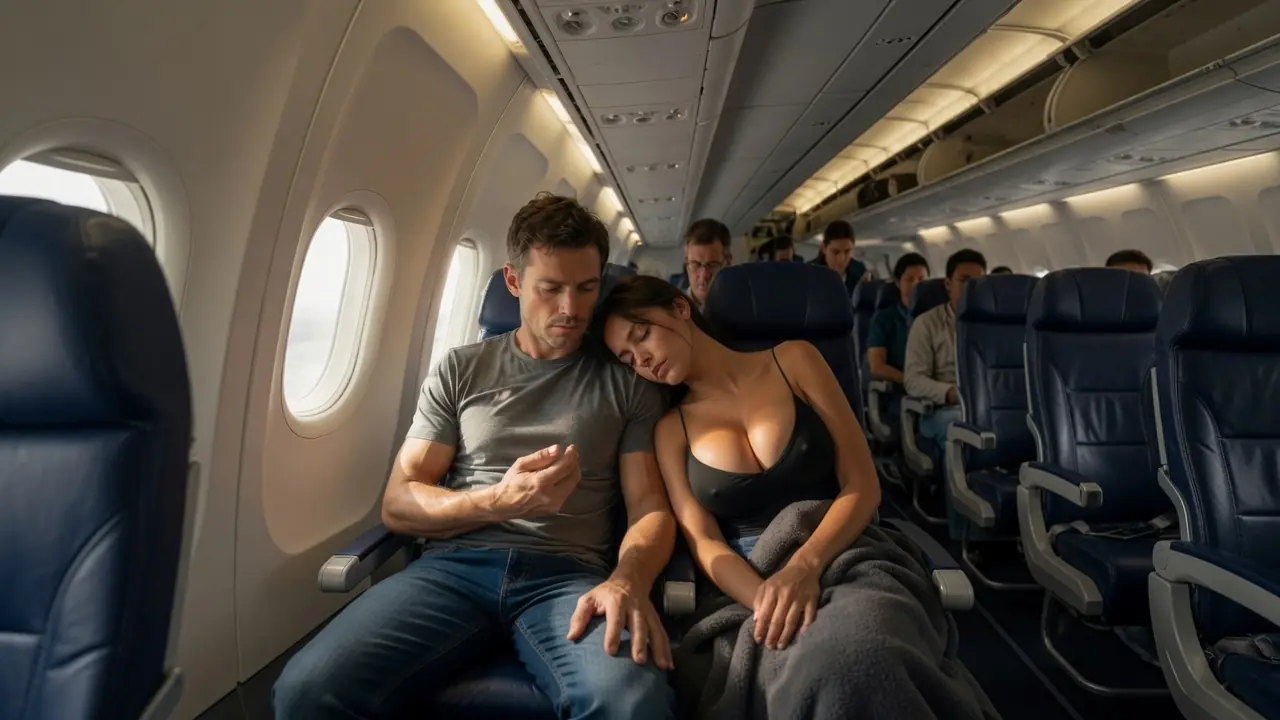
Avery watched the boy settle almost instantly at the sound of his father’s voice. That kind of trust was not demanded; it was earned through a hundred quiet nights, a hundred meals, a hundred promises kept when nobody else was watching. She had negotiated billion-dollar contracts, but she suddenly felt humbled by the simple authority of a father calming his child. Owen did not seem to realize he had done anything remarkable.
A gasp moved through the cabin like a wave. A drink cup flew off a tray and burst against the aisle floor. Somewhere behind them, a baby started crying, and the laughter vanished completely. Avery gripped the armrest, telling herself it was turbulence, only turbulence, a word she understood well enough to respect but not fear.
Owen, however, went completely still. His eyes lifted toward the ceiling panels, then toward the aisle, then to the emergency exits. He counted without moving his lips. The plane lurched again, and his hand went automatically to Ethan’s head, shielding him from the window view. Avery felt a cold thread of concern move through her chest.
The captain’s voice came over the speaker, calm but strained. “Ladies and gentlemen, we’ve entered unexpected severe weather. Please remain seated with your seatbelts fastened. Flight attendants, take your seats.” Avery had heard hundreds of flight announcements in her life. She knew the difference between routine calm and practiced calm. This was the second kind.
A sudden metallic groan passed through the aircraft. The cabin lights flickered once, and this time several passengers screamed. Oxygen masks dropped from the ceiling in a chaotic cascade of yellow cups and swinging tubes. Panic erupted almost instantly, hands grabbing upward, voices shouting, parents fumbling to secure children first. Owen moved faster than anyone in their row.
He pulled down three masks, checked them with quick tugs, placed one over Ethan’s face, then handed one to Avery. “Put it on,” he said, and his voice had changed. It was not the quiet voice from earlier. It was sharp, controlled, and built for emergencies.
Ethan’s eyes were huge, but Owen cupped the back of his head and held his gaze. “Breathe normal. In and out. Just like blowing bubbles.” The boy obeyed through tears. Avery put on her own mask, watching Owen secure his last, and realized her hands were shaking. She had built policies, fleets, safety standards, and corporate systems, but in this row, Owen Parker was the only person who seemed truly prepared.
The aircraft tilted hard to the left. A service cart broke loose somewhere behind them and slammed into seats with a terrible crash. The sound of prayer rose from across the aisle. A teenage boy in front of them began calling for his mother. The plane was no longer just shaking; it was fighting something.
Then the flight attendant’s voice came over the intercom, and fear stripped away every illusion of control. “Is there anyone onboard with flight experience? We have an emergency in the cockpit. Anyone with pilot training, please identify yourself immediately.”
The cabin went silent beneath the engines.
Avery turned slowly toward Owen. He had gone pale. Not tense, not focused, but pale in a way that looked almost sick. His hand gripped the armrest so tightly his knuckles whitened. For the first time, she saw not the calm father or the quiet mechanic, but a man staring straight into a nightmare that had found him again.
The intercom crackled again. “The captain is unconscious, autopilot is failing, and we need a pilot now. Please, if anyone is trained to fly, press your call button immediately.”
No button lit up.
Avery touched Owen’s arm. “Owen.” He shook his head once, small and final. “No.” His voice was barely a whisper. “I can’t.” The word did not sound like refusal. It sounded like terror.
“You were Air Force, weren’t you?” she asked. His eyes snapped to hers, and the pain in them confirmed it before he spoke. “Transport aircraft,” he said. “Years ago.” He swallowed hard. “I don’t fly anymore.”
A flight attendant stumbled down the aisle, gripping seatbacks to stay upright. Blood marked her lip where she had bitten it during the last drop. She stopped beside their row, her eyes desperate. “Sir, are you a pilot?”
Owen could not answer.
Avery answered for him. “He was Air Force. He can help.” Owen turned on her, his face raw. “Don’t do that.” But the attendant was already leaning closer. “Please. The captain collapsed. The first officer is trying to hand-fly, but we’ve lost autopilot, and the weather is getting worse. She needs someone experienced now.”
Ethan looked up through his mask, trembling. “Dad?” Owen closed his eyes. The plane dropped again, and a deep grinding sound rolled through the cabin. Smoke began to seep faintly from one vent, thin and gray, enough to make everyone understand that this was not an ordinary emergency anymore.
“Dad,” Ethan cried, voice breaking, “are we going to die?”
That question changed Owen Parker.
Avery saw it happen. The shaking in his hands stopped, not because the fear disappeared, but because something stronger rose over it. His face hardened with a father’s decision. He pulled Ethan close, kissed the top of his head, and whispered, “Nobody’s dying tonight. Not if I can stop it.”
He unbuckled his seatbelt and turned to Avery. His eyes were sharp now, but full of terrible urgency. “His name is Ethan Parker. He’s six. Birthday March fifteenth. Allergic to shellfish. He likes dinosaurs, hates peas, and sleeps better when Mr. Trunks is beside him.” Avery’s throat tightened as she realized what he was doing. “Owen, don’t.”
“If I don’t come back,” he said, gripping her wrist, “you make sure someone knows his story.” Avery shook her head hard. “You’re coming back to him.” Owen looked at Ethan, then at the front of the plane. “I have to go.”
Ethan clung to him. “I want to come with you.” Owen crouched in the aisle despite the shaking plane. “You stay with Miss Avery. I need you to be brave for me.” Ethan sobbed into his father’s neck. Owen held him one last time, then gently placed the boy’s hand into Avery’s.
As Owen moved toward the cockpit, the aircraft pitched violently. He caught the seatbacks with practiced balance, moving against the chaos like a man remembering an old battlefield. The flight attendant followed behind him, then stopped to secure the cabin. Avery pulled Ethan into her arms, wrapping herself around his small body the way Owen had done. “He’s going to save us, isn’t he?” Ethan whispered.
Avery looked toward the cockpit door where Owen had disappeared. “Yes,” she said, choosing belief because the child needed it. “He’s going to save us.”
Inside the cockpit, Owen Parker faced the thing that had broken him. Warning alarms screamed from every panel. Rain lashed the windshield, turning the outside world into black water and lightning. The captain lay unconscious behind the seats, oxygen mask strapped to his face, while a young first officer fought the controls with both hands.
“I’m Sarah Chen,” she gasped. “Captain had a heart attack. Autopilot’s gone. Main flight computer is failing. Hydraulics are unstable.” Owen slid into the captain’s seat before he could let himself think too much. The yoke felt warm under his hands. Familiar. Terrifying.
His mind flashed to another cockpit, another night, another voice crackling over a headset. Jake. His best friend. His co-pilot. Fire in the sky, alarms screaming, controls shaking, and Owen unable to save him. For five years, that memory had kept him grounded.
Not tonight.
“Give me altitude, speed, and configuration,” Owen said. His voice sounded like the man he used to be. Sarah blinked, then responded, training cutting through panic. “Altitude eleven thousand, descending too fast. Airspeed two-twenty. We lost number two engine temperature stability. Seattle is fogged in, but we don’t have enough control authority to divert far.”
Owen scanned the instruments. The aircraft was heavy, damaged, and descending through terrible weather with one pilot too inexperienced for the conditions and another who had not touched commercial controls in years. He silenced nonessential alarms, not because they were unimportant, but because panic did not need extra noise. “You handle systems,” he told Sarah. “I fly. Call out anything you see. No ego. No hierarchy. We survive as a crew.”
Sarah nodded. “Understood.”
The right engine surged, then screamed. A temperature warning flashed red. Owen’s hands moved before fear could catch up, reducing power, stabilizing what he could, trimming the plane against the uneven thrust. “Seattle approach, this is Flight 447. We have emergency control assistance in the cockpit. Former Air Force transport pilot at controls. Request vectors to nearest viable runway.”
The controller’s voice came back fast and calm. “Flight 447, Seattle Approach. We have you. Runway 16 Left is available, emergency equipment standing by. Weather is below minimums, heavy crosswind, but it’s your best option.”
Owen looked at Sarah. She looked back, understanding the same thing. Best option did not mean good option. It meant only option.
They descended through clouds that tossed the aircraft like a leaf in water. Owen fought the yoke with both hands, feeling the lag in the controls, anticipating every delayed response. The plane did not move when he asked; it moved half a second later, tired and wounded. He had to fly ahead of it, predicting the aircraft’s future before it arrived.
In the cabin, Avery held Ethan through every drop. The boy pressed Mr. Trunks against his mask and tried to breathe with her. Around them, strangers reached for strangers. The teenage boy in front of them held an elderly woman’s hand. A businessman who had been typing angrily before the emergency now whispered prayers under his breath.
Ethan looked up. “My dad has bad dreams about flying.” Avery brushed damp hair from his forehead. “I know.” “His friend died,” Ethan whispered. “Grandma said the sky hurt him after that.” Avery’s eyes filled, but her voice stayed steady. “Then tonight he’s fighting that hurt because he loves you more than he fears it.”
The intercom crackled, and Sarah’s voice filled the cabin. “Brace for emergency landing. Follow crew instructions. Stay seated and keep your heads down when commanded.” Fresh panic surged, but Avery leaned close to Ethan. “Listen to me. Your father is still flying. That means we keep believing.”
In the cockpit, the runway did not appear until they were dangerously low. Owen followed the instrument landing signal through darkness and rain, trusting needles, numbers, and instincts sharpened by years he had tried to bury. Sarah called altitudes. “Five hundred. Four hundred. Slightly high. Crosswind increasing.”
At three hundred feet, a string of white approach lights appeared through the storm. Owen’s chest tightened. “Runway in sight.” Sarah exhaled like she had been holding her breath for the whole descent. “Two hundred feet. Sink rate seven hundred.”
The wind slammed them sideways. Owen corrected with rudder, but the damaged hydraulics responded weakly. The plane drifted, heavy and stubborn. “We’re off centerline,” Sarah warned. “I know,” Owen said, teeth clenched.
At fifty feet, they were still fighting the crosswind. At thirty, the right main gear warning flickered. At twenty, there was no time for perfection. Owen cut power, raised the nose, and forced the plane into the best landing the damaged aircraft would allow.
They hit hard.
The main gear screamed against the runway, rubber burning, metal shuddering. The right side collapsed with a brutal crack, and the aircraft dropped, scraping along the concrete in a shower of sparks. Passengers screamed as the cabin tilted. Luggage burst from overhead bins. Avery wrapped herself over Ethan, shielding his head with both arms.
The plane slid, spun, and groaned like something alive in pain. Owen fought to keep it straight, one engine dead, one wing scraping, rudder weak, nose gear barely holding. The runway lights blurred past in violent streaks. Then, with one last grinding roar, the aircraft stopped.
For three seconds, nobody moved.
Then Owen’s voice came over the intercom, hoarse but alive. “Evacuate. Evacuate now.”
The cabin exploded into motion. Flight attendants shouted commands, forcing doors open and deploying slides. Avery unbuckled Ethan first, then herself, ignoring the blood running from a small cut near her temple. Owen came out of the cockpit moments later, eyes searching wildly. “Ethan!”
“Dad!” Ethan screamed.
Owen fought through the slanted aisle and caught his son so tightly the boy gasped. For one second, the emergency vanished around them. There was only a father holding the child he had promised to come back to. Avery looked away, giving him that moment, then grabbed the arm of an older man struggling to stand.
“Move,” she said, her CEO voice returning under pressure. “We have to get off this plane.”
Outside, firefighters sprayed foam over leaking fuel. Red and white lights flashed through rain. Passengers slid down emergency chutes onto the wet runway and ran toward waiting crews. Owen handed Ethan down to Avery first, then turned back to help others out, refusing to leave until the last frightened passenger and injured crew member had escaped.
When he finally slid down, firefighters pulled him away from the aircraft. Ethan broke free from Avery and ran straight into his arms. Owen dropped to his knees on the foam-covered runway and held his son while rain and tears mixed on his face. “You saved everyone,” Ethan sobbed. “You came back.”
Owen could not speak. He only nodded into his son’s hair.
Hours later, in Avery’s Seattle home, Owen sat at her kitchen table in borrowed clothes while Ethan slept upstairs. The news was already calling him a hero. Avery stood across from him, still wearing a bandage at her temple, her face pale with exhaustion and something deeper. She had spent the last hour on calls with investigators, Meridian executives, and emergency response teams.
“You applied to Meridian three times,” she said quietly.
Owen looked down. “Four.” Avery swallowed. “Our system rejected you automatically.” He gave a bitter little smile. “PTSD flag, employment gap, medical history. Damaged goods.” “No,” she said sharply. “A failed system called you that. And tonight that failed system almost killed three hundred people because it threw away the one man who could save them.”
Owen looked up at her. “You didn’t know.” “I should have,” Avery said. “I signed off on those hiring filters. I approved efficiency over judgment. I let software decide which human beings were worth seeing.” Her voice shook. “And then I fell asleep on the shoulder of a man my company had already erased.”
Silence stretched between them.
Avery placed a folder on the table. “Help me fix it.” Owen stared at it. “What is that?” “A position. Not charity. Not a reward. A real job. Director of Pilot Reintegration and Support.” She sat across from him. “Help us build a pathway for veterans, grounded pilots, and people recovering from trauma. Human review. Real mental health support. A second chance for people the industry has been too afraid to understand.”
Owen’s hand rested on the folder, but he did not open it. “I don’t know if I can be that man.” Avery looked toward the stairs where Ethan slept. “You already were tonight.” His jaw tightened. “Tonight I was scared the whole time.” “Good,” she said. “Then you’ll remember that courage is not clean. It shakes. It bleeds. It still gets up.”
Owen closed his eyes.
For five years, he had believed the sky no longer belonged to him. He had believed his fear was proof that he was finished, that his trauma had made him less worthy of trust. But tonight, with his son crying in the cabin and three hundred lives hanging in the balance, he had walked back into the cockpit anyway. He had not been fearless, but he had been enough.
Two weeks later, Owen accepted the job.
Six months later, Meridian Aviation began reviewing every pilot application with human eyes before any rejection was issued. One year later, the company launched a confidential support program for pilots dealing with trauma, grief, addiction, and fear. Two years later, other airlines began copying the model. Owen hated speeches, hated cameras, and still disliked being called a hero, but he kept showing up because he knew exactly what it felt like to be unseen.
As for Avery, she never forgot waking up on his shoulder. She never forgot the embarrassment, the kindness, the fear, or the moment she looked at him and realized a quiet single father might be the only person between her company and catastrophe. That flight changed her leadership more than any boardroom ever had. It taught her that systems built without mercy eventually become dangerous.
And Owen Parker, who once believed he had lost the sky forever, learned that some doors do not reopen gently. Sometimes they burst open in panic, smoke, and screaming alarms. Sometimes the past you fear most becomes the place where you finally prove you are still alive.
On the anniversary of Flight 447, Avery stood beside Owen at a training center Meridian had built for returning pilots. Ethan, now a little taller, held Mr. Trunks under one arm and looked up at a wall covered with photos of pilots who had been given second chances. Owen watched him, then looked through the wide window at a plane lifting into the morning sky.
“Still afraid?” Avery asked softly.
Owen smiled faintly. “Sometimes.”
“And still flying?”
He looked at his son, then at the sky.
“Yeah,” he said. “Still flying.”