A man in a worn gray coat walked into the interview room ten minutes late, after his old sedan had died in the middle of a cold autumn rain.
In front of the entire executive board, the young female chief executive looked at him with icy contempt and said that people who could not respect time did not deserve a future.
No one in that room knew that the man she had just dismissed was the very engineer who had saved her father’s company from collapse fifteen years earlier.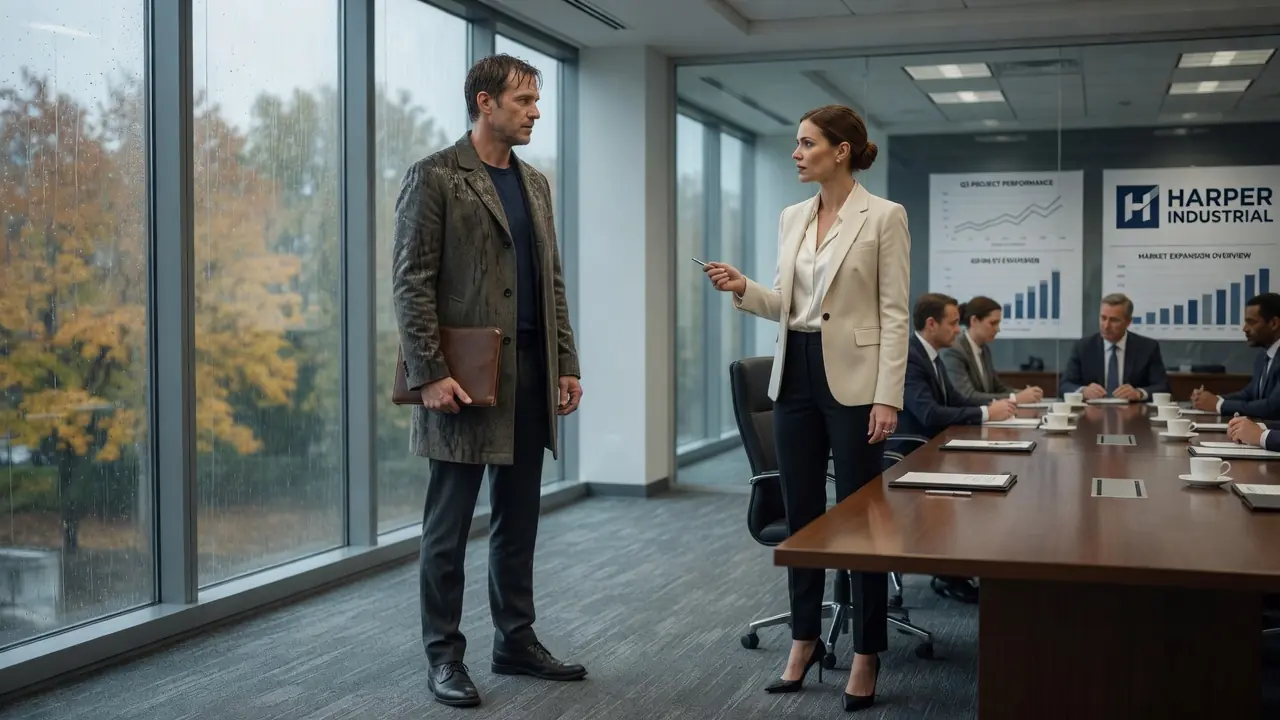
But this time, the company itself had only one chance left to survive, and that chance was walking out the door in a soaked gray coat.
Harper Industrial had once been a name that meant something in this city. It was a company built by hands that valued patience over speed and loyalty over convenience. Now it stood on the edge of failure, buried under debt, bleeding contracts, and drowning in a boardroom full of people who no longer trusted each other.
Robert Harper, the founder, had built the company from a single machine shop into a respected industrial firm. But a failing heart had forced him to step back from the business he loved. His daughter, Emily Harper, had taken his place at the head of the table, carrying both his name and the weight of expectations that came with it.
She was known across the industry for being sharp, disciplined, and utterly unwilling to tolerate excuses. She was a woman who believed that results were the only language worth speaking. Colleagues respected her mind but feared her judgment, because Emily had built a reputation for cutting people out of her life the moment they failed to meet her standards.
That same morning, a different kind of storm was unfolding across town. Daniel Brooks sat behind the wheel of an aging sedan, watching rain streak down the windshield as the engine sputtered and finally gave out on a quiet street corner. He stepped into the downpour without complaint, popped the hood, and worked with steady hands until the old engine coughed back to life.
There was no anger in his movements, only the quiet patience of a man who had learned long ago that panic solved nothing. By the time he reached the gates of Harper Industrial, the interview for the restructuring consultant position had already begun, and every second of his lateness had been noticed by the people waiting inside.
Emily sat at the head of the conference table, flanked by board members who had grown restless, waiting for a candidate who came recommended through channels no one fully understood.
When Daniel finally walked through the door, dripping rain onto the polished floor, the room fell into an uncomfortable silence.
Emily did not offer him a chance to explain himself. Instead, she looked him over once, from his damp shoes to his unbothered expression, and delivered a line that would echo through the company for months afterward.
“If a man cannot manage something as simple as a clock,” she said, “how can anyone trust him to manage an entire corporation on the brink of ruin?”
A ripple of quiet laughter moved through the room, the kind of laughter that exists only to please the person in power.
Daniel did not raise his voice or offer a defense. He simply apologized once, calmly explaining that his car had broken down and that he had done what he could to arrive as quickly as possible.
Emily cut him off before he finished the sentence, telling him the interview was over and that his time, along with hers, had already been wasted enough for one morning.
Security was summoned, and two men in dark suits approached to escort him from the building, though Daniel needed no escort at all. He rose from his chair without protest, buttoned his damp coat, and walked toward the door with the same unhurried calm he had carried since he arrived.
At the threshold, he paused just long enough to look back at Emily.
Instead of anger, his voice carried something closer to quiet certainty.
“I hope you never find yourself in a position where you need to call me back,” he said.
Then he disappeared into the rain.
None of the board members thought much of the exchange once the door closed behind him. They were already moving on to the next candidate on their list, as though nothing significant had taken place.
Emily allowed herself a small, satisfied breath, believing she had simply enforced the same standard she held for everyone who wished to work alongside her. She had built her entire reputation on that standard, refusing to soften her expectations regardless of circumstance, believing that discipline was the only trait separating success from failure in business.
Somewhere beneath her certainty, a quieter voice might have warned her that judgment delivered too quickly often costs more than patience ever could.
But that voice would not be heard for many weeks to come.
Daniel walked three blocks through the rain before his car finally cooperated again, and he sat behind the wheel for a long moment without starting the engine. He was not angry, though he had every reason to be, and he was not surprised, either, since he had grown accustomed over the years to being measured by people who never bothered to ask a single question first.
He thought briefly of the last time he had walked away from a company that owed him more than it ever repaid. He wondered, without bitterness, whether some patterns simply followed a person, no matter how far they traveled.
He drove home through streets slick with rain, past storefronts dimmed for the evening, and told himself that whatever had just happened inside that glass tower was no longer his concern.
He had learned long ago not to carry other people’s judgment of him any further than the door he walked through, and he intended to leave this one exactly where it belonged.
Behind him.
Within weeks, the fragile stability Harper Industrial had been clinging to began to collapse in earnest.
A powerful investment group known as Sterling Capital Partners had been circling the company for months, waiting for the right moment to force a hostile acquisition. That moment arrived when the company’s primary bank froze its remaining line of credit, citing concerns over mounting losses and unstable leadership.
Suppliers who had worked with Harper Industrial for decades began pulling out one by one, unwilling to extend further credit to a company that seemed to be sinking.
Then came the final blow, when one of the largest clients in the company’s history canceled a multi-year contract, citing delays and inconsistent quality that had crept in during months of internal chaos.
The news spread through the office like a slow, suffocating fog.
For the first time in her career, Emily Harper felt the true weight of fear settle into her chest.
She stood at the window of her office late that evening, watching the city lights blur behind streaks of rain, and thought of every decision she had made since taking her father’s place at the head of the company.
She had inherited not just a business, but an identity tied so tightly to success that failure felt less like a setback and more like a personal collapse waiting to happen.
Colleagues who once sought her approval now avoided her gaze in the hallways, sensing the shift in fortune the way animals sense a coming storm long before it arrives.
Emily had always believed that competence alone could shield her from circumstances beyond her control. But watching decades of her father’s legacy unravel within a matter of weeks taught her a harsher truth about the limits of control.
That night, alone in an office that suddenly felt far too large for one person, she allowed herself briefly to feel something she rarely permitted herself to feel at all.
She was afraid.
An emergency meeting was called, and the room that had once buzzed with confidence now felt heavy with silence, broken only by numbers no one wanted to say aloud.
Every proposal brought to the table collapsed under its own weakness, whether it involved emergency loans, partial layoffs, or a rushed merger that would strip the company of everything it had once stood for.
The chief financial officer, a steady man named Mark Whitfield, who had worked alongside Robert Harper for over twenty years, finally spoke the truth no one else wanted to admit.
He told Emily that what the company needed was not another spreadsheet or another consultant with a fancy title, but someone who actually understood the old systems, the ones built before automation and before shortcuts became the norm.
Emily, exhausted and desperate, told him to hire anyone capable, regardless of cost, regardless of reputation, as long as they could fix what was broken.
But when Whitfield reached out to the most respected names in the industry, every single one declined, citing the company’s instability and its increasingly public financial troubles.
That evening, Emily visited her father in the hospital, hoping for guidance in a moment when her own judgment felt like it was failing her.
Robert Harper looked frail against the white sheets, but his eyes remained sharp, watching his daughter with the quiet concern of a man who understood far more than he let on.
Before Emily could explain the depth of the crisis, her father asked a single question that caught her completely off guard.
“Have you found Daniel yet?”
He spoke the name as though it should have meant something to her immediately.
Emily frowned, searching her memory, insisting she had never heard of anyone by that name in relation to the company’s affairs.
Her father said nothing further. He simply closed his eyes and turned his face toward the window, leaving his daughter standing there with more questions than she had walked in with.
The following morning, unable to shake the strange weight of her father’s silence, Emily returned to the hospital and pressed him for answers.
Slowly, and with visible effort, Robert Harper began to tell a story that had been buried for fifteen years, one that predated Emily’s involvement in the company entirely.
Back then, Harper Industrial had stood on the edge of the same kind of collapse it now faced, crushed by outdated machinery and a production system that had fallen decades behind its competitors.
A young engineer named Daniel Brooks had walked through the doors during that crisis, barely out of his twenties, carrying nothing but a notebook full of designs and an unshakable belief that the company could still be saved.
He worked through nights and weekends without complaint, redesigning entire production lines from the ground up until the factory floor operated with an efficiency no one thought possible.
Within a single year, Harper Industrial had not only survived, but had returned to profitability, largely because of the sacrifices made by a man most employees barely noticed.
What struck Robert Harper most, even after all these years, was what happened once the company was finally safe again.
The board had offered Daniel a senior leadership position, complete with a generous salary and a level of authority most engineers only dreamed of reaching.
Daniel turned it down without hesitation, packed his few belongings, and left the company quietly, offering no explanation to anyone who asked.
Robert had tried to reach him afterward, wanting to understand why a man who had given everything would walk away from the reward he had rightfully earned.
But Daniel never responded to a single message.
Robert paused in his retelling, his eyes distant as though he were standing once again in that old factory fifteen years earlier, watching a young man work through the night without complaint.
He described how Daniel used to eat his meals standing at a workbench, sketches spread across every surface, refusing to leave the building until a solution presented itself.
There had been a moment, Robert admitted, when he offered Daniel not just a title, but a share of ownership in the company, believing that no reasonable person would refuse such generosity.
Daniel had simply shaken his head, telling him quietly that some things were not meant to be owned, only cared for, and that he had done what needed doing because it needed doing, not because he expected anything in return.
Robert confessed that he had never fully understood that answer until many years later, lying in a hospital bed and watching his daughter carry burdens that reminded him painfully of his own younger self.
Emily sat in stunned silence as her father finished the story, realizing that the very foundation of the company she now led had been built in part by a stranger she had humiliated in front of an entire board.
Her father looked at her with quiet exhaustion and told her that without that young engineer, she would never have inherited a company at all, because there would have been nothing left to inherit.
That single conversation shifted something inside Emily that she could not immediately name.
She began quietly digging into records, old personnel files, and fragments of information scattered across systems that had not been touched in over a decade.
What she uncovered painted a picture entirely different from the confident, sharply dressed executives she was used to working alongside.
Daniel Brooks had spent the years since leaving Harper Industrial working as an independent consultant, taking on projects that most professionals in his field would have considered beneath them.
He avoided public recognition entirely, kept no online presence, and seemed to actively resist any opportunity that might have elevated his name or his income.
His client list consisted almost entirely of small manufacturers, family-owned workshops, and struggling local businesses, rather than the large corporations that could have paid him a fortune.
Emily’s first instinct was to dismiss what she was seeing, assuming that a man capable of the achievements her father described would surely have moved on to bigger opportunities by now.
She told herself that perhaps his skills had faded, or that his moment of brilliance had simply been a stroke of luck that had never repeated itself.
Still, something compelled her to reach out quietly to a few of the business owners Daniel had worked with over the years, hoping to understand the reality behind the story.
Every single person she spoke to described him not as a consultant who fixed businesses, but as someone who had fundamentally changed the course of their lives.
One workshop owner, a woman named Susan Alvarez, told Emily through tears that Daniel had once turned down a payment of two million dollars simply to ensure that none of her employees lost their jobs during a difficult restructuring.
Story after story painted the same portrait of a man who measured success not in profit margins, but in the well-being of the people standing behind those numbers.
Slowly, the certainty Emily had carried into this investigation began to crack.
She spoke with a warehouse manager named Frank Delgado, who told her that Daniel had once spent three unpaid weekends redesigning an inventory system simply because he noticed employees straining their backs lifting boxes the old way.
She spoke with a young business owner named Rachel Coleman, who described how Daniel had walked away from a lucrative contract the moment he discovered the company planned to use his recommendations as justification for layoffs.
Each story added another layer to a picture Emily had never expected to see, one that stood in sharp contrast to the ruthless efficiency she had always associated with successful consultants in her industry.
She began to realize that everything she thought she understood about strength and leadership had been built on a narrow definition, one that valued speed and toughness while ignoring patience and quiet sacrifice entirely.
By the time she finished her research, sitting alone in her office long after the rest of the building had emptied for the night, Emily no longer recognized the certainty she had walked in with only days before.
Unable to ignore what she had learned, Emily decided she needed to speak with Daniel directly, regardless of how uncomfortable the conversation might become.
She found him at a modest workshop on the outskirts of the city, dressed in the same simple clothing he had worn during their first meeting, entirely unbothered by her sudden appearance.
Emily apologized for the way she had treated him during the interview, admitting that her words had been unfair and that she had judged him without knowing anything about who he truly was.
She asked him to reconsider, to come back and help save the company that owed him more than it had ever acknowledged.
But Daniel simply shook his head and told her it was not that simple.
He reminded her that her father had once trusted him completely, without hesitation, while she had dismissed him within minutes based on nothing more than a delay caused by circumstances beyond his control.
Emily insisted that she had been wrong, that she understood now the mistake she had made.
But Daniel’s response carried no bitterness, only quiet clarity.
He told her that she had not necessarily been wrong in the way she believed, but that she simply had not yet understood the difference between judging results and judging people before knowing their full story.
She pressed further, offering whatever terms he wanted, whatever title or compensation might convince him to return.
He remained unmoved by every proposal she placed on the table.
Finally, Daniel asked her a single question that lingered in the silence between them far longer than any of her offers had.
“If the company is somehow saved,” he said, “will you change the way you treat people who walk through the back door instead of the front? The ones without titles or polished resumes standing behind them?”
Emily opened her mouth to answer, but no words came, because for the first time in years, she genuinely did not know how to respond.
She drove away from the workshop that afternoon, replaying the question over and over, unable to shake the feeling that Daniel had seen something in her she had never fully admitted to herself.
Growing up under her father’s shadow, Emily had learned early that softness was a liability in a world built on competition, and she had spent years perfecting a version of herself that left no room for hesitation or doubt.
Yet sitting in traffic with the rain returning once again to streak across her windshield, she found herself thinking not of quarterly reports or board approval, but of the quiet dignity Daniel carried despite every reason he had to resent her.
She thought of Susan Alvarez’s tears, of Frank Delgado’s gratitude, of a man who had walked away from two million dollars simply to protect people he barely knew.
For the first time, Emily allowed herself to wonder whether the version of leadership she had built her identity around was the right one at all, or whether it had simply been the only version she had ever allowed herself to see.
While Emily wrestled with her own uncertainty, Sterling Capital Partners launched what appeared to be their final and most devastating move against the company.
Shares of Harper Industrial collapsed within a single trading session, triggering panic among remaining investors, who had already grown wary of the company’s stability.
More clients severed their contracts, unwilling to remain associated with a business whose future seemed increasingly uncertain by the day.
Financial news outlets began publishing harsh critiques of Emily’s leadership, questioning whether she possessed the experience necessary to guide a company through such a severe crisis.
Behind closed doors, members of the board began quietly discussing the possibility of removing her from her position entirely, believing that new leadership might be the only path toward salvaging what remained of the business.
Rumors of the potential vote reached Emily before anyone officially informed her, carried through hallway whispers and the careful silences of colleagues who suddenly avoided meeting her eyes.
She spent long nights alone in her office, staring at spreadsheets that offered no solutions, replaying every decision she had made since taking control of the company.
For the first time in her career, she began to question whether the discipline she had always relied upon was truly strength, or whether it had simply been a shield she used to avoid looking too closely at her own uncertainty.
She thought of her father, of the company he had built from nothing, and of the possibility that she might be remembered as the daughter who let it all slip away.
Sleep became a rare visitor during those weeks, and the confident posture she had always carried into every meeting began to feel increasingly like a costume she no longer had the strength to wear.
Emily felt the walls closing in from every direction, and the isolation she had built around herself over the years suddenly felt less like strength and more like a prison of her own making.
Her father’s condition worsened during this period, requiring a second hospital admission that terrified her far more than any financial collapse ever could.
Before slipping into a state of exhaustion that left him barely able to speak, Robert Harper reached for his daughter’s hand and offered her only two words of guidance.
“Trust Daniel.”
He repeated the phrase as though it contained the answer to every question she had been too afraid to ask herself.
Emily broke down in the quiet of the hospital corridor, finally allowing herself to feel the full weight of everything she had been carrying alone.
In that moment, she understood that this was no longer merely a business crisis to be solved through strategy and numbers. It was a legacy built by her father’s hands that she was on the verge of losing entirely.
Three days later, Daniel walked back through the doors of Harper Industrial.
Not as an employee, and not as someone seeking recognition for what he was about to do.
He made it clear immediately that he wanted no executive title, no equity in the company, and no public acknowledgement of his involvement in the crisis unfolding around them.
When Emily asked why he had changed his mind after refusing her so firmly, his answer was simple and carried no trace of hesitation.
“I’m doing this for your father,” he said. “He trusted me once when no one else in the industry would give me a chance.”
Within hours of his arrival, Daniel had assembled key members of the operations team and began working through the night, moving methodically through systems that had been neglected for years.
In less than forty-eight hours, Daniel uncovered a series of problems far more damaging than simple financial mismanagement.
He identified significant losses hidden within the procurement system, where funds had been quietly diverted through inflated invoices that no one had thought to question.
He found evidence of governance failures throughout multiple departments, decisions made without proper oversight that had slowly eroded the company’s financial foundation.
Buried within contract records, he discovered three separate agreements that appeared to be entirely fabricated, designed to funnel resources away from the company under the guise of legitimate business.
Most damning of all, he traced a pattern of internal communication that revealed one senior executive had been quietly feeding confidential information to Sterling Capital Partners for months.
Emily stared at the evidence in disbelief while the rest of the board sat in stunned silence, realizing that the crisis they believed to be purely financial had been engineered from within their own walls.
The senior executive responsible for leaking information to Sterling Capital Partners was a man named Gregory Sanders, someone Emily had trusted for years and considered a close ally within the leadership team.
When confronted with the evidence Daniel had assembled, Sanders offered no real denial, only a hollow attempt to justify his actions by claiming the company had been beyond saving regardless of what he did.
Emily felt a betrayal deeper than anything the market or the media had thrown at her, understanding now that the greatest threat to her father’s legacy had been sitting across the table from her all along.
Daniel remained composed throughout the confrontation, offering no satisfaction in being right, only a quiet insistence that the company move forward rather than dwell on the wreckage of misplaced trust.
It was in that moment, watching him refuse even a single word of triumph, that Emily began to understand the difference between a man who sought power and a man who simply wanted to see something broken made whole again.
Once the extent of the sabotage became clear, Daniel moved quickly to design a plan that prioritized stability over quick fixes and people over shortcuts.
He refused to consider mass layoffs, insisting that gutting the workforce would only accelerate the collapse rather than prevent it.
He rejected outright the idea of selling off portions of the company to raise emergency capital, arguing that such a move would strip Harper Industrial of the very foundation that had made it valuable in the first place.
Instead of taking on additional debt through emergency loans, he began restructuring the production process itself, eliminating waste that had accumulated over years of poor oversight.
He personally reached out to suppliers who had walked away, renegotiating terms with the same patience and honesty that had once saved the company fifteen years earlier.
Slowly and cautiously, key clients who had canceled their contracts began reconsidering, persuaded not by aggressive sales tactics, but by a level of transparency they had not expected from a company in crisis.
Daniel spent long hours walking the factory floor itself, speaking directly with machine operators and line supervisors who had rarely, if ever, been consulted by previous leadership about how their work could be improved.
He listened carefully to their frustrations, noting inefficiencies that had gone unreported for years simply because no one had ever bothered to ask the people closest to the problem.
A veteran machinist named Harold Pierce told him about a bottleneck in the assembly process that had cost the company thousands of hours annually, a fix so simple that Harold had mentioned it to three different managers over the past decade without ever being taken seriously.
Daniel implemented the change within a single afternoon, and production efficiency improved almost immediately, proving to everyone watching that solutions often existed already within an organization, waiting only for someone willing to listen.
Word of these small but meaningful changes spread quickly through the company, and morale began to lift in ways that no financial report could fully capture.
Employees who had grown used to feeling invisible under previous leadership suddenly found themselves being asked for their opinions, and something in the atmosphere of the entire building began to shift toward hope rather than fear.
As the days passed, Emily found herself working alongside Daniel late into the night, poring over documents and strategies that demanded her full attention and left little room for the defensive instincts she once relied on.
For the first time in her professional life, she began genuinely listening rather than simply waiting for her turn to speak, absorbing perspectives she would have dismissed only weeks earlier.
The distance that had once defined their relationship began to dissolve, replaced by a quiet familiarity built through exhaustion, shared purpose, and mutual respect.
She noticed things about Daniel she had failed to see during their first encounter.
The way he remained calm under pressure that would have broken most executives she knew.
The way he never raised his voice, never demanded recognition, and never seemed to measure his worth by the opinions of people around him.
Watching him work, Emily began to understand that the man she had once dismissed as unworthy of her time possessed a kind of quiet strength she had spent her entire career trying to project without ever truly possessing it herself.
One evening, exhausted and drained after another sixteen-hour stretch of meetings and negotiations, Emily finally asked him the question that had been sitting in the back of her mind since her father first spoke his name.
She wanted to know why he had refused the executive position all those years ago.
Why a man capable of rebuilding an entire company had simply walked away without asking for anything in return.
Daniel considered the question for a long moment before answering.
“Titles and corner offices were never what drove me,” he said. “Watching a business survive was reward enough for the effort I gave it.”
He explained that he had grown up in a household where his own father lost a small manufacturing business to circumstances eerily similar to what Harper Industrial had faced, and that the memory of watching that collapse had shaped everything he valued afterward.
He did not want recognition for saving companies. He wanted to make certain that ordinary people did not lose everything simply because those above them made careless decisions.
Emily sat with that answer for a long time after he finished speaking, feeling something inside her shift permanently, as though a door she had kept locked for years had finally been allowed to open.
The truth finally came to light during an emergency shareholder meeting called to address the company’s collapsing stock price and mounting scandal.
Daniel stood before the room, calm as ever, and methodically presented the evidence he had gathered over the previous weeks.
He walked the shareholders through the fabricated contracts, the diverted funds, and the internal betrayal that had nearly destroyed a company built over decades of honest work.
Sterling Capital Partners, caught in the exposure of their own manipulation, watched their acquisition attempt collapse in real time as shareholders began withdrawing their support for the takeover.
Just as the presentation concluded, the doors to the boardroom opened, and Robert Harper entered the room, weakened but standing on his own strength for the first time in weeks.
He addressed the room directly, his voice steady despite his frail condition, and revealed to everyone present that Daniel Brooks was the same young engineer who had saved this very company fifteen years earlier from a crisis nearly identical to the one they had just survived.
A wave of astonishment moved through the room, followed by applause that grew louder as the full weight of the revelation settled over everyone present.
Several longtime board members who had worked alongside Robert Harper for decades rose from their seats entirely, remembering now the quiet young engineer who had vanished from the company without explanation so many years earlier.
Mark Whitfield, seated near the front, felt his throat tighten as he finally understood why Robert had always spoken of that period with such reverence, never quite explaining the details to anyone who asked.
The shareholders, who had spent weeks preparing to vote Emily out of her position, now looked at her with expressions that had softened considerably, sensing that the story unfolding before them was larger than any single quarterly report.
Photographers who had gathered outside to capture what many assumed would be the final collapse of Harper Industrial instead found themselves documenting something closer to a resurrection.
In the back of the room, quietly watching everything unfold, sat several employees from the factory floor who had asked to attend, their presence a small but meaningful reminder that the people most affected by these decisions rarely had a voice in how they were made.
Emily rose from her seat and walked to the front of the room, standing beside the man she had once ordered removed from this very building.
She admitted in front of every board member and shareholder present that the first time she had seen Daniel, she had seen nothing more than a man who arrived ten minutes late.
Now, she told them, she saw the person who had saved her family not once, but twice, asking nothing in return either time.
Daniel simply offered her a quiet smile and reminded her gently that a person’s true worth is rarely visible to eyes that judge too quickly.
The following days brought a wave of change through Harper Industrial that no one could have predicted only a month earlier.
Sterling Capital Partners withdrew entirely from any further attempts at acquisition, their reputation damaged badly enough that two other struggling companies they had targeted began seeking outside counsel of their own.
Gregory Sanders was quietly removed from his position and barred from future involvement with the company, his departure marked by none of the ceremony that once accompanied his rise through its ranks.
News outlets that had spent weeks criticizing Emily’s leadership now shifted their coverage entirely, framing the company’s survival as a remarkable story of resilience against corporate betrayal.
Employees who had spent months anxious about their futures returned to work with a sense of relief that spread visibly through every department, from the factory floor to the executive offices above it.
For the first time in longer than she could remember, Emily walked through the halls of her father’s company and felt something close to peace rather than pressure.
In the months that followed, Harper Industrial slowly rebuilt itself into a company stronger and more stable than it had been in years.
There were no mass layoffs, no rushed sale to outside investors, and no compromise of the values that had once defined the company under Robert Harper’s leadership.
Robert himself finally stepped back completely, retiring with the peace of mind that his life’s work had been preserved rather than dismantled.
Emily emerged from the crisis as a fundamentally different leader, one who had learned to listen before speaking and to withhold judgment until she understood the full weight of a person’s circumstances.
As the company stabilized, Daniel began quietly preparing to step away once more, unwilling to remain in a spotlight he had never sought in the first place.
Emily found him one evening near the loading dock where their story had first turned and asked him directly whether he intended to disappear again the way he had fifteen years earlier.
Daniel offered a soft laugh, telling her that he had simply come to finish a promise he had made long before she had ever taken her seat at the head of the company.
Emily reminded him that her father had always described him as the man who saved the company, but she added quietly that she now believed he had saved something else entirely.
Daniel did not answer right away, choosing instead to look out at the Harper Industrial building glowing under the pale light of early winter.
For the first time in many years, he felt something settle inside him, a quiet release from a past he had spent a long time trying to outrun.
Emily stepped closer and stood beside him in silence, no longer separated by the roles of chief executive and hired consultant.
In that moment, they were simply two people who had once misunderstood each other completely and had slowly found their way toward something honest.
Neither of them spoke for a long while, content to simply stand in the quiet of the evening, listening to the distant hum of the city beyond the factory walls.
Emily finally broke the silence, telling him that she had spent years believing vulnerability was a weakness no leader could afford to show, and that watching him work had taught her otherwise.
Daniel admitted, in a rare moment of openness, that he had spent just as many years believing that walking away from recognition protected him from ever being disappointed by people again.
He confessed that meeting her father all those years ago had been the first time he allowed himself to trust someone in a position of power, and that her initial dismissal of him had reopened a wound he thought had long since healed.
Emily reached out and placed her hand gently over his, not as a gesture of romance, but as a simple acknowledgement of everything they had both survived to reach this quiet moment together.
It was the beginning of something neither of them rushed to define, built slowly over shared meals and long conversations, the kind of connection that grows stronger precisely because it refuses to be hurried.
A year later, Harper Industrial had become widely respected as an example of how a struggling company could recover without abandoning the principles that built it in the first place.
Daniel remained involved as a long-term strategic adviser, choosing his own pace and his own terms, free from the pressure he had once fled from.
Emily, meanwhile, had reshaped the culture of the entire company from the inside out, insisting that no employee be judged by appearance alone and that no conclusion be drawn before the full story was understood.
Every voice within the company, regardless of position or title, was given space to be heard in a way that had never existed before her transformation.
During the company’s anniversary celebration, Emily stood before the entire staff and delivered words that many in the room would remember for years afterward.
She admitted openly that the day she believed herself to be the smartest person in the room was the very day she made her greatest mistake, one built entirely on assumption rather than understanding.
She reminded everyone that a person arriving late is not always a person lacking responsibility, and that sometimes they are quietly fighting battles no one else can see.
As she spoke, the room’s attention shifted toward Daniel, seated modestly among the crowd rather than at the front where his contributions would have justified a place of honor.
He offered nothing more than a small, steady nod and a calm smile, the same expression he had worn since the very first day he walked through Harper Industrial’s doors, soaked from the rain and utterly unbothered by judgment that had once tried to define him.
After the ceremony ended and the crowd slowly dispersed into the cool evening air, Emily found Daniel standing near the same loading dock where they had first begun to understand one another months earlier.
She told him that her father, watching from his modest retirement home earlier that week, had asked only one question about the company’s progress.
He wanted to know if Daniel was still nearby.
Daniel smiled at that, admitting that Robert Harper had become something like family to him over the years, a man who had given him a chance when few others would have bothered.
Emily reminded him gently that he had never really left. Not truly, since some part of him had remained woven into the foundation of this company since the very first blueprint he sketched fifteen years ago.
Daniel looked at her for a long moment, something warm passing behind his usually guarded expression, and told her that perhaps he had simply been waiting all this time for someone willing to see him clearly.
Together, they walked back toward the building, glowing with light against the darkening sky.
No longer strangers separated by assumption, but two people who had learned through hardship exactly what it meant to be truly seen.
A person’s value is rarely found in the first impression they leave behind, but in the quiet work they continue long after no one is watching.
True leadership does not begin with the ability to make swift decisions, but with the patience to listen fully before allowing judgment to speak.