“Four of my best engineers cannot fix this car, so stop pretending a janitor belongs near the engine.”
Victoria Reynolds’s voice cut across the private underground garage of Reynolds Dynamics. She stood beside a motionless silver supercar worth more than most homes, wearing a fitted charcoal suit and an expression sharpened by humiliation. Four senior engineers surrounded the open engine compartment with diagnostic tablets, cables, and tools, yet every screen insisted the vehicle was functioning perfectly. A five-billion-dollar negotiation began in less than an hour, and the most powerful woman in the building could not leave the parking garage.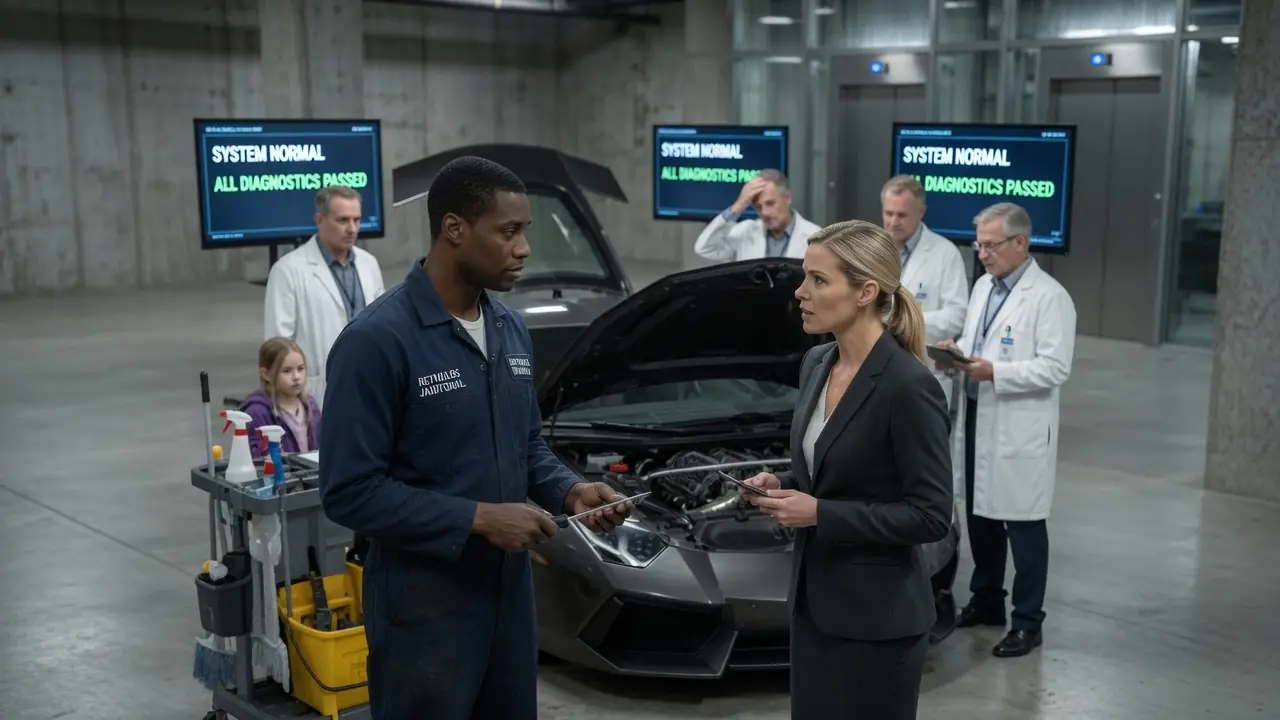
Daniel Carter stood several yards away beside a cleaning cart, one hand resting on the shoulder of his seven-year-old daughter. His navy janitor’s uniform was faded at the elbows, and his black work shoes were scratched from four years of night shifts. Lily looked pale from the mild fever that had forced Daniel to collect her early from school, but her dark eyes remained fixed on the expensive machine. She had stopped walking when she heard the engine attempt to start.
“It sounds like it’s breathing wrong,” Lily whispered.
Daniel had heard it too.
The supercar’s dashboard illuminated normally, its fuel system activated, and the starter received power. Yet beneath the polished mechanical hum was a tiny interruption, barely longer than the space between two heartbeats. The engineers kept studying numbers while the engine repeated the same broken rhythm. Daniel tilted his head and listened again.
Martin Hayes, the company’s chief mechanical engineer, noticed him lingering. “This is an executive area,” he said. “Take the child and leave.”
Daniel nodded automatically. “Yes, sir.”
He had spent years perfecting invisibility. He cleaned offices after executives went home, emptied trash bins beside unfinished designs, and polished floors beneath framed photographs of engineers whose work he understood better than they would ever know. No one asked questions about a janitor, and Daniel preferred it that way. Questions led toward a life he had deliberately abandoned.
Lily tugged his sleeve. “Dad, yesterday it sounded smooth.”
Victoria looked toward them for the first time. “Yesterday?”
“We pass this car when Dad finishes his shift,” Lily explained. “It usually sounds like a heartbeat.”
Hayes gave an impatient laugh. “The engine is not a bedtime story.”
“No,” Daniel said quietly. “But she’s right.”
The laughter stopped.
Victoria’s irritation deepened. “You have something to add?”
Daniel looked at the engineers, then at the car. Every sensible instinct told him to apologize and leave before attention threatened the quiet life he had built. Yet the uneven rhythm continued, and he knew exactly what it meant. Ignoring a problem after recognizing it had never come naturally to him.
“I know this isn’t my place,” Daniel said. “But I think the engine timing is out of phase.”
Hayes stared at his uniform. “You believe you diagnosed a hand-built hybrid powertrain by standing twenty feet away?”
“The update changed the synchronization.”
“What update?”
“The engine-management software installed yesterday.” Daniel gestured toward the vehicle. “I heard the technicians testing it while I was cleaning this level.”
One of the engineers glanced at Hayes. “The manufacturer released a calibration package yesterday morning.”
Hayes folded his arms. “The update passed every diagnostic check.”
“That is the problem,” Daniel replied. “The computer believes the adjustment is acceptable.”
Victoria stepped closer. “Explain.”
Daniel hesitated before speaking in the careful tone of a man trying not to humiliate anyone. “The firing sequence shifted by a fraction of a second. A standard production engine would tolerate it, but this one was assembled and balanced by hand. The pistons are attempting to fire slightly out of phase with the variable valve timing, so the safety system locks the ignition before the sensors register a technical fault.”
Hayes’s expression hardened. “That is speculation.”
Daniel listened as the ignition was pressed again. “No, sir.”
“You cannot possibly know the exact problem from a sound.”
“I know the sound of a synchronization cascade.”
Victoria checked her watch. Fifty-three minutes remained before the international delegation arrived. Her executive team had already begun gathering near the glass elevators, pretending not to watch while recording every detail for future gossip. If she arrived late, the board members who questioned her leadership would treat a failed car as evidence of a failed CEO. Desperation began competing with pride.
“Can you fix it?” she asked.
Hayes stepped forward. “Miss Reynolds, allowing unqualified personnel to touch this engine could void the warranty and cause serious damage.”
Daniel looked at Victoria. “I need a Phillips screwdriver and thirty seconds with the ignition completely off.”
Victoria studied him.
He did not look eager for attention. He looked tired, concerned about his daughter, and strangely certain. There was no arrogance in his expression, only the quiet confidence of someone who had already solved the problem and wished he had not been forced to explain it. Victoria made the decision her engineers clearly opposed.
“Give him the screwdriver.”
Hayes’s jaw tightened. “Victoria—”
“Thirty seconds.”
An engineer placed the tool in Daniel’s hand. Daniel crouched beside the open compartment while Lily stood close enough to see but far enough to remain safe. He removed a small protective cover, found the mechanical timing override, and adjusted it less than a quarter turn. Lily began counting softly.
“Twenty-seven, twenty-eight, twenty-nine, thirty.”
Daniel replaced the cover and stepped back. “Try it.”
Victoria entered the driver’s seat and placed one finger over the ignition switch. For the first time that morning, uncertainty showed openly on her face. She pressed the button.
The engine started instantly.
A deep, smooth sound filled the garage, powerful but perfectly balanced. Every warning light disappeared, and the dashboard displayed full operational readiness. The four engineers stood motionless as the rhythm they had failed to understand settled into flawless mechanical precision. Lily smiled as though the result had never been in doubt.
“I told you it was breathing wrong.”
Victoria switched off the engine and stepped out slowly. “How did you do that?”
Daniel returned the screwdriver. “I listened.”
Hayes connected his tablet again, scanning the newly stabilized data. His face changed as the software confirmed the timing correction. “The resonance pattern is gone,” he said quietly. “The override restored the original valve synchronization.”
One of the younger engineers stared at Daniel. “You were right.”
Hayes did not share his colleague’s humility. “Anyone could make a lucky adjustment.”
Daniel placed both hands on Lily’s shoulders. “Then you were fortunate I guessed correctly.”
Victoria caught the sharpness beneath his calm words. She also noticed that he did not wait for praise, payment, or permission to remain. He simply turned his cleaning cart toward the employee elevator. That indifference unsettled her more than open ambition would have.
“What is your name?” she asked.
“Daniel Carter.”
“How long have you worked in this building?”
“Four years.”
“As a janitor?”
“Yes, ma’am.”
“And before that?”
Daniel’s expression closed. “My daughter needs to get home.”
He guided Lily toward the elevator.
Victoria watched them disappear behind the metal doors. Five minutes later, she drove from the garage and arrived at the negotiation with eleven minutes to spare. She signed the largest contract in company history before lunchtime. Yet throughout the celebration, her thoughts returned to the janitor who had repaired a multimillion-dollar machine with one screwdriver and thirty seconds of attention.
At three that afternoon, she asked security to retrieve Daniel’s employment file.
The first report contained nothing remarkable. Daniel Carter was thirty-six, widowed, and employed on the overnight custodial team. His application listed a high school diploma and several years of warehouse and maintenance work. He had never requested a promotion and had declined supervisory training twice.
Victoria knew the file was incomplete.
“Run a full background review,” she instructed her head of security. “Education, professional licenses, patents, everything.”
The answer arrived shortly before midnight.
Daniel had graduated from the Massachusetts Institute of Technology on a full scholarship. He finished first in his mechanical-engineering class and earned a second specialization in acoustic diagnostics. Before turning twenty-seven, he had published three technical papers involving vibration analysis and mechanical failure prediction.
Then his career ended without explanation.
He left a defense contractor while leading a classified vehicle-safety program. Former colleagues described him as a rare engineer capable of recognizing mechanical failures from sound patterns too subtle for most instruments. One article referred to him as the future of predictive engineering.
The final document explained why that future disappeared.
Sarah Carter, Daniel’s wife, died eight years earlier after another driver crossed the center line. Their two-year-old daughter survived in the back seat but required months of rehabilitation. Daniel resigned shortly afterward and became Lily’s only parent.
Victoria closed the file and looked across the city from her forty-second-floor office. She had assumed the uniform described the man. Daniel had allowed that assumption because anonymity protected the life he wanted.
That realization embarrassed her.
That night, Daniel was cleaning the executive conference room when Victoria’s assistant asked him to come upstairs. He entered her office reluctantly, still carrying a roll of trash liners. Victoria motioned toward the chair across from her desk.
“I prefer standing,” he said.
She placed his background report on the desk. “Why did you hide this?”
“I didn’t.”
“You omitted an engineering degree and an extraordinary career from your application.”
“The custodial job didn’t require either.”
“You worked on military vehicle systems.”
Daniel’s eyes moved toward the report. “You investigated me.”
“You solved a problem my senior engineers could not identify.”
“That doesn’t give you the right to search through my life.”
Victoria heard the rebuke and accepted that he was correct. “You are right. I should have asked first.”
The apology surprised him.
She continued, “I want to offer you a position as senior mechanical consultant. Two hundred fifty thousand dollars annually, full benefits, and your choice of engineering division.”
“No, thank you.”
Victoria blinked. “You have not reviewed the offer.”
“I know what that job becomes.”
“You would be paid nearly ten times your current salary.”
“And I would be absent ten times more often.”
“We can create reasonable hours.”
“That is what my previous employer promised.”
Victoria leaned back. She was accustomed to employees negotiating upward, not walking away from more money than they had ever earned. “You are wasting your ability.”
Daniel’s calm expression changed.
“No,” he said. “I wasted years believing ability mattered more than presence.”
He told her about missed birthdays, canceled vacations, and calls made from secure facilities while Sarah put Lily to sleep alone. He had believed providing money justified every absence until the night a police officer told him his wife would never come home. Daniel arrived at the hospital after Sarah died because his work phone had been locked inside a classified meeting.
“I chose to be Lily’s father,” he said. “The night shift lets me take her to school, cook dinner, and be there when she wakes up.”
“You could provide more for her as an engineer.”
“She needs more than things.”
Victoria had no answer.
Daniel picked up his cleaning supplies. “Your engineers are talented. Tell them to listen before they test.”
He left her office.
Over the next three weeks, Victoria began noticing people she had previously ignored. The overnight security guard remembered which elevators made unusual sounds. A cafeteria worker knew which senior executives treated assistants cruelly when no one important was watching. Custodians recognized leaking pipes and electrical smells before maintenance software reported them.
Her building contained knowledge no report had ever measured.
Then Reynolds Dynamics faced a crisis capable of destroying the company.
The corporation had spent two years developing twelve advanced offshore wind turbines for a Norwegian energy consortium. The system promised greater output with lower maintenance costs, and international clients had already committed billions based on the results. Six weeks before full activation, three turbines began shutting down without warning.
The mechanical systems appeared perfect.
Each turbine accelerated normally, reached operating speed, and then seized. Engineers replaced bearings, modified blade angles, recalibrated control systems, and examined every weld. The failures continued.
The Norwegian consortium threatened to cancel.
Victoria convened emergency meetings lasting eighteen hours at a time. Martin Hayes’s team ran thousands of simulations, but the working turbines and failed turbines appeared identical. Board members began discussing whether Victoria should be removed before the company lost its largest international contract.
At two in the morning, Victoria stood in a conference room filled with exhausted engineers. Screens displayed models, stress charts, weather data, and sensor reports. Everyone possessed more information than any previous engineering team in history, yet no one understood the machines.
Victoria remembered Daniel’s words.
“Where are the raw audio recordings?”
Hayes looked confused. “The vibration analysis is on screen four.”
“I asked for audio.”
“We converted it into usable frequency data.”
“Get the original recordings.”
Hayes sighed. “Victoria, listening to turbine noise is not going to reveal something our instruments missed.”
“Those instruments missed my car.”
Silence followed.
Victoria called Daniel.
He answered on the fourth ring. “Is Lily all right?”
The question revealed what he feared most when receiving a late-night call.
“She’s fine,” Victoria assured him. “I need your help.”
“I said no to the position.”
“This is not a position. It is one problem, and thousands of jobs depend on the answer.”
Daniel arrived ninety minutes later wearing his janitor’s uniform because he had come directly from another floor. Lily walked beside him in pajamas beneath an oversized coat. Victoria immediately felt guilty.
“You could have left her sleeping.”
“With whom?”
Victoria had forgotten that single parents did not possess emergency support simply because executives demanded it. She apologized and arranged a comfortable room beside the conference area. Lily refused to remain there unless she could listen too.
Daniel requested the raw turbine recordings, a quiet office, and headphones.
For forty minutes, father and daughter listened without speaking. Daniel replayed the moments before each shutdown, while Lily drew lines on paper according to the sounds she heard. Engineers waited outside, alternating between skepticism and desperation.
Daniel finally opened the door.
“The turbines are not failing,” he said. “They are protecting themselves from a danger that does not exist.”
Hayes frowned. “That makes no sense.”
“You updated the structural-monitoring software six weeks ago.”
“Yes.”
“The new settings increased vibration sensitivity.”
“Within recommended parameters.”
Daniel placed Lily’s drawing on the table. Three groups of uneven waves appeared beneath sketches of turbines. “The failed units are installed in locations with stronger underwater current patterns. External vibration travels through the support towers, and the new sensors interpret it as internal mechanical instability.”
An engineer pulled up ocean-current data.
The three shutdown locations aligned perfectly with unusually powerful tidal movement.
Hayes stared at the screen. “The protection system is responding to vibration from the water.”
“Exactly,” Daniel said. “Raise the threshold slightly and add a filter distinguishing external frequency patterns from internal stress.”
“How much?”
“Zero point five percent should stop the false shutdown without compromising safety.”
The engineers entered the adjustment into the simulation.
Every failed turbine stabilized.
The conference room erupted with relieved conversation. Engineers rushed between screens while international representatives joined through video calls. A crisis that had threatened billions of dollars disappeared because a janitor and his daughter listened to forty minutes of raw sound.
Victoria watched Daniel gather Lily’s drawings.
“Name your price,” she said.
“I already told you what I want.”
“To remain a janitor?”
“To remain a father.”
“Then teach us without leaving your daughter.”
Daniel looked at her.
Victoria placed a new proposal on the table. He could work as an independent consultant from home, choose every assignment, refuse travel, and limit his hours. The company would also establish an after-school workspace where Lily could remain near him during consultations.
“You would design the position,” Victoria said. “Not me.”
Lily looked up at her father. “You could help people hear the machines.”
Daniel smiled at her. “You think I should accept?”
“I think you should make them promise not to become annoying.”
Victoria almost laughed. “That may be beyond my authority.”
Daniel accepted on one condition: he would keep his night custodial position until he decided otherwise.
News of the janitor who saved a multibillion-dollar project spread through the company. Some executives called it inspiring, while others treated it as an embarrassment. Hayes initially avoided Daniel, ashamed that the man he mocked had solved two problems his team could not.
Daniel never used the victories against him.
Instead, he invited Hayes to listen during their next diagnostic session. He demonstrated how slight rhythmic changes revealed friction, stress, and timing errors before sensors crossed alert thresholds. Hayes gradually stopped defending his expertise and started expanding it.
“I thought admitting I missed something would make me look weak,” Hayes confessed.
“It only becomes weakness when protecting your pride matters more than fixing the machine,” Daniel replied.
The culture at Reynolds Dynamics began changing.
Engineers spent time beside the equipment instead of relying entirely on remote data. Maintenance workers joined design reviews because they understood how machines behaved after years of real use. Employees without advanced degrees were encouraged to report patterns rather than remain silent around specialists.
Victoria changed too.
She began visiting production floors without an executive entourage. She asked questions and waited long enough to hear uncomfortable answers. The board criticized several community projects she approved, but she stopped treating every objection as a threat to her authority.
Six months after the supercar incident, Victoria found Lily in an executive break room working on a school project. The child had designed a small listening device that attached to washing machines and warned families when a bearing or motor began failing. She explained that her friend’s mother had spent weeks using a laundromat because replacing a machine cost too much.
“Would you let Reynolds Dynamics build this?” Victoria asked.
Lily looked suspicious. “Would you sell it for a lot of money?”
“No. We would distribute it through community centers.”
“Then yes.”
Daniel watched from across the room. “You finally listened.”
Victoria smiled. “I had good teachers.”
The Carter Early Warning Device entered production four months later. It created no meaningful profit, but it helped thousands of low-income families repair appliances before small problems became expensive failures. For the first time, Victoria discovered a measure of success that did not appear in shareholder reports.
She also grew close to Daniel and Lily.
Their relationship developed slowly, beginning with occasional dinners after consulting sessions. Victoria learned that Lily loved science fiction, pancakes shaped like animals, and asking questions no adult could answer comfortably. Daniel discovered that beneath Victoria’s cold professional image lived a woman terrified that one mistake would validate everyone who believed she was too young to lead.
Neither tried to rescue the other.
They listened.
One year after the morning in the garage, Victoria gathered the original engineering team around the silver supercar. Daniel wore his janitor’s uniform, Hayes carried no diagnostic tablet, and Lily held the same Phillips screwdriver her father had used.
Victoria addressed them without prepared remarks.
“This vehicle failed because its computer told us everything was normal,” she said. “Our experts trusted the report more than the machine, and we dismissed the person who heard the truth because his uniform did not match our idea of intelligence.”
Hayes stepped forward. “I mocked Daniel because I was embarrassed. He answered by teaching me.”
Daniel shook his head. “Lily noticed the sound first.”
Every adult turned toward her.
Lily shrugged. “Machines are loud when nobody listens.”
Victoria laughed softly.
The supercar remained in the garage for years, though she drove it less often. It no longer represented control or status. It reminded her that the appearance of perfection could hide a problem and that expertise became dangerous when separated from humility.
Daniel never returned to the career he had abandoned.
He created something different.
He consulted on complex failures, mentored young engineers, and still cleaned several floors each week because routine mattered to him. Most importantly, he remained home for breakfast, school events, fevers, bad dreams, and every ordinary moment he once believed success required him to sacrifice.
Lily grew up surrounded by people who finally respected the way she listened.
Years later, she entered engineering school and developed affordable diagnostic technology for hospitals, homes, and public transportation. During interviews, reporters often asked whether her father’s genius inspired her.
She always corrected them.
“My father taught me the science,” she said. “My mother taught me love before we lost her. Victoria taught me that powerful people can change. But the machines taught all of us the same thing.”
They asked what that lesson was.
Lily smiled.
“The truth is usually speaking long before the failure happens. The question is whether anyone important is humble enough to hear it.”
The morning Victoria Reynolds mocked a single father in a janitor’s uniform, she believed the smartest people in the garage were the ones carrying expensive equipment. Thirty seconds later, Daniel Carter started the engine they could not understand.
He did not fix the car because he had more authority.
He fixed it because while everyone else was desperate to prove what they knew, he was the only person willing to stop—and listen.