The wrench landed hard enough to make everyone in Test Hall B look down.
It struck the clear concrete in front of Frederick Ashmore, bounced once, and settled with its open end pointing toward his boots. The metallic clang traveled beneath the high glass roof long after the tool had stopped moving.
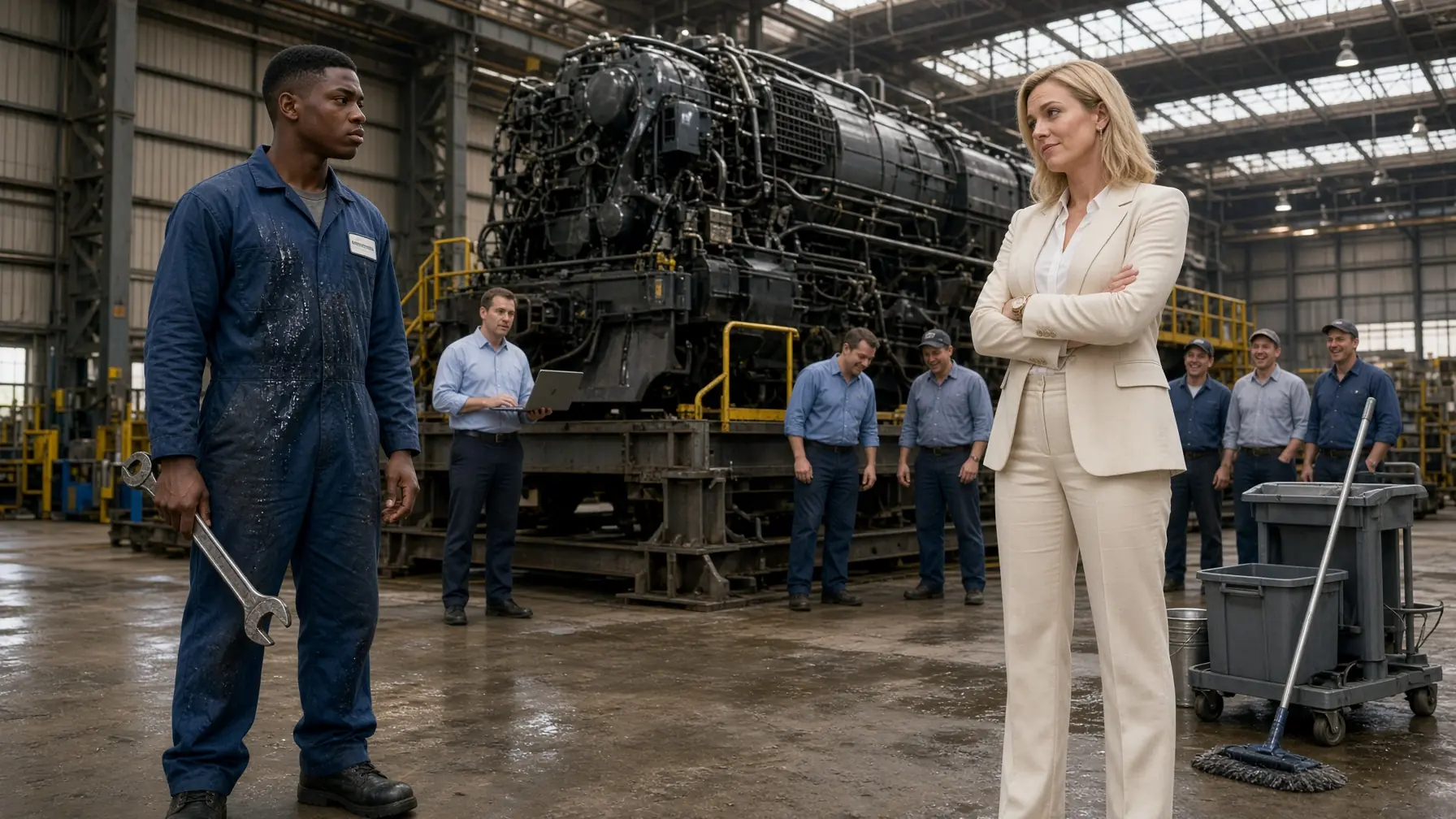
Water dripped from Frederick’s blue uniform.
Courtney Vale stood across from him with her arms beginning to fold, waiting for the moment when embarrassment would become surrender.
Behind her, several engineers were still laughing.
Frederick looked at the wrench.
Then at the enormous engine.
He had not touched either one that morning.
Until then, his job had been to clean the floor around them.
At the beginning of the shift, Test Hall B had looked like a place preparing to prove something.
The overhead lights were already on, though sunlight poured through the glass roof in broad pale sections. Steel beams crossed high above the workstations, and the testing platform occupied the center of the hall with the weight and scale of something that had required the building to be arranged around it.
The prototype freight locomotive engine stood taller than a pickup truck.
Exposed pipes ran along its sides. Fuel lines disappeared behind larger components, and the exhaust assembly rose above the mass of metal toward the hall’s extraction system.
Even silent, it commanded attention.
Frederick had paused beside the entrance long enough to let a worker pass with a wheeled cabinet.
Then he pushed his cleaning cart toward the section assigned to him.
He was exactly eighteen.
Tall and slim, with dark brown skin, short black hair in a clean fade, and a face that still looked unmistakably teenage when he stopped concentrating.
His maintenance uniform was neatly pressed.
The blue shirt lay flat across his narrow shoulders, his name badge sat straight, and his black work boots were clean enough that he noticed the first gray streak the floor left across one toe.
He stopped beside a yellow safety line and checked the path ahead.
People were moving quickly around the engine.
A workstation drawer remained open. A cable crossed a route that had been clear earlier. One of the engineers had placed a hard case just beyond the edge of a bench.
Frederick waited for space rather than trying to force his cart through.
It cost him a minute.
Then another.
He did not appear impatient.
When the route cleared, he moved the cart into position, set the bucket securely, and began working along the edge of the floor.
The hall carried sound strangely.
A dropped socket seemed louder than a conversation several yards away. Footsteps on the platform rang differently from footsteps on concrete.
The engine’s silence made every smaller noise distinct.
Frederick worked with his back partly turned toward it, drawing the mop through a narrow strip that workers had crossed repeatedly since the doors opened.
He moved the bucket only when he needed to.
The gray cart held cloths, cleaning supplies, and an empty section where he could rest what he was using without putting it on a workstation.
A worn steel wrench remained tucked in his uniform pocket.
The engraved initials EA caught the light once when he bent.
He adjusted the pocket with one hand and continued.
No one asked about it.
Most of the men nearby did not look at him long enough to notice it was there.