“GET OUT, or I’ll have them drag you off this tarmac.”
Captain Richard Vale stood at the bottom of the stairs of the white Bombardier Global 7500 with one hand raised like he was stopping a trespasser. The engines hummed behind him, low and steady, while the morning air over Teterboro Airport smelled of fuel, rain-wet concrete, and polished wealth. Naomi Preston stood three steps away from him in a black-and-white designer coat, leather travel bag in one hand, Rolex catching the gray daylight on her wrist. She looked at the pilot, then at the flight attendant behind him, then at the ground crew watching in silence.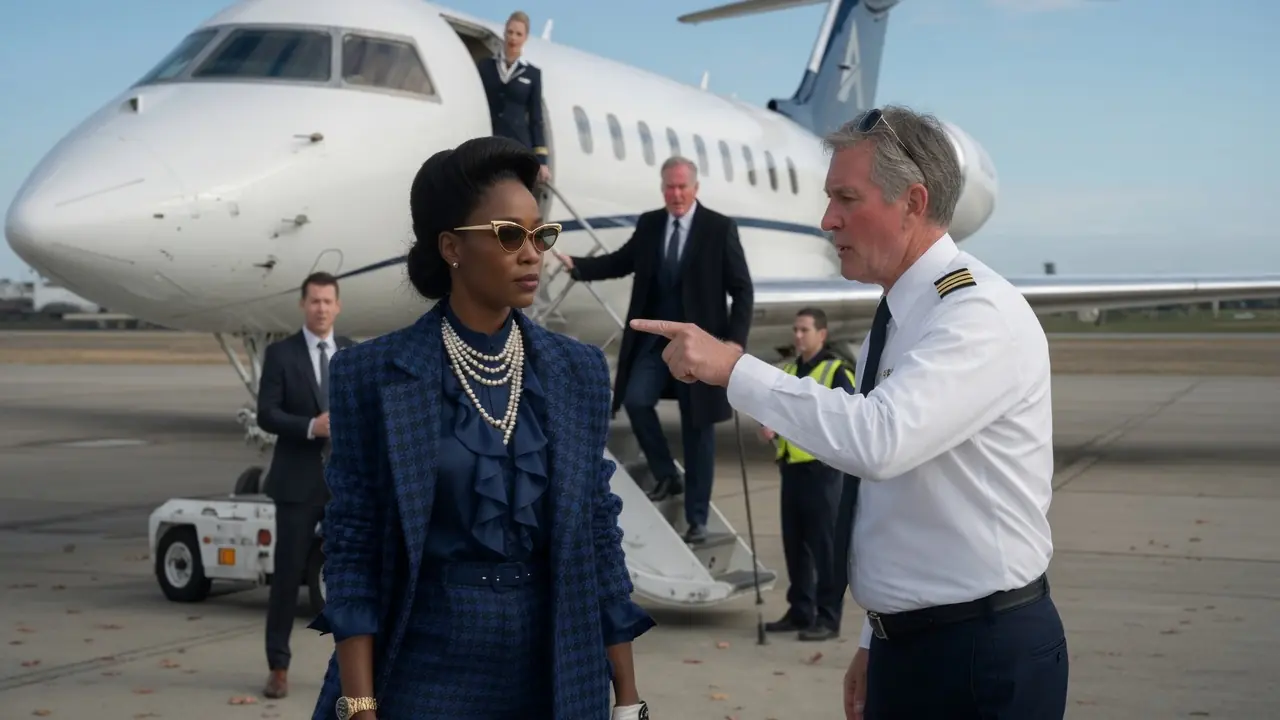
For one second, no one moved.
Naomi had bought that plane three years earlier after Preston Global Holdings closed the largest private logistics contract on the East Coast. The aircraft was not a rental, not a company perk, not a borrowed luxury. It was registered under her holding company, maintained by her aviation department, and staffed by people whose paychecks ultimately came from the empire she had built from nothing. Yet here she was, standing on the tarmac outside her own jet, being told she belonged somewhere else.
Captain Vale looked her up and down with a thin smile. “Service staff uses the rear, and you’re late.”
The flight attendant, Lauren Mills, glanced away as if pretending not to hear. A baggage handler near the fuel truck shifted uncomfortably but said nothing. Two ground staff members stood by the nose of the aircraft, watching with the dull curiosity of people who had already decided this was someone else’s problem. Naomi felt the insult settle around her like cold water, but she did not blink.
“Say that again,” she said.
Captain Vale’s smile widened. “I said service staff uses the rear. Whoever hired you should have explained procedure.”
Naomi slowly checked her Rolex. “Good. Call security, call your supervisor, call whoever taught you to mistake ownership for skin color. In nine minutes, they won’t be removing me from this tarmac. They’ll be escorting you off my aircraft, with your badge in one hand and your career in the other.”
Vale stared at her, then laughed.
It was the laugh that made Naomi’s decision final. Not the insult, not the mistake, not even the threat. Mistakes could be corrected. Ignorance could sometimes be trained out of people. But that laugh told her everything. He was not confused. He was enjoying the power of blocking a Black woman from a space he had already decided she could not own.
Lauren finally spoke, but not to defend Naomi. “Captain, maybe we should just check the manifest.”
Vale threw her a sharp look. “I know the passenger manifest.”
Naomi lifted one eyebrow. “Do you?”
“The principal is Ms. Preston,” he snapped. “Chairwoman of Preston Global. She is scheduled for departure at nine.”
Naomi looked at the aircraft, then back at him. “And what time is it?”
Vale glanced at his watch. “Eight fifty-one.”
“Then you are correct,” Naomi said. “You have nine minutes.”
Something in her calm tone unsettled him. His smile thinned, but pride held him upright. “I don’t know what game you’re playing, but you’re not boarding this aircraft.”
Naomi opened her phone and tapped one number. It rang twice before a male voice answered.
“Preston Aviation Operations, Daniel Cross.”
“Daniel,” Naomi said, putting the call on speaker. “I’m on the tarmac beside N742PG. Captain Vale is refusing me entry to my aircraft and has threatened to have security remove me.”
There was a pause.
Then Daniel Cross’s voice changed. “You’re at the stairs now?”
“Yes.”
“Do not move. I’m coming out.”
Vale’s face shifted for the first time. “Who is that?”
Naomi ended the call. “Someone who reads contracts before making threats.”
Vale’s jaw tightened. “Security!”
Two airport security officers had already begun walking toward them from the service lane. Vale turned to them with the confidence of a man certain the system would obey his version of events. He pointed at Naomi without looking back. “This woman is refusing to leave a private aircraft she has no right to approach.”
The taller officer looked at Naomi. “Ma’am, can I see your ID?”
Naomi did not reach into her bag. “In a moment.”
Vale scoffed. “See? She’s stalling.”
Naomi looked at the officer. “You may want to wait for operations before you decide who is trespassing.”
The officer hesitated. That hesitation told Naomi he had more sense than the pilot, but not enough courage yet. The second officer looked at the tail number on the aircraft, then at Naomi, then at Vale. The tarmac seemed to tighten around them. The crew stood frozen, knowing something was wrong now but not yet willing to admit what.
Daniel Cross arrived in less than four minutes, moving fast across the tarmac with a tablet in one hand and a headset around his neck. He was the director of aviation operations for Preston Global, a former Air Force logistics officer who cared about details the way surgeons cared about clean instruments. His face was already pale before he reached them.
“Ms. Preston,” he said.
The words landed like a hammer.
Lauren Mills’s mouth opened slightly. The baggage handler took one full step back. Captain Vale’s head turned slowly toward Naomi, his eyes narrowing as if reality had become personally offensive.
Naomi kept her gaze on Daniel. “Confirm the aircraft owner.”
Daniel unlocked the tablet with shaking fingers. “Bombardier Global 7500, tail number N742PG, registered to Preston Global Holdings.”
Naomi’s voice stayed quiet. “Full beneficial owner?”
Daniel swallowed. “Naomi Preston. Owner, chairwoman, and principal passenger.”
The first security officer lowered his hand from his belt. “Ma’am…”
Naomi did not look at him. She looked at Vale.
The pilot had gone pale, but arrogance fought for space on his face. “There must have been a misunderstanding.”
Naomi stepped closer by one measured pace. “No, Captain. A misunderstanding is when a passenger goes to the wrong gate. You looked at me, decided I was service staff, blocked me from my own aircraft, and threatened to have me dragged off my own tarmac.”
Vale opened his mouth, but nothing useful came out. “I didn’t recognize you.”
“That was not the problem,” Naomi said. “The problem was what you thought you recognized.”
Lauren looked down at the stairs.
Naomi turned to her. “You heard him.”
Lauren’s face flushed. “Ms. Preston, I thought he knew—”
“You thought silence was safer.”
Lauren’s eyes filled, but Naomi felt no need to comfort her. The time for comfort had been when the insult was happening, when the pilot’s body blocked the stairs, when every person around the plane had a chance to ask one question and chose not to.
Daniel cleared his throat. “Ms. Preston, how would you like to proceed?”
Naomi checked her Rolex again. Eight fifty-nine.
“Nine minutes,” she said.
Vale swallowed. “Ms. Preston, I apologize. Truly. Let’s not make this bigger than it needs to be.”
Naomi looked at him with a calm so cold even the wind seemed to stop. “You made it big when you called security before asking my name.”
Then she turned to Daniel. “Remove Captain Vale, the flight attendant, and every crew member who stood on this tarmac and watched this happen without intervening. Their contracts are terminated effective immediately, pending formal review. Collect their badges. Preserve all audio, video, ground communications, and shift records. I want legal, HR, and aviation compliance on this before I land.”
Daniel nodded. “Understood.”
Vale’s face twisted. “You can’t fire an entire crew minutes before departure.”
Naomi glanced at the aircraft stairs. “I can delay my own plane.”
“This is absurd,” he snapped, panic cracking through his voice. “I have twenty-three years of flight experience.”
“And no judgment,” Naomi said. “That makes you expensive risk.”
The security officers now moved toward Vale, not Naomi. The first one spoke carefully. “Captain, we need you to step away from the aircraft.”
Vale stared at him. “You’re serious?”
Naomi answered for them. “Yes.”
Lauren started crying quietly. “Ms. Preston, please. I have never had a complaint.”
Naomi looked at her. “Now you do.”
The ground crew began handing over badges one by one. Some looked ashamed. Some looked angry. Some looked at Naomi as if her response was harsher than what had happened to her. That was familiar too. People who tolerated humiliation often became experts at criticizing the moment the humiliated person regained power.
Vale’s badge was the last.
He held it for a moment too long before Daniel extended his hand. “Captain.”
Vale slapped the badge into Daniel’s palm. “This will ruin me.”
Naomi looked at him. “No. This revealed you.”
Security escorted him away from the aircraft. Lauren followed, wiping her face. The ground staff left in a line that looked almost ceremonial, except there was nothing honorable about it. Naomi watched until they were off the active tarmac.
Only then did she climb the stairs.
Inside, the cabin was quiet, perfect, and waiting. Cream leather seats, polished wood trim, fresh flowers near the bar, folded newspapers she had not yet read. Naomi paused near the entrance and looked back through the open door at the empty space where the crew had stood. Her anger did not fade. It settled.
Daniel stepped into the doorway behind her. “I have a replacement crew on standby from our Newark rotation. They can be here in twenty-five minutes.”
“Good.”
“I’m sorry,” he said.
Naomi turned. “For what part?”
Daniel lowered his eyes. “For hiring people who failed you.”
She studied him for a moment. Daniel was not a man who made excuses. That was why she had hired him. “Find out who trained them. Find out whether this has happened before. Not just to me.”
“Yes, ma’am.”
Naomi entered the cabin and sat near the window. She opened her phone and saw six missed messages from her executive assistant, Priya. News traveled fast when the owner of the aircraft fired a crew on the tarmac. Naomi called her back.
“What happened?” Priya asked immediately.
“I was refused entry to my plane.”
A silence.
Then Priya said, “By who?”
“The pilot.”
Priya exhaled slowly. “Do you want me to move the San Francisco meeting?”
“No. Delay it by one hour.”
“Do you want a statement prepared?”
“Yes. Internal first. No soft language.”
Priya’s voice sharpened. “Understood.”
Naomi looked out the window at the tarmac, where a new crew vehicle approached in the distance. “And Priya?”
“Yes?”
“Pull every employee complaint attached to Preston Aviation in the last eighteen months. I want patterns, not apologies.”
By the time the replacement crew arrived, the entire atmosphere had changed. The new captain, Angela Reeves, stepped into the cabin first, a Black woman in her forties with steady eyes and a crisp uniform. She stopped at the entrance, met Naomi’s gaze, and said, “Ms. Preston, Captain Reeves. I’ve reviewed the aircraft status, filed the updated crew list, and I apologize for what occurred before our arrival.”
Naomi nodded. “Thank you, Captain.”
Reeves did not overexplain. She did not try to perform outrage. She gave Naomi what the first crew had failed to offer: competence and respect.
The flight departed forty-two minutes late.
During takeoff, Naomi looked down at the shrinking tarmac and thought about her first business loan rejection. She had been twenty-six, wearing her best navy suit, sitting across from a banker who kept asking who “really” owned the logistics plan she had written. She thought about warehouse managers who mistook her for administrative staff, investors who praised her “confidence” like it was surprising, and conference organizers who directed her toward registration tables instead of speaker green rooms.
The plane climbed above the clouds.
Naomi rested her hand over her watch and let herself feel the weight of the morning. Not because Vale mattered. He did not. But because men like him were never isolated accidents. They were the visible edge of a thousand quiet assumptions.
In San Francisco, she delivered the keynote without mentioning the incident. She spoke about supply chains, labor accountability, technology integration, and the cost of weak leadership. People applauded. Reporters asked about market expansion. Investors smiled. No one in that ballroom knew she had started the day being told to use the rear entrance of her own jet.
That evening, in her hotel suite, Priya sent the internal report.
It was worse than Naomi expected.
There had been complaints. A junior mechanic said Captain Vale had referred to nonwhite passengers as “special handling.” A temporary flight attendant reported that Lauren Mills told her certain clients preferred “polished-looking service staff.” A ground coordinator had flagged Vale for refusing to greet a Middle Eastern executive until another employee confirmed the passenger’s identity. Each complaint had been dismissed as personality conflict, tone misunderstanding, or insufficient evidence.
Naomi read every line.
Then she called Daniel.
“Who dismissed these complaints?”
He was quiet for a moment. “HR aviation liaison. Two operations managers. One legal reviewer.”
“Schedule them for review.”
“Disciplinary?”
“Termination review,” Naomi said. “If the system protected behavior this long, the system gets rebuilt.”
The next morning, Preston Global issued an internal memo. It did not name race vaguely as “sensitivity.” It did not hide behind “customer service concerns.” It stated plainly that discriminatory assumptions had resulted in the company’s owner being denied entry to her aircraft, and preliminary review showed the incident was part of a broader failure in aviation culture and accountability.
The memo ended with one line Naomi wrote herself.
No employee at Preston Global is paid to decide who belongs by appearance.
By noon, the story had leaked.
A passenger from a neighboring hangar had filmed part of the confrontation, including Vale saying, “Service staff uses the rear,” and Naomi replying, “In nine minutes, they’ll be escorting you off my aircraft.” The clip spread quickly. Some people called her response iconic. Others claimed she overreacted. A retired pilot on television said firing a crew over words was “emotional.”
Naomi declined every interview request.
Instead, she held a company-wide livestream.
She stood in the main auditorium of Preston Global headquarters in New York, wearing a simple black suit, no podium between her and the employees. Behind her, a large screen displayed the new aviation accountability policy. Thousands watched from warehouses, offices, trucks, remote terminals, and aircraft hangars.
“I am not speaking today because I was personally offended,” Naomi said. “I have been offended before. Most Black women in leadership have.”
The room went completely still.
“I am speaking because offense is not the danger. The danger is when bias is given operational authority. The danger is when an employee feels empowered to deny access, summon security, or threaten removal based on assumption instead of verification. In logistics, we verify containers, routes, customs codes, weather systems, cargo weights, fuel plans, and delivery windows. Yet yesterday, a captain responsible for a seventy-million-dollar aircraft failed to verify the identity of the person who owned it.”
She let the silence hold.
“That is not only prejudice. That is incompetence.”
Employees shifted in their seats.
“Preston Global will not tolerate either.”
The policy rolled out within two weeks. Aviation staff were retrained under new identity verification protocols that applied to everyone, including Naomi. Security escalation rules changed. Complaint review was moved outside direct management chains. Employees who had previously reported discrimination were contacted, interviewed, and protected. Several managers left the company.
Captain Vale tried to sue.
He claimed wrongful termination, reputational harm, and emotional distress. Naomi’s legal team responded with video, employment records, complaint history, witness statements, and contract clauses so cleanly organized that his attorney asked for settlement before the first hearing. Naomi refused any settlement that included silence.
Vale withdrew the case six months later.
Lauren Mills wrote Naomi a letter. It was three pages long, apologizing not only for what she had said or failed to say, but for the comfort she had taken in silence. Naomi read it once, then placed it in a file. She did not respond immediately.
Two months later, Lauren applied for a training program focused on ethical service leadership in aviation. Naomi approved the tuition reimbursement anonymously through the company fund. Forgiveness was not always a conversation. Sometimes it was giving someone a path that did not erase what they had done.
A year after the tarmac incident, Naomi boarded the same Bombardier Global 7500 at Teterboro Airport.
Captain Angela Reeves stood at the stairs.
“Good morning, Ms. Preston.”
“Good morning, Captain.”
The new ground crew greeted Naomi by name, but more importantly, they greeted everyone by process. A courier delivering documents was treated politely. A junior analyst carrying Naomi’s garment bag was asked for ID with respect, not suspicion. A maintenance worker was thanked by the captain before stepping off the aircraft.
Naomi noticed all of it.
Inside the jet, she sat near the window and opened a message from her daughter, Camille, who was fourteen and already taller than Naomi wanted to admit.
Mom, is this the plane from the video?
Naomi smiled faintly and typed back.
Yes.
Did you really fire everybody in nine minutes?
Naomi looked out at the wing, then at the crew moving with quiet professionalism outside.
Not everybody, she wrote. Just the people who forgot respect was part of the job.
Camille replied with a row of fire emojis, then: Proud of you.
Naomi’s throat tightened.
She had not built Preston Global just to own planes, warehouses, ships, and contracts. She had built it so her daughter would inherit a world with fewer locked doors and fewer people standing at the bottom of stairs pretending they owned the right to decide who belonged.
The engines began to hum.
Captain Reeves’s voice came through the cabin speaker. “Ms. Preston, we are ready for departure.”
Naomi looked at the stairs before they closed. For a moment, she could still see Vale standing there, blocking her path with a raised hand and a smug smile. Then the door sealed, the cabin quieted, and the aircraft began to move.
Nine minutes had not changed the world.
But it had changed her company.
It had changed the tarmac.
And for every employee who had ever stood in a room while someone else was humiliated and wondered whether silence was safer, it had changed the cost of saying nothing.
Naomi leaned back as the jet rolled toward the runway. This time, no one questioned why she was there. No one asked her to use another entrance. No one mistook her for service staff.
The plane lifted into the sky under her name, her rules, and her command.
And somewhere far below, the tarmac that had tried to shame her became the place where everyone learned exactly who owned the stairs.