“Okay,” I whispered.
Connor’s smile widened.
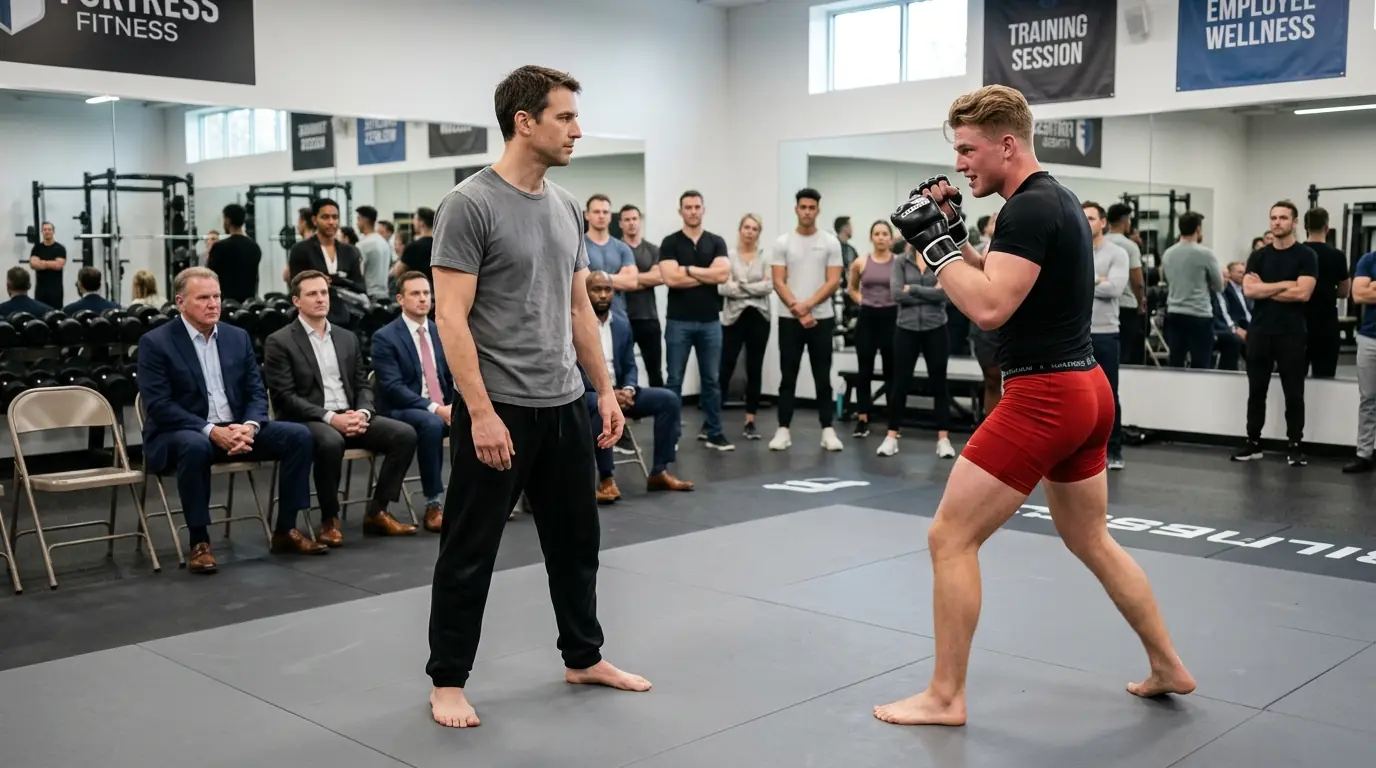
He thought it meant I was scared.
He thought he had finally cracked the quiet little database analyst who refused to play along with his corporate gladiator fantasy.
He was wrong.
It meant I was done protecting him from himself.
For three years, I had built my life around being forgettable.
John Cole.
Operations data specialist.
Cubicle 4B.
The man who fixed broken formulas without complaining and brought the same turkey sandwich to work four days a week.
Nobody at Prescott Logistics knew that I could wake from a dead sleep and identify the direction of a distant engine by sound.
Nobody knew why I always chose the chair facing the entrance during meetings.
Nobody knew why fireworks made my jaw tighten.
Nobody knew because I had worked very hard to make sure they didn’t.
Connor Prescott had mistaken that silence for weakness.
Now blood was running slowly down my cheek.
And something very old inside me had opened its eyes.
Connor raised his gloves.
“What’s wrong, John?”
He bounced lightly on his toes.
“Did I finally wake you up?”
I looked at him.
Not at the belts displayed in glass cases along the far wall.
Not at his expensive gloves.
Not at the CEO.
At Connor.
Really looked at him.
His breathing was terrible.
His shoulders were too high.
His mouth hung open as he dragged air into his lungs.
His right leg was carrying slightly less weight than his left.
His hands were fast, but his balance disappeared whenever he became emotional.
Most importantly, he was angry.
Angry men became predictable.
Connor pointed a glove at me.
“Come on.”
I wiped the blood from my cheek with the back of my hand.
“No.”
He blinked.
“No?”
“I’m giving you one chance to stop.”
A few people along the wall exchanged glances.
Connor laughed.
His father didn’t.
Richard Prescott stood behind him in an immaculate charcoal suit, arms folded tightly across his chest.
He was sixty-two and had spent thirty years building the company.
Everyone feared him.
Connor worshipped him.
That explained more than either of them understood.
“Stop?” Connor repeated.
“You think you’re in control here?”
I said nothing.
He stepped closer.
“My father owns this building.”
Another step.
“He owns your department.”
Another.
“He signs your paycheck.”
He brought his face close enough that I could smell the mint gum beneath the sweat.
“And when I’m finished with you, I’ll make sure no company in this city hires you again.”
There it was.
Not confidence.
Terror.
A twenty-four-year-old boy desperately performing for the one man whose approval he could never quite secure.
I almost felt sorry for him.
Almost.
“You done?” I asked.
His face changed.
Connor threw the first punch.
I moved.
This time, I didn’t only evade it.
I caught his wrist, redirected his momentum and stepped past him.
Connor stumbled several feet before catching himself.
The room went silent.
He spun around.
“What the hell was that?”
I stayed where I was.
“Your warning.”
His nostrils flared.
Then he charged.
Connor had spent years training in clean gyms.
Padded floors.
Timers.
Rules.
Water breaks.
Coaches standing nearby.
He knew how to fight someone who agreed to participate in the same sport.
He had never learned how disorienting it was when another person refused to follow the rhythm he expected.
He threw another combination.
I disrupted his balance and moved away.
A kick came.
I stepped outside its path.
He tried to clinch.
I peeled away before he established control.
Every failed attempt made him more furious.
Every miss made him faster.
Sloppier.
He was no longer fighting me.
He was fighting embarrassment.
“Stand still!” he shouted.
Somewhere behind him, someone laughed nervously.
Connor heard it.
His head snapped toward the sound.
That moment cost him.
I stepped in.
Not violently.
Just close.
Too close for his long punches.
Connor froze.
For the first time all afternoon, his eyes changed.
There was fear there.
Real fear.
I spoke quietly enough that only he could hear.
“You enjoy hurting people who can’t hit back.”
His jaw tightened.