“Physics are physics. Your street stories won't change that.”
Declan Ross stood on the black edge of the wrestling mat as though the entire basement belonged to him. The fluorescent lights caught the clean stitching of his embroidered black belt, and the twenty students gathered around the room kept their eyes on his hands. He was twenty-six, fast, athletic, and accustomed to people stepping aside when he needed an audience. A grappling champion did not have to raise his voice to become the center of a gym. Declan raised his anyway.
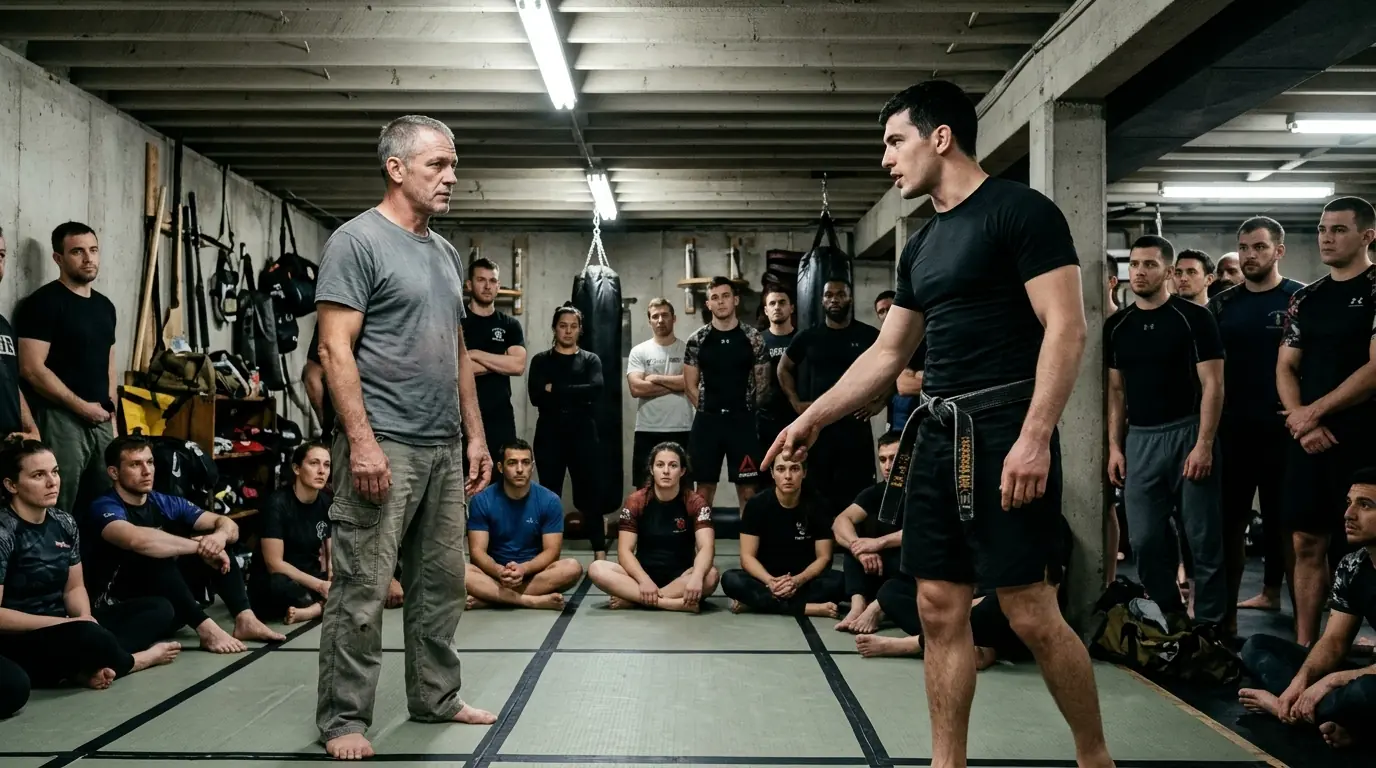
Victor Hayes looked at him from three paces away. At forty-nine, Victor wore a threadbare gray T-shirt, faded canvas cargo pants, and no shoes. His short hair had gone gray at the temples. Long pale scars crossed his hands and disappeared beneath the sleeves of his shirt. When he folded his arms, the motion was so unhurried that someone unfamiliar with him could have mistaken it for indifference.
“Physics won't hurt you,” Victor said. “Your ego will.”
A few students shifted against the benches. Nobody laughed. Declan's smile held a moment longer than it should have, then narrowed as if he had been handed something unpleasant and asked to admire it. Behind him, a heavy bag swung slightly on a chain that had not stopped moving since the previous drill.
Victor had not invited a confrontation. For the first hour of the seminar, he had spent more time teaching people to avoid wrestling than teaching them how to win at it. His lesson concerned the space between a sporting contest and a frightening encounter, the decisions made before hands closed on clothing, and the obligation to stop before enthusiasm became injury. Declan had arrived to disprove the part he found insulting. By the time he spoke, everyone in the basement knew the evening had become something other than a demonstration.
The building sat beneath an old commercial storefront in Baltimore, where traffic rolled over repaired asphalt and a metal stairwell carried visitors down into a room built more for endurance than comfort. Bare concrete walls collected noise. Taped wrestling mats covered most of the floor. Heavy bags hung from exposed beams beside racks of padded training weapons, their ends marked with bright tape so nobody mistook one drill for another. Two long benches faced the central square.
The gym had no glamorous sign at street level. It had no sponsor banners, no posters of champions, and no glass case of trophies. The hand-painted notice beside the basement door said only that students were expected to arrive ready to learn and leave with their partners unharmed. That rule had cost Victor a few customers over the years. He had never amended it.
The twenty students were not a unified group. Some trained regularly at Victor's gym and recognized his silences as part of his instruction. Others belonged to local boxing, wrestling, and martial arts clubs that had pooled money for an evening seminar on control under pressure. A warehouse supervisor had come because he often worked alone at night. A woman who ran a neighborhood youth program had come because teenagers kept asking her how to defend themselves. Two security guards sat near the bags. A nurse with bruises from an accidental fall had come because she wanted to understand balance and leverage without being thrown carelessly again.