“Fifty thousand dollars says you can't survive sixty seconds with me.”
Chase Mercer tossed the microphone onto the training mat and smiled at the elderly man standing barefoot near the edge of the ring.
The crowd erupted.
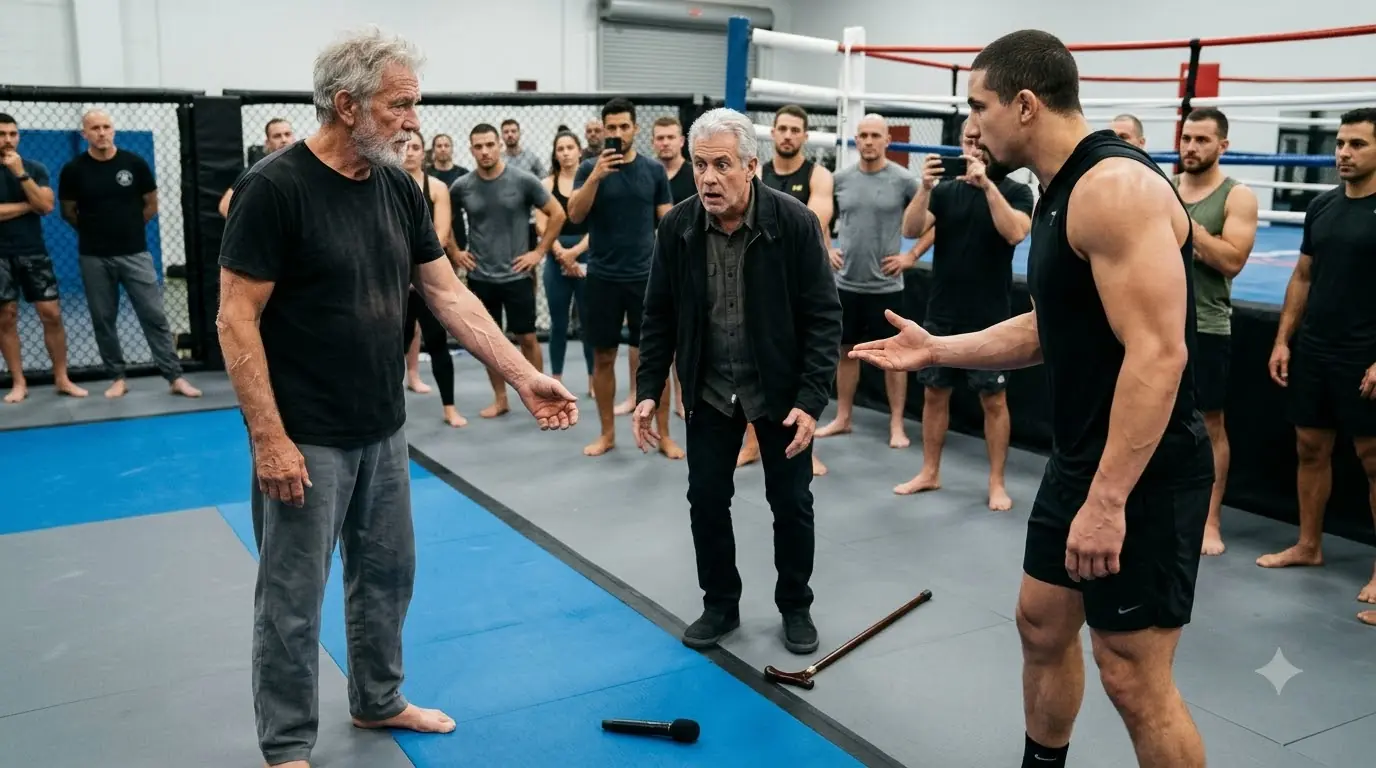
At thirty-two, Chase was one of the most recognizable fighters in the regional mixed martial arts circuit. His face appeared on gym posters, his training clips drew millions of views, and his undefeated streak had made him believe that fear was something other people carried.
Across from him stood Elias Grant.
Sixty-eight years old.
Gray hair. Weathered face. A white beard trimmed close to his jaw. An old black training shirt and loose gray trousers.
No gloves.
No shoes.
No visible rank.
He had spent the morning teaching children how to fall safely.
Chase had spent the morning laughing at him.
“Come on, old man,” the champion said. “You call yourself an instructor. Show these people something worth learning.”
Elias looked toward the students gathered around the mat.
Several were recording.
Others watched with the uncomfortable anticipation of people who wanted the confrontation to end but feared missing what happened next.
“I didn't come here to fight you,” Elias said.
Chase stepped closer.
“Then admit you're a fraud.”
The old man's expression did not change.
Chase grabbed his shoulder and shoved him backward.
A sharp murmur traveled through the gym.
Elias caught his balance without raising his hands.
The movement was small.
Almost invisible.
But an older man standing near the entrance suddenly stopped walking.
He was in his late fifties, wearing a dark jacket over an ordinary shirt. His hair was almost entirely gray, and he leaned slightly on a polished wooden cane.
He had entered the gym only moments earlier.
Now his eyes were fixed on Elias.
More precisely, on the old instructor's left forearm.
When Chase shoved Elias again, the sleeve of the black shirt rode upward, exposing three pale scars crossing the forearm at unusual angles.
The stranger's face drained of color.
He took one step forward.
Then another.
“Where did you get those scars?” he whispered.
Nobody heard him over the crowd.
Chase pulled off his own training shirt and threw it aside, showing off the muscular body that had made him famous.
“Look at him,” he shouted. “He's shaking.”
Elias wasn't shaking.
He had simply lowered his eyes toward the mat.
The stranger reached the boundary line.
He stared at the scars, then at an old crescent-shaped mark near Elias's right collarbone.
His cane slipped from his hand.
It struck the floor with a hard crack.
The champion turned irritably.
“What's your problem?”
The stranger didn't look at him.
He stared at Elias with tears beginning to fill his eyes.
Then he spoke a name that had not been heard inside a professional fighting gym for more than thirty years.
“Teacher?”
Elias slowly raised his head.
The stranger's voice broke.
“It's really you.”
And for the first time that afternoon, the old instructor looked afraid.
Not of the champion.
Of being remembered.
Six weeks earlier, Elias Grant had arrived at the Ridgeway Combat Academy carrying a worn canvas bag and a letter from the gym's owner.
The academy occupied a converted warehouse on the outskirts of Cleveland. Bright overhead lights illuminated a regulation boxing ring, several training mats, heavy bags, exercise stations, and an enclosed studio for children's classes.
Its walls were covered with championship photographs.
Most featured Chase Mercer.
Chase had trained at Ridgeway for years and had become the gym's most valuable attraction. His championship bouts brought publicity, sponsorships, and a steady stream of younger fighters who wanted to learn from someone they watched online.
The owner, Samuel Price, had known Elias for nearly twenty years.
They had met through a youth athletics program in a difficult part of the city, long before Samuel owned a professional training facility.
Elias had taught a handful of children in a church basement.
He never charged.
Samuel remembered watching him spend an entire afternoon helping one frightened eleven-year-old boy learn how to fall without striking his head.
The boy had been terrified of physical contact.
Elias never laughed at him.
He never raised his voice.
He simply showed the movement again and again until the child understood.
Samuel had not forgotten that patience.
When Ridgeway's children's self-defense instructor left unexpectedly, Samuel called Elias.
“I need someone who knows how to teach beginners,” he said.
“There are younger people.”
“There are.”
“People with certificates.”
“Plenty.”
“Then why call me?”
Samuel smiled into the phone.
“Because I remember what happened when those kids were scared.”
Elias hesitated.
He had retired from regular instruction years earlier.
His left knee troubled him in cold weather. One shoulder no longer moved as freely as it once had. His hands had lost some speed, and old injuries sometimes made themselves known for reasons as small as an approaching storm.
He did not want to return to a competitive gym.
But Samuel described the children.
Some were being bullied at school.
Some were shy.
A few had experienced frightening situations and needed a safe environment where confidence could develop without aggression.
Elias listened.
“What would I teach?” he asked.
“Balance. Falling. Awareness. Basic defense.”
“No competition?”
“Not unless you want it.”
“Then I'll come and look.”
Samuel laughed.
“That means yes, doesn't it?”
“Means I'll come and look.”
Three days later, Elias entered Ridgeway wearing the same simple clothes he would eventually wear during the confrontation with Chase Mercer.
He had never cared much about appearance.
He believed a teacher's value became visible through the students.
The trouble was that Ridgeway had spent years teaching people to see value differently.
Its walls celebrated victories.
Its social media celebrated knockouts.
Its most successful athlete celebrated dominance.
And Elias, who preferred quiet instruction to spectacle, seemed almost designed to offend the gym's culture.
“Storage rooms are in the back,” he said.
Elias looked at him.
“Thank you.”
Then he continued toward Samuel's office.
Chase watched him go.
“Hey, I said storage.”
Elias stopped.
“I'm meeting Samuel.”
Chase laughed.
“About what?”
“Teaching.”
The champion stared at him.
Then he laughed harder.
“You?”
Elias nodded.
“Apparently.”
Chase looked down at the old man's canvas bag.
“What are you teaching? How to survive a retirement home?”
Two fighters standing nearby laughed.
Elias did not respond.
He walked away.
That silence became Chase's first reason to dislike him.
Chase Mercer had grown up in a world where attention and survival often seemed connected.
His father left when he was nine. His mother worked two jobs, and he spent much of his adolescence angry at the absence of things he could not name.
Fighting gave him structure.
Winning gave him recognition.
Recognition became money.
And money eventually convinced him that every relationship operated according to the same rules as a contest.
Someone won.
Someone lost.
Someone stood above the other.
It was a simple system.
Chase liked simple systems.
His coach, Victor Hale, had tried for years to temper that attitude.
Victor was fifty-six, a former fighter with flattened ears and an old shoulder injury that made him careful about demonstrating throws.
He recognized Chase's talent early.
He also recognized the danger beneath it.
“You're building a career,” Victor often told him. “Don't confuse that with building character.”
Chase usually smiled.
“Character doesn't pay the bills.”
Victor would shake his head.
“One day you'll discover what does.”
For a long time, the champion believed his coach was simply getting old.
Then Elias Grant arrived.
Within two weeks, the children's classes began attracting attention.
Not online.
Inside the gym.
Parents noticed that their children became more confident without becoming more aggressive.
A quiet girl named Lily stopped crying whenever another child moved too close.
A twelve-year-old boy called Noah, who had once been suspended for fighting, began learning to walk away from provocations.
Elias made the children repeat simple exercises.
How to maintain balance.
How to protect their heads during a fall.
How to step away from an argument.
How to recognize when fear was making them rush.
He never told them that being strong meant hurting someone else.
Instead, he asked a question at the beginning of every class.
“What is the first thing you protect?”
The children initially shouted different answers.
“Your face!”
“Your stomach!”
“Your head!”
Elias shook his head.
“Your judgment.”
Eventually they learned to answer together.
That troubled Chase.
Not because he disagreed with the words.
Because parents began gathering to watch Elias teach.
Some stayed after class to speak with him.
A father told Samuel that his son had never been excited about training until Elias arrived.
Another parent asked whether the old instructor could offer an adult beginner session.
Samuel began considering expanding the program.
Chase noticed.
One evening he approached Samuel's office and found the owner studying a new schedule.
“What's this?” Chase asked.
“Expanded fundamentals classes.”
“Who's teaching?”
“Elias.”
Chase laughed.
“Seriously?”
Samuel looked up.
“What's funny?”
“You've got professional fighters in this building, and you're giving classes to a barefoot grandfather.”
“He's good with students.”
“Good at talking.”
“Good at teaching.”
“Where did he fight?”
Samuel closed the schedule.
“I didn't hire him to fight.”
“That's convenient.”
“Chase.”
The champion leaned against the desk.
“Does he even have credentials?”
Samuel's expression changed.
“He has experience.”
“What experience?”
“Enough for this role.”
Chase stared.
“That's not an answer.”
Samuel looked at him for a long moment.
Then he said, “Not every answer belongs to you.”
Chase left furious.
He interpreted Samuel's secrecy as proof that Elias had something to hide.
He was right.
But not in the way he imagined.
The first real confrontation happened during an afternoon class.
Elias was demonstrating a simple balance exercise with Noah.
The boy had difficulty keeping his feet beneath him when someone applied gentle pressure to his shoulder.
Each time he lost balance, he became frustrated.
Elias told him to reset.
“Don't fight the force,” he said. “Understand where it's going.”
Noah tried again.
This time he remained standing.
His face brightened.
“Did you see that?”
“I did.”
“I didn't fall.”
“No.”
“How?”
“You stopped trying to win against your own feet.”
Several children laughed.
Chase entered the training area carrying boxing gloves and followed by two younger fighters.
He watched Elias demonstrate the movement again.
Then he shook his head.
“This is what we're charging parents for?”
The children went quiet.
Elias looked toward him.
“Class is in progress.”
Chase ignored him.
He approached Noah.
“Kid, you want to learn how to actually fight?”
Noah looked uncertain.
Elias spoke gently.
“Chase, please give us the mat.”
The champion grinned.
“I'm offering to help.”
“We're practicing balance.”
“Against what? A strong breeze?”
One of the younger fighters laughed.
Noah's face flushed.
Chase stepped closer and placed a hand against the boy's shoulder.
“Here. Let me show you real pressure.”
Elias moved between them.
“Not without his permission.”
Chase looked down at him.
“Are you serious?”
“Yes.”
“It's a combat gym.”
“It's a children's class.”
Chase's smile faded.
“You going to stop me?”
Elias did not raise his voice.
“If necessary.”
For a moment, something dangerous passed across Chase's face.
Then he laughed.
“Look at this guy.”
He backed away with both hands raised.
“Relax. I'm not going to hurt the little king of kindergarten karate.”
Noah stared at the floor.
Elias waited until Chase left.
Then he crouched beside the boy.
“You all right?”
Noah nodded, though his eyes were wet.
Elias did not pretend nothing had happened.
He simply said, “Someone making fun of what you're learning doesn't make the lesson less useful.”
Noah swallowed.
“Could you beat him?”
The question surprised Elias.
He considered it carefully.
“I don't need to.”
“But could you?”
Elias looked toward the doorway.
“I hope I never have to find out.”
Chase heard about that answer the following morning.
One of the younger fighters repeated it while they wrapped their hands.
Chase laughed.
“He hopes he never has to find out?”
“That's what the kid said.”
“Perfect. He's scared.”
Victor Hale overheard the exchange.
“Or he's sensible.”
Chase turned.
“You defending him too?”
“I'm defending common sense.”
“Everybody acts like this old man is special.”
Victor tightened a bandage around his wrist.
“Maybe because he doesn't need to convince anyone.”
Chase stared at him.
“What's that supposed to mean?”
Victor looked up.
“Nothing you want to hear.”
The exchange remained with Chase.
He began watching Elias whenever he could.
At first he looked for incompetence.
Then he looked for hesitation.
Then he looked for evidence that the old man feared physical contact.
What he found confused him.
Elias moved slowly when he walked.
He occasionally favored his left knee.
He could not hold his left arm overhead for long without discomfort.
But when he demonstrated a fall, his body changed.
His weight shifted with quiet certainty.
His feet seemed to know where the floor would be before he reached it.
He never wasted movement.
Sometimes Chase saw him adjust a student's posture with one hand and immediately recognized how easily that same touch could become a controlling grip.
It irritated him.
A man who looked so physically diminished should not move with such precision.
Chase tried to recreate one of Elias's balance demonstrations after the children left.
He asked a younger fighter to push against his shoulder.
Then another.
The movement seemed trivial.
But when he attempted it without using strength to compensate, he repeatedly lost position.
Victor watched from across the mat.
“You're leaning too early.”
Chase scowled.
“I know.”
“Then stop.”
The champion tried again.
He failed.
Victor smiled faintly.
“Maybe ask the old man.”
Chase threw the practice pad across the room.
There was another thing Chase noticed.
Elias never removed his shirt in public.
Even during the hottest training sessions, he wore sleeves that covered most of his upper arms.
When he demonstrated movements, he occasionally adjusted the fabric before raising his hands.
At first Chase assumed embarrassment.
Then, during an evening class, a child accidentally spilled water over the instructor's shirt.
Elias laughed gently and stepped away to dry himself.
As he lifted one sleeve, Chase saw a pale mark along his forearm.
Not the usual scar from a superficial cut.
Longer.
Older.
Deep enough to change the shape of the skin.
Chase pointed.
“What happened there?”
Elias pulled down the sleeve.
“Long time ago.”
“Accident?”
“Yes.”
“What kind?”
“One I survived.”
Chase grinned.
“Sounds dramatic.”
Elias looked at him.
“It wasn't pleasant.”
Something in the answer made Chase stop smiling.
For a second.
Then the champion shook his head and walked away.
That night, he searched online for Elias Grant.
He found almost nothing.
No major championship record.
No professional fight history.
No tournament rankings.
No promotional interviews.
No videos of the old man's supposed prime.
To Chase, the absence of information confirmed his suspicions.
He went to Samuel's office the next morning.
“There's nothing on this guy.”
Samuel did not look up.
“Who?”
“Elias.”
“What do you mean?”
“No record. No titles. No legitimate history.”
Samuel set his pen down.
“Why are you investigating him?”
“Because you're letting him teach here.”
“He passed the required checks.”
“Then show me his background.”
“No.”
Chase stared.
“I'm the face of this academy.”
“You're one of its athletes.”
“I'm the reason people know this place exists.”
Samuel stood slowly.
“Chase, you're a talented fighter. You've brought success to Ridgeway. But that does not give you the right to interrogate every instructor.”
“He's a fraud.”
“Do you have evidence?”
“There's no evidence he's anything else.”
Samuel's expression hardened.
“That's not how evidence works.”
Chase turned and walked out.
Within hours, he posted a message on social media.
Ridgeway's letting barefoot old-timers teach self-defense now. Maybe next week we'll hire a magician.
He did not name Elias.
He didn't need to.
A photograph accompanied the post.
It showed the old instructor standing beside the children's mats.
The caption spread.
Students commented.
Some laughed.
Others defended Elias.
The disagreement became another source of attention for Chase.
He enjoyed it.
He did not notice that one particular person had seen the photograph.
A man living nearly two hundred miles away.
A man who had spent decades believing the person in that image was dead.
His name was Robert Whitaker.
At fifty-eight, Robert worked as a physical therapist in Columbus.
He had a limp from an old injury and walked with a wooden cane on difficult days.
Most of his patients knew him as a quiet, patient man who had an unusual understanding of fear.
He often worked with people recovering from serious injuries.
When someone became discouraged, he rarely offered empty reassurance.
He listened.
Then he helped them take the next step.
Robert had learned that approach from someone long ago.
Someone he had not seen in thirty-four years.
The photograph appeared on his phone during a break between appointments.
A former colleague sent it with a short message.
Doesn't this guy look familiar?
Robert enlarged the picture.
At first he saw only an elderly instructor.
Gray beard.
Black shirt.
Bare feet.
Then he looked at the way the man stood.
Weight distributed slightly toward the right foot.
Left shoulder lower than the other.
Hands relaxed.
Robert's chest tightened.
He enlarged the image again.
The face was older.
The beard changed it.
But the eyes—
Robert sat down.
For several minutes, he could not move.
He opened an old metal cabinet in his office and removed a small box he rarely touched.
Inside were photographs, letters, and a yellowing newspaper clipping from an event decades earlier.
One photograph showed several young men standing beside a martial arts instructor.
The instructor was younger, broad-shouldered, dark-haired, and smiling faintly.
Robert stared at the photograph.
Then at the image on his phone.
He whispered, “It can't be.”
He searched for Ridgeway Combat Academy.
Found the address.
And requested time away from work.
Meanwhile, Chase decided the situation had gone far enough.
He was preparing for a championship defense and had become frustrated by the attention Elias's classes received.
At a planning meeting, he suggested a public demonstration.
“Let people see what actual fighting looks like.”
Samuel considered it.
“A controlled exhibition could be useful.”
Chase smiled.
“Exactly.”
“With proper supervision.”
“Obviously.”
Samuel looked at him.
“And it won't involve you provoking instructors.”
Chase raised his hands innocently.
“Why would I do that?”
Samuel did not answer.
The event was scheduled for Saturday afternoon.
It would feature advanced striking demonstrations, beginner self-defense lessons, and a short question-and-answer session.
Chase promoted it heavily.
His followers came.
Local students came.
Several parents attended with children.
A few sports reporters arrived.
The event promised to be Ridgeway's largest public gathering of the year.
Elias disliked the idea immediately.
Not the demonstrations.
The crowd.
He had spent years avoiding public attention.
The moment he heard that Chase intended to stream portions of the event, he approached Samuel.
“I don't want to be filmed.”
Samuel looked surprised.
“Why?”
“Personal reasons.”
“People already have pictures of you.”
“I know.”
“Is there something I should understand?”
Elias looked toward the empty children's mat.
For a long moment he said nothing.
Then he asked, “Do you remember the old youth program?”
Samuel nodded.
“Of course.”
“Do you remember why I left?”
Samuel's expression softened.
“I remember you said you needed to disappear for a while.”
Elias looked away.
“I should have explained more.”
Samuel stepped closer.
“You never owed me your past.”
“Maybe not.”
“Then don't let Chase push you into telling it.”
Elias gave a tired smile.
“That's what I'm trying to avoid.”
The Saturday event began with music, lights, and enthusiastic applause.
Chase entered to the cheers of fans who had come specifically to see him.
He wore black training shorts and a sleeveless athletic top.
Two younger fighters accompanied him.
His championship belt rested on a display stand near the ring.
He demonstrated combinations against pads, then invited an assistant to show how quickly professional fighters could close distance.
The crowd applauded.
Cameras followed every movement.
Chase smiled into them.
He felt at home.
Across the gym, Elias taught a quieter lesson.
The children practiced controlled falls.
Parents watched.
No dramatic music played.
No one shouted.
Elias knelt beside a frightened student and showed her where to place her chin before falling backward.
“Good,” he said when she completed the movement.
She grinned.
It was a small victory.
Chase saw it.
And resented it.
During a break, the champion walked over.
“Hey, professor.”
Elias looked up.
“Chase.”
“Mind if I ask you something?”
“I'm teaching.”
“This'll be quick.”
Chase turned toward the crowd.
“Everybody wants to know something.”
A few people looked over.
The cameras followed.
Chase grinned.
“What makes a guy who won't even wear shoes qualified to teach anybody how to fight?”
Several spectators laughed.
Elias stood slowly.
“I teach them how to stay safe.”
“Yeah, I've heard that.”
Chase stepped onto the mat.
“But at some point you have to deal with a real opponent.”
“That's not today's lesson.”
“Convenient.”
Elias looked toward the children.
“Chase, this isn't the place.”
The champion raised his voice.
“Then where is?”
The crowd gathered closer.
Chase saw the attention and leaned into it.
“You know what I think? I think you learned a few tricks when you were young, and now you hide behind children because nobody your age would fall for them.”
Elias said nothing.
“Look at me when I'm talking to you.”
Elias raised his eyes.
“I'm looking.”
Chase stepped closer.
“Prove you're not a fraud.”
Samuel appeared from the far side of the gym.
“Chase. Enough.”
But the champion was already committed.
He turned to the spectators.
“I'll put up fifty thousand dollars.”
The room quieted.
“Sixty seconds,” Chase announced. “That's all he has to survive.”
Samuel moved toward them.
“This is not happening.”
Chase pointed at Elias.
“Then he can admit he doesn't belong here.”
Elias looked at the crowd.
Children were watching.
Parents.
Young fighters.
People holding phones.
He recognized the moment.
Not its details.
Its shape.
A powerful man had decided that humiliation was acceptable entertainment because everyone else was watching.
Elias had seen that before.
Long ago.
The memory unsettled him more than Chase's threats.
“I won't fight you,” he said.
Chase laughed.
“Coward.”
Then he shoved him.
Robert Whitaker arrived just as Chase made his challenge.
He entered quietly through the main doors, leaning on his cane.
He had driven nearly three hours.
During the journey, he had imagined several possibilities.
The photograph was a coincidence.
The man only resembled someone from his past.
The memory had distorted with time.
He told himself not to expect anything.
Then he saw Elias standing barefoot on the mat.
Even from a distance, recognition struck him with physical force.
He moved closer.
Chase shoved the old instructor again.
Elias stumbled one step.
Recovered.
The movement confirmed something Robert had almost forgotten.
The old man had not braced by extending his arms.
He had shifted his weight beneath himself and allowed the force to pass.
It was a method Robert had learned before his injury.
Before the hospital.
Before everything changed.
Robert approached the mat.
Then Chase grabbed Elias's sleeve.
The fabric pulled upward.
Three pale diagonal scars appeared along the forearm.
Robert stopped.
He had seen those scars before.
Not on an instructor's arm.
On the body of a man who dragged him away from something terrible.
His cane slipped from his hand.
It struck the floor.
He barely noticed.
“Teacher?” he whispered.
Elias heard the word.
His face changed.
The champion was still speaking, but Elias no longer seemed to hear him.
Robert stepped closer.
“Teacher, it's me.”
Elias stared.
The young face was gone.
The man before him had gray hair, a lined forehead, and a limp.
But the eyes were unmistakable.
“Robert?”
The stranger covered his mouth.
Tears spilled down his cheeks.
“Yes.”
The gym quieted.
Chase looked between them.
“What's going on?”
Robert ignored him.
He stepped onto the edge of the mat.
“I thought you died.”
Elias lowered his eyes.
“So did a lot of people.”
Robert shook his head.
“No. I went back. We all went back. They told us nobody had survived in that room.”
Chase laughed nervously.
“What room?”
Neither man answered.
Robert reached toward Elias's forearm, then stopped.
The scars were enough.
He whispered, “I remember the door.”
Elias closed his eyes.
For the first time that day, his hands trembled.
The moment broke when Chase spoke again.
“Can somebody explain why we're all crying over an old guy?”
Victor Hale, standing beside the ring, turned sharply.
“Shut your mouth, Chase.”
The champion stared.
Victor had never spoken to him that way in public.
Robert looked at the championship belt.
Then at the cameras.
Then at Chase.
“You challenged him?”
Chase folded his arms.
“I challenged an instructor who claims he knows how to fight.”
Robert took a slow breath.
“You don't know who you're standing in front of.”
Elias shook his head.
“Robert. Please.”
But Robert had spent thirty-four years carrying a debt he never believed he would have the chance to acknowledge.
He would not let it be buried again.
“Ask him about the night at the old gym,” Robert said.
Chase smirked.
“What old gym?”
Robert looked toward Elias.
“May I?”
The old instructor stared at him.
Around them, the room seemed to hold its breath.
At last Elias nodded.
Only once.
Robert turned toward the crowd.
“Thirty-four years ago, there was a youth training center on the south side of Cleveland. A lot of us went there because we had nowhere else to go.”
His voice shook, but he continued.
“We weren't talented kids. Not most of us. We were angry. Scared. Some of us were already in trouble.”
He looked at Elias.
“This man taught us.”
Chase shrugged.
“So he's been teaching a long time. Congratulations.”
Robert ignored him.
“One winter evening, an electrical fire started in the building. We were finishing training. Smoke spread through the hallway before anyone understood what was happening.”
Elias looked at the floor.
Robert continued.
“A group of us got trapped behind a jammed interior door. We couldn't get it open. The lights failed. The smoke was so thick we couldn't see each other.”
The crowd had become completely silent.
“I was sixteen.”
Robert swallowed.
“I remember screaming for help.”
He glanced at the scars.
“This man came back for us.”
Elias's eyes closed.
Robert looked directly at Chase.
“He could have gone outside. People were already evacuating. But he heard us.”
The champion's expression slowly changed.
Robert continued.
“He forced the damaged door open far enough to crawl through. Hot metal and broken glass cut his arm. Part of the doorway collapsed while he was getting us out.”
He touched his own leg.
“I was injured. I couldn't move fast enough. He carried me.”
Elias whispered, “Robert.”
But the younger man continued.
“There were six of us. He got every one out.”
The words landed heavily.
“And when the last boy was safe, the roof section above the corridor collapsed.”
Someone in the crowd gasped.
Robert looked at Elias.
“They told us you were dead.”
Elias shook his head.
“I was in the hospital.”
“We didn't know. You were transferred. Then the center closed. We tried to find you.”
The old instructor looked away.
Robert's voice broke.
“I spent half my life thinking I never got to thank you.”
There was more.
The fire had not killed Elias, but it changed his life.
He suffered deep cuts, burns, and a serious shoulder injury. His knee was damaged during the collapse, and rehabilitation took years.
The scars that Chase mocked were not signs of weakness.
They were reminders of a decision that nearly cost Elias everything.
For months after the fire, he could barely lift his left arm.
He could not train as before.
He lost his old job.
He withdrew from the public life he once knew.
The headlines praised his courage briefly.
Then the world moved on.
Elias did not want to become a permanent symbol of the worst night of his life.
Nor did he want the rescued students to feel responsible for his injuries.
So he stepped away from the attention.
He moved through rehabilitation, smaller teaching roles, and eventually quiet work with children who needed patience more than spectacle.
Samuel had met him years later without knowing every detail.
He knew Elias had survived something difficult.
He knew the old man could teach.
That had been enough.
Chase stared at the scars.
For the first time all afternoon, he seemed unable to find a joke.
Robert looked toward the children.
“Every time I teach a patient how to stand after an injury, I remember what he told me.”
Elias looked up.
Robert smiled through tears.
“He said, 'You don't have to be fearless. You just have to know what to do while you're afraid.'”
A long silence followed.
Then Lily, the little girl who had struggled with falling, stepped forward.
“That's what he tells us.”
Robert laughed softly.
“Of course he does.”
Elias covered his face for a moment.
Not because he was ashamed.
Because the past he had tried to leave behind had returned wearing the faces of people who had survived it.
Chase stepped backward.
He looked toward the crowd, searching for a familiar expression.
Admiration.
Amusement.
Approval.
He found none.
His manager stood near the ring with his arms folded.
Victor Hale watched him with visible disappointment.
Samuel moved onto the mat.
“Chase,” he said, “we're done.”
The champion swallowed.
“I didn't know.”
Robert turned toward him.
“No. You didn't.”
Chase opened his mouth.
Robert continued.
“But you didn't need to know.”
The words struck harder than any public insult.
“You didn't need his story to know that shoving an old man in front of children was wrong.”
Chase looked down.
Robert's voice remained firm.
“You wanted to prove you were stronger.”
He nodded toward Elias.
“Fine. You're younger. You're healthier. You compete professionally. Maybe you can beat him in a fight today.”
The champion looked up.
Robert continued.
“What would that prove?”
Chase said nothing.
“Would it make the children safer? Would it make you a better teacher? Would it erase what he did?”
No answer came.
Then Elias spoke.
“Robert.”
The room quieted again.
“Enough.”
Robert turned.
Elias looked toward Chase.
The champion's face had lost its arrogance.
For the first time, he appeared like a man who had finally realized the crowd was no longer protecting him.
“You wanted a lesson,” Elias said.
Chase swallowed.
“Yes.”
“Then listen.”
The old instructor stepped closer.
“You have strength. Speed. Training. A future people would envy.”
He paused.
“But every time you use those things to make somebody else feel small, you show how little control you have over yourself.”
Chase looked away.
Elias continued.
“A frightened child needs more courage to return to class than you need to throw a punch in a room full of people cheering for you.”
No one moved.
“You could have taught those children something today.”
Chase's jaw tightened.
“Instead, you taught them that a strong man can be cruel when he thinks nobody will stop him.”
The champion stared at the mat.
Elias looked at his bare feet.
Then back at Chase.
“That's not fighting skill.”
He let the silence settle.
“That's failure.”
Samuel suspended Chase from all academy instruction and public demonstrations immediately.
It was not an impulsive punishment.
The champion had crossed boundaries repeatedly.
He had mocked an instructor online, disrupted children's classes, pressured younger athletes to laugh at humiliation, and physically shoved a man who repeatedly refused to fight.
The final incident was merely the clearest expression of a problem that had been developing for months.
Chase protested at first.
His sponsors expected appearances.
He had a championship defense approaching.
He said the gym would lose money.
Samuel listened.
Then he answered, “A gym that can only survive by allowing you to hurt people who trust us doesn't deserve to survive that way.”
The statement ended the discussion.
Chase left through the back entrance while the crowd remained around Elias and Robert.
The recording spread anyway.
At first, viewers focused on the confrontation.
Then they focused on Robert's recognition.
Eventually, a former newspaper editor located an old article about the fire.
The records confirmed the rescue.
Six teenagers had been evacuated from a smoke-filled training center by an instructor named Elias Grant.
The article described his injuries and long hospitalization.
It also mentioned the students who survived.
One was Robert Whitaker.
Within days, three more former students contacted the academy.
They were adults now.
One worked in construction.
Another taught mathematics.
A third had become a nurse.
Each had a different life.
Each remembered the same man.
They did not return to celebrate his fighting record.
They returned to thank him.
Chase spent the next two weeks almost entirely away from the gym.
His first reaction was anger.
He hated the comments.
He hated the clips.
He hated that strangers who had never stepped into a fighting ring were calling him weak.
For several days, he convinced himself he was the victim of an unfair public judgment.
Then his coach visited.
Victor found him sitting alone in his apartment, watching an old training video.
“Come to argue?” Chase asked.
“No.”
“Then what?”
Victor sat across from him.
“Do you remember why you started fighting?”
Chase gave a bitter laugh.
“To win.”
“No.”
The champion looked up.
Victor continued.
“When you were fourteen, you told me you wanted to stop being scared.”
Chase's expression changed.
He had forgotten that conversation.
Victor had not.
“You were a good kid,” the coach said. “Angry, yes. But you used to help younger boys wrap their hands. You stayed late to clean the mats.”
Chase looked away.
“What happened?”
Victor sighed.
“You began believing respect was something you could force people to give you.”
Chase stared at the old video.
On the screen, his younger self was smiling after a practice session, exhausted and happy.
He barely recognized the boy.
Victor stood to leave.
At the door, he turned.
“You can still win fights, Chase.”
The champion looked up.
“But if winning is the only thing you know how to do, you're going to spend the rest of your life frightened of losing.”
A month later, Chase returned to Ridgeway.
There were no cameras.
No championship belt.
No entourage.
He wore plain training clothes and carried a small duffel bag.
Samuel met him near the office.
“Why are you here?”
Chase looked toward the children's mat.
“Is Elias teaching?”
“Yes.”
“I want to apologize.”
Samuel studied him.
“Without an audience?”
“Without an audience.”
Samuel nodded toward the training room.
“Then wait until class is finished.”
Chase waited.
He watched Elias demonstrate a simple fall.
He watched Noah help a younger child find his balance.
He watched Lily stand confidently in front of the group.
No shouting.
No humiliation.
No one trying to become famous.
When class ended, Chase approached the old instructor.
Elias looked at him calmly.
“Chase.”
The champion stopped several feet away.
“I owe you an apology.”
Elias waited.
Chase swallowed.
“I mocked you. I embarrassed you. I put my hands on you when you told me not to.”
“Yes.”
“I didn't know about the fire.”
Elias shook his head.
“That isn't what you should apologize for.”
Chase lowered his eyes.
“I know.”
For a long moment neither spoke.
Then Chase continued.
“I treated you like you had to earn the right to stand in the same room as me.”
Elias watched him.
“And I made the kids watch it.”
The old instructor nodded slowly.
“That's true.”
Chase looked up.
“I'm sorry.”
Elias accepted the words without ceremony.
“Thank you.”
The champion hesitated.
“Is there anything I can do?”
Elias glanced toward the stack of training mats.
“Yes.”
Chase straightened.
“What?”
“Those need cleaning.”
He stared.
Then, unexpectedly, he laughed.
Not the sharp laugh he used to humiliate people.
A genuine, embarrassed laugh.
“Okay.”
Elias handed him a cleaning cloth.
Chase began.
The academy did not immediately restore Chase to teaching.
He had to rebuild trust.
That took time.
He attended conduct training.
He worked with Victor on coaching methods.
He apologized privately to the students whose classes he had disrupted, with their parents' permission.
Some accepted his apology.
Others did not.
Elias told him that forgiveness could not be demanded simply because a person finally understood what he had done.
Chase learned to live with that.
He returned to professional competition months later, still ambitious and still capable of fighting fiercely.
But he stopped posting videos that mocked weaker opponents.
He also began visiting the children's classes occasionally, not as the champion who would show everyone how strong he was, but as a guest who asked the instructor what help was needed.
Sometimes Elias let him hold pads.
Sometimes he asked him to demonstrate a basic stance.
Sometimes he told him to sit and watch.
Chase gradually discovered how difficult it was to teach without making himself the center of attention.
He was not always good at it.
But he improved.
One afternoon Noah asked him a question.
“Do you think Mr. Grant could have beaten you when he was younger?”
Chase looked across the room.
Elias was speaking with a parent near the doorway.
The champion considered the question.
“I don't know.”
Noah frowned.
“You don't?”
“No.”
“Doesn't that bother you?”
Chase smiled faintly.
“Not anymore.”
Robert Whitaker returned to Ridgeway regularly after the reunion.
At first he and Elias spoke cautiously, as though thirty-four years might collapse under the weight of being acknowledged too quickly.
They talked about the old training center.
The rescued students.
The years after the fire.
Robert told Elias how his rehabilitation had inspired him to become a physical therapist.
Elias admitted that he had avoided reconnecting with the students because he feared they would feel guilty about his injuries.
Robert shook his head.
“You carried us out.”
“I got hurt.”
“You got us out.”
“Both are true.”
Robert looked at him.
“We spent years carrying the guilt anyway. Because we never had the chance to hear you say we weren't responsible.”
Elias sat quietly.
Then he said, “You weren't responsible.”
Robert lowered his head.
For a long time, neither man spoke.
The words arrived decades late.
They mattered anyway.
Elias eventually agreed to attend a reunion with the surviving students.
They met in a small community hall rather than a grand venue.
There were photographs, ordinary food, stories, tears, and laughter.
One former student brought his teenage son.
Another brought her grandchildren.
They showed Elias what their lives had become.
He had once carried them away from danger.
Now he could see the many lives that had grown beyond that moment.
For the first time, the scars on his arms felt less like an ending and more like a beginning he had not known how to recognize.
One year after the confrontation, Ridgeway Combat Academy hosted another public event.
The championship posters still hung on the walls.
But the schedule now included a new program.
The Elias Grant Youth Safety Initiative.
It offered free foundational instruction to children who otherwise could not afford training.
Robert helped develop its injury-prevention component.
Samuel arranged funding.
Victor supervised the advanced athlete volunteers.
And Chase Mercer taught one carefully structured introductory session each month, always under the guidance of a senior instructor.
The first event opened with Elias standing barefoot on the center mat.
He wore the same black shirt.
His gray hair was thinner.
His left knee still troubled him.
The scars remained.
But this time nobody laughed.
Lily, now older and noticeably more confident, stood beside him.
A new group of children faced them.
Elias smiled.
“What is the first thing you protect?”
A few children shouted uncertain answers.
One said, “Your head.”
Another said, “Your hands.”
Lily raised her voice.
“Your judgment!”
Elias nodded.
“That's right.”
At the back of the room, Chase stood beside Robert.
He watched the lesson in silence.
Robert glanced at him.
“You're thinking about something.”
Chase nodded.
“The day I challenged him.”
Robert waited.
Chase looked toward Elias.
“I thought he was weak because he wouldn't fight.”
“And now?”
The champion took a slow breath.
“Now I think he was the only one in the room who didn't have anything to prove.”
Robert smiled.
Across the mat, Elias demonstrated how to recover balance after a gentle push.
He moved carefully.
One foot shifted.
His shoulders turned.
His weight settled.
Simple movements, performed with the patience of someone who understood their value.
The children copied him.
Some stumbled.
Some laughed.
He helped them begin again.
Chase watched the old man's bare feet against the blue training mat.
Once, those feet had carried six frightened teenagers through a burning building.
Years later, they had carried a teacher back into a gym where a champion mistook age for weakness.
And now they stood before another generation of children learning that strength was not measured only by the damage a person could cause.
It was also measured by what they chose to protect.
Elias looked toward the back of the room.
His eyes met Chase's.
The champion lowered his head respectfully.
Elias returned the gesture.
Then he turned back to the children.
“Again,” he said gently.
“Let's try it one more time.”
And this time, when the old barefoot instructor stepped onto the mat, every person in the room understood why he belonged there.