“She’s here, the lady with the real food!”
The shout ran through the railroad grading camp before Adeline Whitaker’s wagon had even reached the cook line. Men dropped shovels, wiped dust from their faces, and turned toward the road where her two horses pulled through the morning haze. Steam rose from the iron pot bolted to the back of the wagon, carrying the smell of beef stew, onions, carrots, and fresh bread across the camp like a blessing. For men who had spent weeks surviving on weak coffee, cold beans, and biscuits hard enough to crack teeth, that smell was worth more than a payday.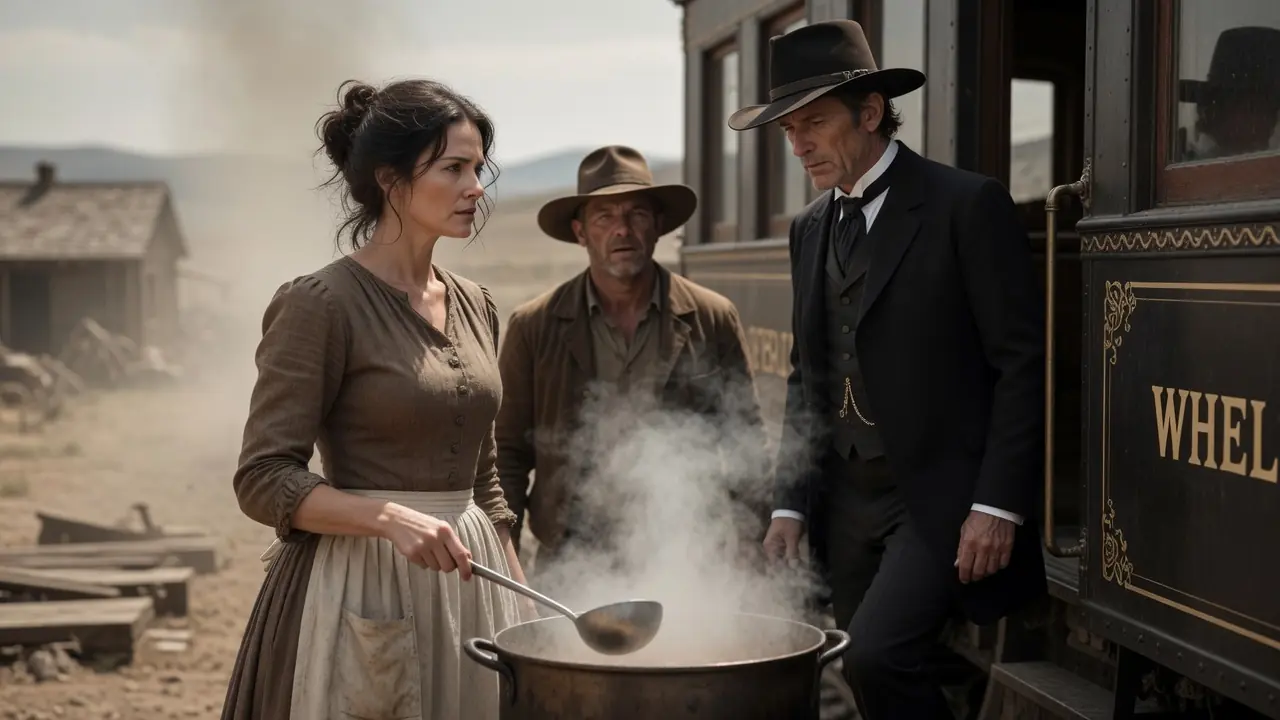
Adeline sat straight on the wagon bench, one hand on the reins, her brown frontier dress protected by a clean white apron. She did not look like the kind of woman people expected to see at a railroad camp. Her hair was neatly pinned, her gloves were buttoned, and her posture still carried the training of parlors, church socials, and city drawing rooms. Yet there she was, rolling into dust and noise with enough food to silence mockery.
Caleb Whitaker rode beside her on a bay horse, his hat low against the sun and his eyes sharp on the camp. He had heard the men laugh when he first brought Adeline home after their wedding. Everyone in town said he had married a woman too soft for Wyoming wind and too delicate for ranch life. Some said she would leave before the first snow, and others said she would last only until the first burnt supper.
Caleb had pretended not to hear them, but the words stayed with him. His ranch was failing, his cattle were thin, and unpaid bills lay across the kitchen table like accusations. He loved Adeline, but love did not stop fences from collapsing or creditors from circling. Some small frightened part of him had wondered whether the town might be right.
Adeline had proved them wrong before the first week was over. She found his kitchen neglected, his pantry nearly empty, and his ranch hands eating food so bad they had stopped complaining because complaint required hope. She said nothing unkind. She simply rolled up her sleeves, tied on an apron, and went to work.
By dawn the next morning, the ranch house smelled alive again. Beef simmered with herbs, biscuits rose in the oven, and apple pies cooled beside the window. The ranch hands came to supper expecting another punishment in a bowl. Instead, they ate in complete silence, the kind of silence that comes when grown men are too moved to speak.
Old Tucker, who had not praised a meal in twenty years, scraped his bowl clean and muttered, “Ma’am, that’s the finest supper this ranch has ever seen.”
Caleb remembered the way Adeline looked down after hearing it, not proud exactly, but steady. As if kindness was not weakness, but a discipline. As if feeding hungry men was not women’s work or city work or ranch work, but simply the right work because it needed doing. That was the night Caleb first understood he had married someone stronger than anyone in town had guessed.
Then Adeline heard about the railroad camp ten miles away. Hundreds of workers were grading the land for a new line through the valley, and they were living on company rations that barely kept them standing. Men came into town hollow-eyed, spending their wages on anything hot because the railroad food was too poor to carry them through long days. Adeline listened once, asked three questions, and made up her mind.
The next morning, she loaded a wagon with stew, biscuits, pies, coffee, and clean tin bowls. Caleb told her the road was too rough, the camp too crude, and the men too desperate. She smiled and said, “Then I’ll arrive in pieces, but I’ll still arrive.” By sunrise, she was already on the road.
The first day, the workers approached cautiously. A few men bought stew because it smelled better than anything the company had served in weeks. Then word moved faster than steam. By noon, every bowl was gone, every biscuit sold, and men were licking gravy from their spoons with an embarrassment they did not bother to hide.
By the third day, they were waiting for her before sunrise. Someone shouted, “She’s here, the lady with the real food!” and the whole camp moved toward the wagon like church bells had rung. Adeline learned their names, remembered who liked extra pepper, who needed softer bread because of bad teeth, and who saved half a biscuit for a younger brother working farther down the line. She served them like they were men, not machines.
The money came slowly at first, then steadily. Coins filled an old cigar box. Caleb paid the feed bill. Then the blacksmith. Then the store account. The cattle grew stronger, the ranch hands worked with renewed strength, and the house no longer felt like it was waiting for foreclosure to knock at the door.
The town stopped laughing after the first month. Men who once joked that Caleb’s city bride would run back East now found excuses to pass the ranch at supper time. Women who had dismissed her began asking for her biscuit recipe, though not all of them admitted it. Adeline shared it with anyone who asked because generosity cost less than bitterness.
But success never stays invisible for long. It attracts hungry eyes, especially from men who believe anything valuable must belong to whoever has the strongest paperwork and the cleanest boots. At the railroad camp, the workers were no longer just eating better. They were working better, complaining louder, and noticing how little the company had cared before Adeline arrived.
That was what finally brought Charles Harrington.
He came in a polished black coach on a cold morning when wind dragged dust across the camp. Three men stepped out, all wearing dark suits too clean for the place, their boots spotless, their faces arranged into expressions of authority. The tallest man removed his gloves slowly and looked at Adeline’s wagon as if it were an insect on his dinner plate. Behind him, company clerks and guards lingered, waiting to look important.
The workers fell quiet. Caleb moved closer to Adeline, one hand resting near his belt, though he knew she disliked unnecessary displays of temper. Adeline continued ladling stew into a bowl and handed it to a tracklayer named Joseph before turning toward the strangers. She had learned early that men like Harrington enjoyed making people stop what they were doing.
“Mrs. Whitaker,” the tall man said. “I am Charles Harrington, regional director for the Union Western Railroad.”
“Then I hope you’re hungry,” Adeline replied.
A few workers snorted softly into their cups.
Harrington’s smile faded. “This is railroad property.”
Adeline lowered the ladle into the pot. “Is it?”
“It is not a kitchen for a city bride pretending she belongs here.”
Caleb stepped forward, anger flashing across his face. “Watch your mouth.”
Adeline lifted one hand without looking at him. Caleb stopped. That small gesture did more than any shouted defense could have done. It told every man watching that Adeline was not hiding behind her husband.
Harrington noticed too, and it irritated him. He was used to women withdrawing when men with authority spoke. Adeline did not withdraw. She stood beside her wagon, sleeves rolled, steam rising around her, and looked at him with the calm of someone who had been underestimated so often she had learned to let it become useful.
“Your men never complained while my food kept them standing,” she said.
“My men are not the issue.”
“They look like the issue to me.”
Harrington glanced at the workers, who were now watching with open hostility. “The company has reviewed your operation. You are conducting private commerce on land reserved for railroad development. You will cease immediately.”
Adeline wiped one drop of stew from the ladle with a cloth. “And if I don’t?”
“Then the company will confiscate the wagon, the supplies, and any proceeds earned illegally on railroad ground.”
The camp went silent enough to hear the horses shift.
Caleb’s jaw tightened. “You don’t have the right to steal everything she built.”
Harrington ignored him. “The law favors progress, Mr. Whitaker.”
Adeline looked past Harrington at the half-built grade stretching toward the hills. Men had cut through earth for weeks, laying the foundation for rails that would one day carry freight, passengers, wealth, and power. The railroad believed the valley belonged to its future. That belief had made them careless.
“Progress,” she said softly. “That is a lovely word men use when they want other people to move.”
Harrington’s eyes narrowed. “Mrs. Whitaker, I advise you to accept this gracefully.”
“Gracefully?”
“Yes.”
Adeline smiled then, not warmly. “Mr. Harrington, women are often advised to be graceful at the exact moment men are behaving without grace.”
The workers murmured. Harrington’s face hardened.
“You have ten minutes to remove yourself and your wagon.”
Adeline turned and set the ladle carefully across the pot. Then she reached into the pocket of her apron and withdrew a folded document tied with a thin blue ribbon. Caleb stared at it, confused. She had not shown it to him before, not because she distrusted him, but because timing mattered.
Harrington looked at the paper with impatience. “What is that?”
“The reason you should not have threatened my wagon.”
He gave a short laugh. “A recipe?”
“No.” She untied the ribbon. “A deed.”
The word moved through the camp like wind through dry grass.
Harrington’s smile returned, but it was thinner now. “A deed to what?”
Adeline stepped closer, holding the document between gloved fingers. “Before you touch my wagon, you may want to learn who really owns the land beneath your tracks.”
No one moved.
Even the steam from the pot seemed to rise more slowly.
Harrington stared at her. “What did you say?”
Adeline unfolded the paper. “The railroad purchased right-of-way from the county for the eastern approach. But the western grade crosses Parcel 14, formerly recorded under the Mercer family trust.”
Caleb’s brow furrowed. “Adeline?”
She did not look at him yet.
“My father was Henry Mercer,” she continued, her voice carrying clearly across the camp. “He bought that parcel twenty-two years ago as part of a water access claim. After his death, it passed to me.”
Harrington reached for the document. “Let me see that.”
Adeline pulled it back. “You may request a copy from the county clerk, as your survey men should have done before driving stakes across my land.”
The workers began whispering now. Caleb stared at his wife like he was seeing another door open inside a house he thought he knew. She had told him her father had left a few complicated papers and a small inheritance tied up in land. She had not told him the railroad had placed its grade across it.
Harrington’s mouth tightened. “This is absurd. The company completed a survey.”
“Poorly.”
“Our legal department cleared the route.”
“Lazily.”
His eyes flashed. “Careful, Mrs. Whitaker.”
Adeline’s voice sharpened. “No, Mr. Harrington. You be careful. You are standing on my land, threatening to seize my wagon, while your men work a grade your company has not paid for.”
A sound rippled through the workers, not laughter exactly, but something more dangerous. Satisfaction.
Harrington turned to one of his clerks. “Fetch the route map.”
The younger man fumbled through a leather tube and pulled out a rolled survey. Harrington spread it over a crate. Adeline stepped beside him and pointed with one clean finger to the line crossing Lander Ridge Creek, then bending along the valley floor.
“There,” she said. “Parcel 14.”
The clerk looked at the map, then at a smaller ledger. His face changed first. Harrington saw it and snatched the ledger from him.
“Sir,” the clerk whispered, “the county entry only covers the adjoining parcel.”
Harrington’s face went rigid.
Caleb’s voice came low behind Adeline. “How long have you known?”
“Since the second week I came to the camp,” she said. “I saw the survey stakes were wrong.”
“And you didn’t tell me?”
“I needed to confirm it before I made noise.”
Old Tucker, who had ridden in with supplies that morning, muttered from the edge of the crowd, “She confirmed it, all right.”
Harrington folded the ledger shut. “Even if there is a boundary dispute, the railroad can pursue condemnation.”
“You may try,” Adeline said. “But until a court grants you authority, any further work on Parcel 14 is trespass.”
His expression turned colder. “Do you understand what you are doing? You are standing in the path of a railroad.”
“No,” Adeline said. “I am standing on land my father paid for.”
Harrington stepped close enough that Caleb moved forward again, but Adeline did not retreat. “The railroad has investors, lawyers, influence, and time. You have a stew wagon.”
“I have a deed.”
“You have sentiment.”
“I have title.”
The words struck clean.
Harrington looked around and realized too late that every worker had heard enough. These were men who understood being used by powerful people. They knew what it meant to have wages delayed, meals cheapened, injuries dismissed, and promises altered when convenient. Now they watched a woman in an apron tell a railroad executive no, and the no had paper behind it.
One of the workers removed his hat. “Ma’am, you say stop, we stop.”
Another nodded. “Can’t grade land that ain’t theirs.”
Harrington spun toward them. “You men are under contract.”
Joseph, still holding his bowl of stew, looked him square in the face. “Contract don’t say we steal widow land.”
“I am not a widow,” Adeline said quietly.
Joseph blinked. “Beg pardon, ma’am.”
Caleb, despite everything, almost smiled.
Harrington slammed his gloves against his palm. “This is temporary. You will hear from our attorneys by tomorrow.”
“I hope so,” Adeline said. “Tell them to bring someone who reads boundaries better than your surveyor.”
The camp murmured again.
Harrington looked at her food wagon with pure hatred. “You think feeding a few laborers makes you powerful?”
“No,” Adeline said. “I think ownership makes me powerful. Feeding them just made them willing to listen.”
That was the sentence that broke his composure. Harrington turned sharply and ordered his men back to the coach. The clerks scrambled after him, carrying maps and ledgers that suddenly looked less like authority and more like evidence. Within minutes, the polished black coach rolled away in a cloud of dust.
No one cheered at first. The silence had to loosen. Men looked at one another, then at the half-built grade, then at Adeline, who calmly picked up her ladle and returned to the stew pot.
Finally, a worker called, “So, are we still eating?”
Adeline lifted a bowl. “Only if you have a coin.”
The camp erupted in laughter.
Caleb came to her side while the workers lined up again. His face was full of questions, pride, and something like awe. “Adeline.”
She handed stew to a worker before answering. “Yes?”
“You own the land under the tracks.”
“Part of it.”
“And you did not think to mention that while I was worrying over feed bills and fences?”
She looked at him then. “Caleb, you married me when the whole town laughed. You gave me your name, your house, your table, and every problem you had. I was simply trying to bring something of my own to the marriage before announcing it.”
His expression softened. “You brought more than I deserved.”
“No,” she said. “I brought exactly what a wife should bring.”
“What is that?”
“A fighting chance.”
By evening, the railroad camp had stopped work on the western grade. Not officially at first. The men simply refused to drive another stake into Parcel 14 until the company settled the ownership question. Harrington’s telegraph to headquarters reportedly used the word obstruction three times and the phrase unreasonable female claimant twice.
Adeline laughed when she heard.
By the next afternoon, the railroad lawyers arrived. They were less polished than Harrington and much more careful. They examined Adeline’s deed, compared it to the county map, and discovered what she had already known: the railroad had built nearly half a mile of grade on land it did not own. Condemnation would take time, attract attention, and anger the very workers whose labor they needed.
Negotiation began at Caleb’s kitchen table.
That alone became a story. Men who once laughed at Adeline’s soft hands now watched railroad attorneys remove their hats before entering her home. Caleb sat beside her, but he did not speak over her. When one lawyer addressed him instead of her, Caleb leaned back and said, “She owns the land. Talk to my wife.”
Adeline asked for three things. A fair payment for the right-of-way. A formal contract allowing her food wagon to operate at all company camps along the route. And an agreement that workers at the Lander Creek camp would receive hot meals once a day, whether from her wagon or from a company kitchen that met her standards.
The lawyers objected most to the last part.
Adeline did not blink. “Hungry men build poor railroads.”
That ended the argument better than any legal theory could.
The settlement saved the Whitaker ranch completely. The right-of-way payment cleared every debt, restored the fences, and bought enough feed for the winter. The food contract turned Adeline’s wagon into a traveling business, employing two ranch hands, three women from town, and eventually even Old Tucker’s niece, who could bake better pies than anyone but Adeline.
The railroad got its tracks, but not cheaply and not arrogantly. Charles Harrington was transferred east before the first snow. No one in town knew whether it was a promotion or punishment, but everyone preferred to believe the latter. The workers remembered the day he threatened Adeline’s wagon and left with nothing but dust on his boots.
As for the town, laughter became respect in the slow, embarrassed way towns change their minds. The same men who had wagered she would leave before winter now tipped their hats when she passed. Women who once mocked her city manners sent their daughters to help in the kitchen and learn accounts from her. Adeline taught them both, because flour and arithmetic had saved more than one life in her opinion.
One evening, months after the first train finally crossed Parcel 14, Caleb and Adeline stood on the hill above the ranch. The cattle grazed below them, the fences stood straight, and smoke rose from the kitchen chimney. Far off, the railroad line shone faintly in the fading light.
Caleb took her hand. “They said you would not last until the first snow.”
Adeline smiled. “Did you believe them?”
He was quiet long enough to be honest. “A little.”
She appreciated the truth more than denial.
“And now?” she asked.
Caleb looked at the ranch, the tracks, the house, and the woman whose final words had stopped an entire railroad in front of men who thought power belonged only to suits and contracts. “Now I believe the railroad was lucky you only wanted fair payment.”
Adeline laughed softly.
Below them, the dinner bell rang, and ranch hands began moving toward the house with the same eagerness the railroad workers once showed at camp. Food had not solved every hardship. Winter would still come. Cattle would still need care. Bills would still arrive. But the ranch no longer felt like it was waiting to die.
It felt like something had taken root.
Caleb squeezed her hand. “Mrs. Whitaker?”
“Yes?”
“I am very glad you arrived in pieces.”
She looked at him, amused. “I told you I would.”
Then they walked down the hill together, toward the house, toward supper, toward the life no one in town had believed she could survive.
And far beyond the ranch, where iron rails crossed land that had once been dismissed as empty, men still told the story of the city bride with the stew wagon.
The woman who fed the hungry.
The woman who saved a ranch.
The woman who stopped a railroad cold by saying exactly what powerful men forgot to ask.
Who really owns the land beneath your tracks?