The laughter began in February, months before Margaret Hale harvested a single ear of corn. She stood beneath the fluorescent lights of the county seed cooperative, studying a faded catalog while nearly every farmer around her ordered the same reliable commercial hybrids. Those varieties promised straight rows, uniform ears, high yields, and guaranteed access to large processors. Margaret ignored all of them and circled an old Ozark sweet-corn strain that most farmers had stopped growing decades earlier.
Dale Harper noticed immediately.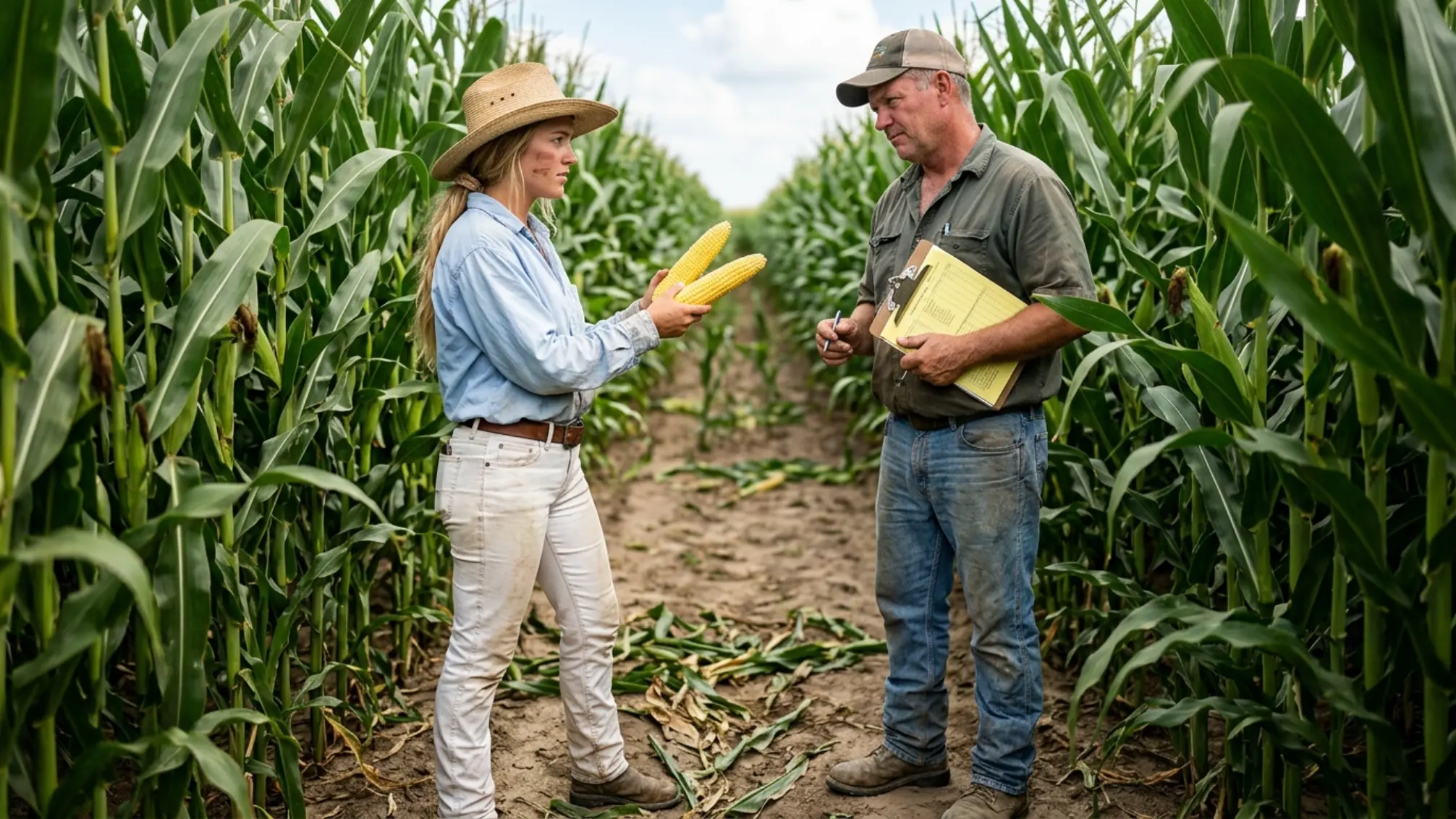
At fifty-four, Dale had spent his entire life farming the rolling hills outside Springfield, Missouri, and had developed the confidence of a man who believed experience had made surprise impossible. He approached with a paper cup of coffee in one hand and stared at Margaret’s order form.
“No.”
Margaret looked up from beneath the brim of her straw hat. Her long blonde hair fell loosely over a pale-blue farm shirt, and amusement shone in her hazel eyes.
“Good morning to you too.”
Dale pointed at the catalog. “Tell me you’re not planting that.”
“I’m planting that.”
“That variety hasn’t been commercially relevant since your grandfather was young.”
“That doesn’t mean it stopped being corn.”
“It means nobody wants it.”
Margaret folded the catalog closed. “Nobody here wants it.”
Several farmers nearby heard the exchange and began listening. Dale glanced toward them, pleased to have an audience.
“You’re going to plant valuable acreage with garden corn?”
“It’s sweet corn.”
“It’s uneven, low-yielding, difficult to harvest, and impossible to sell through regular contracts.”
Margaret smiled faintly. “You memorized the description.”
“I read warnings.”
“I read possibilities.”
The room laughed.
Margaret carried the seed order to the counter without defending herself further. She had learned that people rarely mocked an idea because they had studied it carefully. They mocked it because laughter was easier than reconsidering what they already believed.
Still, the sound followed her all the way home.
The Hale farm stretched across nearly five hundred acres of rich Missouri hills. Margaret’s family had grown corn, soybeans, wheat, and cattle there for four generations, but her favorite field sat behind the eastern pasture where her grandfather Samuel once tested unusual crops. Most of his experimental plots disappeared after his death, yet Margaret preserved his notebooks inside an old cedar cabinet.
One notebook mentioned the forgotten sweet corn repeatedly.
Exceptional flavor.
High sugar complexity.
Strong aroma after drying.
Commercial market uncertain.
Samuel had underlined the last sentence three times.
Most farmers would have treated those words as a warning. Margaret saw a question her grandfather had never been given enough time to answer.
When she was fourteen, Samuel had taken her into that same field and handed her a freshly picked ear. The kernels were deep gold rather than pale yellow, and the rows curved unevenly around the cob. Margaret bit into it raw.
The sweetness surprised her.
It was not merely sugary. Beneath the sweetness were flavors she could not name—honey, toasted grain, something almost floral.
“Why doesn’t everyone plant this?” she had asked.
Samuel looked across the ordinary commercial corn beyond the fence.
“Because everyone is chasing yield.”
“Isn’t that the point of farming?”
“The point is growing something worth more than it costs you.”
At fourteen, Margaret had not understood the distinction.
At twenty-four, with fertilizer prices rising and commodity margins shrinking, she understood it perfectly.
She planted forty acres during the first season. The young stalks emerged unevenly, just as Dale predicted. Some grew taller than her shoulders while others remained several inches shorter. The ears matured at slightly different rates, forcing Margaret to walk the field repeatedly instead of harvesting all at once.
The crop demanded patience.
It rewarded her with extraordinary flavor.
Local families began stopping at the roadside stand after tasting free samples. A restaurant in Springfield bought several crates each week. A small farmers market sold out of every ear she delivered, but those customers could not purchase enough to support forty acres.
Margaret needed a serious buyer.
She loaded several crates into her truck and drove to the county cooperative in September. Grant Mercer, the grain buyer, met her near the loading platform with Dale standing beside him.
Grant lifted one ear from the crate and studied its uneven kernels.
“What variety is this?”
Margaret told him.
His eyebrows rose. “You planted commercial acreage with it?”
“Yes.”
“Why?”
“Because it tastes better than anything else grown in this county.”
Grant turned the ear slowly. “Processors don’t buy taste.”
“People do.”
“Processors buy volume, uniformity, shelf stability, and predictable sugar content.”
“The sugar content is exceptional.”
“Exceptional isn’t the same as predictable.”
Dale crossed his arms.
Grant called another employee over. The two men whispered while examining the corn as though Margaret had delivered something diseased.
She hated the whispering more than open criticism.
Finally, Grant placed the ear back into the crate.
“This isn’t commercial sweet corn.”
“It is literally sweet corn.”
“You know what I mean.”
“No, Grant. Explain it.”
His eyes shifted toward the other farmers watching from the warehouse doors.
“Large distributors won’t take it. The ears aren’t uniform. Harvest dates vary too much, and processors aren’t equipped for a specialty variety with this yield.”
“Then who buys it?”
“Roadside stands. Restaurants, maybe.”
“I already have those.”
Grant sighed. “Margaret, I’m trying to be honest.”
“Be honest.”
He tapped his clipboard.
“The co-op could classify it as feed grade.”
For several seconds, Margaret thought she had misunderstood him.
“Feed grade?”
“It still has nutritional value.”
“You want me to sell sweet corn as livestock feed?”
“It pays something.”
The casual laughter that followed was quieter than the laughter in February, but it hurt more. In February, people had mocked a plan. Now they were mocking a harvest she had spent an entire season protecting.
Margaret lifted the crate.
Grant stepped after her. “You asked for an honest assessment.”
“No. I asked for a buyer.”
“This is business.”
“So is saying no.”
She carried the corn back to her truck.
Dale followed her outside.
“Margaret.”
She turned.
He nodded toward the crates. “Take the feed price before the crop spoils.”
“Would you?”
“If I’d planted something nobody wanted, yes.”
Margaret pulled one large golden ear from the top crate and held it against his chest.
“Taste it before you price three years of my work like cattle scraps.”
Dale refused to take it.
“Flavor means nothing when nobody’s willing to buy.”
Margaret lowered the ear.
“Then maybe real money has been too blind to taste what I grew.”
She drove away while the co-op workers continued laughing behind her.
That evening, Margaret stood between the corn rows holding the same ear. The setting sun turned the tassels to gold, and the stalks whispered against one another in the wind. Her younger sister Emily found her near the middle of the field.
“You missed supper.”
“I wasn’t hungry.”
Emily looked at the corn. “What did the co-op say?”
Margaret laughed once, though nothing felt funny.
“Feed grade.”
Emily stared at her. “They’re idiots.”
“They’re buyers.”
“Buyers can be idiots.”
“They’re also the people with storage, trucks, contracts, and money.”
Emily took the ear from her and bit into it.
“This tastes better than anything in the grocery store.”
“That apparently isn’t enough.”
“Maybe you’re asking the wrong market.”
Margaret looked across the field.
That was what Samuel had written without ever saying it directly. The market remained uncertain because everyone kept asking commodity buyers to value something that was not a commodity.
Yet knowing that did not reveal where the correct buyer might be.
The next two seasons tested Margaret’s faith in the crop. She reduced the acreage but continued preserving the seed. Roadside sales grew, and several chefs became loyal customers, yet every commercial conversation ended the same way.
Too inconsistent.
Too specialized.
Too small.
Too unusual.
Dale created new jokes every month.
At the diner, he announced that Margaret was preparing to open a petting zoo for corn. At the cooperative, he asked whether cattle preferred the crop boiled or grilled. Margaret usually ignored him, but privately, doubt became harder to silence.
By the third harvest, nearly two hundred wooden crates surrounded the loading shed. The corn looked magnificent, but local orders accounted for less than a quarter of it.
Margaret stood beside the crates wondering whether stubbornness had finally become irresponsibility.
Then she heard a truck.
A dark-green delivery vehicle appeared at the end of the farm lane, rolling slowly beneath a cloud of Missouri dust. It carried Kentucky plates and looked as though it had traveled for hours without stopping.
The truck halted beside the loading area.
A tall man in his late fifties climbed out. He had silver hair, a weathered face, and the exhausted posture of someone who had spent most of the day behind the wheel.
Then he saw the corn.
His entire expression changed.
He smiled—not politely, but with the relief of a man who had finally found something he had almost stopped believing existed.
“My name’s Henry Lawson,” he said, extending his hand.
“Margaret Hale.”
Henry picked up an ear from the nearest crate and examined the kernels.
“Can I taste it?”
Margaret stared at him.
“Is something wrong?” he asked.
“No. Nobody’s asked that before.”
“What do they ask?”
“Yield. Acreage. Volume. Storage life.”
Henry began peeling the husk. “Those things matter after flavor.”
He bit into the raw corn.
Then he stopped chewing.
Margaret watched his eyes move from the ear to the field and back again.
“Good grief.”
“What?”
He took another bite.
“Where did you get this seed?”
“My grandfather preserved it. An old Ozark strain. I’ve been selecting the best ears each year.”
“How long?”
“Three seasons personally. He worked with it decades ago.”
Henry walked toward the field without waiting for an invitation. He tasted ears from different rows, asked about planting dates, soil composition, rainfall, sugar development, drying methods, and harvest timing.
For two hours, he examined the crop more carefully than the cooperative had examined it in three years.
Finally, Margaret asked the obvious question.
“What exactly do you do?”
Henry smiled.
“Whiskey.”
She blinked. “Whiskey?”
“Small-batch bourbon and specialty grain spirits.”
“And you drove from Kentucky for sweet corn?”
“Not any sweet corn.”
He held up the ear.
“This corn.”
Henry explained that his distillery had spent years searching for a grain with a distinctive sugar profile. Modern commodity corn fermented efficiently but produced predictable flavors. Craft distillers wanted character—something customers could recognize after aging.
A researcher at an agricultural university had mentioned the old Ozark variety. The strain was believed to be commercially extinct until Henry found a farmers-market photograph showing Margaret holding two ears.
“I drove across three states because of a picture?”
“I drove across three states because every other lead ended with seed samples too weak to scale.”
He looked across her field.
“This is not commodity corn.”
Margaret gave him a tired smile. “That’s what everyone keeps telling me.”
“No.” Henry pointed at the kernels. “I mean it as a compliment.”
He loaded several coolers with samples before leaving.
“Give me three weeks.”
“For what?”
“To prove this makes the whiskey I think it makes.”
Three weeks passed.
Then four.
Then five.
Henry did not call.
Margaret continued selling what she could and preparing the remaining corn for storage. Every day without news made the cooperative’s feed-grade offer appear less insulting and more practical.
Dale encountered her at the diner during the fifth week.
“How’s the whiskey empire?”
Margaret poured coffee into her cup.
“Still sober.”
He laughed.
“Did the mysterious stranger vanish?”
“He’s testing samples.”
“You gave him corn for free, didn’t you?”
“Yes.”
“That man drove away with enough product for a fine barbecue.”
Margaret stood.
Dale smirked. “Come on, sweetheart. Admit you got played.”
She leaned across the table.
“Call me sweetheart again, and you’ll drink that coffee through your nose.”
The diner went silent.
Dale’s smile disappeared.
Margaret picked up her coat and left.
The green truck returned during the sixth week.
Henry climbed out carrying a thick folder, and his serious expression made Margaret’s stomach tighten. Emily joined her near the loading shed.
Henry approached without smiling.
Margaret folded her arms. “Just say it.”
He stared at her for another second.
Then he burst into laughter.
Not mocking laughter.
Joy.
“You have any idea what you’ve grown?”
“Corn.”
“No.”
He spread laboratory reports across the hood of his truck.
The grain showed extraordinary sugar development, unusual fermentation behavior, and remarkable flavor retention after distillation. The trial spirit carried notes of caramelized honey, toasted corn, vanilla, and something the laboratory described as “wildflower sweetness.”
Margaret read the pages without understanding half the terminology.
Henry simplified it.
“Your corn makes incredible whiskey.”
“Oh.”
“That’s all you’ve got?”
“I don’t know anything about whiskey.”
“Fair.”
He handed her a contract.
Margaret read the price and stopped.
Then she read it again.
Emily leaned over her shoulder and gasped.
“This says seven times market price.”
Henry nodded.
“For how much?”
“All of it.”
Margaret looked toward the crates stacked around the shed.
“You want the entire harvest?”
“If you’ll sell it.”
“Why would you pay that much?”
“Because I’m not buying feed. I’m buying the primary flavor of a product I can sell for premium prices over the next ten years.”
The first specialized grain trailer arrived two weeks later.
Then another.
Every bushel left the farm under contract. The distillery paid transportation costs, provided storage assistance, and funded seed preservation so the strain could expand without losing its unique qualities.
The unfamiliar trucks attracted attention.
By the third shipment, Dale drove onto the farm.
He stepped out beside the loading area and watched workers fill a trailer with the corn he had advised Margaret to sell for feed.
“How much are they paying?”
Margaret continued checking the weight records.
“Enough.”
“How much?”
“Seven times the commodity price.”
Dale stared at her.
“For this corn?”
She looked up.
“For this corn.”
“You’re lying.”
Henry emerged from the warehouse carrying shipment papers.
“You must be Dale.”
Dale frowned. “Do I know you?”
“No, but I’ve heard about you.”
Margaret tried not to smile.
Henry extended his hand. “Henry Lawson. Lawson Ridge Distilling.”
Dale shook it cautiously.
“You’re genuinely paying premium prices for sweet corn?”
“I’m paying for flavor.”
“The ears aren’t uniform.”
“Neither are good barrels.”
“The yield is lower.”
“The value per acre isn’t.”
Dale looked toward Margaret.
Henry followed his gaze.
“You’re the man who called it feed grade, aren’t you?”
Dale’s face reddened.
“I evaluated it based on standard markets.”
Henry smiled politely.
“I wanted to thank you.”
“For what?”
“If everyone had understood its value, I never would have secured the first contract.”
Dale said nothing.
The story spread through the county before sunset.
Grant Mercer entered the cooperative the following morning to find farmers discussing Margaret’s distillery agreement. When she arrived for fencing supplies, every conversation stopped.
Grant approached carefully.
“I heard you found a buyer.”
“He found me.”
“Seven times market?”
“Yes.”
“We might be interested in handling future volume.”
Margaret looked at the same loading platform where he had called her corn feed grade.
“You already made your offer.”
“That was based on the information available.”
“You never tasted it.”
“Co-ops don’t grade crops by taste.”
“Then you’re not the buyer for this one.”
Grant lowered his voice. “We could offer storage, transport, and regional distribution.”
“Henry already arranged those.”
“We’re trying to help.”
“No. You’re trying to collect a fee after someone else proved the crop had value.”
She paid for the fencing supplies and left.
Five years later, Margaret’s specialty-corn acreage had doubled twice. Lawson Ridge Distilling released a limited bourbon named Hale Gold, featuring the farm and Samuel’s preserved seed notes on every bottle.
The first release sold out in forty-eight hours.
Brewers, artisan food producers, and other distillers began requesting contracts. Margaret agreed selectively, protecting the seed and refusing to expand faster than the soil could support.
The variety everyone had dismissed became one of the most sought-after specialty grains in the region.
One autumn evening, Dale stood beside Margaret at the edge of the field. Golden rows stretched across the hills while harvest crews worked in the distance.
“You know what still bothers me?” he asked.
“That you were wrong?”
“I’ve been wrong before.”
“You hid it better.”
Dale looked toward the corn.
“I laughed at this for years.”
“Yes.”
“I thought yield was the only number that mattered.”
“So did most people.”
He turned toward her.
“How did you know?”
Margaret shook her head.
“I didn’t.”
“But you kept planting it.”
“My grandfather wrote that the market was uncertain. He didn’t write that the corn lacked value.”
Dale considered that distinction.
“Would you sell me seed?”
Margaret smiled.
“For cattle feed?”
He sighed. “I deserved that.”
“Yes, you did.”
She agreed to sell him enough seed for five test acres, provided he followed the preservation requirements and stopped calling specialty crops foolish before tasting them.
The following spring, Dale planted the corn.
He never admitted publicly how proud he was when the first golden ears formed.
Margaret did not need him to.
She had already learned the lesson her grandfather left hidden inside those old notebooks: the world often confuses familiarity with value. Commodity buyers had looked at her corn and seen irregular ears, low yields, and inconvenient harvest dates.
Henry Lawson tasted it and found character.
The cooperative had offered livestock prices.
The distiller paid seven times the market rate.
The corn had never changed.
Only the person judging it had.