“Only a desperate farm girl pays cash for broken scrap.”
The co-op officer stood beside the flatbed trailer, laughing as Leota Pruitt rested one gloved hand on the rusted French oil press she had just purchased for forty-five dollars. The machine’s feed hopper was cracked, its worm shaft was seized solid, and its discharge cone was missing entirely. Dust covered the cast-iron body, while the remains of an enormous wasp nest clogged the throat where seeds were supposed to enter.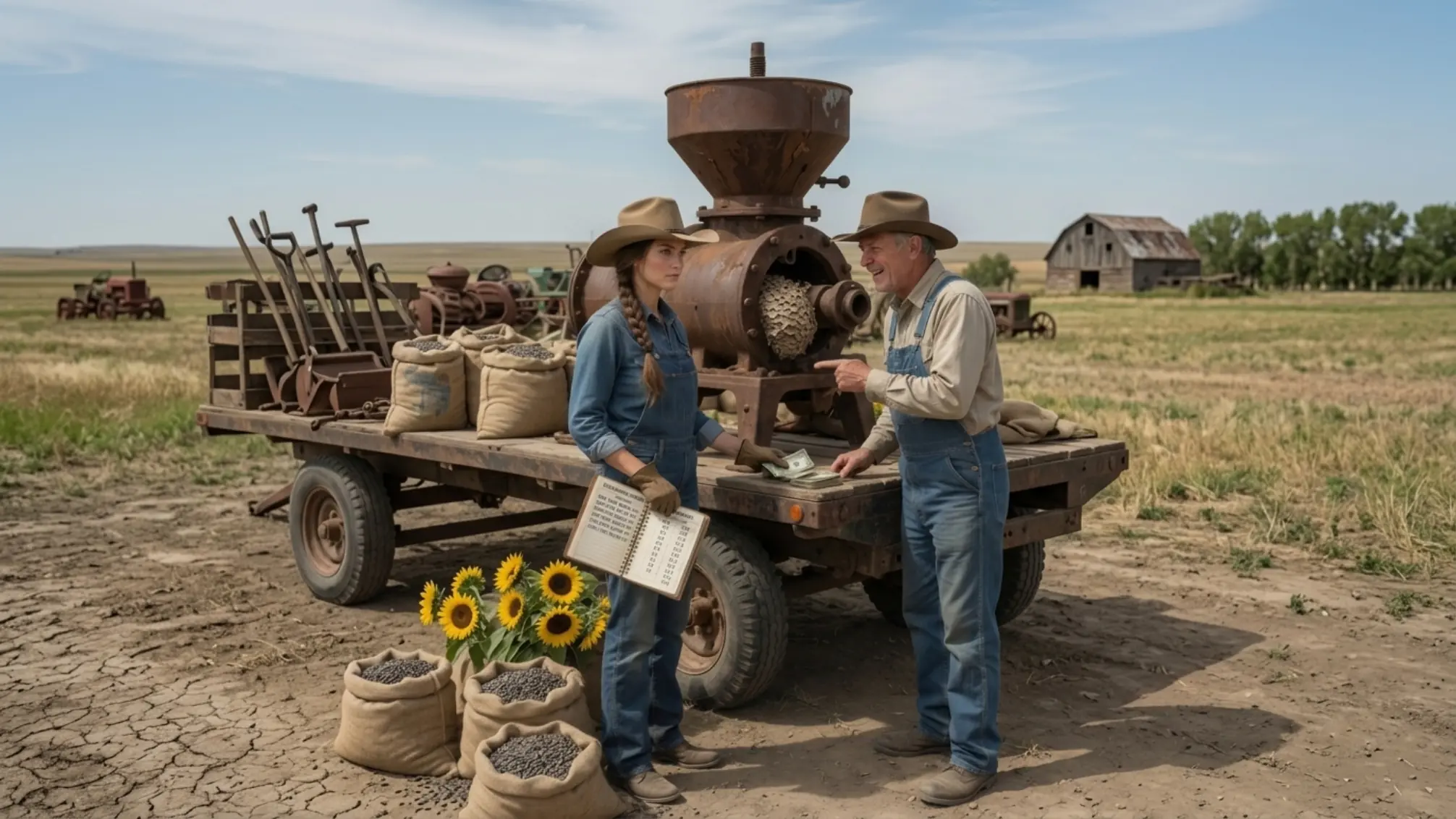
Leota adjusted the brim of her tan work hat and raised the spiral notebook she carried beneath one arm. “You priced the rust. I calculated what it can produce.”
The man looked toward the other farmers gathered at the equipment liquidation sale outside Ness City, Kansas. Several grinned, eager to enjoy another joke at the expense of the thirty-one-year-old woman who ran her late father’s farm alone. The co-op officer pointed toward the ruined machine.
“Your worthless sunflowers won’t earn back forty-five dollars.”
Leota laid her palm against the seized shaft. “Then watch this machine make your co-op beg for my oil.”
The laughter followed her all the way home.
Her brother-in-law Dale helped load the press onto his trailer, but he shook his head during the entire drive. He asked what anyone in Ness County would do with sunflower oil, why she wanted a foreign machine without replacement parts, and whether she had finally grown tired of farming sensibly. Leota answered each question with the same quiet patience she used when repairing machinery.
“I plan to press oil.”
Dale laughed again.
By Sunday morning, the story had reached the parking lot outside the First Methodist Church. According to the version being repeated there, Leota had spent good money on a broken contraption designed to process a crop nobody wanted from sixty acres the county extension office had already declared nearly useless. That version was accurate in every visible detail.
It simply left out the three years of work nobody had seen.
Leota had been raised seven miles south of Ness City on a 240-acre dryland farm. Her father, Clarence Pruitt, grew wheat and milo on ground that received too little rain, too much wind, and no sympathy from anyone. He survived by fixing everything himself, avoiding debt, and refusing to purchase anything he could build with his own hands.
Behind the farmhouse stood a low shop with a corrugated roof and a concrete floor Clarence had poured in 1938. Inside were a drill press, cutting torch, welder, metal lathe, and enough hand tools to maintain every machine on the property. Clarence learned welding from a former shipyard worker and taught himself to operate the lathe from a library manual after ruining several pieces of steel.
He believed a farmer unable to repair his own equipment was renting his independence from someone else.
Leota learned beside him.
Her three brothers eventually left the farm. One found work in Wichita’s aircraft plants, another attended college, and the third married into a hardware-store family in Dodge City. Leota was the child who remained in the workshop, watching the cutting angle of the lathe tool, measuring bearings, sorting welding rods, and asking why parts failed rather than simply how to replace them.
Clarence never called her unusual. He handed her the tools because she paid attention.
Leota intended to leave once. She enrolled in college in Emporia and bought a bus ticket for the fall of 1960. Then her mother became ill, and what was meant to be one missed semester became the rest of Leota’s life on the farm.
She never complained publicly.
People later said she had accepted the sacrifice without resentment, though acceptance and silence were not always the same thing. Leota buried whatever she had lost inside work, and the farm absorbed it without asking questions.
Clarence died in 1965. He left Leota the land without a mortgage, every machine in the shop, and $11,400 in savings accumulated across forty years. More important than the money was the rule he had repeated whenever neighboring farmers discussed loans.
“The land will outlast everything you put on it. Debt won’t. Be careful which one you feed.”
Leota kept the wheat-and-milo rotation for three years. She changed nothing until she understood why Clarence had done it that way, and then she changed only what evidence told her to change.
The southwest sixty acres became her first question.
The soil there was sandy, light, and unreliable for wheat. During a dry spring, young plants struggled before developing enough roots. During hard wind, the field lost moisture faster than the heavier ground closer to the house. The county extension agent advised her to return it to native grass and run a few cow-calf pairs.
He was correct that the soil performed poorly under wheat.
He was wrong to assume wheat was the only crop worth considering.
In 1967, Leota drove to the library in Hays and spent two Saturdays reading agricultural bulletins about crops suited to dry plains. She studied safflower, flax, and several oilseed varieties before finding research on sunflowers. The plants tolerated lighter ground, sent deep roots toward moisture, and performed under conditions that weakened traditional grain crops.
A second bulletin discussed cold-pressed sunflower oil.
Leota began writing in the spiral notebook she kept inside her truck. She recorded estimated yield per acre, seed oil percentages, extraction ratios, shipping costs, storage requirements, and prices offered by natural-food cooperatives beginning to appear in larger cities. She wrote letters to seed suppliers and requested catalogs from agricultural-equipment manufacturers.
She did not plant sixty acres immediately.
In 1968, she planted six.
The first crop produced less seed than the northern-plains research predicted, but the oil content was higher than the bulletin’s average. Leota underlined that number twice. She repeated the test in 1969 and again in 1970, adjusting planting depth, row spacing, and harvest timing.
By the third season, she knew exactly what the southwest ground could produce.
She also knew selling sunflower seed as an ordinary commodity would never justify the change. The real value existed inside the seed. Cold-pressed oil sold for several times the commodity rate when buyers cared about quality, regional sourcing, and chemical-free extraction.
The missing piece was a press.
Leota searched for one for eighteen months.
New continuous-screw expellers cost more than eight hundred dollars before installation, an amount she refused to spend on an unproven market. Used presses were rare in western Kansas, and the few she located were too large, too expensive, or too far away to move economically.
Then she saw the broken French press at the liquidation sale.
Everyone else saw scrap iron and a freight problem.
Leota saw the last component of a system already measured, tested, and waiting.
She moved the machine into Clarence’s shop and spent the first two weeks doing nothing but examination. She brushed away dust, removed the wasp nest, mapped every remaining part, and searched for the original manufacturer’s markings beneath layers of grease. She did not force the seized worm shaft immediately because she knew impatience could turn repairable damage into permanent destruction.
Each evening after farm chores, she applied penetrating oil around the shaft and heated the barrel housing carefully with the cutting torch. She moved the shaft a fraction of a turn, stopped, added more oil, and waited. After four evenings, the metal finally loosened.
The worm emerged heavily stained but intact.
Leota measured wear along the flights and compared the dimensions with diagrams obtained through interlibrary loan. The shaft was not new, but it remained within acceptable limits for sunflower seed. The cracked hopper required welding, reinforcement, and careful grinding so seed would not collect along the repaired seam.
The missing discharge cone was more difficult.
That cone controlled pressure inside the barrel. Too little pressure would leave oil inside the seed cake. Too much pressure would generate heat, damaging the cold-pressed quality Leota intended to sell. Without the cone, the press was useless.
She located a French agricultural-equipment manual through the Kansas State Library system. The drawings were small and several measurements were expressed in unfamiliar standards, but the taper and thread profile were clear enough to reproduce.
Leota cut steel bar stock and mounted it on Clarence’s lathe.
Her first cone was wrong.
She had misread the taper, and the piece would not seat properly against the barrel. Instead of forcing it into place, she placed it on the bench, measured again, and began a second one. The new cone threaded smoothly and allowed compression to be adjusted by hand.
She built a motor mount from angle iron and installed a one-and-a-half-horsepower electric motor salvaged from a damaged grain auger. New bearings cost eight dollars and fifteen cents. A replacement drive belt from Wichita cost eleven dollars.
From hardware cloth and welded square tubing, she made a cleaning screen for the hopper. She shaped a steel collection trough beneath the oil outlet and directed it toward a five-gallon stainless bucket purchased for four dollars and twenty cents.
Her total investment, including the press, came to $104.50.
A comparable new machine cost eight times that amount and offered less control over pressure.
The first test took place on a Tuesday evening in September 1971. Leota cleaned two pounds of sunflower seed, weighed them, and poured them into the hopper. The motor began humming, the belt ran straight, and the worm drew the seed slowly into the cast-iron barrel.
For several seconds, nothing emerged.
Then a thin golden stream moved along the collection trough.
The oil was clear, pale, and carried the fresh smell of a sunflower head opened beneath summer heat. Leota stood with her hands inside her overall pockets, watching without celebration. She allowed enough oil to collect for measurement, switched off the motor, and wrote the extraction figure in her notebook.
The result fell within four percent of her projection.
She adjusted the discharge cone and ran the seed cake a second time.
The yield improved.
Her southern neighbor, Gerald Ostrander, came by the following Saturday because his wife had heard Leota was running an oil operation. He entered the shed expecting to see another foolish experiment and stood silently while the machine processed seed.
After ten minutes, Gerald walked around the press.
He examined the welded hopper, motor mount, and threaded cone. He removed his cap and rubbed the back of his neck.
“Where’d you buy that cone?”
“I made it.”
“On what?”
“Father’s lathe.”
Gerald looked at the steady flow of oil. “Clarence would’ve gotten a kick out of that.”
It was the closest thing to an apology anyone offered that year.
The story traveling through Ness County began changing. Farmers still remembered the wasp nest and seized shaft, but now they also heard that Leota had rebuilt the machine herself. Some remained skeptical, yet fewer laughed openly.
Leota expanded cautiously.
She increased sunflower production from six acres to thirty in 1972. The next year, she began selling oil to a natural-food cooperative in Lawrence. The buyer required clean bottles, consistent flavor, and reliable delivery. Leota met every condition.
Two health-food retailers in Wichita followed.
A Kansas City restaurant discovered her oil in 1975. Its chef cared less about commodity prices than taste, freshness, and origin. He paid nearly three times the bulk-market rate because Leota’s oil was cold-pressed, unrefined, and traceable to one Kansas farm.
By 1974, the entire southwest sixty carried sunflowers.
What the co-op had called marginal ground became the most profitable section of her property.
Leota never treated the new income as permission to become careless. She maintained wheat and milo on the heavier 180 acres, preserved equipment, and deposited every dollar above operating costs into the Ness City State Bank. She bought no machinery on credit and refused to expand faster than her savings allowed.
In 1973, she purchased a used grain truck for $1,200 cash. Before putting it into service, she brought it into the shop and replaced the brake shoes, wheel bearings, fuel pump, and fan belt herself. The truck cost another $240 in parts and years of dependable use.
The sunflower operation grew because Leota controlled both production and processing. Grain farmers sold whatever the market asked for on harvest day. Leota converted seed into a specialized product and sold it to buyers chosen before planting.
Commodity prices could fall without destroying her entire income.
By 1978, she had $64,000 in savings and no debt.
Then the farm crisis arrived.
Interest rates climbed toward eighteen percent in the early 1980s. Land values fell, grain prices weakened, and operating loans that once looked manageable began crushing families. Farmers who borrowed during the prosperous 1970s discovered that good harvests could not produce enough cash to service expanding debt.
Eleven Ness County farms went to auction between 1981 and 1986.
Leota knew those families. They were not lazy, stupid, or incapable. Most had followed advice considered reasonable only a few years earlier: expand, modernize, borrow while land values rise, and trust future production to cover present debt.
The future changed.
The loans did not.
Gerald Ostrander’s son sold recently purchased acreage at a loss and gave up his combine to preserve the original family ground. Other families lost houses, barns, equipment, and fields in the same afternoon.
Leota took no satisfaction from surviving while they struggled. Her wheat income declined too, but the sunflower-oil contracts remained strong. Restaurants and specialty stores did not set their prices according to the Kansas wheat board.
A distributor in Chicago requested two hundred gallons each month, more than Leota’s sixty acres could supply.
She opened the spiral notebook again.
In the fall of 1983, 480 acres bordering her southwest ground went to auction after bankruptcy. The property included 120 acres of the same sandy loam everyone else judged as marginal wheat ground. Leota understood its value because she had spent fifteen years proving what sunflowers could produce there.
The auction drew local farmers, bankers, and two Wichita speculators searching for distressed land.
Leota arrived in work clothes and took a seat near the aisle.
She bid on 240 acres: the farm buildings, 120 acres of light ground suitable for sunflowers, and 120 acres of heavier soil for wheat. The opening price was $420 per acre.
One speculator followed her through $450.
The second remained active through $470.
At $490, only Leota and one Wichita buyer remained. He studied her, perhaps assuming a woman who operated a small farm would eventually require financing approval or lose her nerve.
Leota bid $510 per acre.
The speculator stopped.
The auctioneer struck the table and announced the sale. The final amount came to $122,400. Leota walked forward and wrote a personal check from the Ness City State Bank account carrying both her name and Clarence Pruitt’s.
No loan officer entered the room.
No financing condition appeared on the agreement.
Sixty people watched the auctioneer inspect the check.
The barn became silent.
Several men standing near the back had laughed in the Methodist Church parking lot twelve years earlier. Some had repeated the story of the foolish farm girl who bought a broken oil press for a crop the county did not grow.
None of them laughed now.
Dale stood against the far wall.
He had loaded the machine onto his trailer and mocked her for the entire journey home. As Leota passed with the purchase agreement, he opened his mouth but found no words.
That evening, he told his wife, “I think I finally understand what she was doing.”
His wife answered, “I think the whole county understood today.”
Leota planted the new light ground in sunflowers the following spring. Her oil production tripled, allowing her to fill the Chicago order and add two new restaurant buyers. She hired part-time help during planting and harvest but continued managing the press herself.
The old French machine remained at the center of the operation.
She replaced bearings, rebuilt the worm flights, strengthened the hopper, and refined the discharge cone. During heavy harvest years, the press ran eighteen hours a day. The cast-iron body vibrated across the concrete floor, turning thousands of pounds of seed into clear golden oil.
Every sale entered the same ledger Clarence had once used.
Leota purchased a newer tractor in 1987, though “newer” meant used and fully paid for. She brought it directly into the shop, examined every system, and repaired what might fail before trusting it in the field.
Her niece Carol began spending summers on the farm during the late 1980s. At first, she performed ordinary work: loading seed, cleaning screens, filling bottles, and recording inventory. Gradually, Leota taught her the logic behind the machinery and business.
“You stand here,” Leota said beside the press. “You watch. Then you do it until you understand why.”
Carol was sixteen when Leota allowed her to adjust the discharge cone under full pressure. Too much compression could overheat the oil or damage the shaft. Too little would reduce extraction.
Carol corrected the flow on her third attempt.
“Faster than I learned,” Leota said.
Praise from her carried weight because she never offered it without proof.
By 1995, Carol managed the pressing operation during harvest. By 1998, she negotiated with distributors and restaurants. She understood that the farm’s success did not come from sunflowers alone.
It came from controlling costs, avoiding unnecessary debt, understanding the buyer, and refusing to accept other people’s definition of useless ground.
In 2001, the Ness County Farm Bureau invited Leota to speak at its annual meeting. She stood before the room for only eight minutes, wearing plain farm clothes and carrying no prepared speech.
She told the farmers that she had watched the county make the same mistake in two directions. During prosperous years, people borrowed because they believed high prices would last. During hard years, they sold because they believed low prices would never end.
“The trouble isn’t only borrowing or selling,” she said. “It’s building a farm whose survival depends on what the market does next.”
She explained that her costs remained low because she owned equipment outright and repaired it herself. Her income remained diversified because the buyers purchasing her oil were not the same buyers setting commodity grain prices.
“Not every farm can copy mine,” she said. “But every farmer can stop borrowing for at least one thing he could build, repair, or learn to do.”
Gerald Ostrander, now eighty-three, attended the meeting. Afterward, he approached her near the coffee table.
“Clarence would’ve gotten a kick out of that too.”
Leota smiled faintly. “I believe he would.”
Years later, people still asked how she recognized value inside that ruined oil press. They expected a story about instinct, bravery, or luck.
Leota rejected all three.
She had tested the crop, studied the market, calculated the oil content, and searched eighteen months for equipment. The press mattered because it arrived after the plan, not before it.
Most people at the liquidation sale saw a cracked hopper, seized shaft, missing cone, and wasp nest. They judged the machine by what it was at that moment.
Leota judged it by what she knew how to make it become.
The same was true of the southwest sixty.
The co-op saw land too dry for dependable wheat.
Leota saw soil suited to sunflowers, seed suited to pressing, oil suited to specialty buyers, and a market independent from the one governing every neighboring farm.
The machine cost forty-five dollars.
The rebuilt system cost $104.50.
The land bought with its earnings cost $122,400 in cash.
Yet Leota never considered those figures the full measure of what Clarence had left her. His greatest inheritance was not the farm, workshop, or savings account.
It was the ability to look at something dismissed as useless and ask a harder question.
Not, “What is it worth now?”
But, “What can I build from it before everyone else understands?”
The co-op officer who mocked her sunflowers had predicted they would never recover the cost of the press.
He was wrong before the first golden drop reached the bucket.
The press did not make Leota successful by accident. It merely revealed the value she had already found—in dry soil, careful records, learned hands, and a woman disciplined enough to execute a plan while an entire county laughed.
By the time the laughter stopped, the oil was flowing, the buyers were waiting, and the farm girl they had dismissed was writing a check none of them believed she could afford.