The auctioneer had been doing county surplus sales for 11 years and he had never seen a crowd lose interest this fast.
It was a Tuesday morning in September of 1998 and the Osage County equipment yard smelled like diesel and cut grass.
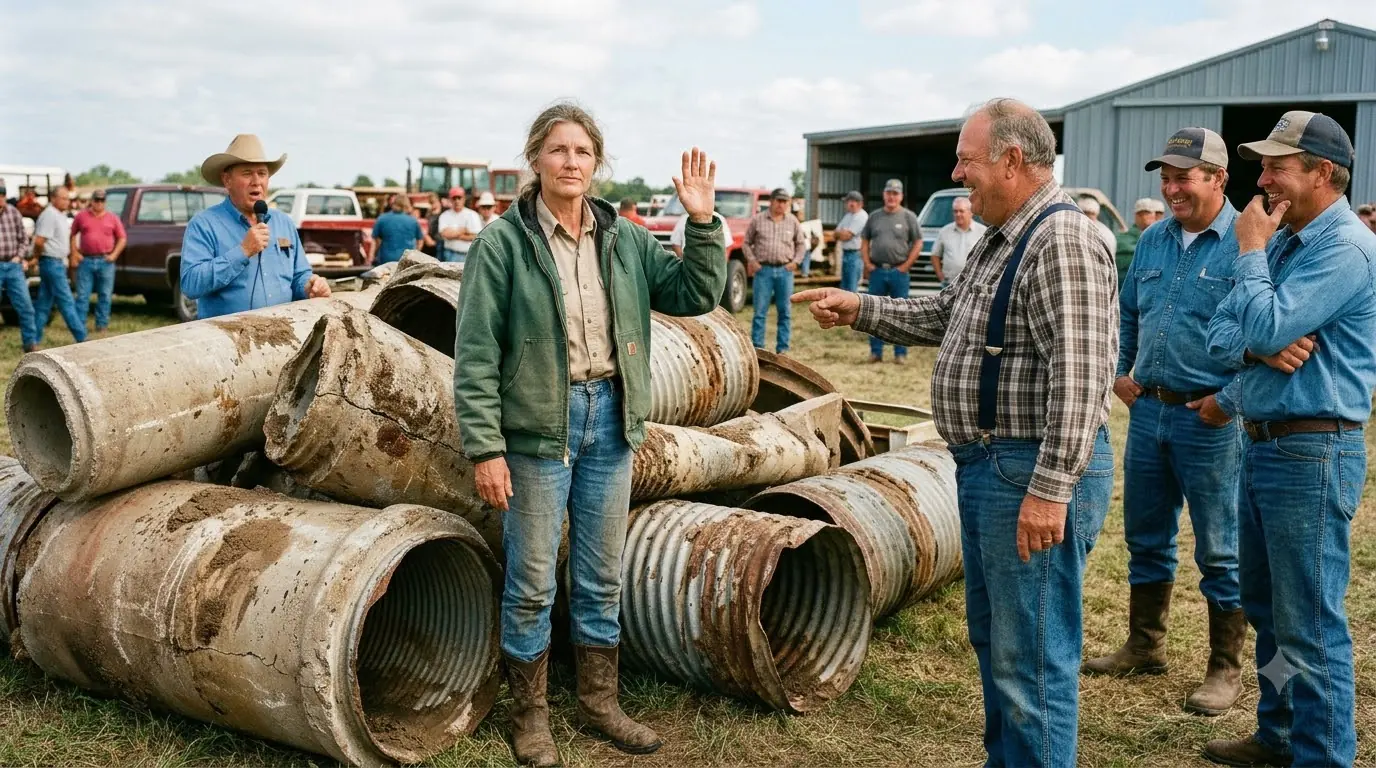
A few dozen people had shown up for the sale, farmers mostly, some salvage dealers, a couple of contractors looking for cheap steel.
They had already picked through the good stuff, two aging road graders, a brush hog with a bent gearbox, a flatbed trailer missing its rear lights.
All of it went fast, argued over and bid up the way anything mechanical tends to be when farmers are involved. Then the auctioneer got to the culvert pipes.
He gestured toward the far corner of the yard where 40 large concrete and steel drainage culverts were stacked in rough piles. Some were cracked along the barrel.
A few had shifted in their stacking and sat crooked against each other. Most were stained brown with rust and soil. The county had pulled them during a road improvement project. Newer, longer-lasting pipe had replaced them and nobody saw any reason to keep the old ones around.
The auctioneer started his pitch anyway. Lot 47, 40 culvert sections. Mixed concrete and corrugated steel, various diameters, sold as is where is. Any takers?
Silence. One of the salvage dealers walked over, looked at a cracked concrete section and shook his head. The steel ones might have some scrap value, but not enough to justify hauling 40 pieces across the county. He stepped back into the crowd.
The auctioneer tried again. $20 for the lot, any takers? A woman near the back of the crowd raised her hand. She was wearing a faded green canvas jacket and work boots caked with dried field mud.
Her hair was gray at the temples and she had the kind of quiet, settled posture that comes from decades of physical work done without complaint. She looked like someone who had spent her entire life standing in farm fields doing math in her head while everyone else was still reading the problem. Her name was Evelyn Brooks. She was 56 years old and she was the only person in that entire yard who wanted those pipes.
The auctioneer blinked. 20 dollars, do I hear 25? Nobody moved. Sold, he said to the lady in the green jacket.
The man standing next to Evelyn, her younger brother Luke 49, a corn and soybean farmer from the next county over, leaned close and said quietly, "Evelyn, what in the world are you doing?" She didn't answer. She was already walking toward the culvert pile looking at each piece carefully the way a person examines something they have been thinking about for a long time. People talked about it.
That was the honest truth of small communities. Someone does something that doesn't make immediate sense and the story circulates through coffee shops and grain elevators before the week is out. By Thursday most people in the surrounding area had heard some version of it. Evelyn Brooks had bought 40 broken county culverts for 20 dollars.
She was hauling them out to her farm. Nobody knew why. The theories were not charitable. The general consensus as best as Luke could gather from conversations he'd rather not have been part of was that Evelyn had finally slipped.
She was a widow living alone on 320 acres. She had no children. She was getting older, probably losing her judgment. Maybe she had started making decisions the way older people sometimes do, acting on instinct and stubbornness rather than logic, collecting things that other people could plainly see had no value.
One grain dealer suggested she was going to use them as planters. Another man, a retired road contractor named Harold Fitch who liked to hold court at the diner near the county line said she was probably going to stack them into a wall somewhere and call it landscaping. He laughed when he said it and a few people laughed with him. Luke didn't laugh, but he also didn't know what to think.
He drove out to Evelyn's farm the following Saturday morning and found three flatbed trucks parked in her lower field unloading culvert sections one by one with a rented crane attachment. The pipes were being set on the grass in a long deliberate row, not stacked, not piled, but laid out in a specific sequence. Evelyn stood nearby with a clipboard directing the placement with small hand gestures. Luke watched from the fence line for a while, then he walked over.
"You've got them sorted," he said. "By diameter and length," she said without looking up from her clipboard. "Why?" She made a small mark on her paper.
"Because the grade changes across the lower drainage corridor. Different sections of the system need different capacity." Luke waited for her to say more. She didn't.
"What system?" He finally said. Evelyn looked up and studied the row of culverts the way a chess player looks at a board after moving a piece. "The water that comes off the Hennessey Ridge runs through four separate draws before it hits the county road," she said.
"Every one of those draws empties into the same low corridor behind my south field. When you get a significant rainfall event in this watershed, something above 3 inches in 24 hours, that corridor fills faster than any of the existing channels can clear it. The water backs up. It spreads laterally.
The road culverts on the county crossings weren't designed for that kind of volume. They were designed for average years." She paused. "This hasn't been an average weather pattern for the last 3 years."
Luke looked at the pipes. He looked at his sister. He thought about what she had just said and could not quite organize it into anything he knew what to do with. "Evelyn," he said carefully, "these things are cracked."
"Some of them," she said. "The ones with structural cracks go in the secondary channels. The solid ones go in the primary corridor. A crack in a buried culvert doesn't matter much if the surrounding envelope is installed correctly and the grade is right."
Luke drove home without saying much. He told his wife that evening that he wasn't sure if Evelyn knew exactly what she was doing or had simply convinced herself she did. His wife, who had known Evelyn for 25 years, said she'd put her money on the first option. What almost nobody in the county remembered, and what Evelyn had never bothered to mention, was that she had spent 16 years working for the county road department before coming back full-time to the farm.
She hadn't been a secretary. She hadn't answered phones or scheduled appointments. She had been a road maintenance supervisor. Specifically, she had managed drainage infrastructure for a 70-mile section of rural county roads through most of the 1970s and into the mid-1980s.
She had overseen culvert installations, road crown calculations, ditch slope angles, and erosion repair after every major weather event the county saw during that stretch of time. She had sat through engineering reviews. She had argued, quietly with data, over culvert sizing decisions that she believed were undersized for the actual watershed conditions. Most of those arguments she had lost.
The county engineer at the time had followed standard state guidelines for culvert sizing. The guidelines were based on average rainfall data and designed for average conditions. They were not designed for what hydrologists called the 100-year event, the kind of rainfall that statistically only appears once in a century, but had no intention of checking anyone's schedule before it arrived. Evelyn had kept notebooks throughout those years.
Spiral-bound, water-stained, filled with her own measurements and calculations and field observations. She had drawn her own versions of the drainage maps for the road she maintained, marking places where she believed the existing infrastructure was undersized, where the topography would concentrate water in a flood scenario, and where a failure in one location would cascade into failures downstream. She had six of those notebooks in a metal filing cabinet in her farmhouse office. She had not looked at them in years.
She had not needed to. The calculations were still in her head. By the middle of October, the trenching had begun, and that was when the real conversation started. Evelyn had hired a small excavation contractor named Dennis Pruitt, who operated a trackhoe and a small crew out of a shop near Lyndon.
Dennis had done drainage work for her before. He didn't ask many questions. He dug where she told him to dig, at the angles she specified, to the depths she marked out with stakes and string lines that she had laid across the lower field herself over the course of two early mornings. The trenching was extensive.