The county road shop in Parnell, Nebraska, kept its surplus out back behind a chain-link fence that hadn't been locked in years.
Nine snowplow blades leaned against the fence in a rough line, rusted orange-brown. Along the cutting edges, the old county yellow paint chipped down to bare steel in patches.
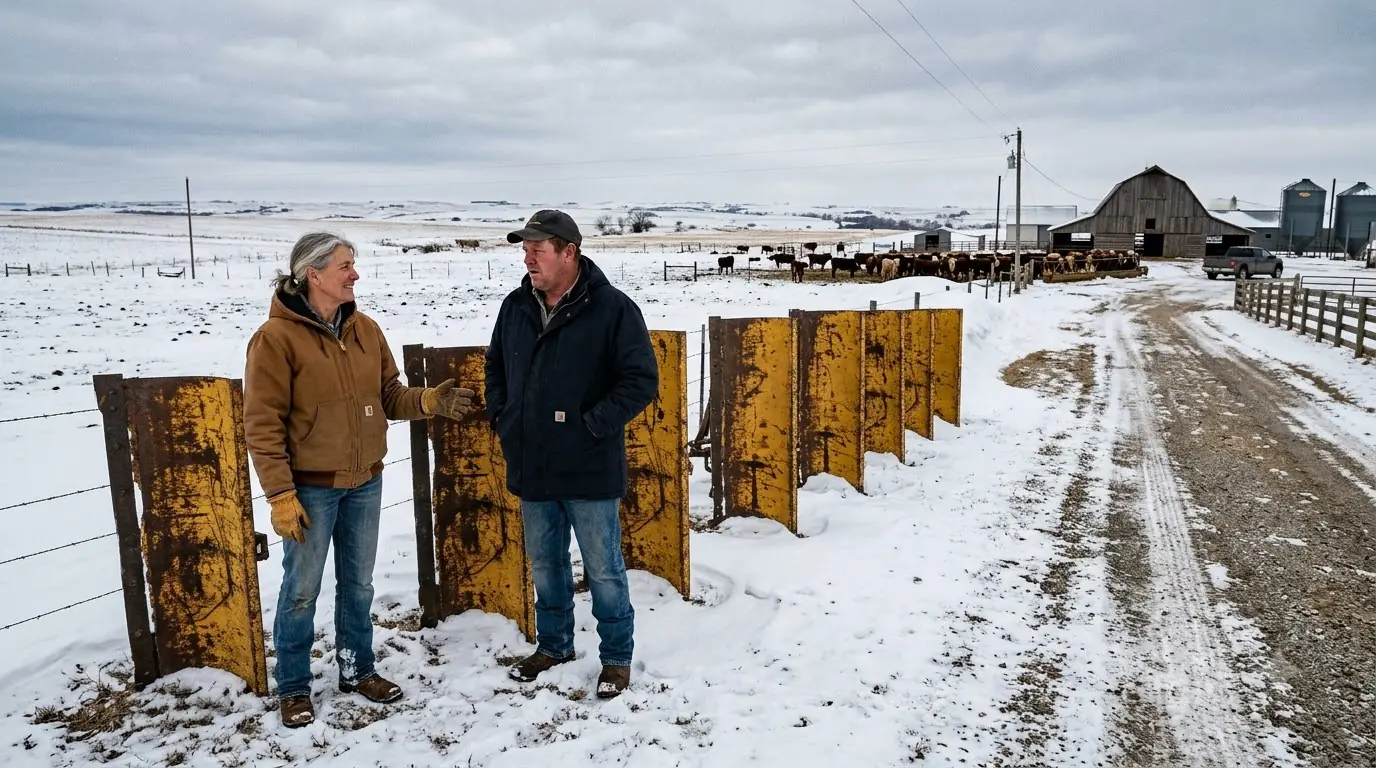
Some still had cracked rubber deflector strips hanging from the top curve. One had a corner bent so far inward it looked like something had driven it into a bridge abutment.
Bolt holes were stripped. Dried road salt had eaten white lines into the metal. Weeds grew through the gaps between them.
Nora Whitaker stood looking at them the way most people look at a hand of cards.
Marty Hobbs came out of the shop wiping his hands on a rag. He ran the surplus yard for the county road department and had been trying to get rid of these blades since the previous spring. He'd called two scrap dealers. Neither wanted to make the drive for what they'd get per ton.
"Those came off the old trucks when we re-equipped last year," Marty said. "Cutting edges are shot. Mounting brackets are stripped on most of them. Couple of the moldboards are bent past straightening. They're not going back on a truck."
Nora ran her hand along the curved back of the nearest blade. She pushed against it, testing the steel. Solid. She moved to the next one and did the same thing. She wasn't looking at the cutting edges. She was looking at the curve.
"How much for all nine?" she said.
Marty glanced at the row.
"All nine? Load all nine."
He wrote the receipt at scrap weight: $380 for the lot.
Nora paid cash and pulled her stock trailer around to the back while Marty got the forklift.
Ray Holloway was inside the shop picking up a hydraulic fitting for his loader tractor. He ran cattle two places west of Nora's, about 240 head on open prairie that stretched flat to the horizon in every direction. Good grass, good fences, a long gravel lane that drifted shut at least twice every winter. He owned a Case loader with a bucket wide enough to clear it in three passes.
He came outside as the forklift swung the third blade onto Nora's trailer.
"Nora, what are you going to do with those?"
"Use them."
"Use them how?"
"They're off the trucks because they're done."
"You can't mount those on anything."
"I'm not mounting them on anything."
Ray waited.
Nora latched the trailer chain and didn't say more.
He looked at the blades, looked at her, and went back inside shaking his head.
By the time Nora got home, Ellie was in the machine shed changing oil in the feed truck. Ellie was 31, Nora's daughter, and she'd been running the day-to-day on the cow-calf operation since Nora's husband had died three years earlier. She could operate every piece of equipment on the place, keep the herd health records straight, and negotiate feed prices without flinching.
She heard the trailer before she saw it.
When she came around the corner of the shed, Nora was backing nine rusted snowplow blades up to the fence line near the barn.
"What is that?"
"Plow blades. Nine of them. From the county surplus."
Ellie walked over and looked at the load. Rust scale came off in her glove. The cutting edges were rounded smooth from years of scraping asphalt. One blade had a crack running six inches from a bolt hole.
"These are off the old plows," Ellie said. "They pulled them because they're worn out."
"They pulled them because they can't mount them anymore. The steel's still good where it matters."
"Where does it matter if they can't go on a truck?"
"I'll show you this weekend."
Saturday morning, Nora drove Ellie out the farm lane in the pickup.
The lane ran three-quarters of a mile from the county road to the house, straight west across open pasture with no trees and no windbreak for the last half mile.
About 400 yards from the house, the lane dropped through a shallow road cut where the ground dipped toward a dry creek bed. The cut was only three feet deep, but it ran for about 60 yards.
On both sides, open prairie grass stretched flat to the north and south.
Nora stopped the truck at the east end of the cut and got out.
"Look at the fence posts," she said.
Ellie looked.
On the north side of the lane, the fence posts showed smooth bare wood from the ground up to about three feet. Below that line, old grass and dirt were packed against the base of each post in a hard wedge.
On the south side, the posts were clean.
"That snowpack," Nora said. "Every winter, northwest wind carries snow across that pasture and drops it right here in this cut. The road dips, the wind slows down, and the snow piles up."
"I know it drifts here. We plow it every time."
"How many times did you plow this cut last February?"
Ellie thought about it.
"Four, maybe five."
"Five. I counted. And every time the wind filled it back in within a day because the snow was still moving across that pasture, and this cut was still the lowest spot."
Nora walked to the north edge of the cut and pointed across the open grass.
Nothing out there but flat ground and sky. No trees, no buildings, no ridge. Just 600 yards of unbroken prairie between the lane and the northwest horizon.
"The snow that buries this road doesn't fall here," she said. "It falls out there. Miles of it. And the wind picks it up and carries it south until it finds a place to slow down. This cut is that place."
"So, what's the plan?"
"We can't raise the road."