The old folks in the West used to say that life never warns you before it changes you.
Big moments do not roll in like thunder.
They sneak up quietly, like a dust cloud on a slow afternoon.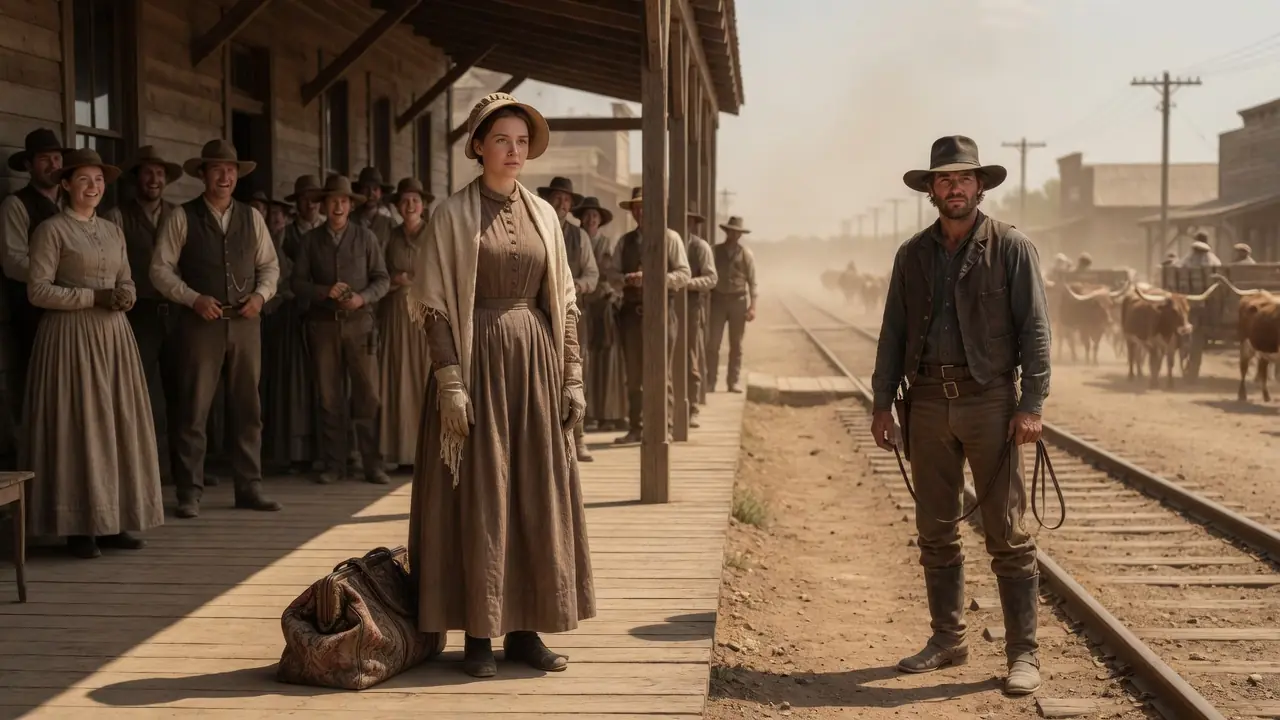
And on one burning September day in 1882, a woman named Anna Turner stood on a train depot platform in Millerton, Texas, learning what it meant to be looked at, but never truly seen.
The sun hammered the wooden boards like it was punishing every soul there, and the heat made people meaner than usual.
Ten women stood on that platform, each waiting to be chosen by some rancher in need of a wife.
But Anna already knew in her bones that she was not going to be the first one anyone reached for.
She held her carpet bag tight against her skirt, though there was not much inside.
Her mind drifted for a moment to the day her husband had returned her to her parents’ home like he was returning a plow that would not cut straight.
Three years married and not one child.
That was all it took for him to decide she was broken.
Her mother had pressed some travel money into her hand with a soft pat, and her father never even lifted his eyes from the newspaper.
By sunset, Anna had been alone again.
Now she stood beside the other women while Mr. Harwick, the man running the bride sale, shouted each woman’s skills like he was auctioning show horses.
One by one, the younger girls were chosen.
A rancher with silver hair stepped forward for a woman from Pennsylvania.
Another rancher claimed a seamstress with bright ribbons tied in her hair.
Each time a woman climbed down from the platform, the rest shifted uneasily, knowing the choices were narrowing fast.
Soon eight women were gone.
Then only two remained standing.
Then one.
Then none except Anna.
The crowd’s eyes swept over her like she was a dirty window, not even worth a clean look.
Someone in the back called out that there had to be something wrong with the one in brown.
Another voice answered that she must be secondhand goods, returned merchandise.
Laughter rolled across the depot.
Some women covered their mouths with gloved hands, pretending to be polite while enjoying every second of Anna’s humiliation.
She stood straight, forcing her hands to stay still even though her fingernails were biting into her palms.
She kept her eyes on the far horizon where the heat shimmered over the tracks.
If she let herself meet this crowd’s eyes, she knew she would fold like a paper cup in a rainstorm.
Mr. Harwick stumbled over his words as he tried to present her.
He said she had experience in household management.
That only made the laughter louder.
Someone shouted that she sure had experience failing at marriage.
Anna’s stomach twisted, but she did not let her face show one drop of what she felt inside.
She pictured herself walking back to the boarding house, back to whispers and pity, back to nights where the loneliness pressed down heavy.
She could almost feel the weight of failure sitting on her shoulders again.
Then she heard something.
Bootsteps.
Slow, steady, purposeful.
Like the sound of a man who did not need attention, but always got it anyway.
The laughter died as people stepped aside.
Heads turned.
A path opened through the crowd, and through it walked a man everyone knew by name, even if they had never spoken to him.
The rancher who had lost his wife and newborn child three years earlier.
The man who never came to church socials, never smiled at anyone, and worked from dawn until dark like he was trying to outrun pain that lived inside him.
His clothes were worn from years of ranch labor.
His face carried lines carved by wind, sun, and grief.
But he walked like someone who could weather any storm and still stand tall afterward.
He stopped at the bottom of the platform, looking up at Anna.
Instead of staring at her face the way the others had done, trying to judge what was wrong with her, he looked at her hands.
He noticed the half-moon cuts where her fingernails had pierced skin.
She unclenched them without meaning to.
Harwick moved toward him fast, nervous and sweating.
He stammered something about not knowing Jacob was shopping for a bride.
Jacob answered in a rough voice that he had not meant to.
But he had changed his mind.
He lifted his chin toward Anna like he had already made his choice.
“This one,” he said in a quiet voice that somehow carried through the depot. “She’s coming with me.”
Silence fell heavy over the crowd.
Even the wind seemed to stop.
Anna’s breath caught.
She opened her mouth to speak, but no sound came.
She felt the platform steady under her feet, though her knees trembled.
After so many months of feeling invisible, someone had finally stepped forward.
Someone who was not laughing.
Harwick sputtered, trying to warn Jacob about her past, about her return, about her condition, as he called it.
Jacob cut him off.
“Didn’t need to know,” he said, already turning away.
Anna found her voice long enough to answer.
“I’m coming.”
Those words changed everything.
She climbed down with her small carpet bag in hand.
People stared at her like she carried a curse.
Some whispered that Jacob was a fool taking on another man’s burdens.
Others said she would disappoint him, too.
But Anna did not stop.
She followed Jacob through the crowd, step for step.
At his wagon, he paused.
He did not reach for her bag.
He did not offer a hand.
Instead, he stood still, giving her the chance to walk away if she chose.
That moment meant more than anything he had said back at the platform.
She made her choice.
She climbed into the wagon alone, settling onto the hard wooden seat.
When he joined her, she saw a flicker of something in his eyes.
Not pity.
Maybe respect.
As the mules pulled them away from the depot, the weight of everything she had survived began to lift.
She breathed deeper, the air easier in her chest.
The silence between them felt different from the silence on the platform.
That had felt like judgment.
This felt like possibility.
Jacob did not look at her when he finally spoke.
“You didn’t beg.”
That was all.
But somehow those four simple words were enough.
And as the road stretched ahead of them, Anna felt the smallest spark of something she had not felt in years.
Maybe this was not the end of her story.
Maybe it was the beginning.
The wagon rolled along the dusty trail, hitting every rut like it had a personal grudge.
Anna held the sideboard tight to keep from sliding into Jacob, who seemed completely unfazed by the rough ride.
He handled the reins calmly, moving with the rhythm of the wagon as though he and the road understood each other.
Behind them, the depot shrank into a memory she hoped never to revisit.
Anna wanted to explain herself.
She wanted to defend the life she had failed to build.
She tried to say there were things he should know about why she had been the bride no one wanted.
He cut her off gently, saying he did not need to know.
The way he said it was not dismissive.
It was final, steady, like he had made peace with choosing her exactly as she was.
So she tried again.
“Do you want to know if I can cook?”
“Yes.”
“Wash clothes?”
“Yes.”
“Raise chickens?”
“Yes,” she answered.
The corner of his mouth twitched in what might have been a smile when she joked about which end laid the eggs.
They settled into a comfortable quiet.
The wagon passed the last small house at the edge of town.
Anna recognized it from her lonely walks.
She had once imagined herself ending up like the widow who lived there, alone behind a sagging fence with roses growing wild.
Now she sat beside a man who had chosen her, not because she was the prettiest or the youngest or the most desirable, but for reasons she did not yet understand.
He asked about her carpet bag, noting that it felt light.
She told him she did not own much.
“Good,” he said. “I don’t have much either.”
There was comfort in that honesty.
Anna asked about the ranch, and he answered in short, simple sentences.
Eight or nine miles away.
One hundred and sixty acres.
Most of it rough country.
A house with four rooms and a lean-to he had built himself.
He told her she could have that lean-to as her own space, with a lock on the inside of the door so she had privacy.
She turned to study his face.
Weathered.
Strong.
Carrying more loss than most men ever endured.
He said he had built the extra room because anybody answering the advertisement might want space of their own.
He was not expecting romance.
He was not expecting gratitude.
He was not expecting anything, really.
“What changed your mind today?” she asked.
He did not answer quickly.
They rode past cottonwoods that lined a small stream.
A hawk circled overhead.
The mules plodded forward, steady as an old heartbeat.
He finally said he had seen the crowd gathered like a pack of crows, and something inside him had shifted.
He did not want to watch the world pile more shame onto someone who had already carried enough.
He had chosen her because she stood tall through it all.
Before she could respond, she saw a rider waiting by the stream.
His hat was low.
His posture was stiff.
Jacob muttered that it was Harwick, and he did not sound pleased about it.
Harwick moved his horse to block the trail, waiting with a stack of rolled papers in his hand.
He claimed he needed to explain things to Jacob.
Legal matters concerning Anna’s past.
Anna felt her stomach tighten, knowing exactly what the man wanted to expose.
She told Harwick to say whatever needed saying.
He hesitated, then said it plainly in front of both of them.
She could not have children.
Her previous marriage had produced none, and the doctor had confirmed that the issue was not with the husband.
Anna felt her face burn, not with shame, but with old pain that had never healed right.
She waited for Jacob to react.
Waited for him to decide she was not worth the trouble.
Instead, Jacob climbed off the wagon, walked slowly toward Harwick, and rested a hand on the bridle.
He did not raise his voice.
He did not threaten.
He simply said he already knew enough.
He was not interested in anyone else’s opinion about the woman he had chosen.
Harwick pushed again, insisting Jacob needed protecting.
Insisting that a barren wife meant a barren future.
Insisting that Jacob was signing himself up for an empty house, an empty nursery, an empty life.
That word, empty, seemed to echo across the prairie like something broken.
Jacob’s reply came low and steady.
He told Harwick he already lived with empty.
He had buried a wife and a child.
His house already had more silence than anyone deserved.
Taking Anna home would not make any of that worse.
Harwick backed off finally, riding away with dust kicking up behind him.
Jacob returned to the wagon and told Anna he was sorry she had been forced to hear that again.
She told him he did not have to defend her.
But he said he did.
They watered the mules at the stream, and she watched him move with calm strength, checking hooves and straps.
She felt safe in his presence in a way that surprised her.
She felt seen.
Then she told him the truth.
What Harwick had said was correct.
She could not give him children.
Jacob rinsed his hands in the cold water, wiped them on his trousers, and said his wife had died trying to give him one.
He was not looking for a broodmare.
He was looking for someone who could share the work without expecting more than he could give.
Anna nodded.
She understood expectations better than most.
Jacob told her he did not talk much.
He did not host neighbors.
He worked from dawn to night.
The house was not pretty.
Life would not be fancy.
But he offered honesty, safety, and a room of her own.
No man had ever offered her that much before.
She asked what the land looked like.
He pointed to the distant horizon.
“Over that rise,” he said quietly.
And she felt something ease inside her.
It might not be a home yet.
But it was a place to start.
The mules picked up their pace as the sun dipped low, stretching shadows long across the ground.
Anna was just beginning to settle into the quiet rhythm when she saw dust rising behind them.
Not a gentle cloud like before.
A hard and fast streak.
A boy on horseback riding as though the world were on fire.
Jacob’s whole body went alert.
“That’s Sam,” he said, and the tone of his voice made Anna’s stomach twist. “He wouldn’t be riding like that unless something’s wrong.”
Sam reached them breathless, yelling that fire had jumped the creek and was racing toward their land.
Jacob turned the wagon sharply, his jaw set.
“Change of plans,” he said.
And just like that, the fragile sense of calm shattered.
Something far more dangerous than shame was waiting beyond the rise.
Now trouble was coming for all of them.
Jacob urged the mules forward, pushing them faster than Anna thought possible.
Smoke drifted across the sky, thick and dark, turning the evening sun into a red smear.
The wagon jolted over ruts so deep Anna had to brace herself with both hands.
Sam Patterson rode beside them, shouting that the fire was chewing through dry grass like it was hungry for everything in its path.
Jacob kept his eyes fixed on the rising smoke.
He did not panic.
He did not curse or rush.
He simply held the reins firm, calculating every choice with the calm of someone who had faced worse storms than this.
When they reached the rise, Anna finally saw it.
A wounded horizon where gray smoke rolled like waves over burned land.
The fire was still miles away, but the wind carried the warning straight toward them.
Jacob drove hard until the house came into view.
A small shape against massive land.
Plain but strong, like a man who did not waste words.
He helped Anna down quickly, but gently.
“I need to check the firebreaks,” he said. “You come inside. I’ll show you the house before I go.”
He moved fast through the rooms, pointing out what she needed to know.
“This here is the kitchen. Pump works fine. Stove pulls a little left, so watch it. Cellar door is through there. Shelves are stocked. Over here is the small parlor. Don’t use it much.”
He kept going, sweeping through the place like he was racing the wind.
He showed her the bedroom that had belonged to his wife once, then led her to the lean-to he had built.
Her room.
Small, clean, with a narrow bed and a bolt on the inside of both doors.
No frills.
No extra space.
But it was hers.
For the first time in years, she had a room where no one had the right to enter without permission.
He noticed her looking around.
“No one bothers you here,” he said. “Not even me.”
She nodded, swallowing back the strange mix of relief and fear that came with realizing she was truly alone on land she did not yet understand.
Jacob stepped toward the door.
“I have to go help the Pattersons. Fire moves fast in this wind. Might not be back till late. Could be morning. But you’ll be safe.”
She wanted to ask him to stay.
She wanted to admit she did not know where anything was or how to manage this new life alone.
But her pride was stitched tight.
She only managed a small nod.
He left with the same steady steps he had arrived with.
No hesitation.
No wasted breath.
The house felt too quiet once he was gone.
Anna stood in the center of the kitchen, surrounded by unlabeled shelves, dusty plates, and a stove that smelled like bacon grease.
Everything needed care.
Everything needed someone to claim it.
She rolled up her sleeves.
She pumped the water until it ran clear.
She scrubbed the table until the wood showed beneath the grime.
She emptied old grounds from the coffee pot, cleaned the stove, and swept dust off the shelves.
The cellar was stocked with jars of peaches, onions, and potatoes.
The smokehouse had salt pork.
The chicken coop had five hens and a rooster with an attitude.
She gathered eggs, fed the chickens, and washed the dirt from her hands.
The small chores helped her breathe easier.
Work always had.
As the sun lowered, she cooked cornbread and fried potatoes with wild onions.
She was not sure if Jacob expected a meal, but it felt right to prepare one.
The fire outside might threaten the land, but inside, she could build something steady.
The sky turned orange, then gray, as smoke drifted overhead.
She heard horses before she saw them.
Not one.
Several.
The yard filled with shapes half hidden by dusk.
Men covered in ash walked toward the house with slow steps.
Jacob opened the door first.
He looked like he had walked through a chimney.
Soot covered his face, and his shirt was torn at the shoulder.
The three men behind him looked worse.
One of them, a tall man with a thick red beard, stepped forward like he owned the place.
“Well, now, Jake,” he said in a heavy voice. “You didn’t tell us you had company.”
The three men stared openly at Anna.
Their eyes moved over her in a way that made her take a step back until her hip hit the table.
Jacob stepped between them, casual but firm.
“This is my wife,” he said.
Wife.
That single word changed the whole air in the room.
Redbeard blinked, then adjusted his stance.
“Since when you got a wife, Jake?” he asked.
“Since today.”
The men exchanged looks.
The smell of smoke and sweat hung thick in the kitchen.
The second man, tall and gaunt, pushed forward.
“We’ve been fighting that fire all day,” he said. “Least you could do is feed us.”
Anna’s pulse kicked hard.
She did not have enough food prepared for four men.
Maybe two, at best.
Jacob did not move.
“Wife’s had a long day, too,” he said. “Just came from the bride sale.”
Redbeard’s smile changed.
Not warm.
Not friendly.
More like he had just learned something he intended to use later.
The other two men shifted their weight, glancing at one another.
Jacob ignored the tension.
“Fire’s under control for now. Wind slowed. But you boys need to head home. Roads get dangerous in the dark.”
Redbeard did not argue.
But he also did not like being dismissed.
The older man, with streaks of gray, finally pulled the other two toward the door.
As they left, Anna heard one mutter something about bargain brides and easy pickings.
The door closed behind them.
The silence that followed pressed against her ribs.
Jacob’s shoulders dropped a little.
He stared at the door the men had walked through before turning slowly to her.
“I made supper,” she said. “If you’re hungry.”
He washed his hands and sat.
He ate slowly, eyes on the food as though he had not tasted a meal cooked by another person in years.
He said nothing for a long time.
Then he looked up and said he appreciated the work she had done.
She nodded, unsure what to say, unsure what she was allowed to feel.
When the meal ended, she washed the dishes while he checked the windows and doors.
She noticed how tired he seemed, how heavy his boots sounded on the worn floorboards.
Before heading to his room, he paused.
“Lock both doors tonight,” he said. “You’ll sleep better.”
A shiver ran through her.
She had not felt unsafe until he said that.
But he must have seen the worry in her eyes.
He added that those men would not come back.
Not now.
Not once they knew she belonged here.
Then he disappeared into his room, leaving her alone in the quiet house.
She locked both doors and lay in the narrow bed of the lean-to, still dressed.
Every shadow felt alive.
Every sound sharpened her nerves.
She listened for Jacob moving next door.
The soft footsteps.
The sigh of sinking into bed.
And somewhere in that long stretch of darkness, she realized something.
This house might be broken.
She might still be unwanted by the world.
But tonight, she was not abandoned.
A man had chosen her, defended her, and offered her peace without asking anything in return.
She fell asleep listening to the sound of his breath through the thin wall.
Steady.
Real.
Morning crept into the ruined house with a strange kind of quiet.
The storm had ripped away half the roof, torn boards from the walls, and scattered their belongings across the yard like broken memories.
But somehow the small bedroom where Jacob and Anna slept had stayed whole, as if the storm had spared the one place where two people were finally learning to breathe again.
Anna woke first.
She sat up slowly, aching from the night.
Jacob was already pulling on his boots, moving carefully so he would not disturb her.
His eyes met hers for a moment, and something passed between them.
Something soft.
Something new.
“We have to start rebuilding,” he said. “And we have to check on the neighbors.”
She rose and dressed behind the painted screen, the one piece of the past still standing.
When she stepped out, Jacob stood waiting for her, hat in hand, as though unsure whether he was allowed to look at her the way he wanted to.
They walked through the wreckage side by side.
The barn was gone.
Her small room was gone.
The chicken coop lay upside down, but the hens clucked loudly underneath, annoyed but alive.
A little victory in a field of broken things.
Jacob touched her shoulder gently.
“We’ll fix it all,” he said. “Piece by piece.”
They saddled the horses and rode toward the Patterson place.
The path looked like a scar across the land.
Trees were stripped bare.
Fences lay flat.
A wagon wheel sat half buried in mud, still spinning from the night before.
When they reached the Pattersons’ place, neighbors were already gathered.
Patterson lay on a cot outside, wrapped in blankets, pale but alive.
Mrs. Patterson rushed to Anna the moment she saw her.
“You saved him,” she said, her voice cracking. “I don’t know how to thank you.”
Anna did not know what to do with such gratitude, so she simply nodded.
Jacob checked Patterson’s legs, then looked to Anna for confirmation.
She told him the bones were set right.
With time and care, the man had a chance.
Word of Anna’s actions spread fast.
Men who had laughed at her weeks earlier now tipped their hats.
Women whispered, not with pity, but with respect.
Even the younger girls watched her with admiration, as if she had become someone worth learning from.
On the ride home, Jacob said quietly, “Folks are seeing you now. Not the way they saw you at that depot. This time, they see who you are.”
Anna did not answer at first.
She was thinking about the strange feeling rising in her chest.
Not pride.
Not relief.
Something warmer.
When they reached the ruined ranch, they stood together in the yard, studying what needed rebuilding.
The wind carried the scent of burned grass, but beneath it lingered something hopeful.
Jacob looked at her with calm certainty.
“Whatever comes next,” he said, “we face it together.”
And for the first time in her life, Anna believed that together might finally mean something that would last.
Rebuilding began the next morning, long before the sun had fully risen.
The storm had torn so much apart, but it had not taken their will to start again.
Jacob and Anna worked side by side, pulling broken boards away from the house, gathering tools from where the wind had scattered them, and stacking lumber that could still be used.
Every small task felt like a promise that the life they were building mattered.
Neighbors came by with supplies, offering hands instead of judgment.
Mrs. Patterson brought food.
Sam Patterson brought tools.
Even the roughest ranch hands showed up ready to work.
People who once looked at Anna with doubt now approached her with respect, asking her what needed doing.
She answered with calm certainty, and they followed.
By the third day, Jacob paused while lifting a heavy beam.
He wiped sweat from his brow and looked at Anna the way a man looks at someone who has changed his world.
“You held everything together when it mattered most,” he said. “I could not have done any of this without you.”
Anna felt heat rise in her chest.
Not embarrassment.
Something gentler.
Something like belonging.
That evening, after the others had gone home, they sat on the porch that still leaned a little from the storm.
The sky glowed orange as the sun dropped behind the hills.
For a while, they simply listened to the quiet.
The chickens settling in for the night.
The wind brushing softly across the land.
The calm that comes after surviving what almost broke you.
Jacob finally spoke.
“When I chose you at that depot, I thought I was doing something practical. Thought I was choosing someone who needed a place as much as I needed help. But I didn’t understand then what I understand now.”
Anna waited, her heart beating slow and steady.
“I didn’t just choose someone to help with work,” he said. “I chose the person who helped me live again.”
He reached for her hand.
Not fast.
Not hesitant.
Just honest.
She took it, feeling the warmth of his palm and the weight of everything they had survived together.
Two people the world had counted out.
Two people who found strength in each other’s quiet places.
That night, when they stepped inside the house, the place did not feel broken anymore.
It felt like the beginning of something real.
Something they were building together, brick by brick, choice by choice.
Weeks later, when they rode into town to sign the marriage register, people greeted them not with whispers, but with smiles.
A few folks nodded as if they had known all along that these two battered souls would find each other.
Anna held Jacob’s arm a little tighter as the clerk wrote her new name.
Anna Holt.
It fit her in a way nothing else ever had.
As they rode home, the sun warm on their backs, she realized the truth that had followed her from the depot to the storm cellar to this new life.
Being the one nobody wanted had led her straight to the one person who saw her fully.
And sometimes, being seen was the greatest love of all.