The train had been gone four hours.
Nora O’Shea stood on the platform at Hartwell with her carpetbag at her feet and her hat pinned tight against a wind that smelled of dust and creosote.
The platform was wooden and narrow, weathered to the color of old bone. Beyond it, the main street of Hartwell stretched in both directions beneath the hard May light.
There was a general store with flour sacks stacked beside the door, a telegraph office with peeling green paint, and a saloon with its batwing doors standing open as if the building itself had grown tired of pretending to be respectable. A boardwalk ran the length of the street, but not a soul was on it now except a boy leading a mare toward the livery stable. Somewhere down the road, a loose shutter knocked softly in the wind.
Nora had counted her money twice on the train.
Fourteen dollars and sixty cents.
Enough for a room at the boarding house, maybe two nights if she did not eat. Enough for a plate of food if the boarding house would not take her without payment up front. Enough to stay alive a little longer, but not enough to go back.
Not that there was anything to go back to.
She had come west because the letter said there was work waiting for her.
Mrs. Abigail Whitcomb of Hartwell, Kansas Territory, had written in a tidy hand saying she needed a cook and housekeeper for her family home. Wages were modest but steady. Room and board included. Sunday afternoon free if chores were done. Nora had read the letter six times in Boston before making her choice.
She had sold her trunk.
Sold her second wool dress.
Paid the agency fee.
Bought the train ticket.
Then, somewhere between one post office and another, a second letter failed to reach her in time.
Mrs. Whitcomb had died of fever three weeks before Nora arrived. Her sons had dissolved the household, enclosed partial wages for the inconvenience, and written with polite regret that the position was no longer available.
That letter had found Nora only after she was already halfway across the country.
So she had kept going.
People said the West was full of chances.
They said a woman willing to work could always find a kitchen, a laundry room, a boarding house, or a ranch that needed feeding. They said courage mattered more than bloodlines, accents, or old grief.
People said many things to women who had already run out of choices.
The woman who had driven the wagon from the station had explained Hartwell on the way into town. Mrs. Porter ran the boarding house. Tight operation. No credit. No exceptions. The town knew why Nora was there before her boots touched the platform because word traveled faster than trains in places like this.
A woman arriving alone on the afternoon car from the East, wearing a dress too thin for the territory and carrying everything she owned in one bag, was legible to anyone with eyes.
The woman at the general store had asked questions without seeming to ask them.
Where was Nora headed?
Did she have family in the territory?
Was she related to anyone named Calloway up on the North Ridge?
Nora had answered carefully.
She was here to cook for a household.
She had a letter of reference from the previous family she had served.
She did not say that the household had vanished before she reached it. She did not say she had no family west of the Mississippi River. She did not say that her father had died under a collapsed dock in Boston Harbor and her mother had followed him eighteen months later, not from fever or injury, but from the slow surrender of a woman who had run out of reasons to rise.
Nora did not say she had crossed the country because staying in the East would have meant becoming a shadow in someone else’s kitchen forever.
She simply stood on the platform and waited for the next thing life intended to demand from her.
By late afternoon, dust had gathered along the hem of her dark green dress.
Her stomach cramped with hunger, but she ignored it. Hunger was not new. Fear was not new either. She had known both since childhood in County Clare, and then again in Boston, where the streets smelled of coal smoke, wet wool, and too many people trying to survive in rooms built for half their number.
Still, this fear had a different shape.
In Boston, poverty crowded around a person.
In Hartwell, poverty felt wide open.
There was too much sky. Too much room for a person to disappear.
The boarding house stood two blocks from the station, whitewashed and narrow, with a porch that sagged at one end. Nora lifted her carpetbag and walked toward it before courage could thin any further.
Mrs. Porter opened the door after the second knock.
She was a broad woman with gray hair pinned tightly under a cap and eyes sharp enough to count the coins in Nora’s pocket without seeing them.
“You’re the Irish girl,” she said.
Nora straightened.
“I am Nora O’Shea, ma’am.”
“That’s what I said.”
Nora had learned long ago not to answer certain tones. She held out the letter from the Whitcomb family and the reference folded behind it.
“I was expected for a position, but there has been a change.”
Mrs. Porter took the papers, read enough to understand, and looked Nora over again.
“You got money?”
“A little.”
“How little?”
“Fourteen dollars and sixty cents.”
Mrs. Porter’s brows lifted slightly.
“At least you’re honest.”
“I’ve found lying costs more than truth, sooner or later.”
That earned a faint grunt that might have been approval.
“Room is one dollar a night. Supper is extra.”
Nora’s hand tightened around the carpetbag handle.
“How much extra?”
“Twenty-five cents.”
She calculated quickly.
A room.
A plate.
Maybe two days.
Then nothing.
Mrs. Porter seemed to read the math on her face.
“You can take the back room tonight. Small bed. No fire unless you pay for coal. Supper’s beans, cornbread, and ham bone gravy.”
“Don’t thank me yet. I don’t carry guests on credit.”
“I will pay.”
“I believe you will.”
Nora stepped inside.
The boarding house smelled of boiled coffee, starch, old wood, and cabbage. Two men sitting in the parlor looked up from a checkerboard as she passed. One nodded politely. The other looked too long and smiled too little.
Nora kept her chin level.
Her room was barely wider than the bed. A washstand stood near the window, and the quilt smelled faintly of lye soap. She set her carpetbag down, removed her hat, and sat on the edge of the bed.
For the first time since the train left Boston, she let her shoulders drop.
Only for a moment.
Then she opened her bag and checked everything again.
One spare blouse.
One apron.
A pair of stockings carefully mended.
A small tin containing needles, thread, and two buttons.
Her mother’s rosary.
A packet of letters.
A folded reference from the McKenna household in Boston, where she had cooked, cleaned, and learned how to make thin soup taste like care when there was not enough meat for the pot.
At the bottom of the bag was a small leather notebook.
Her father had given it to her before they left Ireland.
“Write things down, Nora,” he had said. “A person with a record is harder to erase.”
She had written recipes in it first.
Then debts.
Then names.
Then prayers she was too angry to say aloud.
That night at supper, Nora sat at the end of Mrs. Porter’s long table with five other boarders. Three were cattlemen passing through. One was a telegraph repairman. One was a schoolteacher named Clara Bell, who smiled kindly and asked Nora if she had traveled far.
“Boston,” Nora answered.
“That is far enough to make a person tired.”
“It is.”
The cattleman across from Nora laughed.
“Boston girl won’t last a week out here.”
Nora looked at him calmly.
“I lasted Boston. I expect Kansas can take its turn trying.”
The schoolteacher hid a smile behind her napkin.
The cattleman blinked, then barked a laugh.
“Well now. Maybe she’ll last two.”
Mrs. Porter said nothing, but later she gave Nora an extra spoonful of beans without comment.
The next morning, Nora began looking for work.
She went first to the general store. Mr. Enoch Bell, who owned it, said he did not need a clerk and already had a niece who could sweep floors. The livery stable needed no help. The laundry woman had three daughters and no use for another pair of hands. The saloon owner looked at Nora in a way that made her turn around before he finished speaking.
By noon, the sun had grown sharp.
By one, her boots had raised blisters.
By two, she had learned that a town could be polite and still closed as a locked trunk.
She returned to the boarding house with dust on her face and only twelve dollars and ten cents left after breakfast, dinner, and the room.
Mrs. Porter was kneading dough in the kitchen.
“No luck?”
“Not yet.”
“That means no.”
“For today.”
Mrs. Porter grunted.
“You cook?”
“Yes.”
“Bake?”
“Yes.”
“Can you handle beef?”
“If it is dead first.”
Mrs. Porter’s mouth twitched.
“There’s a rancher coming in today. Needs a cook. Lost his last one after she threw a skillet at his foreman and walked six miles into town.”
Nora set down her hat.
“What kind of rancher makes a woman prefer six miles of road?”
“Thomas Calloway.”
Nora remembered the general store woman’s question.
“Calloway on the North Ridge?”
“That’s him. Cattle ranch. Good land. Bad luck. Worse manners. Pays fair when he remembers people need paying.”
“That sounds promising and not promising at all.”
Mrs. Porter pressed the dough flat with both palms.
“He’s not wicked. Just hard. There’s a difference.”
“What does he need?”
“Someone to cook for six ranch hands, keep the kitchen, manage stores, and not cry when men complain.”
“I rarely cry where men can see.”
Mrs. Porter looked at her for a long moment.
Then nodded.
“He’ll be here before supper.”
Thomas Calloway arrived just before five.
Nora saw him first through the parlor window, riding a tall bay horse down the street with two pack mules behind him. He was perhaps thirty-five, broad-shouldered, sun-browned, and lean in the way of men who worked more than they ate. His hat sat low, his shirt was faded blue, and dust clung to him like an old acquaintance.
He dismounted in front of the boarding house and looked at the building as if it had personally offended him.
Mrs. Porter wiped her hands on her apron.
“Stand straight,” she told Nora.
“I am standing straight.”
“Stand straighter.”
Thomas knocked once and entered before anyone answered.
“Mrs. Porter.”
“Mr. Calloway.”
His eyes moved to Nora.
Not rudely.
Not warmly either.
He assessed her the way a man might assess a horse he suspected was too fine-boned for the work.
“This her?”
“This is Miss Nora O’Shea.”
He looked at Nora’s hands.
“Can you cook?”
“Yes.”
“For hungry men?”
“Yes.”
“Men who’ve been branding calves all day and think coffee is a human right?”
“Yes.”
“Can you make biscuits?”
“Yes.”
“Can you make them without turning them into stones?”
“That depends on whether your flour is fresh and your stove has a mind for cooperation.”
Mrs. Porter made a sound that might have been a cough.
Thomas’s eyes narrowed slightly.
“Can you work without talking back?”
Nora met his gaze.
“Can you hire without insulting the help?”
Silence filled the parlor.
Mrs. Porter looked toward the ceiling as if asking God for patience.
Thomas stared at Nora.
Then, unexpectedly, his mouth twitched.
“Fair enough.”
He removed his hat.
That small gesture changed him. Not softened exactly, but corrected something. Under the brim, his hair was dark and badly in need of cutting. His eyes were gray, tired, and more careful than cruel.
“I need a cook for North Ridge Ranch,” he said. “Six men most days. More during drives. Room in the cookhouse. Wages twelve dollars a month, board included. Sundays half day unless stock trouble says otherwise.”
“Twelve dollars?”
“It’s fair.”
“It is.”
He looked faintly surprised that she had not argued.
“When can you start?”
Nora glanced toward the narrow hallway that led to the small room where her bag sat.
“Now.”
Thomas’s brows moved.
“You have no trunk?”
“No.”
“Family?”
“No.”
“People expecting you?”
“No.”
The last answer changed his face.
Just for a moment.
Then the hardness returned.
“North Ridge is twelve miles out. Road’s rough. If you come, you stay at least one month. I don’t have time to haul a cook back because she misses streetlamps.”
“I have missed better things than streetlamps and survived.”
Mrs. Porter turned away, but Nora saw her shoulders move with a silent laugh.
Thomas studied Nora again.
“Get your things.”
North Ridge Ranch sat beyond a long road of dust, grass, and low hills that turned purple in the evening light.
Nora rode in the wagon beside Thomas while the bay horse followed tied behind. He said little. She said less. The wind tugged at her hat and blew grit into her eyes, but she kept her face forward.
After an hour, the ranch came into view.
A weathered main house stood beneath a cluster of cottonwood trees. Beyond it were corrals, a barn, a bunkhouse, a smokehouse, a small wash shed, and a cookhouse with a stone chimney. Cattle moved in the distance like dark marks across the land. A windmill creaked slowly near a water tank.
It was larger than Nora expected.
And lonelier.
As they rolled into the yard, three men came from the barn. One was young and freckled, hardly older than seventeen. Another was tall and quiet, with a limp. The third had a thick black mustache and eyes that looked too amused too quickly.
The mustached man grinned.
“Well, boss, you brought us a little one.”
Thomas stepped down from the wagon.
“This is Miss O’Shea. She’ll be cooking.”
The young man removed his hat.
“Ma’am.”
The limping man nodded.
The mustached one kept smiling.
“Can she reach the stove?”
Nora climbed down before Thomas could answer.
“I can reach a skillet well enough to test it on your skull if you keep wondering.”
The young man coughed.
The limping man looked away.
Thomas did not smile, but Nora saw something shift near his eyes.
The mustached man’s grin thinned.
“Feisty.”
“Hungry men prefer feisty when supper is on time,” Nora said.
Thomas pointed.
“Cookhouse is there. Bunkhouse there. Main house is mine. Hands are Eli, Jonah, Pete, Ramon, and Jasper.”
He nodded toward the mustached man.
“Jasper Pike is foreman.”
Jasper tipped his hat.
“Welcome to North Ridge.”
Nora did not like the way he said welcome.
The cookhouse was rough but workable.
A cast-iron stove dominated one wall. Shelves held flour, cornmeal, beans, coffee, salt pork, dried apples, molasses, onions, and a few tins of peaches. The table was scarred and large enough for eight. A small room at the back held a narrow bed, a peg for clothes, and one cracked basin.
Nora set her carpetbag on the bed.
Then she rolled up her sleeves.
By sundown, she had made biscuits, beans with salt pork, fried onions, and coffee strong enough to stand a spoon in. It was not fancy, but it was hot, and the men ate like wolves with manners they had half remembered.
Eli, the freckled boy, looked at his biscuit with reverence.
“Ma’am, this ain’t a rock.”
“I did promise.”
Jonah, the limping man, said quietly, “Good coffee.”
That seemed to be the highest praise ranch men allowed themselves.
Jasper ate without complimenting anything.
Thomas sat at the far end of the table, silent, hat on the bench beside him. He took one bite of biscuit, paused, and looked briefly at Nora.
“That’ll do,” he said.
Nora understood enough about men like him to know that meant more than it sounded.
Life at North Ridge began before sunrise.
The first week nearly broke her.
Not because she could not cook, but because everything took longer than it had in any Boston kitchen. Water had to be hauled. Wood had to be split or carried. Flour had weevils if not sifted carefully. The stove smoked when the wind shifted. Men needed breakfast before dawn, dinner packed for the range, supper at dark, coffee always, and complaints as regularly as prayer.
Her hands cracked.
Her back ached.
Smoke stung her eyes.
But each night, she wrote in her notebook.
Flour low by Tuesday.
Jasper takes extra coffee in saddlebag.
Eli likes dried apples but pretends not to.
Thomas does not eat enough.
Jonah’s limp worsens in damp weather.
Ramon hums hymns while repairing tack.
Pete cheats at cards poorly.
It was an old habit, writing things down.
It made the ranch less strange.
Or perhaps it made her less afraid.
Thomas kept his distance.
He was not unkind, but he was watchful. He ate what she cooked, paid wages on time at the end of the first month, and once left a sack of better flour near the cookhouse door without saying anything. When she thanked him, he only nodded and said the store had extra.
Nora knew that was not true.
The general store rarely had extra anything.
She learned pieces of his story from others.
North Ridge had belonged first to his father, Amos Calloway, who had built it from nothing and nearly lost it twice to drought and debt. Thomas inherited it seven years earlier after Amos died under a horse. Thomas had been engaged once to a woman named Ellen Marsh, but she had married a banker in Abilene instead after deciding ranch life was too uncertain.
Since then, Thomas had become quieter.
Harder.
Not cruel.
Mrs. Porter had been right.
There was a difference.
Nora saw that difference in small things.
He never let Eli ride dangerous horses.
He paid for Jonah’s medicine when the limp grew bad.
He sent Ramon money for his sister’s children in Santa Fe without mentioning it.
He checked every gate after storms himself, as if responsibility were something a man proved with his own hands.
But the ranch was troubled.
Nora noticed that too.
Cattle counts did not match what men muttered over coffee. Supplies vanished faster than they should. Jasper Pike spoke to strangers near the far fence line twice in one week. Thomas received letters that made his face close like a door.
One evening, Nora found him standing outside the cookhouse, holding a paper in one hand.
“You plan on hovering there until supper burns?” she asked.
He looked up.
“I don’t hover.”
“You’re doing a fair imitation.”
He folded the paper.
“Bank letter.”
“Bad?”
“Banks don’t write good ones.”
She wiped her hands on her apron.
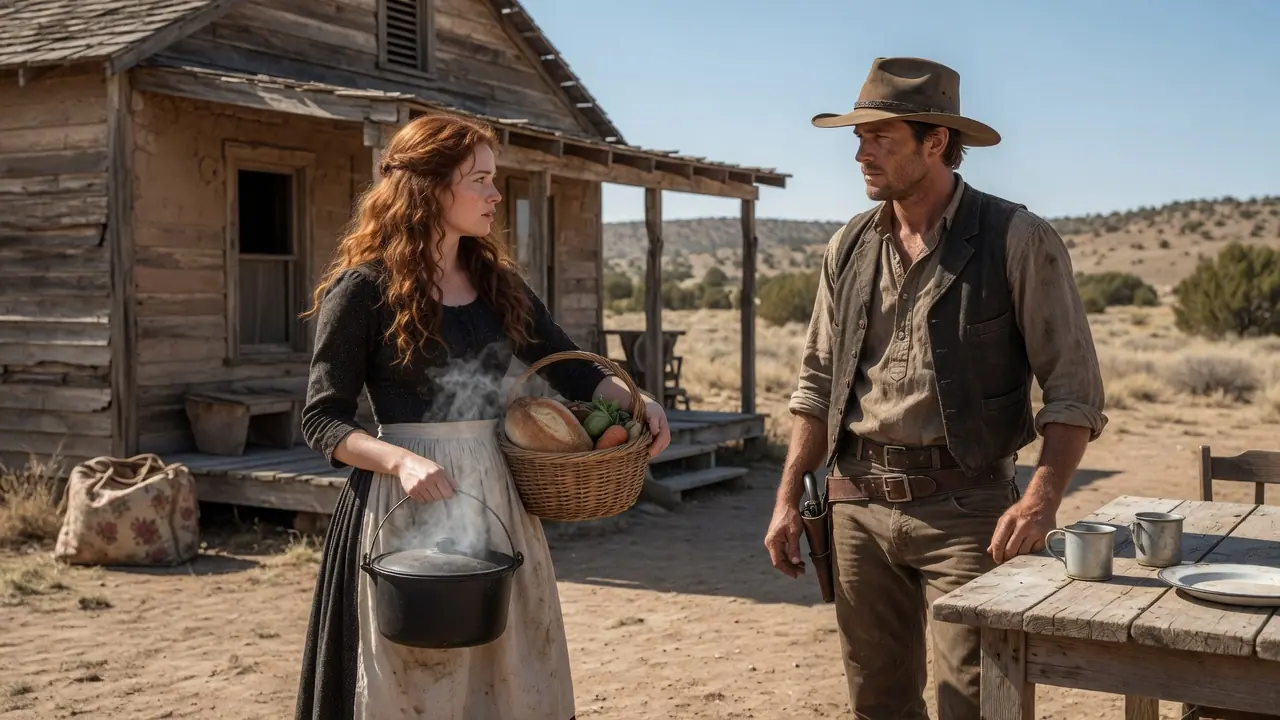
“Sit. Supper is still ten minutes from ruin.”
To her surprise, he sat on the cookhouse step.
Nora brought him coffee.
He accepted it.
For a while, neither spoke.
Then he said, “You read figures?”
“Yes.”
“How well?”
“Well enough to know when flour disappears faster than biscuits.”
He looked at her sharply.
She took a sip from her own cup.
“You have trouble with your stores. Cattle too, from the way men stop talking when I enter.”
Thomas stared out at the yard.
“You hear too much.”
“No. Men talk too loudly around women they assume are thinking about gravy.”
That almost made him smile.
Almost.
He handed her the bank letter.
Nora read it carefully.
The Caddo Creek Bank was calling in a portion of a note early, citing missed interest and unstable cattle returns. The language was polite and deadly.
“This says you owe more than expected.”
“I know what it says.”
“Do you owe it?”
His jaw tightened.
“Not according to my records.”
“Then your records are wrong, or theirs are.”
He looked at her.
“You think I can’t keep accounts?”
“I think tired men make mistakes. I also think bankers make profitable ones.”
He said nothing.
Nora folded the letter.
“Show me your books.”
“No.”
“Then enjoy guessing.”
He stood.
“My books are private.”
“So is hunger, but it announces itself anyway.”
Thomas took the letter and walked away.
The next morning, a stack of ledgers sat on the cookhouse table before dawn.
No note.
No explanation.
Just trust, though neither of them used the word.
Nora began after breakfast.
The books were not disorderly. Thomas was careful, but his figures were written in a cramped hand and sometimes copied from scraps after long days. She checked purchase records, cattle counts, bank notes, supply orders, and shipping receipts.
By noon, she found the first mistake.
By supper, she knew it was not a mistake at all.
Someone had been altering cattle counts before sale.
Not dramatically.
Small numbers.
Three here.
Five there.
Enough to pass unnoticed if a man trusted his foreman and worked too many hours to question every page.
By the next day, she found duplicate supply charges from Caddo Creek vendors connected to Jasper Pike’s cousin.
By the third, she discovered two bank receipts missing from Thomas’s file but referenced in the store ledger.
Nora wrote everything cleanly in her notebook.
Then she waited until Thomas came for coffee.
“You are being robbed,” she said.
He stopped in the doorway.
No greeting.
No softening.
Just those four words.
“By who?”
“You know who.”
His face darkened.
“Say it.”
“Jasper Pike.”
Thomas looked toward the yard where Jasper was tightening a cinch on his horse.
“Proof?”
“Enough to start. Not enough to finish.”
He came inside.
Nora spread the papers across the table.
The cattle counts.
The supply receipts.
The missing bank credits.
The altered numbers.
Thomas stood over them silently, one hand resting on the chair back. His face did not change much, but Nora saw the color leave his mouth.
Jasper had worked for him three years.
That kind of betrayal does not only steal money.
It steals judgment.
“Why?” Thomas asked.
Nora did not answer quickly.
Why was often the least useful question after betrayal.
“Because he could,” she said at last. “And because you trusted him while carrying too much alone.”
Thomas looked at her then.
Something passed between them, hard and true.
“What do we do?” he asked.
We.
It was a small word.
Nora heard it.
“We let him think nothing has changed.”
Over the next two weeks, Nora kept cooking, smiling when required, and writing everything down.
Thomas changed nothing outwardly. He still gave Jasper orders. Still listened to reports. Still let him think the ranch was blind. But quietly, he sent Jonah to Hartwell with letters. He asked Ramon to count cattle from the south pasture separately. He sent Eli to deliver a message to Mrs. Porter, who apparently knew half the territory and distrusted the other half.
Nora created a second set of books.
Clear.
Precise.
Impossible to dismiss.
During those nights, Thomas often came to the cookhouse after the men slept. He would sit at the table while Nora worked through figures, lamplight falling across his tired face.
At first, they spoke only of numbers.
Then of weather.
Then of Boston.
Then of Ireland.
“My father believed America would make room for us,” Nora said one night.
“Did it?”
She looked at the ledger.
“Not at first. Maybe it makes room slowly and charges rent while doing it.”
Thomas smiled faintly.
“That sounds like America.”
“What about you?” she asked. “Did Kansas make room for you?”
“I was born here.”
“That is not what I asked.”
He looked toward the dark window.
“No. I had to fight for mine too.”
Little by little, the cookhouse became less like a workplace and more like the one room where the truth could sit down.
Nora learned Thomas did not sleep well before storms.
Thomas learned Nora sang under her breath when rolling dough.
Nora learned he hated sweet coffee.
Thomas learned she added sugar anyway when he looked too worn and pretended not to notice him drinking it.
The ranch changed under her hands too.
Not because she tried to rule it.
Because food and order are quieter forms of authority.
The men stopped arriving late to meals after she once served their beans cold and said time had flavor. Eli gained weight in his face. Jonah’s limp improved when Nora began adding willow bark tea to his evenings and bullied him into soaking his leg. Ramon started bringing herbs from the low creek because she asked once and thanked him properly.
Even Pete stopped cheating at cards as often because Nora gave him a look that reminded him of his grandmother.
North Ridge began to feel less like a ranch surviving and more like a place choosing to live.
That was when Jasper grew careless.
One night, near the end of June, Nora woke to the sound of horses.
Not the restless movement of animals in the corral.
Departing horses.
She rose quickly, pulled a shawl around her shoulders, and stepped to the cookhouse door.
Moonlight silvered the yard.
At the far side of the barn, Jasper stood with two strangers. Three horses were saddled. A small strongbox sat near Jasper’s feet.
Nora’s heart began to beat hard.
She turned to wake Thomas, then stopped.
The main house was dark.
Too far.
If she ran across the yard, Jasper might see her.
Instead, she slipped back inside, took the iron poker from beside the stove, and went out the rear door toward the wash shed. From there, she moved along the shadow of the smokehouse until she reached the side of the barn.
Jasper’s voice carried low.
“Calloway won’t know until morning. By then the papers are gone and the herd’s halfway through Miller’s Cut.”
One stranger laughed.
“What about the girl?”
“What about her?”
“She’s been watching.”
“She’s a cook.”
The contempt in his voice settled Nora’s fear into anger.
A cook.
As if women had not been hearing secrets over boiling pots since the beginning of time.
She backed away too quickly.
Her heel struck a loose bucket.
The sound cracked through the night.
Jasper turned.
“Who’s there?”
Nora ran.
Not toward the cookhouse.
Toward the bell beside the bunkhouse.
Every ranch had a warning bell.
Fire.
Raid.
Stampede.
Trouble.
She reached it with Jasper shouting behind her and swung the iron poker hard.
The bell clanged through the night.
Once.
Twice.
Three times.
The bunkhouse erupted.
Thomas came from the main house with a rifle in his hands, boots unlaced, shirt open at the throat.
Jasper grabbed Nora’s arm.
She struck him with the poker.
Not beautifully.
Not gracefully.
Hard enough.
He cursed and stumbled back.
Thomas shouted, “Jasper!”
The yard filled with men, horses screaming, lanterns swinging.
The two strangers tried to mount and flee. Ramon and Jonah cut them off near the corral. Pete came out with a shotgun he claimed never worked unless pointed at fools. Eli, pale but determined, held a lantern high.
Jasper reached for his gun.
Thomas already had his rifle leveled.
“Don’t,” he said.
Jasper froze.
For several seconds, no one moved.
Then Jasper lifted both hands.
Nora stood beside the bell, breathing hard, the poker still in her grip.
Thomas glanced at her.
Only once.
But the look in his eyes said everything he could not say while holding a rifle on a man he had trusted.
By dawn, the truth had opened fully.
The strongbox contained altered ledgers, stolen bank receipts, and a forged transfer draft that would have allowed Jasper and his partners to claim Thomas had defaulted. The missing cattle were already penned in a hidden gulch two miles south, waiting to be moved under a false brand.
Mrs. Porter arrived from town with Sheriff Abel Knox just after sunrise.
She looked at Nora holding a coffee pot outside the cookhouse.
“You rang a ranch bell with a stove poker?”
“Yes.”
“Good girl.”
Sheriff Knox arrested Jasper and the two strangers. Thomas gave his statement. Nora gave hers. The ledgers gave the rest.
The bank manager, Mr. Sutter, tried to claim ignorance until Thomas and Nora carried the corrected books into his office three days later with Sheriff Knox standing behind them.
Mr. Sutter’s face grew damp with sweat as Nora laid out the figures.
“You keep fine books for a cook,” he said weakly.
Nora smiled.
“I cook fine meals for men who underestimate me too.”
Thomas did not hide his smile that time.
By the end of July, North Ridge Ranch was no longer under threat from the false default. Jasper’s theft was exposed. The missing cattle were recovered. Mr. Sutter resigned from the bank under pressure from men who disliked being cheated even more than they disliked scandal.
Thomas paid Nora her wages with a bonus.
She counted the money, then placed most of it back on the table.
His face hardened.
“No.”
“You haven’t heard what it’s for.”
“No.”
“You are stubborn before information. That is inefficient.”
“It’s your money.”
“And I am spending it.”
“On what?”
“Glass for the cookhouse window, two new saucepans, coffee beans that don’t taste like burnt fence posts, and a proper lock for my door.”
Thomas opened his mouth.
Closed it.
Then said, “Fine.”
“And curtains.”
He stared.
“Curtains?”
“Yes.”
“For the cookhouse?”
“Yes.”
“Why?”
“Because men who eat indoors may as well learn civilization gradually.”
The curtains were yellow.
Every hand on the ranch mocked them for three days.
Then, when dust blew hard from the west and the cloth softened the light inside the cookhouse, not one man complained.
By autumn, Nora had been at North Ridge five months.
She no longer looked like a woman blown in from the train by accident. Her skin had browned beneath the sun. Her hands had strengthened. Her dress had been patched twice and replaced once with fabric Mrs. Porter helped her choose. Her accent remained, though Hartwell had begun folding itself around it.
The ranch prospered.
Not richly.
Honestly.
Thomas hired a new foreman from Abilene, a quiet Black cowboy named Samuel Boone, who had no patience for foolishness and an eye for cattle that bordered on miraculous. Eli learned to read numbers under Nora’s stern instruction. Jonah began carving small wooden spoons in the evenings. Ramon planted herbs near the cookhouse and called it Nora’s kingdom.
Thomas still worked too hard, but he ate more.
Sometimes he laughed.
The first time it happened at supper, every hand at the table went silent.
Thomas looked around.
“What?”
Pete said, “Nothing, boss. Just checking if thunder followed.”
Nora hid her smile in her coffee cup.
One evening in October, after the first frost silvered the grass, Thomas found Nora outside the cookhouse watching smoke rise from the chimney.
“You’ll freeze standing there,” he said.
“I’ve been colder.”
“I know.”
She looked at him.
He seemed nervous, which was so unusual that she almost teased him. But something in his face stopped her.
“I went to town today,” he said.
“So I see. You came back with sugar and no tobacco. A rare improvement.”
He reached into his coat and held out an envelope.
“What is that?”
“Letter.”
“I can see it is a letter.”
“For you.”
Nora took it carefully.
The return address was from Boston.
Her hand tightened.
She opened it and read.
The McKenna family, her former employers, had heard through the domestic agency that she had gone west. Another household in Boston needed a cook immediately. Good wages. Respectable address. Room included. If she wished to return, they would recommend her.
Nora read the letter twice.
Thomas stood very still.
“You had it sent here?” she asked.
“Mrs. Porter mentioned the agency had written. I told the post office to send it out.”
“That was kind.”
He looked toward the pasture.
“You should have choices.”
The words entered her chest softly.
Choices.
For most of her life, Nora had moved because doors closed behind her.
Ireland.
Boston.
Hartwell.
North Ridge.
Now, for the first time, a door had opened and no one was pushing her through it.
“You want me to go?” she asked.
Thomas looked at her then.
“No.”
The answer came rough.
Honest.
“But I won’t keep you here because I need a cook.”
Nora folded the letter.
“What do you need?”
His throat moved.
“That is harder to say.”
“Try.”
He removed his hat and turned it in his hands.
“I needed a cook when you came. I thought that was all. Someone to make biscuits, keep coffee on, stop the men from poisoning themselves with their own attempts at stew.”
“That was wise of you.”
He smiled faintly.
“But you gave this place more than food. You gave it order. You gave the men reason to sit at a table instead of just feeding. You saved my books. You saved my herd. You saved me from trusting the wrong man until he took everything my father built.”
Nora looked away because praise frightened her more than hardship.
Thomas stepped closer, but not too close.
“And you made the house feel less empty even though you hardly ever go inside it.”
The wind moved between them.
Nora thought of Boston.
Narrow rooms.
Crowded streets.
Wages handed out by women who called her girl though she was twenty-six.
She thought of Hartwell station, where she had stood with fourteen dollars and sixty cents and no plan except not dying.
Then she thought of North Ridge.
The yellow curtains.
The herbs by the cookhouse.
Eli reading numbers aloud.
Ramon humming.
Jonah’s carved spoons.
Thomas at the table after dark, asking her opinion like it mattered.
“What are you asking me, Thomas Calloway?”
He drew a breath.
“Stay.”
“As your cook?”
“If that is all you want.”
“And if it is not?”
His eyes held hers.
“Then stay as my wife, if you can see any good in a hard-headed rancher who took too long to realize the most valuable thing on his land was not cattle.”
Nora’s eyes burned.
She looked down at the letter in her hand.
“My father once told me a person with a record is harder to erase.”
Thomas waited.
“I have spent years being useful in houses that were never mine,” she said. “Cooking in kitchens where my name was forgotten as soon as the plates were cleared. I came here because I had nowhere else to go.”
She looked toward the cookhouse.
“Then this place began remembering me.”
Thomas’s face softened.
“I remember you.”
That undid her.
Not dramatically.
Quietly.
A tear slipped down her cheek, and she laughed because it embarrassed her.
“I will not be proposed to beside a woodpile with flour on my sleeve.”
Thomas looked alarmed.
“No?”
“No.”
“What should I do?”
“Ask again tomorrow. After supper. With clean hands. And maybe flowers, if the territory can spare any.”
For the first time since she had known him, Thomas Calloway laughed without holding it back.
The next evening, he came to the cookhouse after supper with clean hands, a nervous face, and a small bunch of wild asters tied with twine.
Eli, Pete, Jonah, Ramon, and Samuel Boone all pretended not to watch from the bunkhouse porch.
Mrs. Porter had somehow arrived from town with a pie and no explanation.
Thomas stood in front of Nora and asked properly.
She said yes.
The wedding took place in November at the small white church in Hartwell.
Nora wore a blue dress Mrs. Porter helped alter. Thomas wore a black coat that made him look uncomfortable and handsome. Sheriff Knox stood in the back. Samuel Boone polished his boots. Eli cried and denied it for the rest of his life.
Mrs. Porter made three pies.
Ramon played fiddle.
Jonah gave them a set of carved spoons, each handle marked with a tiny ridge pattern.
Pete gave them a coffee tin and said marriage needed strong coffee and stronger nerves.
Thomas moved Frank’s old dining table from the main house into the largest room and asked Nora where she wanted everything before touching a single chair.
That mattered.
More than flowers.
More than vows, almost.
He had learned that love did not rearrange a woman’s life without asking where she wished to stand.
Winter came hard that year.
Snow closed the north road twice. Cattle had to be moved closer. The wind found cracks no one knew existed. But inside the main house, lamps burned warmly, and the kitchen smelled of bread, stew, coffee, apples, and the kind of peace built by work rather than luck.
Nora did not stop keeping books.
She kept ranch accounts cleaner than any bank in Hartwell.
She kept recipes.
Weather records.
Births of calves.
Wages.
Debts paid.
Debts forgiven.
Names of travelers who stopped for a meal.
One page she titled Things Worth Remembering.
Under it, she wrote:
A train can leave you behind and still bring you where you belong.
A cook sees more than men think.
Yellow curtains improve morale.
Thomas takes sugar in his coffee when tired, though he denies it.
Home is not the place that hires you. It is the place that asks you to stay.
Years later, people in Hartwell would still tell the story of Nora O’Shea Calloway.
They would say she came with one carpetbag and fourteen dollars and sixty cents.
They would say Thomas Calloway hired her because he needed a cook.
They would say she saved North Ridge Ranch from thieves, crooked books, and a banker who learned too late that an Irish girl with a pencil could be more dangerous than a man with a gun.
But those who knew the truth said something quieter.
Thomas had only wanted food on the table.
Nora gave him a table worth sitting at.
He wanted someone to cook for his ranch hands.
She gave those men a home.
He wanted help surviving another hard season.
She gave him back the part of himself that still knew how to trust.
And in a territory where cattle could be counted, land could be measured, and debts could be written down in ink, what Nora gave him remained the one thing no ledger could price.
She gave North Ridge a heart.
And Thomas Calloway spent the rest of his life knowing he had hired a cook and received a miracle.