The wagon left Ruth Calder alone beneath an enormous Dakota sky at a quarter past four in the afternoon. Her late aunt’s homestead stood behind her, a weather-beaten cabin, a leaning barn, and forty acres of grass rolling toward a distant ridge. The October wind worried at the hem of her navy dress and tugged loose strands from the braided bun at the back of her head. Before the driver climbed onto his seat, he gave her the same warning she had heard at every stop since leaving Mill Creek.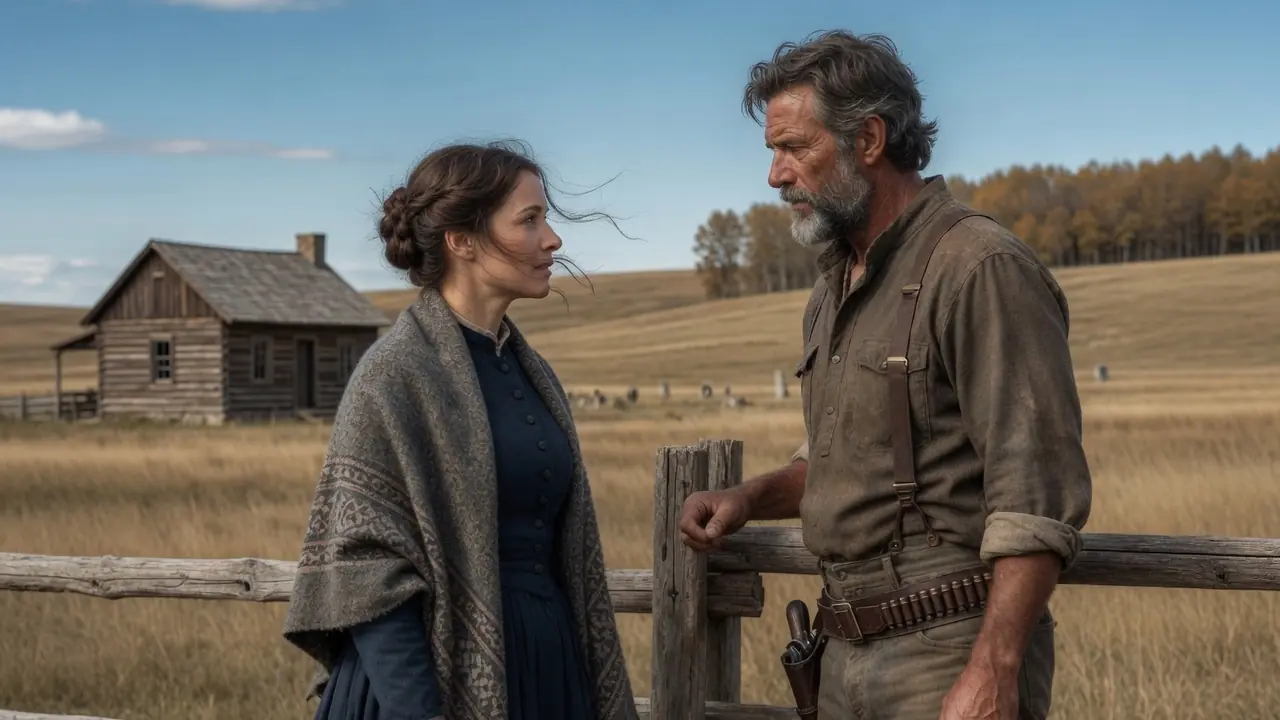
“Best keep clear of Caleb Marrow,” he said. “Man has a temper mean enough to sour milk in the pail.”
Ruth adjusted the gray wool shawl around her shoulders. “Has he harmed anyone?”
The driver glanced toward the northern fence line as though speaking the name might summon its owner. “Not exactly. But he drove off two hired hands, broke a merchant’s nose, and threatened to shoot a preacher who came asking questions. Folks around here say there’s something wrong inside him.”
“Folks say many things when they do not know the answer.”
The driver looked unconvinced, tipped his hat, and urged the horses away. Ruth watched the wagon shrink along the dirt track until its dust disappeared into the lowering light. Then she turned toward the property that now belonged to her and wondered whether crossing half a continent for solitude had been brave or simply another form of running.
At thirty-four, Ruth had spent twelve years teaching children in crowded Pennsylvania schoolrooms. She had survived a broken engagement, her father’s long illness, and the quiet humiliation of discovering that the man she intended to marry preferred her inheritance to her company. When Aunt Margaret died and left the Dakota homestead to her only niece, Ruth packed books, clothing, and every remaining piece of courage into two trunks. She wanted a place where no one knew the woman she had almost become.
The cabin required work immediately. One shutter hung from a single hinge, mice had eaten through a flour sack, and half the roof above the kitchen leaked when the wind carried rain from the west. Ruth spent the first evening sweeping dust, stacking firewood, and convincing herself that the groans in the walls came from settling timber rather than prowling animals. She slept with a rifle beside the bed and woke before sunrise to silence so complete it made her ears ache.
Her first sight of Caleb Marrow came from the kitchen window.
A tall man stood near the northern fence, lifting a broken rail into place. He wore a dirt-stained brown shirt, leather suspenders, and a gun belt low around his hips. Wavy salt-and-pepper hair touched his collar, and a rugged beard covered most of a face darkened by years beneath the sun. He worked quickly, driving each nail with controlled force, never once looking toward the cabin.
Ruth stepped onto the porch. “Mr. Marrow?”
The hammer stopped.
He turned slowly, and she understood why townspeople found him intimidating. His gray eyes were deep-set and watchful, and his broad frame seemed built to resist weather, cattle, and unwanted conversation equally well. He did not greet her or remove his hat because he wore none.
“You crossed the property line,” Ruth said.
“The fence was down.”
“I can see that.”
“Your cow could have wandered north.”
“I do not own a cow.”
His gaze shifted toward the empty barn. “Then whatever you buy later could wander north.”
Ruth walked closer. “Were you planning to tell me you repaired it?”
“No.”
“Why not?”
Caleb placed the hammer inside his belt. “A fixed fence works whether someone thanks me or not.”
Before Ruth could answer, he crossed back to his side of the property and disappeared through the tall grass. She stood beside the repaired section, studying the fresh nails and the new rail he had cut to fit perfectly. It was thorough work, given freely by a man everyone described as cruel.
The following week brought more contradictions.
Ruth mentioned to the shopkeeper that she hoped to plant potatoes before the ground hardened. The store had none left, and the next supply wagon would not arrive for twelve days. Two mornings later, she found a burlap sack beside the barn containing enough seed potatoes for three rows, but no note identified the giver. Boot prints led north through the dew.
When her mare developed a limp, Ruth discovered the loose shoe at sunset. She had no experience removing it and feared the animal would injure herself before morning. Caleb appeared outside the stable as she struggled with the mare’s hoof, took one look at her tools, and stepped forward.
“Give me the pullers.”
“You might begin with good evening.”
“You might begin by not wrenching against the nail.”
Ruth handed him the tool. “Good evening, Mr. Marrow.”
He crouched beside the mare. “Evening.”
His hands were large but gentle against the animal. He spoke to the mare in a low voice, eased the damaged shoe free, cleaned the hoof, and promised to bring the blacksmith at first light. Ruth noticed a scar running from his left wrist beneath his sleeve and another across his jaw beneath the beard.
“Thank you,” she said.
Caleb stood. “Keep her in the stall.”
“I intended to.”
“Then we understand each other.”
“You make kindness sound like an accusation.”
Something moved behind his eyes, but he turned away before she could name it. He walked north without accepting food, coffee, or payment. The next morning, the blacksmith arrived and said Caleb had already covered the cost.
Mill Creek’s residents remained eager to warn her.
At the general store, Mrs. Hobbs claimed Caleb once threw a man through a saloon window. The postmaster said he had not entered church in seven years. A ranch wife whispered that his temper had driven his family away, though she could not explain where they had gone. Each person supplied certainty where facts were missing.
Reverend Moss approached Ruth after Sunday service. He was a narrow, nervous man whose collar seemed too tight around his throat. “A woman living alone should exercise caution,” he told her. “Marrow resents Christian concern.”
“What concern did you offer?”
“I attempted to discuss his soul.”
“Perhaps he did not consider it your property.”
The reverend looked offended. “You speak lightly because you do not know what happened.”
“No one has told me what happened. They only tell me what kind of man they decided he became afterward.”
Ruth returned home beneath a sky turning silver with approaching rain. She found Caleb standing near the eastern pasture, examining a line of clouds gathering over the ridge. His shirt sleeves were rolled above muscular forearms, and a coil of rope hung from one shoulder.
“Storm coming,” he said.
“So the clouds suggest.”
“Not ordinary rain.”
“What do you recommend?”
“Brace the barn door. Move your mare into the lower stall. Bring enough wood inside for three days.”
Ruth followed his gaze. “Will you help?”
His expression closed at once. “You have hands.”
“I do. You also have experience.”
He looked toward the horizon again. “I will secure the roof. You handle everything below it.”
They worked until darkness swallowed the land.
Caleb climbed onto the barn despite rising wind and replaced loose shingles with boards from Ruth’s shed. She dragged feed, tools, and firewood beneath cover, then secured the animals and shutters. They finished as the first heavy drops struck the earth.
“Come inside,” Ruth said. “You will not reach your cabin before the worst of it.”
“My place is less than a mile.”
“The creek lies between us.”
“It is shallow.”
“Not after this rain.”
Caleb hesitated. The wind bent the cottonwoods nearly sideways, and lightning opened the western sky in a white fracture. Ruth lifted the door latch.
“You repaired my fence, bought seed, saved my horse, and kept the barn roof from flying into Minnesota. You may accept one supper without surrendering your reputation.”
His mouth almost formed a smile. “My reputation is safer outside.”
“Then bring it in before it drowns.”
The storm trapped him there for two nights.
Rain hammered the roof without pause, turning the fields into black water and raising the creek beyond its banks. Ruth gave Caleb the small room beside the kitchen and placed a folded blanket near the stove. He kept his gun within reach and slept lightly, waking at every hard gust as though expecting something worse than weather to enter.
During daylight, they worked together to keep the cabin dry. Caleb reinforced the western wall while Ruth emptied pans beneath leaks and cooked meals from beans, preserved fruit, and salted pork. Their conversations began with practical matters and gradually moved toward the lives they had lived before Dakota.
He learned that Ruth had taught geography, literature, and arithmetic. She learned that Caleb once worked cattle from Montana to Texas before settling on the northern acreage twelve years earlier. He spoke little about why he stopped traveling, and each time she approached the subject, he found another task requiring attention.
On the second evening, Ruth noticed him staring at the small bookshelf beside the hearth.
“You can read them,” she said.
“I know.”
“That was an invitation, not an explanation.”
He selected a worn collection of poems and turned it over in his hands. “My wife used to read aloud.”
Ruth became still.
Caleb returned the book to the shelf. “Storm is weakening.”
The rain stopped before dawn.
At first light, Caleb walked toward the flooded creek to test the crossing. Ruth followed despite his warning to remain behind. They discovered a section of the northern fence collapsed beneath branches and water, and one of Caleb’s cattle trapped against the bank.
Together, they dragged rope through freezing mud. Caleb entered the water, fastened the loop around the animal, and shouted for Ruth to pull with the mare. The cow scrambled free, but the current struck Caleb’s legs and swept him sideways.
Ruth drove the mare forward until the rope tightened around his waist. Caleb reached the bank and climbed out coughing, his clothing soaked and his face drained of color. She helped him to the cabin, forced him out of his wet shirt, and wrapped him in every blanket she owned.
When he awoke hours later, he found her sitting beside the bed.
“You could have drowned,” she said.
“So could the cow.”
“The cow did not know better.”
“Neither did I, apparently.”
Ruth studied the old scars across his chest and arms. None looked like the marks of easy years. “Why do you behave as though your life is worth less than everything you protect?”
His expression hardened. “Do not.”
“Do not what?”
“Ask questions you have no right to ask.”
“I pulled you from a flooded creek.”
“That gives you my thanks, not my history.”
He rose too quickly, nearly falling. Ruth caught his arm, and Caleb pulled away as though touch burned. Without another word, he dressed and left before the creek had fully receded.
For ten days, she did not see him.
The repaired fence remained strong. A crate of dry firewood appeared beside her porch one morning, but no footprints survived the frost. Ruth understood the message: Caleb would continue helping from a distance as long as she asked nothing of the man performing the kindness.
She might have accepted that arrangement had she not found the shoe.
A calf escaped from Caleb’s pasture one afternoon and wandered near his cabin. Ruth guided it back, calling his name when no one appeared. The front door stood partly open, moving against its frame in the wind.
She stepped inside only to ensure he was not injured.
The cabin was orderly and painfully bare. One table, one chair, one iron bed, and a cold stove occupied the main room. Above the hearth stood a framed photograph of Caleb beside a fair-haired woman holding a little boy. Next to the photograph rested a child’s worn leather shoe, small enough to fit inside Ruth’s palm.
A voice behind her said, “Put it down.”
Caleb stood in the doorway.
His gray eyes were not merely angry. They were terrified.
Ruth carefully returned the shoe to the shelf. “The calf crossed my land.”
“You had no right to enter.”
“The door was open, and you did not answer.”
“You saw I was not here.”
“I saw the photograph.”
His jaw tightened. “Leave.”
“Caleb—”
“Leave!”
The force of the shout shook dust from the rafters. Ruth flinched, but she did not retreat immediately. She looked toward the child’s shoe, then back at the man whose grief filled the cabin more completely than furniture ever could.
“They warned me you were a monster who drove everyone away,” she said.
Caleb’s anger collapsed into something hollow. His eyes moved toward the graves beyond the rear window. “Maybe I am. Everyone who stayed close to me ended up gone.”
Ruth stepped nearer, though she left space between them. “No, Caleb. You are a lonely man hiding grief behind anger so no one can leave you again.”
His breathing became uneven. “You know nothing about it.”
“I know what abandonment does. I know what sorrow becomes when no one is allowed near it.”
He looked at her then, and the years behind his silence became visible. “I have lived with that quiet so long,” he said, his voice breaking, “I forgot what it felt like to be loved.”
Ruth did not touch him.
Not yet.
She sat in the single chair and waited.
Caleb remained near the door for a long time. Then he crossed the room, lifted the child’s shoe, and held it with both hands. The story came slowly, one sentence at a time, as though each word had to be pulled through scar tissue.
His wife’s name had been Eliza. Their son, Samuel, was four years old when scarlet fever spread through Mill Creek seven winters earlier. The doctor refused to cross the storm because he believed the roads were too dangerous. Reverend Moss came only after both Eliza and Samuel had died, offering scripture to a man who had spent three days begging heaven for a different answer.
Caleb buried them alone beyond the ridge.
Afterward, people tried to help, but he could not bear their pity. When they continued arriving, he shouted, threatened, and drove them away. One drunken rancher mocked the little grave markers, and Caleb threw him through a saloon window. The story became larger with every retelling until the grieving widower disappeared beneath the monster Mill Creek preferred to understand.
“I should have saved them,” Caleb said.
“You could not control the fever.”
“I could have ridden for the doctor sooner.”
“You did not know.”
“I should have known.”
Ruth looked at the child’s shoe. “Grief always invents a moment when we might have changed everything. It gives us one impossible door and punishes us forever for failing to open it.”
His eyes narrowed. “Who did you lose?”
“A life I thought I would have.”
She told him about Nathaniel Price, the man she intended to marry in Pennsylvania. He had spent three years praising her strength, intelligence, and independence. After her father died, she discovered Nathaniel had secretly borrowed against property he expected her to inherit. When she refused to marry him, he told their friends she was cold, difficult, and incapable of devotion.
Ruth left not because his betrayal broke her heart, but because too many people believed his explanation more easily than hers.
“They said you were a monster,” she finished. “They said I was impossible to love. Perhaps people enjoy naming what they are too lazy to understand.”
Caleb sat across from her on the edge of the bed. “He was a fool.”
“So were the people who believed the easiest story about you.”
The first change came quietly.
Caleb stopped leaving gifts without explanation. When he brought seed, tools, or meat, he knocked on the door and accepted coffee. Ruth visited the graves beyond his ridge and placed small wildflowers beside the weathered markers, but only after asking permission.
He began reading aloud from her books during winter evenings. His voice was rough and careful, and he often paused over unfamiliar words. Ruth never corrected him unless he asked.
By December, Mill Creek noticed.
Mrs. Hobbs saw them buying flour together and immediately whispered that Ruth had been bewitched. Reverend Moss arrived at her property to warn her that Caleb’s violence might return. Ruth listened until he finished, then asked whether he had ever apologized for abandoning the family during the fever.
The reverend left without answering.
Garrett Sloan, a widowed merchant who had shown unwanted interest in Ruth since her arrival, reacted more aggressively. He approached Caleb outside the feed store and accused him of preying on a vulnerable woman. Caleb’s hands curled into fists, but he looked toward Ruth before deciding what to do.
She stepped between them.
“I invited Mr. Marrow into my life,” she said. “Your disappointment does not make me vulnerable.”
Sloan laughed. “You think you know him?”
“I know what he does when no one is applauding.”
Caleb walked away without striking him.
That restraint changed something in the town, though few admitted it. People who expected violence found none. Farmers began acknowledging that Caleb’s fences were the strongest in the territory and that he had quietly helped half of them during storms. The blacksmith confessed Caleb had paid debts for two struggling families without taking credit.
Spring arrived late but brilliant.
Ruth planted potatoes, repaired the schoolhouse, and agreed to teach six children from neighboring homesteads. Caleb built desks from pine and pretended the project was merely an excuse to use leftover boards. The children feared him at first, but Samuel Hobbs discovered that Caleb could carve wooden animals, and soon every student wanted one.
He softened around them in ways that hurt and healed him at once.
One afternoon, Ruth found him holding a small wooden horse while staring toward Samuel’s grave. She stood beside him without speaking. Caleb reached for her hand.
It was the first time he touched her by choice.
Their courtship unfolded without formal announcement. They shared meals, chores, books, and long rides across the grasslands. Caleb repaired Ruth’s porch; she sewed the torn cuff of his winter coat. Each kindness became an argument against the loneliness both had accepted as permanent.
The town’s final test came during the summer social at Mill Creek.
Ruth attended in a pale blue dress, and Caleb wore a clean shirt that appeared to make him physically uncomfortable. Music played outside the church hall while families gathered beneath lanterns. Several people greeted Caleb cautiously, but no one asked him to leave.
Then Sloan approached after too much whiskey.
He mocked Caleb’s dead family and suggested Ruth would soon discover why every person close to him disappeared. Silence spread across the yard as Caleb’s face changed. His hand moved once, and half the town prepared for the monster they had described for seven years.
Ruth touched his sleeve.
Caleb looked at her.
“No,” she said softly. “Do not become the story he wants.”
Sloan smiled, believing he had won.
Caleb stepped closer but kept both hands at his sides. “You are trying to make my grief entertain you. That tells this town more about you than any fist could.”
He turned away.
No one followed Sloan when he left.
Later, beneath the cottonwoods, Caleb asked Ruth to walk with him toward the creek. Moonlight silvered the grass, and music drifted from the social behind them. He stopped near the water and removed a small object from his pocket.
It was a plain silver ring.
“I cannot promise I will never be angry,” he said. “Or afraid. Or foolish enough to think silence protects people.”
Ruth waited.
“But I can promise I will not shut you outside what I carry. I can promise to stay when staying frightens me. And if you can love a man still learning how to receive it, I would spend the rest of my life learning beside you.”
Tears filled her eyes. “That sounded rehearsed.”
“For three months.”
“You took too long.”
“I was terrified.”
“That is not a refusal.”
Caleb slipped the ring onto her finger.
They married in September before the first frost. The ceremony took place beside the fence where they had truly met, with schoolchildren holding wildflowers and half the town gathered nearby. Reverend Moss offered to officiate, but Ruth chose an older traveling minister who had never mistaken pity for compassion.
After the vows, Caleb looked toward the ridge where Eliza and Samuel rested. Ruth followed his gaze.
Love had not erased them.
It had made room for life beside their memory.
Years later, travelers passing through Mill Creek still heard stories about Caleb Marrow. The stories changed depending on who told them. Some described the angry rancher who once drove everyone away, while others remembered the man who repaired fences before being asked, carried children through winter storms, and built the territory’s first proper schoolhouse.
Ruth knew both versions contained pieces of truth.
Caleb had been cruel at times. Grief had sharpened him, isolation had hardened him, and the town had given his pain a name easier to fear than understand. But a person was not only the worst thing sorrow taught him to become.
On spring evenings, Ruth and Caleb often stood beside the northern fence while blossoms opened on the young trees near the cabin. He would place one arm around her shoulders, and she would lean against the man everyone once warned her to avoid.
“They called you a monster,” she reminded him once.
Caleb looked down at her. “Maybe they needed me to be one.”
“Why?”
“So they would not have to admit they left a grieving man alone.”
Ruth took his hand. “And what are you now?”
He considered the farmhouse, the schoolhouse, the distant graves, and the woman beside him.
“Loved,” he said.
For a man who had forgotten how, the word was everything.