“Where is breakfast? Don’t be selfish.”
The young woman in silk pajamas spat the words across the kitchen as if she were speaking to a maid who had forgotten her place.
Her name was Bianca Hayes, and she stood barefoot on the cool tile floor of my Charleston kitchen, her dark hair swept over one shoulder, one manicured hand resting on her hip, the other holding a phone she seemed incapable of putting down.
Behind her stood my son, Ethan, silent as a shadow.
He did not correct her.
He did not apologize.
He simply leaned against the doorframe, looking down at the floor as if the wood grain had suddenly become fascinating.
I sat at the breakfast table with my morning newspaper open in front of me. A cup of black coffee rested beside my right hand. Outside the tall kitchen windows, early sunlight moved through the branches of the old magnolia tree, scattering pale gold across the garden path. The house was quiet except for the faint hum of the refrigerator and the distant sound of gulls drifting in from the harbor.
This was the same kitchen where I had fed Ethan pancakes before school.
The same kitchen where my husband, Robert, used to stand at the stove on Sunday mornings, burning bacon and pretending he meant to.
The same kitchen where grief had sat beside me after Robert died, where I learned to drink coffee alone, where I taught myself that silence was not always loneliness.
Now Bianca stood in it like she had conquered something.
They had moved into my quiet Charleston home without asking.
That was not how they described it, of course.
People rarely call invasion by its proper name when they want you to feel guilty for noticing.
Three weeks earlier, Ethan had called me from the highway, his voice strained.
“Mom, could Bianca and I stay with you for a few days?”
A few days.
That was how these things always began.
Their apartment near King Street was “having plumbing issues.” The landlord was “impossible.” A pipe had burst in the unit above them, or so Ethan said, and their furniture needed to be moved out while repairs were done. He sounded tired. Embarrassed. Maybe even frightened.
I was seventy-two years old, but I was still a mother.
When your child calls in distress, your first instinct is not suspicion.
It is to open the door.
So I did.
I told them they could use the guest room upstairs, the one with the blue quilt and the view of the garden. I made up the bed, cleared drawers, stocked the bathroom with fresh towels, and put a little vase of camellias on the nightstand because I still believed kindness should look like something.
They arrived with two suitcases.
Then came six boxes.
Then garment bags.
Then a standing mirror Bianca claimed had to come inside because “storage humidity ruins everything.”
By the end of the week, the guest room no longer looked like a guest room.
It looked occupied.
By the second week, Bianca had rearranged my pantry because she “couldn’t function in chaos.” She moved Robert’s old fishing hat from the hallway hook and placed it in a closet because it was “visually depressing.” She ordered new white towels for the upstairs bathroom and charged them to my account after telling the sales clerk, “My mother-in-law approved it.”
I had not approved it.
When I asked Ethan about it, he sighed.
“Mom, they’re just towels.”
That became his answer for everything.
Just towels.
Just a few boxes.
Just temporary.
Just Bianca trying to feel comfortable.
But comfort, in Bianca’s hands, became occupation.
She began walking through my house in silk pajamas at ten in the morning, opening cabinets, criticizing furniture, speaking loudly on the phone while I read in the sunroom. She complained that the house was “too old-fashioned,” that the guest room mattress hurt her back, that the kitchen needed updating, that my coffee was too strong, that my thermostat setting was unreasonable for “a house this large.”
A house this large.
She said it the way people do when they have begun measuring what they intend to take.
I watched.
I listened.
I said less than I knew.
That morning, when Bianca demanded breakfast, something in the air finally became honest.
“Where is breakfast? Don’t be selfish.”
The words hung between us.
I looked up slowly from my newspaper.
Bianca expected embarrassment.
Maybe anger.
Maybe apology.
She expected me to rise from the chair, go to the stove, crack eggs, butter toast, and prove that I was still willing to earn my place in a house that already belonged to me.
She had mistaken my courtesy for service.
My age for weakness.
My love for Ethan for permission.
I did not flinch.
I did not yell.
I simply folded the newspaper once, then again, smoothing the crease with my fingertips.
The movement was slow.
Deliberate.
The kind of calm that arrives after a person has already made a decision.
“The pantry is there,” I said.
Bianca blinked.
I pointed without looking away from her.
“The refrigerator is there.”
Ethan lifted his eyes then.
For the first time all morning, he seemed afraid.
Not of Bianca.
Of me.
Without another word, I picked up my phone from the table and walked out of the kitchen, leaving the entitled couple in stunned silence.
But picking up that phone was not just an exit.
It was my first move.
My name is Margaret Whitfield.
Not Maggie, though Robert called me that.
Not Mother, though Ethan used to say it with affection when he wanted my attention.
Not “old lady,” which I once heard Bianca mutter under her breath when she thought I was too far down the hallway to hear.
Margaret Anne Whitfield.
And that name was printed clearly on the deed to 48 Tradd Street.
The house had belonged to Robert’s family once, but family stories often skip the paperwork. Robert’s father lost nearly everything after a bad investment in the 1970s. The house was mortgaged twice and almost sold to a developer before Robert and I bought the remaining debt ourselves.
I was thirty-four then, working as an office manager at a shipping company during the day and doing bookkeeping for three small businesses at night. Robert taught high school history and painted houses every summer for extra money. We did not inherit comfort. We fought for it, one payment at a time.
Years later, when Robert’s health began failing, he insisted we put the house fully in my name.
“Ethan is grown,” he said from the hospital bed in our downstairs sitting room. “This house should protect you before it benefits anyone else.”
I told him not to talk that way.
He squeezed my hand.
“Maggie, listen to me. People become strange around houses and money. Even people you love.”
I had been offended then.
Not because he was wrong.
Because I wanted our son to be impossible of becoming the kind of man that sentence imagined.
Robert knew better.
He always knew people more clearly than I wanted him to.
After he died, I kept the house not because it was grand, though it was beautiful in its faded Charleston way. I kept it because every room held proof that a life had been lived there with devotion. The front porch where Robert read every evening. The narrow staircase Ethan slid down at six years old and cracked a tooth. The dining room where we hosted Thanksgiving for twenty-eight people one year because Robert believed folding chairs counted as hospitality.
It was not an asset to me.
It was a witness.
Bianca saw only square footage, location, old money charm, and future resale value.
That was her first mistake.
Her second mistake was believing I had not noticed.
I walked from the kitchen into Robert’s old study, closed the door, and stood for a moment beneath the wall of built-in bookshelves. His leather chair still sat near the window, cracked at the arms, stubbornly comfortable. On the desk was a framed photograph of the three of us taken when Ethan was twelve. He stood between us, sunburned and smiling, holding a seashell like it was treasure.
I looked at that boy’s face before making the call.
Then I pressed the number for my attorney.
Charles Pennington had handled our family legal matters for more than thirty years. He was eighty now, half retired, and still sharper than most men half his age. His office was on Broad Street above a stationery shop that smelled of paper and dust.
He answered on the fourth ring.
“Margaret?”
“Charles, I need you to come by the house today.”
His voice changed at once.
“What happened?”
“My son and his wife have overstayed their welcome.”
There was a pause.
“How badly?”
I looked toward the closed study door.
“She demanded breakfast this morning.”
“That sounds rude, not legal.”
“She also charged household items to my account, redirected two pieces of mail, and yesterday I found a folder in the guest room labeled ‘Tradd Street Renovation Concepts.’”
Silence.
Then Charles said, “I’ll be there in an hour.”
“Bring whatever notice is required.”
“Margaret.”
“Yes?”
“Are you sure?”
I looked at Robert’s photograph on the desk.
“Yes,” I said. “I am finally sure.”
After I ended the call, I did not leave the study immediately.
I opened the bottom drawer of Robert’s desk and removed the blue folder Charles had prepared for me after Robert died. I had avoided looking at it for years because grief turns paperwork into something almost obscene. Deeds. Trust documents. Powers of attorney. Insurance papers. All the legal skeletons left behind after love leaves the room.
But that morning, the folder felt less like grief and more like armor.
Inside was the deed.
Margaret Anne Whitfield.
Sole owner.
I placed it on the desk and stared at my name.
There are moments in a woman’s life when seeing her own name becomes an act of rescue.
At 10:23, Bianca knocked once on the study door and entered without waiting.
I did not hide the folder.
She saw it immediately.
“What are you doing in here?” she asked.
I looked up.
“This is my study.”
She rolled her eyes slightly.
“I meant why did you walk off like that? Ethan is upset.”
“Is he?”
“You embarrassed him.”
I smiled faintly.
“That must be uncomfortable.”
Her face tightened.
“Margaret, you don’t have to be passive-aggressive.”
“I am being direct.”
“Fine.” She stepped farther into the room. “Then I’ll be direct too. Ethan and I are under a lot of stress. The apartment situation is a nightmare, my work is demanding, and this house is not easy to adjust to.”
“You were not invited to adjust permanently.”
Her eyes narrowed.
“We are family.”
“Are we?”
That stopped her for half a second.
Then she smiled, but the smile had sharpened.
“You know, most mothers would be grateful to have their son close.”
“Most guests would be grateful to have a place to sleep.”
“We’re not guests.”
“No,” I said quietly. “That has become clear.”
She glanced at the paper on the desk.
“What is that?”
“The deed.”
Her expression flickered.
Only for a second.
But I saw it.
Interest.
Calculation.
Fear.
“Why are you looking at that?” she asked.
“Because it has become relevant.”
Bianca laughed softly.
“Relevant to breakfast?”
“Relevant to boundaries.”
Her face hardened.
“I think you’re overreacting because I asked for food.”
“No, Bianca. You ordered food from a woman whose home you entered as a temporary guest.”
She folded her arms.
“You act like we’re strangers off the street.”
“No. Strangers off the street would probably say thank you.”
Her cheeks flushed.
“I’m going to get Ethan.”
“Please do.”
She turned and left quickly.
A few minutes later, Ethan entered the study alone.
He was forty-one years old, though in that moment he looked younger, almost boyish in the way guilty sons often do when they hope motherhood will soften judgment. He wore jeans and a navy sweater, his hair still damp from the shower. I could see Robert in his face sometimes. The shape of his eyes. The way his mouth tightened when he was uncomfortable.
“Mom,” he said.
“Ethan.”
He closed the door behind him.
“Bianca said you’re upset.”
“I am not upset.”
He looked relieved too soon.
“I am finished.”
His face changed.
“What does that mean?”
“It means you and Bianca need to find somewhere else to stay.”
He stared at me.
“Because of breakfast?”
“No. Because of three weeks of disrespect, unauthorized charges, rearranged rooms, intercepted mail, and the renovation folder upstairs.”
His eyes shifted.
He knew about the folder.
That hurt, though I had expected it.
“Mom, it wasn’t like that.”
“What was it like?”
He rubbed the back of his neck.
“We were just brainstorming.”
“For my house?”
“For the future.”
I sat back.
“There it is.”
He sighed.
“Mom, this house is too much for you.”
The sentence arrived in Bianca’s voice, though Ethan’s mouth formed it.
I studied him.
“Is it?”
“You’re alone here.”
“I am not helpless.”
“I didn’t say that.”
“You implied it.”
“I’m worried about you.”
“No,” I said. “You are worried about how long you will have to wait.”
He flinched.
“That’s unfair.”
“Is it?”
His face reddened.
“I’m your son.”
“Yes.”
“This is my childhood home.”
“Yes.”
“Dad would have wanted—”
“Do not use your father as a key to a door he locked for my protection.”
The words struck him silent.
I opened the folder and turned the deed toward him.
“Your father made sure this house was mine. Not because he did not love you. Because he loved me enough to know I might someday need something no one could take.”
Ethan stared at the document.
He had likely assumed what many adult children assume: that parental property is simply inheritance waiting for patience to run out.
“Mom,” he said softly, “I would never take anything from you.”
I looked toward the door Bianca had exited through.
“You already let someone try.”
He lowered his eyes.
That silence was answer enough.
Charles arrived at 11:15.
Bianca had changed by then into white linen pants and a pale green blouse, as if dressing nicely could restore moral advantage. Ethan stood near the fireplace in the living room with his hands in his pockets. I sat in Robert’s old chair, the deed folder on the side table beside me.
When Charles entered, Bianca smiled at him the way she smiled at restaurant hosts and bank managers.
“Mr. Pennington,” she said warmly. “I’m not sure why Margaret felt the need to involve an attorney over a family misunderstanding.”
Charles removed his glasses and polished them with a cloth.
“Mrs. Hayes, in my experience, family misunderstandings often become legal matters when one party forgets who owns the house.”
Bianca’s smile vanished.
Ethan closed his eyes.
Charles sat beside me and opened his briefcase.
“I have reviewed Mrs. Whitfield’s documents many times. She is the sole legal owner of this property. You and your husband are temporary guests. There is no lease. There is no ownership interest. There is no written agreement granting occupancy beyond Mrs. Whitfield’s permission.”
Bianca’s jaw tightened.
“We receive mail here.”
“Recently,” Charles said.
“Some of our belongings are here.”
“Also recently.”
“We have nowhere else to go on such short notice.”
Charles looked at me.
I nodded.
He continued.
“Mrs. Whitfield is willing to provide written notice and a reasonable timeline as required. But make no mistake. Her permission has ended.”
Bianca turned to Ethan.
“Are you hearing this?”
Ethan said nothing.
She looked back at Charles.
“This is insane. She’s an elderly woman. We moved in to help her.”
I laughed once.
I could not help it.
Everyone turned toward me.
“Help me?” I asked.
Bianca lifted her chin.
“Yes. Whether you appreciate it or not.”
I stood slowly.
“Then let us list the help. You moved my husband’s photograph from the upstairs hall because it was ‘too heavy.’ You charged towels to my account without permission. You threw away the labels I use in my pantry. You told my neighbor I was becoming ‘forgetful.’ You left cabinet doors open, lights on, dishes in the sink, and last night your husband asked me where I keep the property insurance papers.”
Ethan looked sharply at Bianca.
She looked away.
I continued.
“This morning, you walked into my kitchen and demanded breakfast. Not asked. Demanded. Then you called me selfish in the home my husband and I paid for with forty years of work.”
The room went quiet.
Charles slid a paper across the coffee table.
“This is the written notice. You may review it with counsel if you wish.”
Bianca did not touch it.
Ethan did.
His hand shook slightly as he read.
“Thirty days,” he said.
“Thirty days,” I confirmed.
“Mom, that’s not enough time.”
“It was enough time for your wife to design renovations.”
Bianca snapped, “I knew it. This is about control.”
“No,” I said. “This is about ownership.”
Her eyes flashed.
“You’re choosing a house over your son.”
I looked at Ethan.
“No. I am choosing not to lose both.”
That sentence hit him harder than I expected.
He sat down slowly.
Charles gave them another copy of the notice, then stood.
“I will see myself out, Margaret.”
“Thank you, Charles.”
At the door, he paused and looked at Ethan.
“Young man, I knew your father. He spent half his life making sure your mother would never have to beg for safety. Think carefully before you stand on the wrong side of that effort.”
Then he left.
For the rest of the day, the house was silent in a way it had not been since Robert died.
Bianca remained upstairs. I heard drawers opening, her voice on the phone, occasional sharp whispers. Ethan stayed in the living room for a long time, staring at the floor. I went to the kitchen and made myself a sandwich.
Just one.
At 4:00, Ethan came in.
“Can we talk?”
I placed my plate on the table.
“Yes.”
He sat across from me.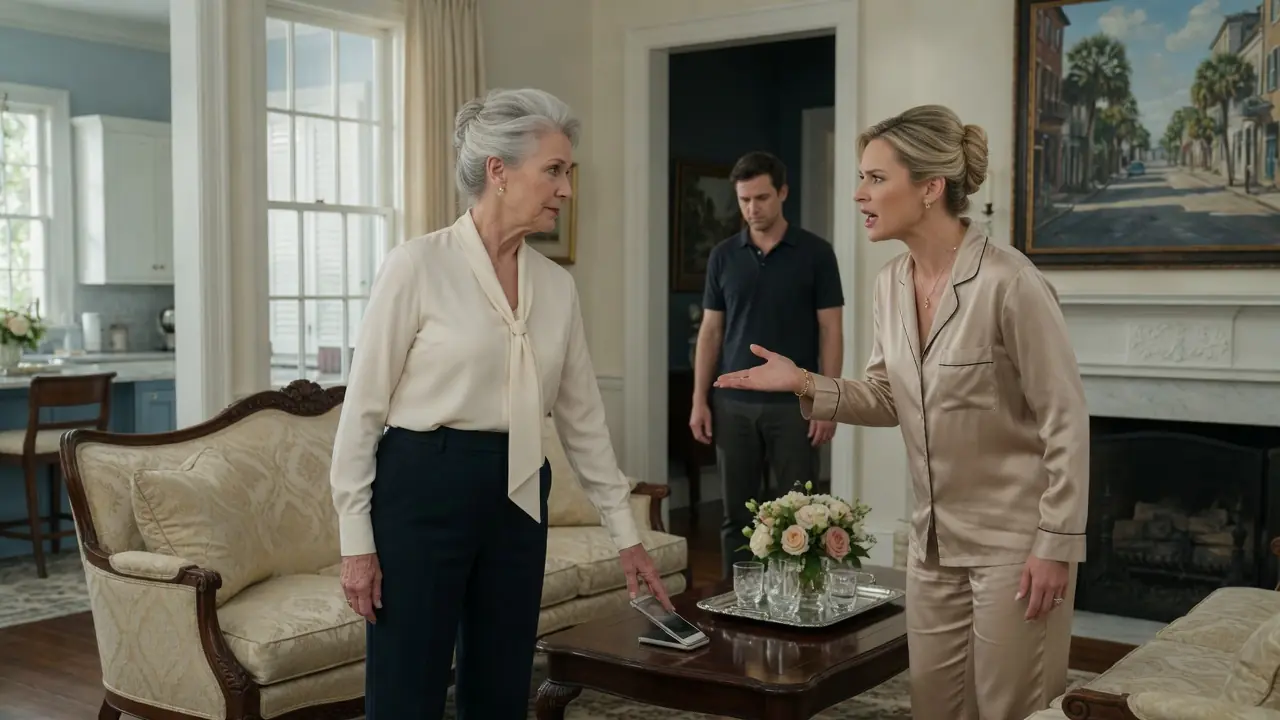
For a moment, he looked around the kitchen as if seeing it not as property, not as future inheritance, but as the room that had held his childhood.
“I didn’t know about the towels,” he said.
“That is not the apology you think it is.”
He winced.
“I know.”
“Did you know about the renovation folder?”
He nodded.
“Yes.”
“Did you know she called me forgetful to Mrs. Alvarez?”
His face hardened.
“No.”
“She did.”
“I’m sorry.”
I looked at him carefully.
“For what exactly?”
He swallowed.
“For letting her treat you like you were in the way.”
That was closer.
“Why did you?” I asked.
He rubbed his hands together.
“Because I was tired. Because we’ve been fighting about money. Because Bianca hates our apartment and wants a life we can’t afford yet. Because every time I pushed back, she said I was choosing you over my marriage.”
“And did you believe her?”
“I think I wanted to believe the easiest version.”
“The easiest version being that I was old, difficult, and unreasonable.”
He closed his eyes.
“Yes.”
The honesty hurt.
But at least it was honesty.
I looked toward the window. The magnolia leaves shifted in the afternoon wind.
“Ethan, marriage changes loyalty. I know that. Your wife should matter to you. But loyalty to a spouse does not require cruelty to your mother.”
He nodded.
“I know.”
“No. You are learning.”
He accepted the correction.
Then he said something that cut me deeply.
“She kept saying the house would be ours someday anyway.”
There it was.
Not hidden now.
Open.
I folded my hands.
“And what did you say?”
“At first, I told her not to talk like that.”
“And later?”
He looked down.
“Later I stopped saying anything.”
I sat very still.
That was the wound.
Not Bianca’s entitlement.
Ethan’s silence giving it room to grow.
“I see,” I said.
His eyes filled.
“Mom.”
“I need you to understand something. This house may not be yours someday.”
He looked up sharply.
I continued.
“I am revising my estate plan.”
His face went pale.
“You’re cutting me out?”
“I did not say that.”
“But you’re thinking about it.”
“I am thinking about whether leaving everything to my only child is wise when he allowed his wife to treat me like a temporary obstacle.”
He covered his face.
I let him sit with that.
A mother’s instinct is to relieve pain.
But wisdom sometimes requires letting a child feel the shape of what he has done.
That evening, Bianca came downstairs with red eyes and a suitcase.
Not because she was leaving permanently.
Because she wanted to be seen leaving dramatically.
“Ethan,” she said from the hallway, “I’m going to my sister’s.”
He stood.
“Bianca.”
“No.” She glared at me. “Your mother has made it clear she wants me out.”
“I made it clear that both of you need to find another place,” I said.
She laughed coldly.
“You must be so proud.”
“I am not proud. I am peaceful.”
That seemed to irritate her more.
She turned to Ethan.
“If you stay here tonight, don’t bother calling me.”
He froze.
The old Ethan would have followed her instantly.
This Ethan looked at me, then at his wife.
“I’ll call you tomorrow.”
Bianca stared at him.
“What?”
“I said I’ll call you tomorrow.”
Her mouth opened, then closed.
For the first time, she realized the house had shifted under her feet.
She left with her suitcase, slamming the front door hard enough to rattle the old glass.
Ethan sank into the chair by the fireplace.
I said nothing.
Some battles inside a man cannot be fought by his mother.
Over the next week, the house became a place of boxes and reckoning.
Bianca returned with her sister and a rented SUV to collect clothes, shoes, cosmetics, her standing mirror, and several decorative items she had purchased to “improve the energy” of the house. She did not speak to me unless necessary.
At one point, she tried to remove a framed watercolor from the upstairs hallway.
“That stays,” I said.
She turned.
“I bought it.”
“You charged it to my account.”
Her face tightened.
Ethan, standing behind her with a box, said quietly, “Put it back, Bianca.”
She looked at him like he had betrayed her.
Maybe he had.
Or maybe he had finally stopped betraying himself.
By the end of the second week, Ethan found a short-term rental near Mount Pleasant. It was smaller than their old apartment, farther from downtown, and nothing Bianca would have chosen for photographs. She hated it. I knew because she made sure everyone knew.
Ethan moved the last boxes himself.
Before he left, he stood in the kitchen doorway.
The morning light fell across the table where I had folded the newspaper two weeks earlier.
“Mom,” he said.
“Yes?”
“I’ve been remembering something.”
I waited.
“When I was nine, Dad told me this house was not an inheritance. He said it was a promise.”
My throat tightened.
“I remember.”
“I forgot.”
“Yes.”
He looked at me.
“I’m sorry I made you remind me.”
I wanted to hug him.
I wanted to tell him it was all right.
But it was not all right yet.
So I said, “I’m glad you remembered.”
He nodded.
“Can I come for dinner next Sunday?”
“Alone?”
He hesitated.
“Yes.”
“Then yes.”
He looked relieved and ashamed at once.
Healing often begins there.
After he left, I walked through the house and opened every window.
Charleston air moved through the rooms, carrying the scent of salt, magnolia, and distant rain. I stood in the kitchen and listened to the quiet return. Not the empty quiet of abandonment. The clean quiet of a house no longer being occupied by entitlement.
I put Robert’s fishing hat back on the hallway hook.
I moved the pantry labels back exactly where I wanted them.
I returned the towels Bianca ordered and used the refund to buy a new rosebush for the garden.
Then I called Charles again.
“Have you made a decision?” he asked.
“Yes.”
We revised the estate plan carefully.
Ethan was not disinherited, but the house would not pass to him outright. It would go into a trust with strict conditions. He could live in it if he wished, but he could not sell it without waiting years, and no spouse could claim interest through marriage. If he did not want it under those terms, the house would eventually be sold, and a large portion would fund scholarships for Charleston students studying preservation, carpentry, and history.
Robert would have liked that.
He believed old things deserved people patient enough to care for them.
When I signed the documents, I did not feel cruel.
I felt responsible.
That is something women of my generation often learn too late. We are taught to give until people call us selfish for wanting enough left to survive. We are taught that family means endless sacrifice, even when the sacrifice becomes our dignity. We are taught that peace is worth swallowing disrespect.
It is not.
Peace built on your silence is not peace.
It is occupation.
Ethan came to dinner the following Sunday.
Alone.
I made roast chicken, green beans, and cornbread, not because he deserved it automatically, but because I wanted to reclaim the act of feeding my son from the insult Bianca had made of breakfast.
He arrived with flowers.
Not expensive ones.
Yellow tulips from the grocery store.
“They reminded me of the ones you used to plant by the porch,” he said.
“I still plant them.”
“I know. I just stopped noticing.”
That was honest enough to hurt.
During dinner, he told me he and Bianca were in counseling, though he did not sound hopeful. He said she felt humiliated. He said she believed I had turned him against her. He said she still insisted the breakfast comment had been “taken out of context.”
I cut my chicken slowly.
“What context improves ‘Where is breakfast? Don’t be selfish’?”
He gave a tired laugh.
“None.”
“Good. I was worried I had missed one.”
He smiled, then looked down.
“I don’t know what happens next.”
“With Bianca?”
“With anything.”
I looked at him across the table.
“You do the next right thing.”
“That sounds like Dad.”
“It should.”
He nodded.
After dinner, he washed the dishes.
I let him.
There are apologies words cannot complete.
Sometimes a son needs hot water, soap, and the quiet work of cleaning what he helped dirty.
Months passed.
Bianca did not return to my house.
Not once.
Their marriage continued for a while in that uncertain way troubled marriages do, with apologies, accusations, counseling appointments, and long silences. Ethan changed during that time. Slowly. Not perfectly. He began calling more often without asking for anything. He came by to repair a loose shutter. He took me to a doctor’s appointment and did not act like it made him noble. He apologized again one afternoon, and I told him not to apologize unless he had found a new part of the truth.
He thought about that.
Then he said, “I let Bianca talk about you like you were already gone.”
That one mattered.
Because it was the truth beneath all the others.
A year after the breakfast incident, Ethan and Bianca separated.
He told me in the garden while helping me prune the roses.
“She said I became small after I moved out of your house,” he said.
“What did you say?”
He gave a sad smile.
“I said maybe I had been small before and was only now trying to grow.”
I looked at him with surprise.
“That sounds painful.”
“It was.”
“Good.”
He laughed.
“You don’t soften much anymore.”
“I softened too much before.”
He nodded, accepting it.
A few weeks later, Bianca came by while Ethan was not there.
I saw her through the window before she knocked. She wore a cream dress, sunglasses, and the expression of a woman who had rehearsed humility but not learned it.
I opened the door but did not invite her in.
“Margaret,” she said.
“Mrs. Whitfield.”
Her lips tightened.
“Mrs. Whitfield. I wanted to apologize.”
I waited.
“I was under a lot of pressure when we stayed here. Ethan and I were struggling, and I handled things badly.”
“Badly is a small word.”
She inhaled.
“I was disrespectful.”
“Yes.”
“And I am sorry.”
I studied her.
There were tears in her eyes, but I could not tell whether they came from regret or defeat. Sometimes the two wear similar faces.
“Thank you for saying that.”
She looked relieved.
Too relieved.
“I was hoping we could start fresh.”
“No.”
Her face froze.
“No?”
“No.”
“But I apologized.”
“You did.”
“And you don’t accept it?”
“I accept that you said the words. I do not accept you back into my home.”
Anger flashed behind her eyes.
“You really are cruel.”
“No,” I said. “I am experienced.”
Her mouth tightened.
“You’ve poisoned Ethan against me.”
“If your marriage could be poisoned by me asking not to be ordered around in my own kitchen, it was already unwell.”
She stared at me.
For a moment, I saw the old Bianca. The one who wanted to wound.
Then she stepped back.
“You’ll be alone in this house someday.”
I smiled softly.
“Better alone in my own house than crowded by people waiting for me to disappear.”
She had no answer.
She left.
I closed the door gently.
Not slammed.
Gently.
Because power does not always need noise.
Years later, when people ask why Ethan and I became closer after one of the worst seasons of our lives, I tell them the truth.
Love did not save us.
Not by itself.
Love without boundaries nearly destroyed us.
What saved us was truth.
The truth of the deed.
The truth of Bianca’s entitlement.
The truth of Ethan’s silence.
The truth of my own fear that if I protected myself, I might lose my son.
And the truth that any relationship worth keeping must survive the word no.
Ethan eventually divorced Bianca.
He never asked to move back in.
That mattered to me.
He rented a modest apartment, rebuilt his finances, and began visiting every Sunday. Sometimes we cooked together. Sometimes he sat in Robert’s chair and read while I worked in the garden. Sometimes we spoke of difficult things. Sometimes we did not need to.
One Sunday morning, two years after Bianca demanded breakfast, Ethan arrived early with groceries.
“I thought I’d make breakfast,” he said.
I stood in the kitchen, looking at him.
He looked nervous.
“I mean, if that’s okay.”
“What are you making?”
“Pancakes. Dad’s recipe.”
“Your father burned pancakes.”
“I know. I improved it.”
He set the bags on the counter and began taking out eggs, flour, milk, butter, and blueberries. I sat at the table with my coffee and opened the newspaper.
For a moment, time folded.
My son at the stove.
Morning light through the magnolia tree.
The kitchen warm with ordinary life.
Ethan glanced back.
“You want anything else?”
I looked at him over the top of the paper.
“The pantry is there,” I said. “The refrigerator is there.”
For half a second, he froze.
Then he laughed.
Not nervously.
Honestly.
“I deserved that.”
“Yes,” I said.
Then I folded the newspaper and smiled.
“But I’ll take coffee.”
He poured it.
And this time, no one demanded.
No one ordered.
No one mistook the woman at the table for someone who needed to earn her place.
The house remained mine.
The kitchen remained mine.
The life Robert protected for me remained mine.
And my son, slowly and imperfectly, learned that a mother’s love is not a door people can kick open whenever they want shelter, money, food, or forgiveness.
It is a gift.
And gifts can be withdrawn from hands that only know how to take.
The morning Bianca demanded breakfast, she thought she was exposing my selfishness.
She was wrong.
She exposed her entitlement.
She exposed my son’s weakness.
And, without meaning to, she exposed the strength I had forgotten was still inside me.
I did not yell.
I did not beg.
I did not defend myself to people standing in a house they did not own.
I simply folded my newspaper, pointed to the pantry and the refrigerator, picked up my phone, and made the first move.
By the time that day ended, the house was no longer theirs to pretend toward.
It was mine again.
Maybe it always had been.
I had simply needed one cruel demand to remind me.