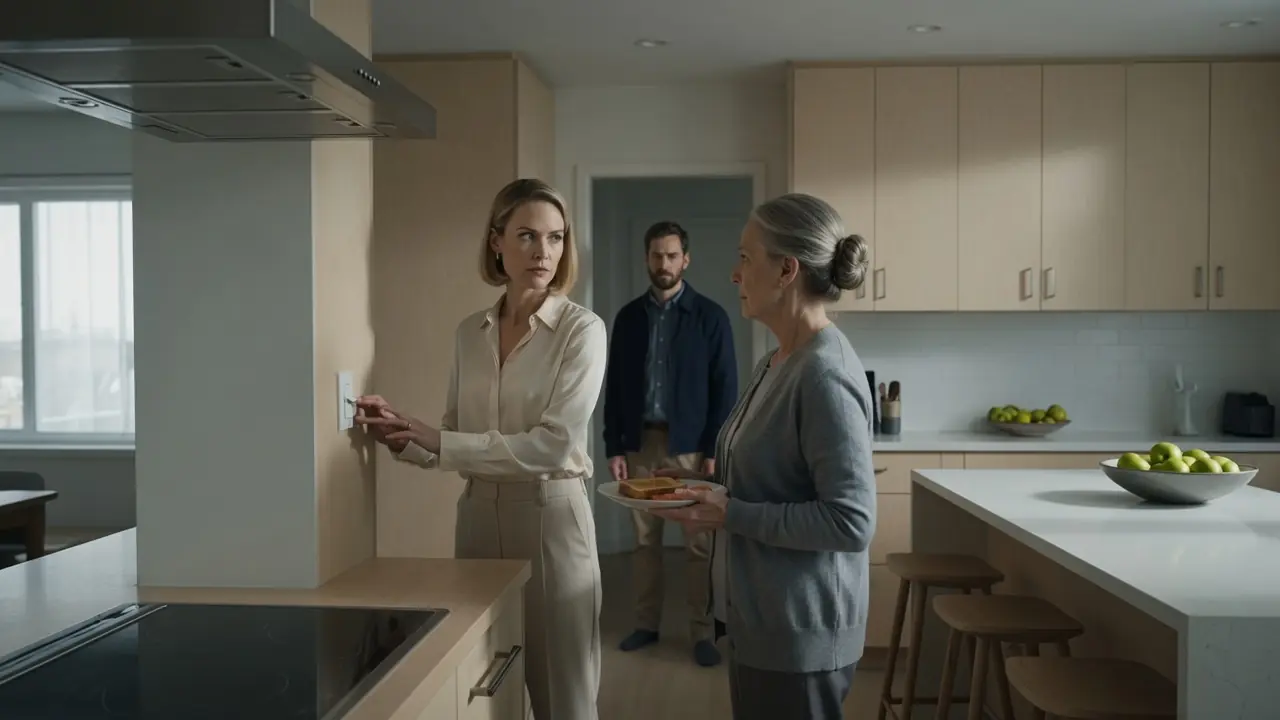
The kitchen went dark while my hands were still wet from washing tomatoes in the sink. For one second, I thought the bulb had burned out, but then I turned and saw Kristen standing beside the light switch with her fingers still resting on it. She wore a cream blouse, tailored pants, and the calm expression of someone who had decided cruelty sounded better when spoken softly. The plate in my hands held one slice of toast, three pieces of tomato, and a little cheese I had cut for myself before dinner.
“Go eat in your room,” Kristen said. “This dinner is private.”
I stood there in my own kitchen, holding my own plate, under the light she had just turned off. The counter beside me was pale birchwood, refinished by my own hands years earlier when my husband Peter was still alive and our son Daniel still complained about the smell of varnish. I had made school lunches on that counter, birthday cakes, Thanksgiving stuffing, and weak tea on nights when grief sat beside me like another person. Now my daughter-in-law looked at me as if I were a guest who had overstayed her invitation.
Behind her, Daniel stood in the hallway. My son had one hand around his phone and the other tucked into his pocket, as if silence could make him invisible. He saw my face. He saw Kristen’s hand on the switch. He saw the plate trembling slightly in my hands, and still he looked away.
That hurt more than the words.
Kristen glanced toward the dining room, where two place settings had already been arranged with the blue-rimmed plates Peter and I bought for our twenty-fifth anniversary. “My colleague is coming over,” she said. “It’s important. I don’t want things to feel awkward.”
“Awkward,” I repeated.
She lifted her chin. “You know what I mean.”
I did know what she meant. She meant I was old. She meant my gray cardigan, my soft house slippers, and my small dinner plate did not match the version of success she wanted to display. She meant the woman who had given her family shelter was suddenly inconvenient when someone from outside might see where that shelter came from.
I looked at Daniel again. “Do you know what she means?”
His mouth tightened. For one hopeful second, I thought he would step forward. I thought the boy I had raised would remember every supper I stretched, every coat I mended, every winter morning I scraped ice from the car so he could sleep five extra minutes before school. But Daniel only rubbed the back of his neck and said, “Mom, maybe just for tonight.”
Just for tonight.
Those three words were a door closing.
I placed the tomato back on the cutting board. I set the knife down carefully. I did not scream, did not cry, did not tell Kristen that the mortgage had been paid by my savings, my sacrifices, and my husband’s life insurance. I simply picked up my plate and walked down the hall to the small bedroom at the back of the house.
The room had once been Daniel’s when he was a boy. The old baseball sticker he stuck to the closet door at nine years old was still there, half peeled at one corner. When he and Kristen moved in two years earlier, I gave them the master bedroom because Lily was small and they needed more space. I told myself the back room was enough for me.
That night, it felt like a punishment cell.
I sat on the edge of the bed with my plate on my lap. From the kitchen, I heard Kristen turn the light back on. A few minutes later, the front door opened, and her colleague arrived with a bright laugh and expensive perfume that drifted faintly down the hallway. Glasses clinked. Lily squealed at something. Daniel said, “Come in, good to see you,” in the warm voice he had not used for me all evening.
The smell of garlic and butter filled the house.
My house.
Resting.
That was the word people used when they did not want to say discarded.
My name is Margaret Ellis. I am sixty-seven years old, and I taught fourth grade for thirty-one years. I had quieted classrooms full of restless children with one look, spotted forged parent signatures from across a desk, and handled parents twice my size who thought shouting could replace responsibility. I was not a weak woman.
But family can weaken you in ways strangers never could.
Daniel and Kristen had moved into my house “for a few months” after their rent went up and Daniel’s hours were cut. Kristen cried in my living room that first week, saying she felt like a failure. Daniel sat beside her with Lily on his lap, looking so tired that I said yes before they finished asking. A mother’s heart often answers before wisdom arrives.
At first, the house came alive again. Lily’s toys appeared in the hallway. Daniel fixed the basement door handle. Kristen cooked pasta and insisted I sit while she served me. I bought a moon-shaped nightlight for Lily’s room, cleared closet space, and folded towels into the guest bathroom with the tender excitement of someone needed again.
Then the changes began.
My tea moved from the cupboard to a lower drawer because Kristen wanted the shelves “more organized.” My old casserole dishes went into the basement because they did not match the kitchen. The living room photographs of Peter and me were replaced by framed prints Kristen ordered online because she said the room needed a cleaner look. Each change was small enough to excuse, but together they became an invasion.
Daniel always had the same answer. “She’s just trying to make the place feel like home, Mom.”
I wanted it to feel like home for them. That was the trap. Kindness, without boundaries, can become an open door people eventually forget to knock on. I told myself Kristen was stressed, Daniel was tired, Lily needed stability, and I could adjust.
By the end of the first year, I was asking permission without realizing it.
Could I use the washing machine, or did Kristen have a load scheduled? Could I invite my friend Elaine for tea, or was Daniel working from the dining table? Could I put my gardening boots by the back door, or did they make the entryway look messy? The house was still legally mine, but emotionally, I had begun shrinking inside it.
The night Kristen turned off the kitchen light, something in me finally stopped shrinking.
I woke before dawn with my plate still untouched on the bedside table. The house was quiet. Somewhere upstairs, Lily coughed in her sleep, then settled. I sat up slowly, my back stiff, my eyes dry from a night without tears.
Grief had taught me something important: there is a moment after pain when the world becomes very clear.
I washed my face, changed into a clean blouse and dark trousers, and walked into the kitchen at six-thirty. The dining room still held evidence of the private dinner: wine glasses, folded napkins, a smear of sauce on one of my anniversary plates. Kristen had left the blue-rimmed dishes in the sink, as if the woman banned from dinner would naturally clean up after it.
I did not touch them.
Instead, I made coffee, sat at the kitchen table, and opened the old address book I still kept in the drawer beside the phone. Most people laughed at me for keeping paper numbers, but paper had survived many things technology did not. My finger moved down the page until it reached the name I wanted.
Patricia Wells.
Patricia had been my lawyer since Peter died. She had handled the estate, the mortgage discharge, my will, and the paperwork when I retired from teaching. She was practical, kind, and impossible to intimidate. At seven exactly, I dialed her office number, knowing she often arrived before her staff.
She answered on the third ring. “Wells Legal.”
“Patricia, it’s Margaret Ellis.”
There was a pause, then her voice warmed. “Margaret. Is everything all right?”
I looked at the dirty anniversary plates in the sink. “No. But it will be.”
“What happened?”
I told her the truth. Not the softened version. Not the version where I made excuses for Daniel or turned Kristen’s behavior into stress. I told her my daughter-in-law had turned off the kitchen light and sent me to eat in my room. I told her my son had watched and said nothing. I told her I owned the house outright and no longer felt welcome inside it.
Patricia was quiet until I finished. Then she said, “What do you want to do?”
That question nearly made me cry, because no one in my house had asked what I wanted in a very long time.
“I want my home back,” I said.
“Then we start today.”
By eight-thirty, Patricia had outlined the first steps. She would prepare a formal occupancy agreement and notice requiring Daniel and Kristen to leave within a set period. She would update my will so the house and any proceeds would be protected in a trust for Lily when the time came, not controlled by Daniel or Kristen. She would also refer me to a realtor for a valuation, not because I had decided to sell, but because I needed to understand my options.
“Margaret,” Patricia said before we ended the call, “you are not being cruel.”
I closed my eyes.
“You gave them shelter,” she continued. “They turned shelter into entitlement. Boundaries are not cruelty.”
After we hung up, I sat very still.
The house began waking around me. Daniel came down first, hair damp from the shower, tie hanging loose around his neck. He stopped when he saw me sitting at the kitchen table with my coffee, the dirty dishes still in the sink, and Patricia’s notes beside my hand.
“Morning, Mom,” he said cautiously.
“Good morning.”
His eyes moved to the dishes. “I was going to get those.”
“No, you weren’t.”
He looked away.
Kristen entered a few minutes later wearing a robe, her blonde hair clipped neatly back. She paused at the threshold, sensing something different before she understood it. People who are used to control notice quickly when the air no longer obeys them.
“Margaret,” she said, “about last night—”
I lifted one hand. “Sit down, Kristen.”
She blinked. “Excuse me?”
“Sit down.”
Daniel frowned. “Mom, what’s going on?”
I looked at him. “You should sit too.”
They exchanged a glance, the kind married people use when deciding how to handle an unreasonable elderly parent. That look might have broken me the day before. That morning, it only confirmed my decision.
They sat.
I placed my coffee cup down carefully. “I spoke to Patricia Wells this morning.”
Daniel’s face changed. “Your lawyer?”
“Yes.”
Kristen’s posture stiffened. “Why would you call a lawyer?”
“Because I own this house,” I said. “And apparently everyone here needed to be reminded of that.”
Silence filled the kitchen.
Daniel leaned forward. “Mom, come on. Nobody said you don’t own the house.”
“No. You just allowed me to be treated like I didn’t.”
His face flushed.
Kristen folded her arms. “If this is about last night, I already said we needed privacy. You’re making it sound worse than it was.”
I looked at her. “You turned off the light while I was making my dinner.”
Her mouth tightened. “The dinner was important.”
“So was my dignity.”
Daniel rubbed his forehead. “Mom, Kristen didn’t mean—”
“Daniel,” I said sharply.
He stopped. I had not used my teacher voice on him since he was sixteen. It still worked.
“Do not tell me what your wife meant. Tell me what she did. Tell me what you did.”
His eyes lowered.
I waited.
Finally, he whispered, “I should have said something.”
“Yes,” I said. “You should have.”
Kristen stood suddenly. “This is ridiculous. We pay for groceries. We help with bills. Daniel fixes things around here. We are not freeloading.”
“You pay for groceries you eat,” I said. “You contribute to utilities you use. Daniel fixes small things because he lives here. None of that gives you the right to exile me from my own kitchen.”
Her face hardened. “Exile? That’s dramatic.”
I stood then, slower than she had, but with more certainty. “No, Kristen. Dramatic was turning off a light to humiliate an old woman in front of her son. What I am doing is legal.”
Daniel looked frightened now. “Mom.”
“Patricia is preparing documents,” I said. “You and Kristen will have sixty days to find another place.”
Kristen’s mouth opened. “You’re kicking out your own granddaughter?”
That was the arrow she knew would hurt most.
I gripped the back of the chair. “Do not use Lily as a shield for your behavior.”
Daniel flinched.
Kristen’s eyes flashed. “Lily lives here too.”
“Yes,” I said. “And I love her. That is why my updated will protects her future directly. But loving Lily does not require me to surrender my home to her parents.”
Daniel stared at me. “Updated will?”
“Yes.”
His face went pale, and that hurt in a different way. Not because he cared about the money, I hoped, but because the word will made him realize I had started thinking of life after him differently. For years, I had assumed everything would pass simply to Daniel. That morning, I no longer trusted simplicity.
“Mom,” he said softly, “we never wanted you to feel this way.”
I looked at him, and for a moment I saw the boy with jam on his sleeve again. Then I saw the man in the hallway, looking away.
“But you allowed it,” I said.
The next hour was ugly in the quiet way family ugliness often is. Kristen accused me of overreacting. Daniel tried to mediate, which meant asking me to soften what I had already decided. I remained calm because anger would have given them something easier to dismiss.
At nine-thirty, Lily came downstairs in her pajamas holding her stuffed rabbit. She looked from one adult face to another and knew, as children always do, that something had cracked.
“Grandma?” she asked.
My heart softened immediately. “Good morning, sweetheart.”
“Are you mad?”
I opened my arms, and she came to me. I held her close, breathing in the smell of sleep and strawberry shampoo. “I’m not mad at you,” I said. “Never at you.”
Kristen’s face tightened at the sight, but she said nothing.
Over the next few days, the house became a battlefield of restraint. Kristen stopped speaking to me unless necessary. Daniel moved through the rooms like a man carrying a weight he did not know where to set down. Lily spent more time in my room, coloring at the small desk while I folded laundry or read beside her.
One afternoon, she looked up from her crayons and asked, “Are we moving?”
I set my book down. “Yes, sweetheart. Your mom and dad are going to find a new place.”
“Are you coming?”
“No. This is Grandma’s house.”
She thought about that. “But I can visit?”
My throat tightened. “As often as your parents allow.”
Lily frowned. “Why wouldn’t they allow?”
I kissed the top of her head. “Grown-up things are sometimes complicated.”
She accepted this for a moment, then returned to coloring a purple cat.
Daniel came to me alone a week later. Kristen had taken Lily to the park, and the house was quiet except for the dishwasher running. He stood in the kitchen doorway like he had that night, but this time he did not look away.
“Can we talk?” he asked.
I sat at the table. “Yes.”
He pulled out the chair across from me. He looked tired, but not in the old way. This tiredness had shame in it.
“I’m sorry,” he said.
I folded my hands.
“I know that’s not enough,” he continued. “But I need to say it without explaining it away. I should have stopped her. Not just that night. Before that. Months before that.”
“Yes,” I said quietly.
He swallowed. “I kept telling myself you were okay because you didn’t complain.”
“I didn’t complain because I was afraid of making your life harder.”
His eyes filled. “Mom.”
“I thought if I stayed easy, you would stay close.”
That broke him. He covered his face with both hands, and for a moment he looked younger than forty, younger than thirty, almost like the boy who had cried into my shoulder after Peter died. But I did not rush to comfort him this time. Comfort had too often become the place where accountability went to sleep.
“I failed you,” he said.
“You did.”
He nodded, crying silently now. “I don’t know how to fix it.”
“You begin by moving out.”
He looked up, wounded but listening.
“You begin by building a home where your wife does not need to take mine from me to feel powerful. You begin by teaching Lily that love does not mean swallowing disrespect. And you begin by never again asking me to make myself smaller so you can avoid conflict.”
Daniel nodded slowly. “Okay.”
That was the first honest moment we had shared in months.
Kristen did not soften so quickly. She treated the sixty-day notice like a betrayal and told Daniel I was destroying the family. I heard them arguing upstairs at night, their voices low but sharp. Once, I heard Daniel say, “It’s her house, Kristen,” and I sat in my room with my hand over my mouth because the sentence should not have felt like a miracle.
They found a townhouse twenty-five minutes away. Smaller than they wanted, more expensive than they hoped, but theirs. Daniel asked if he could take the guest bed, the nightstand, and some dishes. I said yes to the bed and nightstand, no to the blue-rimmed anniversary plates.
On moving day, Lily cried.
That nearly undid me.
She wrapped her arms around my waist and said, “I don’t want to leave Grandma’s house.”
I knelt with some difficulty and held her face in my hands. “This will always be Grandma’s house,” I said. “And you will always be welcome here.”
“Promise?”
“I promise.”
Kristen stood near the front door, arms crossed, eyes red but proud. Daniel carried boxes to the truck without speaking much. Before he left, he came back into the kitchen and found me standing by the counter where everything had begun.
He looked at the light switch, then at me.
“I’m sorry I looked away,” he said.
I nodded. “Don’t do it again.”
“I won’t.”
“I don’t only mean with me.”
He understood. “I know.”
When the truck pulled away, the house became quiet again. Not empty exactly. Quiet. There is a difference. Emptiness aches because something has been taken. Quiet can breathe because something has been returned.
I walked through each room slowly.
The master bedroom was mine again. The closet had space. The living room walls held the faint outlines of pictures Kristen had removed, and I decided I would rehang the photographs of Peter. In the pantry, clear plastic containers still stood in neat rows, but I moved my tea back to the top shelf where it belonged.
Then I entered the kitchen.
The afternoon light fell softly across the birchwood counter. I touched the surface with my palm and remembered Peter sanding beside me, Daniel complaining in the doorway, the smell of varnish, the sound of our old radio playing a song I could not name anymore. I turned the light off, then on again.
This time, it was my hand on the switch.
A month later, Daniel brought Lily to visit. Kristen did not come. I did not ask why. Lily ran through the front door carrying a drawing of three houses: one for her, one for me, and one she said was “for when everyone stops being mad.”
Daniel helped me repair the loose porch railing that afternoon. We did not discuss the past the entire time. Sometimes healing begins not with more words, but with the right person finally showing up with a toolbox.
Before he left, he stood beside his car and said, “Kristen wants to apologize someday.”
“Someday is not today,” I said.
He nodded. “I know.”
I looked at him carefully. “Are you all right?”
He gave a tired smile. “Not yet. But I’m trying to become the kind of man who doesn’t look away.”
That answer was enough for the moment.
As autumn came, I joined a community garden committee, invited Elaine for tea twice a week, and started reading in the living room again instead of hiding in the back bedroom. Patricia finalized the trust documents for Lily. My will changed. My house remained mine.
Sometimes I still missed the noise. I missed Lily’s morning songs, Daniel’s footsteps, even the illusion that sharing my space meant I was less alone. But I did not miss the shrinking. I did not miss asking permission to exist in rooms I had paid for with years of work and grief and love.
One evening, I made toast with sliced tomato and cheese, the same small dinner I had been holding that night. I placed it on one of my blue-rimmed plates and sat at my kitchen table with every light on. The house was quiet around me, but this time the quiet was not punishment.
It was peace.
I took a bite, looked at Peter’s photograph on the wall, and smiled.
The next morning, one phone call had not destroyed my family. It had not made me cruel, dramatic, or selfish. It had simply reminded everyone, including me, of something I should never have forgotten.
A home is not truly yours because your name sits on paper.
It is yours when you stop letting people make you disappear inside it.