My daughter-in-law gave me rubber gloves before she gave me a cup of tea. She placed them in my hands as if they were a gift, yellow rubber folded neatly over the edge of a bleach bucket. The house smelled of roses, furniture polish, and something expensive burning quietly under the surface. Khloe Hart stood above me in her cream designer dress, pointing toward the basement stairs as though she were showing me my proper place in the world.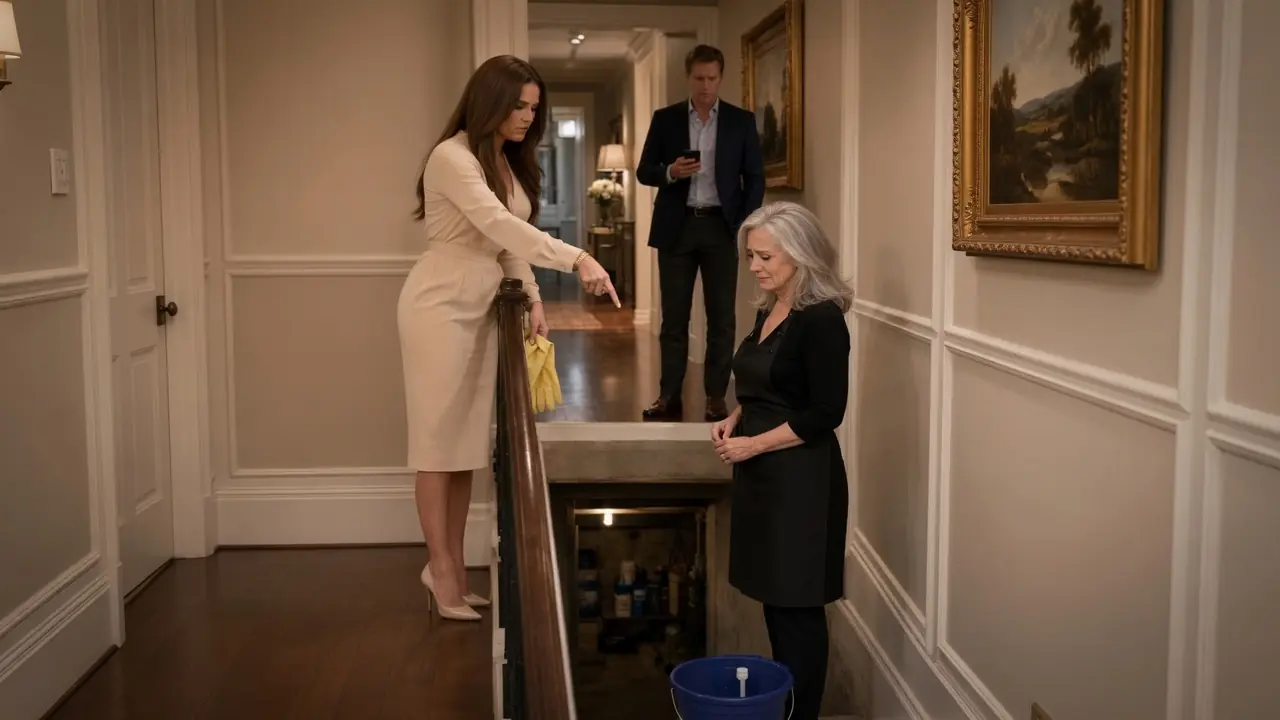
“You cook, you clean, and you eat after everyone else has finished,” she said softly. “That way things stay simple for everyone.”
I looked at the gloves, then at her face. There was no anger in her expression, only the smooth confidence of a woman who believed cruelty became acceptable when spoken in a quiet voice. Behind her, my son Ethan stood in the hallway with his phone in his hand, pretending to check a message. He did not look at me, which was the first wound of that house and not the last.
I had buried my husband, William Winston, twelve days earlier. For forty-one years, I had slept beside a man whose voice could calm a boardroom and whose hand always found mine beneath the dinner table when the room became too full of strangers. We had built companies, raised children, survived recessions, and buried more dreams than anyone saw from the outside. Then one gray morning, his heart stopped, and the world decided I had become fragile.
Ethan called it “taking care of Mom.” Khloe called it “helping each other through a difficult season.” The lawyer called it “a temporary family arrangement,” though he had looked at me over his glasses when he said it, as if he hoped I understood the word temporary better than my son did. I understood more than all of them.
The “beautiful suite” Khloe promised me was a half-finished basement room next to a furnace that coughed through the night. There was a narrow bed, one small lamp, and a window so high I could see only shoes crossing the driveway. My three suitcases sat against the wall like quiet witnesses. Khloe stood on the stairs and recited rules while Ethan remained above us, still holding the phone that had become his shield.
Dinner before six. Guest linens washed by hand. Floors cleaned twice a week. No sitting in the living room when visitors were present. If I joined meals, I was to clear my plate quietly after everyone else had finished, because Khloe believed grief had made me too old to understand humiliation unless it came with instructions.
I nodded through every rule. I even smiled.
That was what she expected from a sixty-four-year-old widow who had just laid her husband to rest. A quiet woman. A weakened woman. A woman removed from the grand house in Greenwich with three suitcases, a tired face, and no fight anyone could see. Khloe mistook my silence for surrender because women like Khloe were very good at reading labels and very bad at reading people.
By morning, I had already seen enough. Prep school envelopes lay tucked beside the coffee machine, half-hidden under a stack of invitations. A country club payment notice sat beneath a magazine on the kitchen island. A luxury car lease letter had been turned facedown on the marble counter, but not before I noticed the red overdue stamp near the corner.
Ethan’s shoulders stiffened every time Khloe mentioned money. Khloe’s smile sharpened whenever someone asked how they were “handling all this generosity.” Their refrigerator was full, their flowers were fresh, their wine was imported, and their house performed success so loudly that only a fool would fail to hear the fear beneath it. I was grieving, but grief had not taken my sight.
To guests, they were the perfect West Hartford couple. Ethan was handsome, polished, and nervous beneath his expensive watch. Khloe was elegant, charitable, and cruel in the places where no one important was supposed to look. Together, they stood on thin ice and kept insisting it was marble.
The charity dinner was scheduled for my third night in the house. Khloe prepared for it as if the entire town was arriving to decide whether she still belonged among them. Caterers moved through the kitchen carrying silver trays, white flowers filled crystal vases, and place cards were rearranged by hands that shook whenever her phone buzzed. I stood in the side kitchen cutting kale while she whispered to a friend near the pantry.
“She lost almost everything after William died,” Khloe said, her voice dipped in false sorrow. “Honestly, we’re saints for letting her stay here.”
Her friend made a soft sound of sympathy.
“Of course, she needs structure,” Khloe continued. “At her age, people can become difficult.”
My knife stopped against the cutting board. Difficult. That was what she called a woman who had signed payroll during recessions, negotiated with men twice her size, and held her husband’s hand while he apologized for leaving her too soon. I did not defend myself because some people must be allowed to speak long enough to become evidence against themselves.
By seven, the dining room shone with anxious elegance. Laughter floated through the rooms, smooth and expensive. Guests spoke about foundations, board seats, Nantucket summers, and donations large enough to sound generous over wine. I moved through the kitchen in a black apron, carrying trays, wiping counters, and listening.
Khloe entered just as I finished plating the first course. She looked me over from head to toe. My hair was clipped back, my sleeves rolled, and my hands smelled of lemon, butter, and dish soap. She held the yellow gloves again, as if their presence completed the picture she wanted.
“Please don’t come into the dining room,” she said under her breath. “Your clothes don’t belong in this circle.”
I looked beyond her shoulder. Ethan stood near the fireplace, checking his phone again and again. His face was pale beneath his practiced smile, and every time the front door opened, he looked as if a bill collector had arrived disguised as a guest.
“Do you understand me?” Khloe asked.
I wiped my hands slowly on a towel. “Perfectly.”
She smiled. “Good. After dessert, you can start the silver. And don’t use the dishwasher for the crystal.”
“You have a lot of rules for a woman who is late on nearly everything,” I said quietly.
Her smile froze.
“What did you say?”
I turned toward her fully. “Nothing the walls haven’t already heard.”
Khloe stepped closer, lowering her voice into something sharper. “You should be grateful, Margaret. We took you in.”
“You took me downstairs.”
“Because you needed somewhere to go.”
“No, Khloe. Because you needed someone to cook.”
Her eyes hardened. For the first time, I saw the real woman beneath the polished one, and she was not nearly as beautiful without control. “Be careful. This is my house.”
I looked at the marble counter, the imported flowers, the unpaid envelopes hidden poorly behind luxury. “That remains to be seen.”
Before she could answer, a caterer entered for the next tray, and Khloe’s face transformed instantly. She became soft again, glowing again, hostess again. It was almost impressive. Almost.
The doorbell rang at eight-twenty. I heard Ethan’s laugh stop mid-sentence in the dining room. Khloe turned her head sharply, listening as the housekeeper opened the door. A man’s voice carried from the foyer, calm and professional.
“Charles Beckett, Hartford Union Bank. I’m expected.”
Khloe’s hand tightened around the dish towel she had taken from me without realizing it. “Why is he here?”
I looked at her. “Perhaps he came for dinner.”
“No one from the bank was invited.”
“Then perhaps he came hungry for something else.”
She stared at me, and something close to fear passed through her face. Then she turned and hurried toward the dining room, leaving me alone with the trays, the gloves, and the first satisfying moment I had felt since William’s funeral.
Charles Beckett had known my husband for thirty years. He was a careful man with silver hair, gentle manners, and a memory long enough to make liars nervous. I had spoken with him two days after William’s burial, before I agreed to move into Ethan’s house. That conversation had told me enough to know that my son and daughter-in-law were in trouble.
Their mortgage had been refinanced twice. Their school tuition was behind. Their country club account had been frozen pending payment. Ethan had quietly borrowed against assets he did not fully control, and Khloe had attempted to use my temporary residence as emotional leverage for a family bridge loan.
What she did not know was that William had anticipated weakness. Not Ethan’s failure exactly, but the possibility that grief, guilt, and image might tempt our son into foolishness. So he had structured the remaining family trust with one final protective mechanism. No emergency loan, asset transfer, or collateral release connected to Winston family holdings could proceed without my signature.
Khloe believed I had arrived helpless.
In truth, the bank president was in her dining room waiting for me.
I removed my apron. I washed my hands carefully, dried them, and unclipped my hair. Then I walked through the kitchen and into the main hall. A few guests turned as I entered, probably because servants were not supposed to move with such calm. Khloe stood near the dining room archway, blocking me with her body and her smile.
“Margaret,” she said sweetly, loudly enough for others to hear. “You must be tired. Why don’t you rest downstairs?”
I stopped in front of her. “I have rested enough.”
Her eyes flashed. “This is not the time.”
“No,” I said. “This is precisely the time.”
Ethan came toward us, his phone still in hand. “Mom, please. Let’s talk later.”
I looked at my son then, really looked. I saw the boy who used to run barefoot through our Greenwich garden, the teenager who cried when his first dog died, the man who had stood beside his father’s coffin and whispered that he did not know how to live without him. Then I saw the husband who had let his grieving mother sleep beside a furnace because confrontation made him uncomfortable.
“Later was when you should have stopped her,” I said.
His face tightened. “Mom.”
Khloe’s voice dropped. “Do not embarrass us.”
I looked at her cream dress, her perfect hair, the yellow gloves still hanging from one hand like a symbol she had forgotten to hide. “Khloe, you gave me rubber gloves before tea. Embarrassment entered this house before I did.”
A hush spread through the hallway.
Charles Beckett appeared behind Ethan, his expression grave. Several guests watched openly now. Some had the decency to look uncomfortable. Others leaned slightly forward, hungry for scandal dressed as concern.
Khloe pointed toward the basement stairs. “You cook, you clean, and you stay out of sight because my guests don’t need to see Ethan’s broke mother pretending she belongs here.”
The words fell harder than she intended. She had finally spoken too loudly. The dining room heard. The hallway heard. Ethan heard.
I held the yellow gloves she had shoved at me earlier. “Careful, Khloe. The woman you sent to the basement is the reason this house still has lights on.”
Khloe laughed once, sharp and disbelieving. “You lost everything when William died. Don’t act important in my home.”
I smiled softly. “Then explain why the bank president is in your dining room waiting for my signature before your perfect little life collapses.”
The silence that followed was complete.
Khloe looked at Charles. Charles did not rescue her. He only adjusted his glasses and waited, as good bankers do when numbers have already spoken. Ethan closed his eyes, and I knew then that he understood the truth had finally reached the room.
“What signature?” Khloe demanded.
Charles answered before I did. “Mrs. Winston controls the trust authority required for the bridge financing request submitted last week.”
A woman near the dining room whispered, “Bridge financing?”
Khloe’s face went pale beneath her makeup. “That was private.”
“So was my basement room,” I said. “Yet you seemed comfortable describing my situation to your friend near the pantry.”
Her mouth opened, then closed.
I stepped past her and walked into the dining room. Not quickly. Not dramatically. Just steadily. The room was beautiful, I admit that. White flowers, crystal glasses, polished silver, painted faces hiding sudden curiosity. At the head of the table sat a place card with Khloe’s name in gold ink. There was no place card for me.
Charles followed me inside. Ethan remained near the doorway, looking like a man watching the tide take something he should have moved long ago. Khloe entered behind us with anger gathering in her eyes.
“You planned this,” she said.
“No,” I replied. “You performed it. I simply stopped leaving the room.”
Charles placed a folder on the dining table. “Mrs. Winston, the bank requested your presence tonight because Mr. and Mrs. Hart indicated urgency. They stated that all family parties understood the proposed collateral release.”
I looked at Ethan. “Did you tell them I understood?”
Ethan’s voice was hoarse. “I thought you would sign.”
“That is not what I asked.”
He looked down. “Yes.”
That hurt more than Khloe’s cruelty. Khloe had always been an outsider trying to climb through appearances. Ethan was my son. He knew the difference between asking and assuming, between care and convenience.
I sat in the empty chair nearest the folder. It was not my place, but no one dared tell me so. “Charles, read the amount.”
Charles opened the folder. “The requested bridge loan is for one million two hundred thousand dollars, secured partially against Winston family trust holdings, intended to cover residential arrears, school tuition, club obligations, luxury vehicle liability, and short-term business debt.”
Gasps moved through the guests like a wind through leaves.
Khloe snapped, “This is inappropriate.”
“No,” I said. “Inappropriate is handing a widow bleach and telling your friends she is difficult while asking to borrow against her husband’s life’s work.”
Ethan stepped forward. “Mom, I was going to tell you.”
“When? Before or after I finished washing the crystal?”
His face crumpled slightly.
Khloe recovered enough to point at me again. “You are humiliating your son.”
I stood. “No, Khloe. I am saving him from you and from himself.”
Her eyes narrowed. “You think you can walk in here and destroy our life?”
“Your life was already on fire. You just arranged flowers around the smoke.”
Someone at the far end of the table covered a cough. Another guest looked down into her wine as if the glass might offer an exit.
Khloe’s voice rose. “You have no right.”
“I have every right. William made sure of it.”
At the mention of my husband’s name, Ethan flinched.
I turned to Charles. “The trust will not secure this loan.”
Ethan looked up sharply. “Mom, please.”
I held up one hand. “I am not finished.”
The room waited.
“The trust will pay the overdue school tuition directly for the children,” I said. “Not through Ethan. Not through Khloe. Directly to the school.”
Charles nodded. “That can be arranged.”
“The trust will also pay the household utility arrears to prevent disruption for the children.”
Khloe’s jaw tightened. She did not like the word arrears spoken in front of country-club friends.
“As for the luxury car lease, the club account, and the unsecured business debt,” I continued, “those are not family emergencies. Those are performances, and I do not finance theater.”
Ethan’s shoulders sagged. Khloe looked as if she had been slapped.
I faced my son. “You will meet with Charles tomorrow morning and begin a restructuring plan based on your actual income, not your wife’s appetite for admiration. You will sell what must be sold. You will stop pretending before pretending takes your children’s future with it.”
Ethan’s eyes filled. “I’m sorry.”
“I know.”
“Mom, I’m so sorry.”
I wanted to go to him. I wanted to touch his face and tell him everything could be repaired if he only became honest quickly enough. But forgiveness offered too soon can become permission, and I had already given my son too many soft landings.
“You may become sorry enough to change,” I said. “That will matter more.”
Khloe stepped between us. “And what about me?”
I looked at her. “You will return my suitcases upstairs.”
The room remained silent.
“You will apologize in front of every person who heard you call me broke,” I said. “You will never again refer to me as help, burden, difficult, or charity. And tomorrow, when I leave this house, you will explain to your guests why the woman you hid in the basement was the only one who kept your children’s school accounts current.”
Khloe laughed bitterly. “You’re leaving?”
“Yes.”
“Where will you go?”
“Home.”
“You said the Greenwich house was gone.”
“No,” I said. “You said that. I never corrected you because it was useful to know who believed it.”
Her face changed again. Not just fear now. Realization.
William and I had sold one property before he died, yes. Not the Greenwich house. Not the investments. Not the voting shares. Not the quiet pieces of our life that men like my son had forgotten women often managed while men took applause. I had not lost everything. I had lost William.
That was not the same.
Charles closed the folder. “Mrs. Winston’s assets remain fully intact.”
The dining room heard that too.
Khloe looked around and saw the damage at last. Not to me. To herself. Her guests now knew what she had tried to hide. Her generosity was theater. Her charity dinner was debt dressed in candles. Her helpless widow in the basement was the woman with the authority to deny the loan.
She tried once more to regain the room. “Margaret, I was under pressure. You don’t understand what it takes to maintain a certain life.”
I stepped closer. “Khloe, I helped build a life before you learned to rent one.”
The words hit harder than I expected. Her eyes filled, though I could not tell whether from shame or rage. Perhaps both.
Ethan finally spoke. “Khloe, stop.”
She turned on him. “Now you speak?”
He looked at me, then at her. “She’s my mother.”
“She was your mother when you put her in the basement,” Khloe said.
That was the only honest sentence she had said all evening.
Ethan went pale, because truth does not always arrive from kind mouths. He looked at me with the full weight of what he had allowed. For the first time since I moved in, he did not look away.
“I’ll get your suitcases,” he said quietly.
“No,” I told him. “You will sit with your guests and finish the evening honestly. I will get them myself.”
I walked out of the dining room with Charles beside me. Behind us, no one resumed eating. The house that had smelled of flowers and success now smelled of exposed fear. I went down the basement stairs one last time, turned on the small lamp, and looked at the narrow bed where I had spent two nights listening to the furnace cough.
I did not cry.
Grief had already taken enough from me. I would not let humiliation take the rest.
Charles carried two suitcases despite my protest. I carried the third and left the yellow gloves folded on the basement pillow. Upstairs, Ethan met us in the hallway. His face was wet.
“Mom,” he whispered.
I stopped.
“I don’t know how I became this man.”
I believed him. That was the tragedy. People imagine cruelty arrives with a declaration, but often it arrives by degrees. One avoided conversation. One easy excuse. One silence while someone else does the harm. Ethan had not pointed to the basement stairs, but he had stood above them and let me descend.
“You became him by looking away,” I said.
He nodded, crying harder now.
“You can become someone else the same way,” I added. “One honest look at a time.”
He reached for me, then stopped before touching my arm. For the first time, he asked permission without words. I let him hug me, but I did not soften completely. He was my son, and I loved him, but love does not require a mother to return to the basement.
When I pulled away, Khloe stood at the dining room entrance. Her face was drained, her posture stiff. For a second, I thought she might offer an apology. Instead, she looked at the guests behind her, at Charles, at Ethan, at me, and understood that any apology now would sound like strategy.
So she said nothing.
That was probably the most honest choice left to her.
Charles drove me back to Greenwich himself. The house was dark when we arrived, but the security lights warmed the stone path, and the front door still recognized my hand on the lock. Inside, the rooms smelled faintly of cedar, books, and William’s old pipe tobacco, though he had stopped smoking twenty years before. I stood in the foyer with my suitcases around me and felt the silence open its arms.
For the first time since the funeral, I let myself say his name aloud.
“William,” I whispered. “You were right.”
The next morning, Ethan came alone. No Khloe. No performance. He looked smaller in daylight, standing on my porch with a folder in one hand and shame in the other. I invited him in because he was my son, but I did not make tea until he asked whether he could help.
That mattered.
He sat at my kitchen table and told me everything. The failed investment. The refinanced house. Khloe’s spending. His fear of admitting to his wife, his friends, and himself that he had built a life too expensive for his courage. He did not blame Khloe entirely, which was the first sign there might still be hope for him.
I listened. Then I told him what William would have told him.
“Sell the house if you must. Leave the club. Move the children to a school you can afford if the trust tuition support ends. Pay people before impressing people. And never again confuse your mother’s silence with weakness.”
He cried again, but this time I let him.
As for Khloe, she sent flowers three days later. White roses, of course. The card said only, I regret how things happened. I placed the flowers in the mudroom and did not respond. Regret was not repentance, and I had learned to recognize the difference.
In time, Ethan began repairing what he could. He sold the luxury car. He resigned from the club. He moved his family into a smaller house after the West Hartford property went on the market. Whether his marriage survived was not mine to decide. Whether he became a better man was.
Months later, at a school event for my grandchildren, Khloe approached me near the refreshment table. She wore a simple navy dress instead of cream, and for once, no one seemed to be watching her. She looked older, less polished, perhaps more real.
“I was cruel to you,” she said.
“Yes.”
“I was afraid.”
“Yes.”
“That doesn’t excuse it.”
“No.”
She swallowed. “I’m sorry, Margaret.”
I studied her face. There were no guests close enough to impress, no bank president waiting, no advantage obvious enough to cheapen the words. So I nodded.
“Then begin there,” I said.
She did not ask what came next. Good. Some lessons must be lived without instructions.
I never moved back in with them. I visited my grandchildren, hosted Sunday meals in Greenwich, and let Ethan learn the discipline of standing on his own feet. Sometimes he looked at me with pain, remembering the basement. I let him remember. Memory is useful when it keeps a man from becoming comfortable with his worst self.
The yellow gloves remained in my drawer for a long time. Not because I needed them, but because I wanted the reminder. People will hand you what they think belongs to you. A bucket. A basement. A silence. A role small enough to make them feel large.
You do not have to accept it.
And when the moment comes, you do not always need to shout.
Sometimes all you need is to walk into the dining room, let the truth take its seat, and sign nothing.