The moment Marissa smashed the dinner plate against Margaret Lawson’s forehead, the entire room went silent. It was not the shocked silence of people witnessing something unimaginable. It was the guilty silence of people realizing an ugly plan had gone much farther than they expected. Small pieces of white ceramic scattered across the living-room carpet while something warm began moving slowly down Margaret’s temple.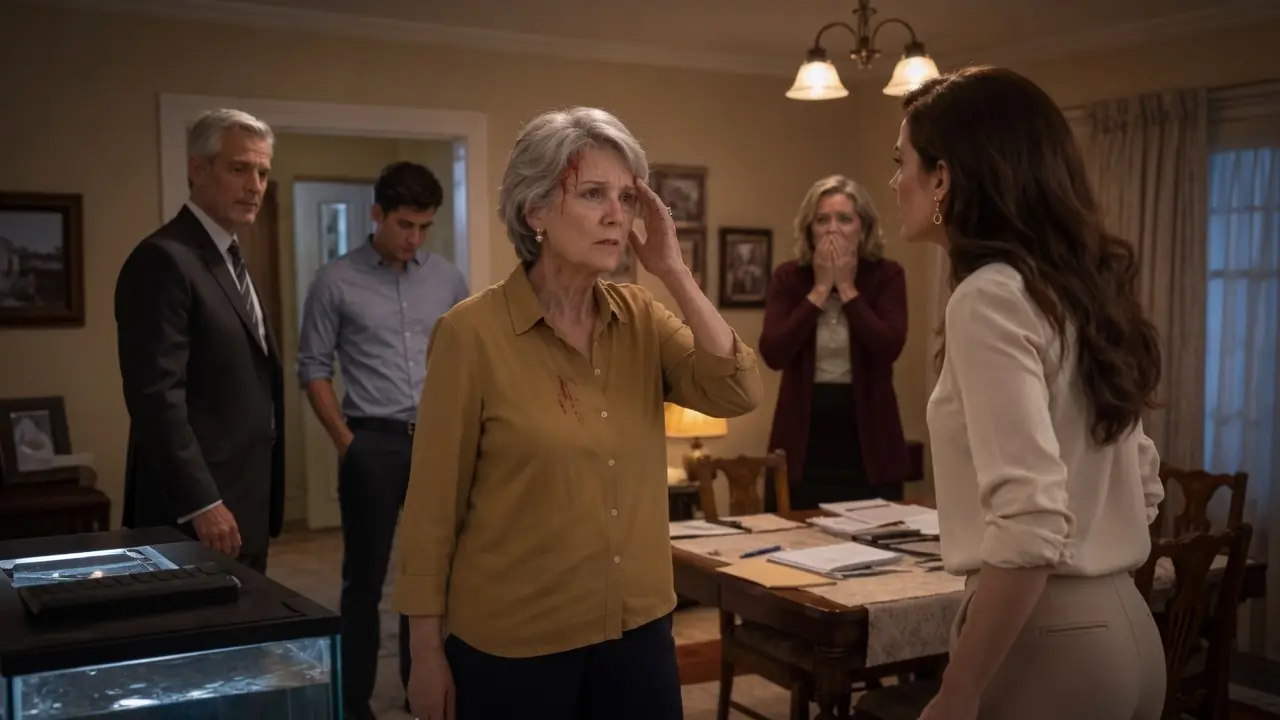
For several seconds, she heard nothing except a high ringing inside her ears. The dining-room lights blurred, and the framed family photographs along the wall seemed to move in and out of focus. Margaret lifted one hand carefully and touched the side of her forehead. When she looked at her fingers, they were red.
Marissa stood less than four feet away with her right arm still raised. Her face was flushed with rage, but she showed no immediate fear or regret. She looked like someone angry that violence had failed to produce obedience quickly enough. Behind her, the property-transfer documents remained spread across the dining table beside untouched glasses of wine.
“How dare you refuse my mother?” Marissa shouted. “You selfish old woman!”
Margaret did not answer immediately.
Her grandson Tyler stood in the doorway between the kitchen and living room. His shoulders were rounded, and his eyes remained fixed on the floor rather than the blood on the face of the woman who had raised him. Diane, Marissa’s mother, covered her mouth with both hands, while Marcus, Marissa’s father, began moving quietly toward the front door.
Marcus was an estate attorney.
He had spent twenty-seven years advising elderly clients about wills, trusts, and property transfers. He understood exactly what Margaret’s signature could do and how difficult it might be to reverse a transfer once the deed was recorded. That knowledge was the reason the documents on the table had been prepared so carefully.
“Give us the house,” Marissa demanded. “Or agree to pay my mother fifteen hundred dollars every month.”
Diane lowered her hands. “Marissa, calm down.”
“You wanted the house too,” Marissa snapped. “Don’t pretend this wasn’t your idea.”
Diane’s face became pale.
Margaret looked around the room slowly. She saw Tyler’s expensive new television, the curtains she had helped him hang, and the coffee table she bought when he first moved into the house. She also saw the people who had invited her there under the promise of celebrating his promotion.
The dinner had never been a celebration.
It was an ambush.
Margaret touched the wound again, then looked directly at Marissa. “You attacked me because I refused to give away property I worked thirty years to own.”
Marissa pointed toward the table. “It is one house.”
“It is my house.”
“You already have somewhere to live.”
“That does not make the rest of my property available to your mother.”
Diane finally spoke. “Margaret, I am struggling.”
Margaret turned toward her. “Then why did you never ask me honestly?”
“I did ask.”
“No. You told me family should share.”
Diane’s husband Marcus cleared his throat. “Perhaps everyone should sit down before this becomes worse.”
Margaret looked at the attorney. “You prepared those papers.”
Marcus adjusted his tie. “They are preliminary documents.”
“They transfer ownership of my rental property to Diane.”
“With a retained life interest.”
“A life interest that ends if I miss taxes, maintenance, or insurance obligations.”
Marcus said nothing.
Margaret had read the documents before refusing.
She knew the deed was designed to sound generous while slowly removing control from her. Diane would become the owner, while Margaret would remain responsible for several major expenses. If she failed to pay, the retained interest could be challenged.
“You expected me not to read them,” Margaret said.
Marcus lifted both hands. “Nobody forced you to sign.”
Marissa laughed bitterly. “Not yet.”
Tyler finally looked up. “Marissa, stop.”
She turned on him. “You said she would agree.”
Margaret’s heart tightened.
“Is that true?” she asked.
Tyler swallowed. “I thought you might help.”
“You told them I would surrender the house?”
“I said you cared about family.”
“I raised you.”
“I know.”
“Then why am I standing here bleeding while you defend the people who trapped me?”
Tyler’s face collapsed, but he still did not move toward her.
That hurt more than the plate.
Margaret had taken him in when he was three years old after her daughter, Natalie, disappeared into addiction and unstable relationships. For twenty-two years, Margaret worked factory shifts, packed school lunches, attended parent meetings, and stayed awake through fevers and nightmares. Tyler had once called her the only parent who never left.
Now he could not cross one room to protect her.
Marissa stepped closer again. “Sign the documents.”
Margaret looked at the shattered ceramic near her shoes.
Then she smiled.
It began as a small movement at the corner of her mouth, but it changed the entire room. Marissa’s anger faltered. Marcus stopped moving toward the door, and Tyler stared at his grandmother as if she had become someone he no longer understood.
“You have no idea what I already did,” Margaret said quietly.
Marissa lowered her arm. “What are you talking about?”
“Three weeks ago, I made a telephone call.”
Diane’s voice trembled. “To whom?”
Margaret reached into the pocket of her mustard-yellow blouse and removed a small black device. A green light flashed along one edge. Marcus recognized it before anyone else.
“Is that recording?” he asked.
“It has been recording since I entered the house.”
Marissa’s face emptied of color.
“You cannot record private conversations without permission,” Marcus said quickly.
Margaret looked at him. “Grace Whitman advised me exactly how to preserve evidence lawfully.”
At the sound of that name, Marcus became still.
Grace Whitman was one of the most respected elder-abuse attorneys in western Michigan. She had built her career investigating coercive transfers, forged powers of attorney, and financial exploitation inside families. Marcus had opposed her in court twice and lost both cases.
“What did you tell her?” he asked.
“The truth.”
Four months earlier, Marissa had first mentioned the rental house while visiting Margaret’s kitchen. Margaret had been washing dishes when Marissa leaned against the counter and began asking how much rent the property generated. Her interest seemed casual at first.
Margaret answered cautiously.
The small brick house had been purchased in 1989 after years of double shifts and skipped vacations. It was not luxurious, but the rent helped pay Margaret’s medical expenses, property taxes, and retirement costs. It also represented the first major thing she had ever owned without depending on anyone else.
A week later, Diane visited.
She complained about the rent on her apartment and said retirement had become more expensive than expected. She then suggested that Margaret transfer the rental house to her because “women our age should look after one another.” Margaret thought the statement was rude but dismissed it as frustration.
The requests continued.
Marissa called twice a week, sometimes speaking sweetly and sometimes accusing Margaret of hoarding wealth. Tyler began repeating that the property would probably become his eventually, so transferring it now would simplify the family’s future. Marcus offered to review Margaret’s estate plan without charging a fee.
That offer frightened her most.
Margaret had known Marcus for six years, and he had never offered professional work without discussing his hourly rate. She declined politely. Two days later, he mailed her a package of documents marked “family planning proposal.”
Margaret did not sign them.
She read every page.
The proposed deed placed ownership in Diane’s name while leaving Margaret responsible for taxes and structural repairs. Another document appointed Marcus as financial agent through an unusually broad power of attorney. A third allowed him to manage, mortgage, or sell property if he determined Margaret had become incapable of making sound decisions.
Margaret called Grace Whitman the following morning.
Grace listened quietly while Margaret described the phone calls, the documents, and the pressure from Tyler. She asked whether anyone had threatened her directly. At that time, no one had.
“Pressure often grows when polite manipulation fails,” Grace warned.
Margaret had wanted to believe her family would never cross that line.
Grace advised her to protect the rental property immediately. They created a revocable asset-protection trust controlled solely by Margaret, with an independent successor trustee unrelated to Tyler, Marissa, Diane, or Marcus. Any future sale, mortgage, or transfer would require verification through Grace’s office.
Margaret also changed her will.
The rental property had once been intended for Tyler. After reading Marcus’s documents and hearing Tyler defend the requests, she removed the house from his inheritance. Future income would support Margaret during her lifetime, and the property would later help fund safe housing for older women facing financial abuse from relatives.
Margaret did not tell the family.
Instead, she waited.
When Tyler invited her to dinner to celebrate his promotion, Grace advised her to be careful. Margaret placed the recording device inside her blouse and arranged a safety check. If she did not telephone Grace by eight-thirty, the attorney would contact emergency services.
It was now eight twenty-seven.
Marissa stared at the green light. “Give me that.”
She reached toward Margaret.
Margaret stepped backward.
Marcus moved between them. “Do not touch her again.”
Marissa looked at her father in disbelief. “You helped plan this.”
“I drafted documents based on the information you gave me.”
“You said she would sign.”
“I said pressure could invalidate everything.”
Diane began crying. “This was not supposed to happen.”
Margaret looked at her. “What was supposed to happen?”
“We were going to talk.”
“You arranged papers before speaking to me.”
“We thought you might resist.”
“You invited me to a false celebration.”
Diane covered her face.
Marissa turned toward Tyler. “Tell her what you said.”
Tyler remained near the kitchen doorway. “I told you she cared about me.”
“You told me the property would be yours.”
“I thought it would.”
Margaret looked at him. “That was before tonight.”
His eyes widened.
“You removed me from the will?”
“The house was removed months ago.”
“Because I asked you to help Diane?”
“Because you allowed other people to treat my life like property waiting for your permission.”
Tyler crossed the room at last. “Grandma, I never wanted anyone to hurt you.”
“You stood still.”
“I was shocked.”
“You were silent before Marissa picked up the plate.”
He stopped.
Margaret remembered entering the house earlier that evening. She had seen Tyler avoiding her eyes before dinner began. He already knew the papers were waiting. He knew Marissa planned to pressure her and chose not to warn the woman who had raised him.
The doorbell rang.
Nobody moved.
Three firm knocks followed.
Marcus looked toward Margaret. “Who is that?”
“My safety check.”
Tyler opened the door.
Two police officers stood outside with Grace Whitman behind them. One officer noticed the blood on Margaret’s forehead immediately and stepped forward. Grace’s expression hardened when she saw the broken plate and papers covering the dining table.
“Margaret, are you safe to walk?” Grace asked.
“Yes.”
“Would you like medical assistance?”
“Yes.”
The senior officer, Aaron Miles, asked everyone to remain where they were. His partner photographed the broken plate, the blood on Margaret’s blouse, and the documents on the table. Marissa tried to explain before anyone questioned her.
“She became aggressive.”
Officer Miles looked at Margaret. “Did you strike anyone?”
“No.”
Marissa continued. “She was shouting and threatening my mother.”
“The recording will show what happened,” Grace said.
Marcus turned toward her. “You cannot assume that device captured the entire context.”
Grace looked at the papers. “Did you prepare these?”
“I drafted preliminary documents.”
“For a client?”
Marcus hesitated.
Diane answered for him. “For me.”
Grace picked up the transfer deed without removing it from the table. “Margaret is the owner. She is the person whose informed consent would be required.”
Marcus looked toward the floor.
“So you represented the person receiving the property while presenting the documents to the elderly owner during a family gathering?” Grace asked.
“This was not a formal signing.”
“There is a notary block already completed.”
The room became silent again.
Margaret had not noticed that detail.
Grace pointed toward the final page. A notary stamp appeared beside an empty signature line, dated that same evening. Notarization was supposed to occur only after Margaret appeared before the notary and signed voluntarily.
“Who stamped this?” Officer Miles asked.
Marcus’s face tightened. “An associate prepared the packet.”
“Before Margaret signed?”
“It may have been an administrative error.”
Grace looked at him coldly. “Or preparation for a fraudulent recording.”
Marissa began backing toward the hallway.
The second officer stopped her.
“I didn’t mean to hurt her,” Marissa said.
Margaret stared at her. “You lifted the plate after I refused to sign.”
“You were laughing at my mother.”
“I was reading the deed.”
“You treated us like criminals.”
“You planned like criminals.”
Paramedics arrived moments later.
They examined Margaret in the living room while police separated the other family members for statements. The injury required stitches but did not appear life-threatening. Margaret insisted on walking out under her own strength.
As she passed Tyler, he reached toward her.
“Grandma.”
She stopped but did not take his hand.
“I’m sorry,” he whispered.
“For the plate?”
“For everything.”
Margaret looked into the face of the man she had raised. She still loved him, and that made the betrayal more painful rather than less. Love could survive disappointment, but trust required evidence.
“You knew why they invited me.”
Tyler nodded.
“You knew the documents were here.”
“Yes.”
“Did you know Marcus had arranged the notarization?”
“No.”
“Did you expect me to sign because I was surrounded?”
He began crying.
“I thought if everyone explained how much Diane needed it, you might agree.”
“That is coercion, Tyler.”
“I didn’t see it that way.”
“You did not want to see it.”
He had no answer.
Margaret left for the hospital.
The recording device went with Grace, who created several secure copies before providing one to police. It captured the entire conversation from Margaret’s arrival, including Marissa stating that Tyler had promised the house would become theirs. It also recorded Marcus explaining that they could challenge Margaret’s judgment if she refused.
The most damaging section came before the attack.
Marcus had told the group that once Margaret signed, the deed could be filed the following morning. Diane asked what would happen if Margaret changed her mind. Marcus replied that reversing a completed transfer would be expensive and difficult.
Then Marissa said, “That is why she signs tonight.”
At the hospital, Margaret received six stitches.
A nurse cleaned the blood from her face while Grace sat nearby. Margaret watched her yellow blouse being placed inside an evidence bag. She had purchased it at a thrift store for twelve dollars because Tyler said the dinner would be special.
“I should have listened sooner,” Margaret said.
“You called me,” Grace replied.
“After four months.”
“You called before signing.”
“I kept believing Tyler would stop them.”
Grace leaned forward. “Parents and grandparents often wait for the person they raised to become the person they remember.”
“He is still that little boy to me.”
“He can be that boy in your memories and still be responsible for the man he became.”
Margaret closed her eyes.
The criminal and professional investigations moved quickly.
Marissa was charged in connection with the assault. The charge was supported by the recording, physical evidence, and statements from multiple witnesses. She initially claimed the plate slipped, but the audio captured her threatening Margaret seconds beforehand.
Marcus faced a separate investigation.
The state bar examined the pre-stamped documents, his conflict of interest, and his participation in pressuring an unrepresented elderly property owner. His associate admitted that Marcus instructed her to prepare the notarization block in advance.
The associate said she believed Margaret had already agreed.
She had not.
Diane avoided criminal charges initially, but the investigation uncovered text messages between her and Marissa discussing how much rental income they expected after receiving the property. One message instructed Tyler to make Margaret “feel ungrateful” if she resisted.
Tyler had answered with a thumbs-up symbol.
Margaret saw the message inside Grace’s office.
One small symbol contained the entire betrayal.
Tyler visited her house two days later, but she did not open the door. He stood on the porch for twenty minutes and left a handwritten letter beneath the mat. Margaret waited until the following morning before reading it.
He admitted that debt had influenced him.
His promotion came with a salary increase, but he and Marissa had already borrowed against their house and carried expensive credit-card balances. Diane promised to help them financially if she received Margaret’s rental property.
Tyler told himself the transfer would eventually benefit everyone.
He knew Margaret would object, but he believed pressure was justified because she had always sacrificed for him before. That sentence made her stop reading.
Her generosity had become evidence against her.
Because she had sacrificed for twenty-two years, they believed a twenty-third sacrifice could be demanded. They had confused repeated love with unlimited ownership. Margaret placed the letter inside a locked drawer and did not respond.
Three weeks later, she visited the rental house.
The tenant was a retired school librarian named Helen Foster who had lived there for six years. Helen maintained the garden carefully and always paid rent before it was due. She knew nothing about the attempted transfer.
Margaret stood in the small kitchen where sunlight crossed the tiled floor.
This house had once represented security.
Now it would represent protection.
Working with Grace, Margaret strengthened the trust. The rental income would continue supporting her retirement, but after her death the property would become part of the Lawson Safe Home Fund. The program would provide short-term housing and legal assistance to older adults escaping financial exploitation.
Margaret donated nothing she still needed.
Grace insisted on that condition.
“Helping others should not require abandoning your own security,” she said.
Margaret understood the lesson.
Marissa accepted a plea agreement ten months later.
She admitted that she intentionally struck Margaret during an argument over the property documents. The agreement included probation, mandatory counseling, community service, financial penalties, and a protective order. Margaret did not attend every hearing, but she delivered a statement at sentencing.
Marissa sat beside her attorney without looking at her.
“The plate caused one injury,” Margaret began. “The plan behind it caused another.”
The judge listened carefully.
“My family invited me into a room where every person already knew what they wanted from me. They prepared legal papers, promises, and threats before I arrived. When I still refused, violence became the final argument.”
Marissa lowered her eyes.
“I am not standing here because I want revenge,” Margaret continued. “I am standing here because people often call exploitation a family disagreement when the victim is old.”
Diane began crying behind the defense table.
Margaret did not stop.
“Age does not turn ownership into selfishness. Love does not create permanent permission. And family does not mean one person must surrender until everyone else feels comfortable.”
The judge accepted the agreement but warned Marissa that violating the protective order would bring immediate consequences.
Marcus’s professional outcome was more severe.
The disciplinary board found that he participated in a conflicted transaction, failed to protect an unrepresented vulnerable party, and permitted improper advance notarization. His license was suspended, and the incident became part of his public professional record.
For a lawyer who built his reputation on protecting estates, the consequences destroyed much of his practice.
Diane moved into a smaller apartment.
She wrote Margaret repeatedly, apologizing for wanting the house and claiming she never expected Marissa to become violent. Margaret responded only once.
You were willing to take the property before violence occurred. The plate did not create the betrayal. It revealed it.
Tyler separated from Marissa six months after the sentencing.
He began attending counseling and sold several expensive possessions to reduce his debts. Margaret learned these details through Grace rather than from him. She refused to allow financial trouble to become another reason she should rescue him.
One year passed before she agreed to meet him.
They chose a public café during the afternoon. Tyler arrived early and stood when Margaret entered. He looked older, thinner, and less certain than the grandson who once believed her home, savings, and future would naturally bend toward his needs.
“Thank you for coming,” he said.
Margaret sat across from him. “You have twenty minutes.”
He nodded.
Tyler did not begin by blaming Marissa, Diane, or Marcus. He said he had known the dinner was designed to pressure her. He admitted that he stayed silent because challenging his wife would have threatened his marriage and financial plans.
“I chose the easier person to betray,” he said.
Margaret looked at him carefully.
That was the first apology that sounded honest.
“You believed I would forgive you,” she said.
“Yes.”
“Because I always had.”
“Yes.”
“And now?”
“Now I understand forgiveness is not the same as returning access.”
Margaret felt tears rise but did not hide them.
“I loved you like my son.”
“You were my mother.”
“Then why did you let them speak about me as though I were already dead?”
Tyler’s face tightened.
“Because I wanted what you owned more than I respected what you chose.”
The answer hurt.
It also created the first solid ground between them.
Margaret did not invite him home that day. She did not restore him to the will or promise that the relationship would return to normal. They began with one supervised lunch each month.
Tyler never asked about the rental house.
Two years after the attack, Margaret stood inside the same living room where the plate had shattered. Tyler had sold the house and asked whether she wanted anything she had purchased before the closing.
The curtains still hung near the windows.
The coffee table remained in the center of the room. A small repaired mark on the carpet showed where one piece of ceramic had cut through the fibers. Margaret looked toward the place where she had stood bleeding while everyone waited for her surrender.
Tyler entered quietly.
“I should have crossed the room,” he said.
“Yes.”
“I think about it every day.”
“Thinking is useful only when it changes what you do next.”
He nodded.
Margaret removed the curtains she had helped hang years earlier. She donated them rather than taking them home. The room no longer belonged to the future she once imagined for Tyler.
Before leaving, she placed one hand against the dining table.
The transfer documents had once waited there beneath glasses of wine and false celebration. Now the surface was empty. The house had been cleared of everything except consequences.
Outside, Tyler walked her to the car.
He did not ask whether he could visit.
He waited.
Margaret appreciated that more than any promise.
Six months later, she invited him to help repaint the rental house after Helen moved closer to her daughter. Tyler worked quietly beside volunteers preparing the property for its first resident through the Lawson Safe Home Fund.
The woman arriving was seventy-one.
Her nephew had tried to force her into signing over a savings account and threatened to remove her from her apartment when she refused. She carried two suitcases, a folder of documents, and the ashamed expression of someone who still believed needing help meant she had failed.
Margaret greeted her at the door.
“You are safe here,” she said.
The woman looked toward Tyler holding a paint roller inside the hallway. “Is he your son?”
Margaret considered the question.
“He is my grandson,” she answered. “He is learning what family requires.”
Tyler lowered his eyes but continued working.
Margaret walked through the small brick house, opening curtains and checking every lock. The property Marissa had tried to seize now sheltered people from the same kind of coercion.
It remained Margaret’s while she needed it.
Its future remained protected because she chose it.
The attack had left a thin scar near her forehead. She saw it each morning in the mirror, but she no longer viewed it as evidence that Marissa had broken something. It reminded her of the night she stopped confusing silence with peace.
Margaret had entered Tyler’s house believing she was attending a celebration.
She left carrying blood, evidence, and the truth about everyone in the room.
They believed her age made her easy to corner.
They believed love would force her to sign.
What they never understood was that Margaret had spent thirty years earning that property and sixty-eight years learning when kindness had reached its limit.
The plate shattered.
Her future did not.