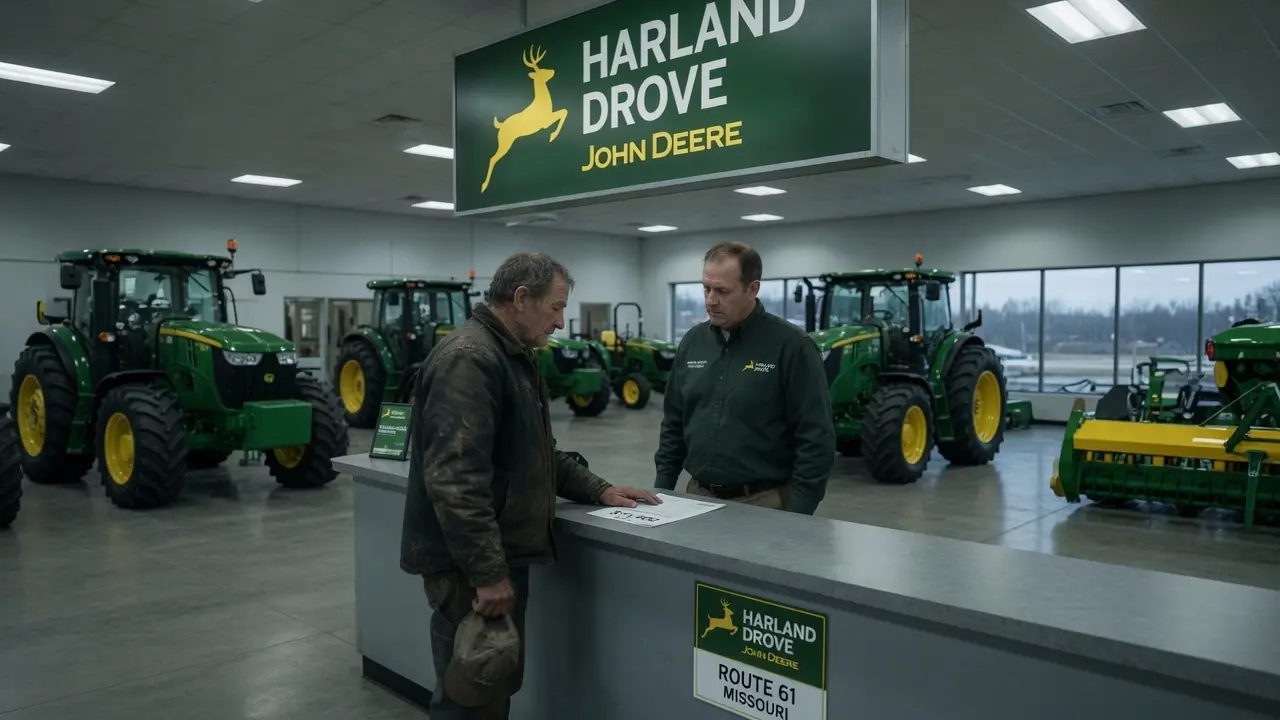
Clifton Ward walked into Harland Drove John Deere with mud on his boots, hydraulic dust on his jacket, and thirty-one years of loyalty sitting heavy on his shoulders. The showroom was too clean for the kind of trouble waiting at the service counter. Polished green tractors stood beneath bright lights, their yellow wheels shining like promises no one had broken yet. Above the front wall, the Harland Drove John Deere sign looked down over the room like a badge of trust.
Harlan Drove stood behind the gray counter with two sheets of paper spread in front of him. One was the warranty denial. The other was the repair invoice for $11,400. He did not slide them toward Clifton right away, and that hesitation told Clifton more than the papers did. A man who believes his own answer does not delay handing it over.
Clifton removed his old John Deere cap and held it low at his side. He had bought his first green tractor before his oldest son was born. He had planted with John Deere, harvested with John Deere, serviced with John Deere, and defended the brand at county auctions when younger farmers complained about cost. In Pike County, people knew Clifton Ward as a steady man who did not switch tools, opinions, or loyalties unless something had truly earned the change.
The breakdown had happened twelve days earlier, in the middle of planting. His John Deere 8285R had stopped in the East Field with a hydraulic fault code flashing across the display. Clifton had called Harland Drove’s service desk, described the code, and brought the tractor in that afternoon. Harlan’s team diagnosed the failed hydraulic pressure valve assembly and first told him the repair would be covered under the extended warranty.
That had been the first answer. The second answer arrived two days later, and it sounded nothing like the first. John Deere’s warranty team had denied the claim because the hydraulic fluid tested outside the required specification range. Harlan’s service advisor said the system showed a modification flag tied to non-authorized fluid. Clifton had listened quietly, then reminded them that Harland Drove’s own technicians had performed every service interval on that tractor since the day he bought it.
Now he stood inside the dealership, across the counter from the man whose name was on the sign. Behind Harlan, green posters praised reliability, uptime, and dealer support. The words looked expensive and empty under the fluorescent lights. Clifton laid his hand on the invoice and pressed two fingers against the number.
“Eleven thousand four hundred dollars,” he said.
Harlan swallowed. “That’s the total with parts and labor.”
Clifton looked at the warranty denial, then at the service records clipped beneath it. “Your shop serviced the hydraulic system.”
“We serviced the tractor, yes.”
“Every time.”
Harlan’s eyes dropped to the counter. “Every scheduled interval, yes.”
Clifton nodded slowly, as if writing the answer into an invisible ledger. He had always believed in accurate accounting, not just with money, but with people. His father had taught him that anger could make a man exaggerate, and exaggeration weakened the truth. So Clifton did not exaggerate. He recorded.
“You’re saying unauthorized fluid was in the system,” Clifton said. “And you’re also saying your dealership is the only place that put fluid in it.”
The word sat between them like something spoiled. Inconclusive. It was clean enough to fit inside a report and weak enough to carry no responsibility. Clifton had heard men use words like that when they were trying to avoid the plain shape of a thing. He looked past Harlan at the tractors lined up behind him, green hoods gleaming like nothing dishonest could ever happen near them.
“Inconclusive means you won’t say it,” Clifton said.
Harlan’s hand moved to the invoice. “Clifton, I understand you’re upset.”
“I’m not upset.”
Harlan looked up.
Clifton’s voice stayed flat. “I’m accounting.”
For a moment, the dealership seemed quieter than before. A parts clerk across the showroom pretended to organize filters on a shelf but kept glancing toward the counter. A young salesman near the tractors lowered his voice and stepped away with a customer. Everyone could feel that something was ending, even if they did not yet understand what it was.
Harlan exhaled through his nose. “The warranty denial stands. I pushed it as far as I could.”
“Did you?”
The question did not come loud. It came calmly, and that made it worse. Harlan looked at Clifton, then at the papers, then back again. “I contacted the warranty team twice.”
Clifton tapped the service records. “Did you tell them your technician likely used the wrong fluid?”
Harlan’s face changed so slightly most men would have missed it. Clifton did not. He had spent his life noticing small changes because crops, cattle, weather, and machines rarely announced trouble loudly at first. A pause, a shift, a glance away — those were the first cracks in a man’s story.
“We don’t know that,” Harlan said.
“Can you prove he didn’t?”
Harlan said nothing.
Clifton looked down at the invoice again. The number was not only money. It was fourteen lost planting days, compressed field work, longer nights, missed weather, and yield risk he would carry until harvest. It was also the price of learning that a dealer he had trusted for years would protect the system before protecting the customer. That kind of lesson cost more than $11,400.
Finally, Harlan pushed the papers toward him. “I’m sorry, Clifton. This is the official answer.”
Clifton picked up the warranty denial first and folded it once. Then he picked up the invoice and folded it behind the denial. His movements were slow, neat, and final. He placed both papers inside the manila folder he had brought from home.
Harlan watched him. “You want us to keep the tractor until Monday?”
“I want it ready Monday as promised.”
“We can do that.”
“I’ll pay under protest.”
Harlan nodded, relief flickering too soon across his face. He thought the worst of it had passed because Clifton had not shouted. He thought a quiet man accepting the invoice meant the relationship had survived. Clifton saw the relief and felt the final number settle in his mind.
Then he picked up his cap.
“This is the last green machine I ever bring through your door,” Clifton said.
Harlan blinked. “Clifton, don’t make a decision like that in the middle of frustration.”
“I told you,” Clifton said. “I’m not frustrated.”
Harlan stepped around the counter, suddenly aware that a sale was not the thing at risk anymore. “You’ve been with us a long time. Your father ran Deere. You run Deere. That has to count for something.”
“It did.”
The past tense landed hard. Harlan opened his mouth, but Clifton had already turned toward the showroom. He walked past the polished tractors, past the clean tires, past the bright green promise of reliability that had followed him for most of his farming life. Nobody stopped him. Nobody knew how.
Outside, the April air felt colder than it should have. Clifton stood beside his truck for a moment before opening the door. Across the lot, his 8285R sat near the service bay, repaired but not forgiven. It was still a good machine in many ways, but now it carried a number attached to it that could never be erased.
When he reached home, his wife Maren was at the kitchen table with coffee cooling beside her. She looked up once and knew from his face that the dealership had chosen paperwork over truth. Clifton placed the manila folder on the table and sat across from her. He did not speak immediately because he wanted the words to come accurate.
“How bad?” Maren asked.
“Eleven thousand four hundred.”
She closed her eyes briefly. “And the warranty?”
“Denied.”
“Because of their fluid?”
“Because of fluid they won’t admit was theirs.”
Maren looked toward the window, where the equipment shed stood with one empty bay waiting for the tractor’s return. She had been married to Clifton for thirty-two years, long enough to know the difference between silence and surrender. Clifton’s silence was never surrender. It was the sound of a man reaching the end of a careful calculation.
“What are you going to do?” she asked.
“Finish planting.”
“And after that?”
Clifton looked toward the shed. “After that, I’m going to sell them.”
“All of them?”
“All four.”
Maren held his gaze for several seconds. She did not ask if he was sure. She knew he would not say something like that unless surety had already done its work inside him. “And replace them with what?”
“Case IH.”
“You’ve never run Case IH.”
“I’ve never had a reason to before.”
That was the whole conversation. There was no dramatic speech, no slammed door, no late-night social media post, no angry call to every farmer in the county. Clifton paid the $11,400 on Monday, picked up the tractor, and finished planting. He worked late, slept little, and did what the season required because fields do not wait for a man’s disappointment to heal.
By the end of April, the planting was done. By the middle of May, the four John Deere machines were listed through a dealer in Hannibal. The 8285R went first, then the utility tractors, then the combine. Neighbors noticed before they asked, and the sight of Clifton Ward’s shed changing color sent curiosity through Pike County faster than any advertisement could have.
The Case IH machines arrived looking unfamiliar in the yard. Red paint where green had always been. Different controls, different feel, different service manuals stacked on the workbench. Clifton did not pretend they were perfect. He studied them the way he studied everything, carefully and without romance.
Frank Elbert, the Case IH dealer from Louisiana, Missouri, came out personally when the first machine arrived. He walked Clifton through the systems, answered every question, and left behind his cell number written in black ink on a card. “If my shop makes a mistake,” Frank said, “we say it and fix it.” Clifton looked at him for a moment, measuring not the sentence but the man behind it.
“We’ll see,” Clifton said.
Frank nodded. “That’s fair.”
By late summer, Clifton had his answer. The Case IH machines did what he needed them to do. They were not miracles. They had quirks, strengths, weaknesses, and learning curves like every machine ever built by human hands. But when a sensor issue stopped one tractor in September, Frank’s shop handled it cleanly, documented the fault, admitted a service update should have been done sooner, and corrected it without pushing the cost back on Clifton.
That mattered more than horsepower.
At the grain elevator that fall, Boyd Sellers asked the question everyone had been waiting to ask. He leaned against his truck, crossed his arms, and looked at Clifton with honest curiosity. “Why’d you switch, Clifton?”
Clifton did not smile. “You really want the answer?”
“I do.”
So Clifton gave it. April third, fault code, warranty promise, denial, unauthorized fluid, four years of dealer service, inconclusive investigation, $11,400 invoice, $4,500 goodwill offer later from corporate, and the final decision at the kitchen table. He told it without raising his voice. He did not call Harlan names, did not insult John Deere owners, and did not tell Boyd what to buy.
When he finished, Boyd stared across the elevator lot for a long time. “That’s it?”
“That’s everything.”
“You’re not mad?”
“Anger isn’t an accounting category, Boyd.”
Boyd looked at him then. “I’m going to think about this.”
“That’s all I’m suggesting.”
Clifton drove home and said nothing more. But Boyd told his brother. His brother told a neighbor. The neighbor asked Clifton directly two weeks later, and Clifton answered the same way, with the same facts, in the same order, without decoration. A true story told plainly travels farther than an angry one because people can carry it without having to adjust for the speaker’s bitterness.
By the next year, other farmers began making their own decisions. Some stayed with John Deere because their operations fit the machines and they trusted their dealers. Clifton never judged them. But others looked at their repair bills, warranty terms, dealer relationships, and service histories with sharper eyes than before. The question was no longer which machine looked best under showroom lights.
The question was who would stand behind the machine when something went wrong.
By the end of four years, John Deere’s numbers in Pike County had changed enough that people in regional offices began asking questions. New equipment purchases had dropped. Customer retention had weakened. Case IH units were appearing on farms that had been green for decades. What looked like scattered buying decisions from a distance had one quiet center when someone finally mapped the relationships.
Clifton Ward.
That was how David Castille, John Deere’s regional director for Missouri and southern Illinois, found the old file. He read the warranty denial, the service history, the fluid dispute, the repair invoice, the goodwill offer, and the final note from customer relations. Then he called Harlan Drove. The conversation did not stay comfortable for long.
Under pressure, Harlan admitted what had only been hidden by the word “inconclusive.” A technician had most likely used the wrong hydraulic fluid grade during the February service. Harlan had suspected it in April. He had not documented it clearly because he did not have written confirmation, and because admitting it would have put the cost back where it belonged.
David hung up with a written statement coming and a sick feeling in his stomach. He had seen companies lose customers before. But this was different. John Deere had not lost Clifton because of price, horsepower, paint color, or competition. They had lost him because one honest farmer had been asked to pay for a mistake he did not make.
And because he was honest, other honest farmers listened.
On a cold March morning in 2022, David drove four hours to Clifton’s farm. He carried a folder on the passenger seat and a check inside it for $11,400. Not a future credit. Not a discount on another machine. Not a loyalty incentive. The exact number from the invoice Clifton had paid four years earlier.
Clifton saw the company vehicle pull into the driveway from the equipment shed. He stepped out and waited, wearing the same calm expression he had worn at the JD dealer counter years before. David approached and introduced himself, though Clifton already knew who he was. News had traveled ahead of him through the same rural network that carried everything else.
“I’d like to talk, if you’re willing,” David said.
Clifton looked at him, then toward the farmhouse. “Come inside.”
Maren made coffee, which meant she intended to hear every word. The three of them sat at the same kitchen table where Clifton had made the decision to sell every green machine he owned. David placed the folder down and did something Clifton had not heard from anyone at John Deere in four years. He told the truth plainly.
“The warranty denial was wrong,” David said. “The dealer handling was wrong. The customer relations response was wrong. And I’m sorry.”
The kitchen went quiet.
Clifton looked at him for a long time. “What do you want?”
“I want to make it right.”
David slid the check across the table. Clifton looked down at the number. $11,400. No conditions. No branding language. No future purchase requirement. Just the number the accounting had always demanded.
“It took four years,” Clifton said.
“It took me six weeks from finding your file.”
“It took John Deere four years.”
David nodded. “Yes.”
He did not add an excuse, and Clifton respected that more than he expected to. Some men ruin apologies by trying to soften them before they finish saying them. David let the yes stand because the yes was accurate. Maren looked at the check, then at David.
“What about the county?” she asked.
David’s face tightened.
Maren folded her hands around her coffee cup. “You came here because of the numbers, didn’t you? Not just his file. You saw what happened after.”
“Yes,” David said.
“And do you understand it?”
David looked toward Clifton, then back at her. “I understand that one farmer’s honest account traveled farther through trust than any complaint could have traveled through anger.”
Maren nodded once. “Then understand the rest. Out here, people remember who fixes mistakes and who hides them behind paperwork.”
Clifton picked up the check and set it beside the manila folder. “I’m not switching back.”
“I’m not asking you to,” David said.
“Frank Elbert runs an honest shop.”
“I’ve heard that.”
“And his machines do what I need them to do.”
David nodded. “I know.”
Clifton studied him again. “I’ll tell Boyd Sellers you came.”
“Tell him whatever is accurate.”
“I’ll tell him you drove four hours, put the right number on the table, and said you were sorry without asking for anything.”
David stood. “That would be accurate.”
They shook hands at the door. It was not forgiveness exactly, and it was not a restored relationship. It was a completed accounting. Some things can be corrected without being rebuilt. Some money can be repaid without buying back the trust that was lost.
After David left, Clifton placed the check in the manila folder beside the old invoice, the warranty denial, and the service records. The folder felt finished now. Not happy. Not erased. Finished. He closed the drawer and went back outside.
The Case IH tractor started with a steady growl inside the shed. Clifton climbed into the cab, checked the field notes, and rolled out toward the acres waiting for him. There was no celebration. No speech. No need to announce that he had been right all along.
He had known that from the day he stood at the JD dealer counter with the bill under his hand.
Back then, Harlan Drove thought he was handing a farmer an invoice. He did not understand he was handing him a reason. A reason to leave. A reason to speak honestly when asked. A reason for a county to look past bright showroom lights and ask what loyalty was really worth.
Clifton Ward never tried to make the whole county switch.
He simply told the truth.
And in farm country, when a quiet man tells the truth with the receipts still folded in his drawer, that truth can pull harder than any tractor in the showroom.