Jake Bergman walked into Dinkle Implement on a gray Tuesday morning with soybean dust still ground into the seams of his jacket. The dealership sat on the edge of West Point, Nebraska, a big metal building full of green paint, polished glass, and posters promising service a farmer could count on. Jake had been coming there since he was a boy, first holding his father’s hand, then riding in the passenger seat of a grain truck, then signing parts receipts with his own name. For nearly thirty years, the Bergman farm had been considered a loyal green farm.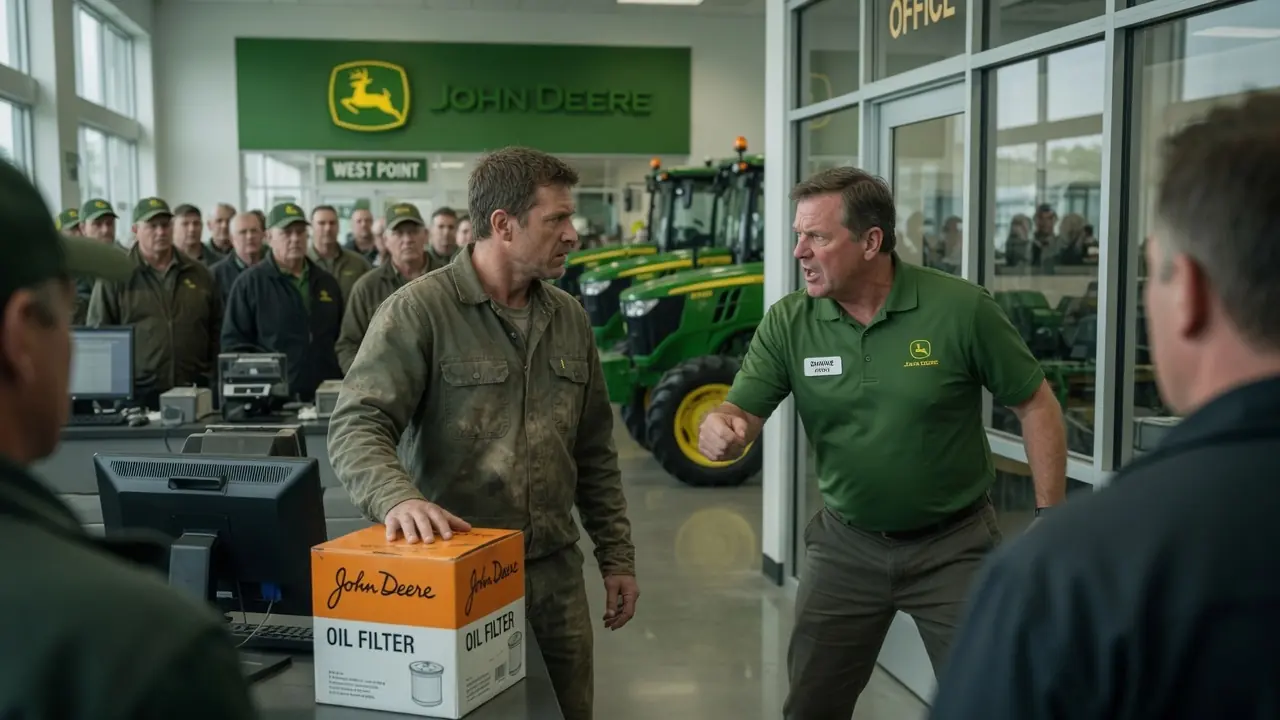
He did not come in looking for a fight. He came in for an oil filter for the old John Deere 4440 his father still refused to sell. The tractor was not the problem, and in Jake’s mind, it never had been. That old machine started when asked, pulled what it could, and never pretended to be smarter than the man sitting in the seat.
The problem had been the combine. Five weeks earlier, during the heart of soybean harvest, Jake’s John Deere S-series combine had stopped in the middle of a field with eighty acres still standing. The monitor flashed warnings, the feeder house locked out, and the machine refused to move grain. Jake had called Dinkle Implement before the dust even settled.
That first call had gone to the service desk. The woman who answered was polite and tired, the way people sounded in harvest season when every farmer in the county wanted help at the same time. She told Jake they were backed up but would get a technician out as soon as possible. Jake believed her because believing the dealership had always been part of the deal.
By the end of the first day, no service truck came. By the end of the second day, Jake was told the technician assigned to him had been pulled to a higher-priority machine. By the third day, the forecast changed, and rain began showing on every weather report he checked. Jake stood in the field at sunset, looking at the soybeans and feeling the old familiar pressure rise in his chest.
He had planted those beans himself. He had watched the first green rows break the soil in May, sprayed around wet weather in June, prayed through the dry spell in July, and walked the field in August with a hand over the pods. They were good beans. Not perfect, because no field ever was, but good enough to make the note payment and give his family breathing room before winter.
On the fourth day, Jake drove to the dealership in person. He found Tom Dinkle standing near the service desk, shaking hands with another farmer and laughing like the building was not full of men losing hours they could never get back. Tom was the second generation running Dinkle Implement. His father had sold Jake’s father tractors, and Tom never missed a chance to remind people of that history.
Jake explained the problem again. He kept his voice calm because he had been raised not to shout at a parts counter. Tom nodded, frowned, and promised they were doing everything possible. Then he said a sentence Jake would remember for the rest of his life.
“Everybody’s waiting, Jake. You’ll just have to be patient.”
Patient. The word followed Jake back to the farm. It sat beside him in the pickup, rode with him past the beans, and stayed with him all night while wind moved across the field. He had been patient when the first call went unanswered, patient when the second promise slipped away, patient when the dealership said the part might be in Omaha, might be in Kansas City, might be on a truck no one could confirm.
On the fifth morning, Jake’s father, Warren Bergman, came to the field. Warren was seventy-two, stiff-backed, and still wore the same faded cap with a John Deere patch that had been stitched there before Jake was born. He stood beside the dead combine and looked over the beans without saying anything for a while. That silence hurt worse than advice would have.
Finally, Warren said, “Your grandfather would have called another neighbor by now.”
Jake gave a bitter laugh. “Nobody has a spare machine sitting around anymore, Dad. Everybody’s running late.”
“Then call someone who does.”
“Who?”
Warren looked at the dead combine. “Someone who wants your business badly enough to show up.”
Jake did not answer, but the words stayed with him. Later that afternoon, with rain now expected within forty-eight hours, he called an AGCO dealer two counties over. He expected nothing. He expected a polite refusal, a sales pitch, maybe a promise to check and call back.
Instead, a man named Luis Ramirez answered and asked three questions. How many acres were left? How soon was rain coming? Did Jake have a grain cart ready? Six hours later, a Fendt combine arrived on a lowboy trailer with a technician, a demo operator, and a fuel card clipped to a folder on the passenger seat.
Jake remembered standing in the field as the machine unloaded. The paint was not green, and part of him felt almost guilty watching it roll down the ramps. He had grown up with green tractors, green caps, green calendars on the kitchen wall, green toys on his bedroom floor. But guilt did not matter when the beans were still standing and the sky was turning darker by the hour.
Luis climbed down from the cab and handed him the folder. “Run it tonight,” he said. “If something goes wrong, call my cell, not the office.”
Jake looked at him. “What do I owe you?”
“Finish the beans first,” Luis said. “We can talk after the crop is safe.”
That sentence did what five days of dealership promises had not done. It made Jake feel like someone understood the field, not just the machine. By midnight, the Fendt was cutting clean through the first block. By sunrise, the combine had eaten through more acres than Jake thought possible with a machine he had never owned.
The rain came hard the following evening. But by then, the soybeans were in the bin. Not every acre was perfect, and some moisture numbers were higher than he wanted, but the crop was saved. Jake stood under the machine shed roof listening to rain hammer the tin above him and realized he was not relieved because a brand had saved him.
He was relieved because someone had shown up.
Two weeks later, Tom Dinkle called. Not the service desk. Not a technician. Tom himself. He said the part for Jake’s Deere had arrived and asked when they could schedule the repair. Jake stared at his phone for a long moment before answering.
“You’re late,” he said.
Tom laughed lightly, as if Jake had made a joke. “Harvest does that. We’re all buried.”
“My beans are done.”
There was a pause. “You found someone?”
“AGCO brought a loaner.”
Another pause, colder this time. “I see.”
Jake thought that would be the end of it. It was not. A week later, after looking over numbers, service records, and his own memory of those five days, Jake signed papers on a Fendt combine. He did not make the decision out of anger, at least not only anger. He made it because harvest had taught him something he could not unlearn.
That morning at Dinkle Implement, the news had already reached the dealership before he walked in. Jake could feel it the second he stepped through the door. The parts clerks looked up and then down. A salesman near a row of compact tractors stopped mid-sentence. Even the coffee machine seemed too loud in the sudden quiet.
Jake carried the orange oil filter box to the counter and gave the part number. The young clerk typed it into the computer without meeting his eyes. Jake had just placed his hand on the box when Tom Dinkle appeared in the office doorway. His face was red, his jaw tight, and the white name badge on his green polo caught the fluorescent light.
“You chose Fendt over us?” Tom said.
Jake turned slowly. “Morning, Tom.”
Tom stepped into the showroom. “Don’t ‘morning’ me. I heard what you did.”
Jake looked around at the tractors lined behind him, the posters on the wall, the clerks pretending not to listen. “Then you heard I bought a combine.”
“I heard you walked away from this dealership after everything we did for your family.”
Jake’s fingers rested on the oil filter box. He could feel every eye in the building shifting toward them. Years ago, that would have embarrassed him. Now it only made him tired.
Tom moved closer. “Your grandfather bought from my father. Your dad bought from my father. You grew up in this place, Jake. Then one bad week and you run to Fendt?”
Jake’s face hardened. “One bad week?”
“That’s what harvest is. Bad weeks. Breakdowns. Waiting. You know that.”
“My Deere sat dead five days.”
Tom waved a hand. “Everyone was waiting.”
“My beans were not waiting.”
The words landed harder than Jake expected. Even the young clerk stopped typing. Tom’s mouth tightened, but he kept going because pride was already driving him faster than sense.
“So much for loyalty,” Tom said, loud enough for the showroom to hear. “I guess thirty years means nothing when another dealer waves a shiny loaner at you.”
Jake lifted his chin. “AGCO saved my crop in six hours. You saved nothing.”
The room went still.
Tom’s face changed. For the first time, the anger faltered and something like humiliation flashed behind it. Jake did not raise his voice, but the sentence carried through the whole dealership. It reached the parts counter, the office door, the waiting area, and the row of green machines sitting polished under the lights.
Tom pointed at him. “You think one emergency loaner makes them better than us?”
“No,” Jake said. “I think showing up makes them better that week.”
“That week,” Tom repeated sharply. “You’re going to throw away generations over that week?”
Jake stepped closer, leaving the oil filter on the counter. “You keep saying generations like my family owes you for memories. My grandfather bought here because your father answered the phone. My dad bought here because your father came out in the dark with tools. They were loyal to service, Tom, not paint.”
Tom’s jaw clenched.
Jake continued, quieter now but sharper. “When my crop was standing and the forecast turned ugly, you told me to be patient. AGCO asked how many acres were left.”
Nobody spoke.
The service manager, who had been standing halfway behind a display rack, looked down at his boots. A salesman crossed his arms and stared at the floor. The young clerk at the counter swallowed visibly, as if he wished he were anywhere else.
Tom tried again, but his voice had lost some of its force. “We had other customers.”
“I know.”
“Machines were down everywhere.”
“I know.”
“We can’t be in every field at once.”
“I know that too,” Jake said. “But you did not say, ‘Jake, we can’t help you.’ You said you would. You said soon. You said tomorrow. You said the part was coming. You kept me waiting because you thought I had nowhere else to go.”
Tom stared at him.
Jake picked up the oil filter box again. “You were right for thirty years. Then one dealer showed me I did.”
The old bell over the entrance rang as another farmer came in, then stopped just inside the door when he sensed the tension. He was a man Jake recognized from church, a corn farmer named Paul Evers. Paul looked from Tom to Jake, then quietly removed his cap. He did not speak, but he stayed.
Tom noticed him, then noticed the others. His public anger was now trapped inside a public room. He could either back down or double down. Tom Dinkle had never been good at backing down.
“You think that Fendt dealer cares about you?” he asked. “They cared because they wanted the sale.”
Jake almost smiled, though there was no humor in it. “Maybe. But they understood something you forgot.”
“What’s that?”
“A sale is earned when the crop is in trouble, not when the showroom is quiet.”
Paul Evers looked down, but Jake saw the small nod. So did Tom. That nod bothered him more than Jake’s words.
The dealership had lived for decades on inherited trust. Farmers came back because their fathers had come there, because the calendars arrived every December, because the parts counter knew their names, because loyalty felt easier than change. Tom had mistaken that comfort for ownership.
Jake had mistaken it too.
For years, he had paid invoices without comparing. He had accepted delays with a shrug because it was harvest and everyone knew harvest was difficult. He had defended Dinkle Implement when younger farmers complained about service rates, diagnostic fees, or parts delays. He had said, “They’ve always done right by us.”
The fifth day changed that sentence forever.
Tom looked toward the service area, then back at Jake. “You should have called me directly.”
“I did.”
“When?”
“Day four. I stood right there.” Jake pointed to the service desk. “You told me everyone was waiting.”
Tom opened his mouth, then closed it.
Jake nodded once. “You remember now.”
The silence answered for him.
Paul Evers finally spoke from near the door. “Tom, I waited three days last fall on a corn head sensor.”
Tom turned sharply. “Paul, this isn’t about you.”
“It sounds like it might be.”
The room shifted again. One farmer speaking gave permission to others. An older man near the parts aisle said his baler had sat two weeks for a hose kit. Another muttered that he had been charged travel time twice in one day. The complaints were not shouted, but they rose like water through cracks.
Tom raised both hands. “Now hold on. We can’t turn this into some kind of courthouse.”
Jake watched him struggle to regain control of the room. Part of him felt sorry for Tom. Not enough to soften the truth, but enough to understand that this moment had been building for longer than one combine, one harvest, or one angry customer.
“You want to know why I bought Fendt?” Jake asked.
Tom glared. “I think you’ve made that clear.”
“No,” Jake said. “You think it was because they showed up once. It was because you didn’t understand what not showing up cost.”
He set the filter box back down on the counter and pulled a folded sheet from his jacket pocket. It was not for drama. It was the yield estimate, the weather loss calculation, and the note from his crop insurance agent showing what five more days in the field could have done to his soybean quality. Jake placed it on the counter.
“That field was worth more than your pride,” he said.
Tom stared at the paper but did not touch it.
Jake tapped it once. “If that rain hit before I finished, I could have lost enough to put my operating loan sideways. You would have sent another apology and another invoice. I would have carried the loss.”
The young parts clerk looked at Tom. So did the service manager. For the first time all morning, Tom seemed to understand that Jake was not making a brand argument. He was describing a near miss that had felt, to him, like betrayal.
Still, Tom’s pride gave one last kick. “We built our name on loyalty.”
Jake’s answer came fast. “Then why did you treat loyalty like a leash?”
Tom went quiet.
The words stayed in the air, heavier than the smell of rubber tires and parts oil. Outside, a truck passed on the highway. Inside, the dealership seemed to hold its breath around the two men standing at the counter.
Jake picked up the oil filter and reached for his wallet. The clerk rang him up with hands that moved too carefully. When the receipt printed, Jake signed it and slid the pen back across the counter.
Tom’s voice was lower when he spoke again. “So that’s it? You’re done with us?”
Jake looked at him. “I’m done pretending history can harvest a field.”
Tom flinched.
Jake softened only a little, because the truth did not need cruelty to be strong. “My dad still has green tractors. I still need parts. But I will not hand you my crop just because my grandfather liked your father.”
For once, Tom had no answer.
Jake turned toward the door. Paul Evers stepped aside to let him pass, then followed him out into the parking lot. The morning wind was cool, carrying the smell of diesel from the service bay and dry leaves from the road ditch. Jake stopped beside his pickup and set the oil filter on the tailgate.
Paul stood near him for a moment before speaking. “That took guts.”
Jake looked back at the dealership. Through the glass, he could see Tom still standing near the counter. “No,” Jake said. “It took five days.”
Paul nodded slowly. “I’ve been thinking about a different combine too.”
Jake gave him a tired look. “Don’t buy one because I did.”
“I won’t.”
“Buy whatever dealer will answer when your field is standing.”
Paul looked across the lot at the green sign. “That used to be them.”
“I know.”
For the rest of that week, the confrontation at Dinkle Implement moved through West Point faster than harvest dust. Some people said Jake had been too harsh. Others said someone needed to say it. Tom tried to keep business normal, but farmers asked different questions at the counter now. Not only horsepower, financing, and trade value, but response time, loaner availability, service coverage, and what exactly happened when a machine died with rain coming.
By winter, Dinkle Implement announced changes. More seasonal technicians. A written harvest emergency policy. A loaner equipment agreement. A direct after-hours service line that did not route through voicemail. Tom made those changes quietly, without admitting they came from Jake’s words at the counter.
But everyone knew.
In January, Jake’s father rode with him to a farm show in Lincoln. Warren walked slowly now, leaning on a cane, but his eyes were still sharp around machinery. They stopped near the Fendt display, and Warren studied the combine without touching it. Jake waited for a joke, a complaint, or some remark about his grandfather spinning in his grave.
Instead, Warren said, “Your grandpa would have liked the man who brought it.”
Jake looked at him. “Luis?”
“Anyone who shows up with a machine when rain is coming.” Warren tapped his cane once on the floor. “Your grandpa was loyal, but he wasn’t stupid.”
Jake laughed quietly. “You could have said that earlier.”
“I wanted you to figure it out expensive enough to remember.”
That was Warren’s way of saying he was proud.
Spring came, then summer, then another harvest. Jake ran the Fendt across his soybean fields while his old Deere, repaired and cleaned, sat near the shed waiting for auction. The first time the new combine had a sensor issue, Jake called Luis. A technician arrived before noon.
It was not magic. It was not perfection. Machines still broke, parts still failed, weather still threatened, and farming still carried more risk than any man could comfortably hold. But Jake no longer mistook a logo for a guarantee. He had learned that trust was not inherited like land or old tools.
It had to be proven under pressure.
Late that harvest, Tom Dinkle drove out to Jake’s farm. Jake saw the dealership pickup from the combine cab and finished the pass before climbing down. Tom stood near the end rows with his hands in his coat pockets. He looked less angry than he had in the showroom, and more worn down by the months that followed.
“I owe you an apology,” Tom said.
Jake leaned against the combine ladder. “For what?”
Tom looked at the cut beans. “For shaming you in front of my people.”
Jake waited.
“And for leaving you hanging last year.”
That was the harder sentence. Jake could tell by the way Tom had to push it out. The wind moved across the stubble between them. A flock of blackbirds lifted from the edge of the field and turned as one toward the creek.
Tom continued. “I kept thinking you were mad because we lost the sale. But that wasn’t it.”
“No,” Jake said. “It wasn’t.”
“You were mad because we made you feel alone in your own field.”
Jake looked at him then. “Yes.”
Tom nodded, eyes lowered. “I understand that now.”
Jake did not offer quick forgiveness. He had learned from farming that not everything healed because someone finally named the wound. Rain-damaged beans could not become dry again just because the sun came out. Still, naming the wound mattered.
“You changing things?” Jake asked.
“Trying to.”
“Try harder.”
Tom almost smiled. “Fair.”
Jake looked back at the combine. “You know what my grandfather used to say?”
“What?”
“A dealer doesn’t sell a farmer iron. He sells him the belief that he won’t be alone when it breaks.”
Tom swallowed. “That’s a good line.”
“He meant it.”
“I think my father did too,” Tom said quietly. “I forgot.”
For a moment, Jake saw not the angry dealership owner from the showroom, but a man standing in the shadow of a reputation he had inherited and nearly spent empty. That did not erase the five days. It did not put Tom back where his father had been in the Bergman family’s trust. But it made him human again.
Tom looked at the Fendt. “Good machine?”
Jake nodded. “It earned its place.”
Tom gave a small, painful smile. “Wish I could say I hated hearing that.”
“You can.”
“No,” Tom said. “I’m trying not to lie as much.”
Jake laughed once despite himself. Tom took that as enough and turned toward his truck. Before he left, he looked back.
“If you ever need parts for the 4440, call me directly.”
Jake raised an eyebrow. “You going to answer?”
Tom nodded. “I’d better.”
The truck drove away, leaving tracks in the field lane. Jake climbed back into the cab and started the combine again. As he pushed into the next rows, he thought about loyalty, about how people used the word when they wanted credit for old kindness without doing new work.
Real loyalty, he realized, was not staying with someone no matter how they treated you. Real loyalty was showing up when it was inconvenient, expensive, and urgent. It was a service truck arriving before the rain, a phone answered after hours, a loaner machine delivered while the crop could still be saved.
That year, Jake finished harvest three days ahead of the weather. He parked the combine at the edge of the last field and watched the evening settle over the farm. Behind him were clean rows, full bins, and a lesson paid for in stress he would not forget.
Green paint had been part of his family’s history. The Fendt had become part of his farm’s future. But the real truth was simpler than brand or pride.
Help had arrived from the people who understood that a farmer’s loyalty dies the moment his crop is left standing alone.