Brent Carlisle laughed before the auctioneer’s gavel even came down.
He stood near the front row of the Harlan County equipment sale with a clean Case IH jacket zipped to his throat and a dealership cap pulled low over his forehead. His boots were polished, his clipboard was tucked under one arm, and his smile carried the smug ease of a man who believed the red logo on his shirt made him the smartest person in the yard. Across the gravel lot, Dale Hutchens stood beside the rusted Case IH 7140 Magnum, holding his bidder card in one hand and studying the tractor like it might still have something to say.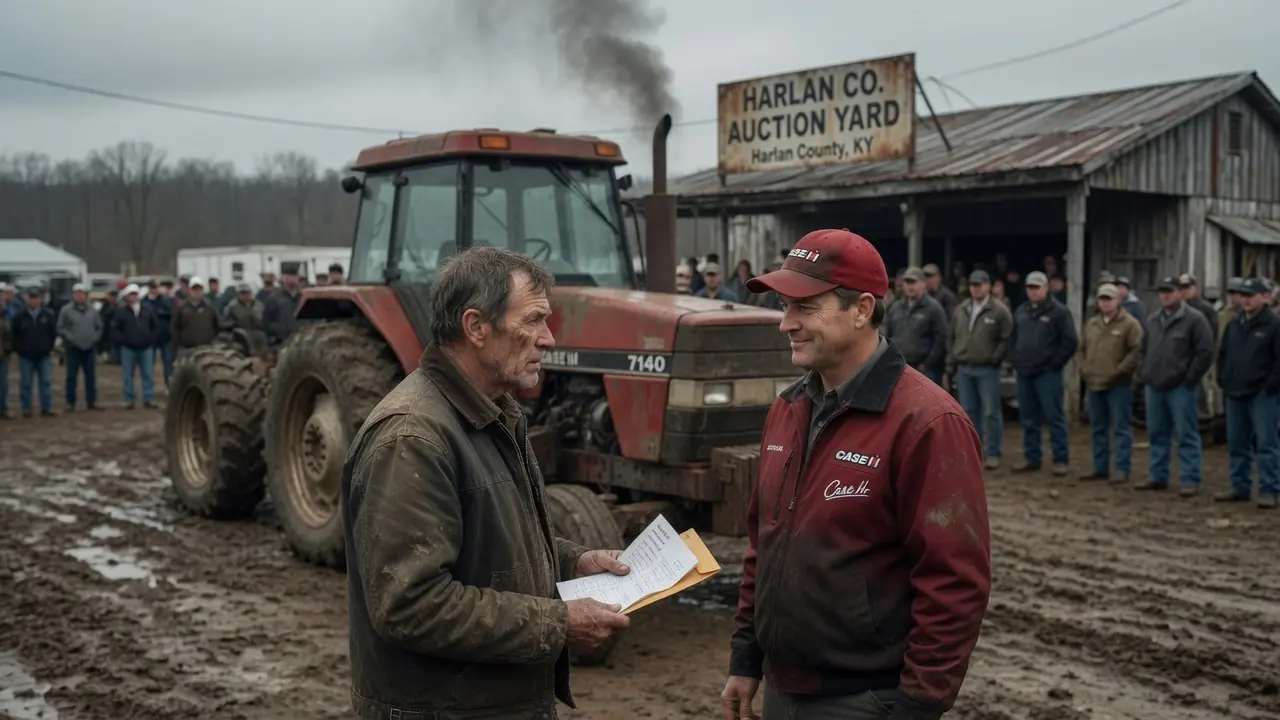
“That thing’s dead, Dale,” Brent called loud enough for nearby farmers to hear. “Transmission’s gone, hydraulics are failing, and the control module’s throwing codes like a Christmas tree.”
A few men chuckled.
Dale did not look at them. He was sixty-one years old, gray at the temples, lean from a lifetime of climbing down from machines and fixing what broke because calling the dealer had always cost too much. He wore a faded canvas coat, old jeans, and work boots darkened by oil and Kentucky mud. Nothing about him suggested money, but everything about him suggested patience.
The tractor sat at the far edge of Lot Seven, separated from the cleaner machinery as if rust were contagious. The hood was stained orange-brown where corrosion had bled down across the faded red paint. The cab glass was fogged from trapped moisture, and a cardboard sign wedged beneath the wiper read, AS IS. NO WARRANTY. DEALER INSPECTED. The words were supposed to be a warning.
Dale saw them as an invitation.
The auctioneer opened the bidding at four thousand dollars. The first bids came slowly, almost reluctantly, from men thinking about parts, scrap value, or the chance of reselling tires. Brent stood nearby with a smirk, arms folded, watching Dale the way a doctor might watch a patient refuse treatment. He had personally reviewed the dealer’s inspection report, and he believed the tractor was finished.
“Six thousand,” Dale said.
The crowd turned.
Brent laughed under his breath. “There goes his retirement.”
The auctioneer called for sixty-two hundred. Dale raised his card. No one followed. A few men looked at one another, half amused and half relieved that they had not been the fools to chase it higher.
“Sold,” the auctioneer shouted. “Six thousand two hundred dollars.”
The gavel cracked.
Brent walked toward Dale immediately. He wanted the moment while the crowd was still warm. “You bought a dead Case IH because you were too broke to understand what real repairs cost.”
Dale turned to him slowly. His face remained calm, but his eyes had gone cold. “No, Brent. I bought it because your dealership saw seventeen codes and quit thinking.”
The farmers nearby grew quiet.
Brent’s smile hardened. “That tractor needed a full rebuild, and you know it.”
Dale stepped closer, voice low enough to be dangerous. “It needed clean Hy-Tran, two filters, and one honest mechanic — not your forty-two-thousand-dollar scarecrow quote.”
Brent blinked first, though he quickly tried to hide it.
At that moment, Dale did not yet know all the details. He did not know about the manila envelope behind the cab liner, the wrong fluid poured in three summers earlier, or the chain of failures that had made a repairable machine look dead to anyone reading codes too quickly. But he knew enough. A machine with a truly destroyed powershift transmission did not sit level, hold fluid pressure sometimes, and look untouched inside the cab. Something about the dealer’s diagnosis did not add up.
And Dale had built his whole life around that feeling.
He had grown up on a farm where “call the dealer” meant something had already defeated every cheaper option. His father taught him to listen to equipment before tearing it apart. “A machine tells the truth,” the old man used to say. “Men are the ones who get impatient.” Dale had carried that sentence through combine breakdowns, hydraulic leaks, electrical failures, and more late-night repairs than he cared to count.
By the time the Case IH arrived at his farm on a rented flatbed that afternoon, the sun was dropping behind the trees. Dale unloaded it slowly, guiding the tractor into his machine shed with chains, blocks, and a neighbor’s help. The engine had to be coaxed, but it started. Rough at first, uneven for thirty seconds, then steady enough to make Dale stand beside it with one hand on the fender and listen.
That was the first truth the tractor told him.
Dead machines did not breathe like that.
He did not grab a wrench that night. He did not tear into the transmission, did not order parts, and did not let anger guide his hands. He sat in the cab with the cracked seat beneath him, turned the key to run, and watched the gauges cycle. Then he shut everything down, walked inside, made coffee, and opened the folder of auction paperwork at his kitchen table.
His wife had been gone seven years, and the house was quiet in a way that still felt too large. Dale had learned to fill that quiet with manuals, diagrams, and the low hum of thought. On the table beside him sat the dealer’s printed diagnosis: transmission failure, hydraulic failure, control-module fault cascade, recommended full rebuild and overhaul. Estimated cost: forty-two thousand dollars.
Dale read it twice.
Then he wrote one sentence on a yellow legal pad.
What did they rule out?
That was the question men forgot to ask when authority spoke loudly enough. A dealership computer could identify symptoms. A technician could interpret codes. But a machine did not become fixed because someone expensive guessed with confidence.
For two days, Dale only observed.
He warmed the tractor to operating temperature each morning. He engaged the PTO and watched its response. He worked the hydraulic remotes and noted which detents surged, which felt weak, and which responded late. He put the machine in gear and drove it slowly along the gravel lane behind the shed.
The tractor moved.
It moved badly. It ground in mid ranges, hesitated in upper ranges, and felt miserable under load. But it moved. Dale wrote that down because the difference between does not work and does not work correctly had saved farmers thousands of dollars more than once.
On the third morning, he connected his older code reader to the diagnostic port. It was not dealership software, and Brent Carlisle would have laughed at it, but it communicated well enough with the Case IH system to pull stored faults. Dale let the scan run fully, then wrote each code by hand. Seventeen total.
He did not panic at the number.
A long list of fault codes often looked like a disaster because people read it like seventeen separate failures. Dale read it like a witness statement. Which codes were primary? Which were downstream? Which appeared because something else had been starved, fouled, or misread?
By noon, four codes were circled in red.
Different sensors. Different systems. Same underlying variable.
Hydraulic pressure.
Specifically, pressure in the shared transmission and hydraulic circuit.
Dale opened the side panels and found the sight glass. The fluid was low, about two quarts under specification, but not empty. Low fluid could cause trouble, but it could not explain everything. He drew a sample from the sump into a clean glass jar and held it up to the shop window.
The color was wrong.
Hy-Tran had a look Dale knew from decades of work: amber-red, clean, and specific in the way it moved against glass. This sample was darker, brownish, murky, with a faint surface sheen that should not have been there. He brought it close, smelled it once, and set it down carefully.
“That ain’t right,” he said to the empty shed.
It was not proof yet. It was a direction.
The next step was the transmission filter. Dale removed the housing and froze when he saw the date stamp. The filter had not been changed in years. When he opened it, the story grew louder. The media held fine gray-bronze residue, almost powdery, mixed with sediment. Clutch material. Friction material from slipping wet clutch packs.
But slipping did not always mean destroyed.
Wet clutch packs could slip because they were worn beyond use, yes. They could also slip because they were starved of correct hydraulic pressure or surrounded by fluid with the wrong chemistry. Hy-Tran was not just oil. It carried friction modifiers the transmission needed to engage cleanly and release properly. A cheap universal fluid could turn a good machine into a slow disaster.
Dale stood over the filter, jaw tight.
Someone had made a decision.
Machines did not fill themselves with the wrong fluid. Machines did not ignore their own service intervals. Somewhere, someone had poured in the beginning of this failure, then kept running the tractor while the damage spread.
He went back into the cab.
At first, the small storage compartment behind the seat looked empty, just as it had the day before. But this time Dale noticed the felt liner in the rear corner had come loose. It had curled back from the metal wall, leaving a narrow gap. He reached in with two fingers and felt paper.
The manila envelope came out stiff, soft on one edge from old moisture, but intact.
Inside was a folded maintenance log.
Dale sat in the cab under the dome light and read every page.
The first handwriting was careful. Oil changes recorded to the hour. Correct Hy-Tran specification written out fully. Filter replacements noted. Coolant checks. Sensor repairs. Grease intervals. Whoever had owned the tractor first treated it like a machine worth preserving.
Then, in 2016, the handwriting changed.
The entries became shorter. Service intervals stretched. Maintenance grew careless. And then Dale found the line that made the whole tractor make sense.
Fluid low on check. Added approximately three quarts. Used universal hydraulic. Didn’t have Hy-Tran on hand.
Dale lowered the notebook into his lap.
Three quarts.
That was it.
A thirty-second decision on a hot July afternoon. No Hy-Tran in the shed, so somebody used universal hydraulic fluid, probably telling himself it was close enough. Then the wrong chemistry began its slow work. Wet clutches slipped. Heat built. Fluid degraded. Material shed. Filters clogged. Solenoids fouled. Sensors lied. Fault codes multiplied until a dealer saw catastrophe where there was actually a trail.
The tractor had not been lying.
Nobody had listened long enough to understand what it was saying.
Once Dale knew the origin, the repair became clear. He drained the entire shared sump, every contaminated drop he could remove. He flushed the system once with fresh Hy-Tran, ran the engine briefly, drained it again, then repeated the process. The third fill was correct fluid to correct level.
He replaced the transmission filter and hydraulic filter. He cleaned both housings until no residue remained. Then he removed the valve body and worked under the bench light, cleaning varnish deposits gallery by gallery. The aluminum was sound. No replacement needed.
Two solenoids in the transmission control circuit were slow on the bench test. Dale cleaned them, tested them again, and they responded correctly. One main pressure sensor showed erratic voltage. That part cost forty-seven dollars at the local dealership counter.
The irony nearly made him smile.
The same brand network that had condemned the tractor sold him the piece that helped bring it back.
Total parts and filters came to a few hundred dollars. Fluid cost more than the sensor, but Dale did not complain. Correct fluid was cheaper than wrong guessing. His labor took twelve days, most of it slow, careful, and undocumented except on his legal pad.
When everything was reinstalled, Dale cleared the stored fault codes and climbed into the cab.
The key turned.
The engine started clean.
He waited ten full minutes for temperature to rise, watching the gauges like a doctor watching a pulse. Then he put the 7140 in gear.
The tractor moved forward firmly.
No grind.
No shudder.
No hesitation.
Dale shifted through the ranges. Each one engaged. Each one held. He backed out of the shed, drove down the gravel lane, turned at the mailbox, and ran the full range again coming back. The hydraulics worked smoothly against the loader resistance he had hooked up for testing.
When he shut it down, he remained seated with both hands on the wheel.
He did not cheer.
He simply whispered, “There you are.”
That fall, Dale used the Case IH to plant. Then he used it again during harvest. It ran through both seasons without complaint. He replaced the cab glass during the winter, repaired the headliner, and reupholstered the cracked seat with material he ordered online. The rust on the hood he mostly left.
It had earned the right to wear its scars.
Word spread, as it always does in farm country. A neighbor saw the tractor running in Dale’s east field and mentioned it at the co-op. Someone else asked how the dead 7140 was suddenly pulling equipment. Dale told the story plainly, without boasting: wrong fluid, fouled system, bad diagnosis, hidden records.
Within a month, three other farmers began questioning expensive repair quotes they had accepted too quickly. One found contaminated fluid in a skid steer that had been quoted for a hydrostatic drive unit. Another discovered a combine feeder-house issue was a collapsed suction line, not a failed pump. A third rebuilt a hydraulic cylinder with a seal kit after being told the whole assembly was finished.
Nothing made the news.
But something changed.
Farmers started asking different questions. Not just how much does it cost, but what exactly failed? How do you know? What did you rule out before reaching that number? Authority still mattered, but it no longer ended the conversation.
Brent Carlisle hated that.
He heard Dale’s story at the parts counter, then at the co-op, then from a farmer who asked him directly whether his dealership checked fluid history before recommending rebuilds. By spring, his polished confidence had started to crack. He cornered Dale at the next Harlan County auction, near the same gravel lot where the Case IH had been sold.
The 7140 was parked nearby that day because Dale had driven it in for everyone to see.
The rusted hood still looked ugly.
The engine sounded perfect.
Brent walked up with his jaw tight. “You’ve been making us look bad.”
Dale turned from the tractor. “No, Brent. Your quote did that.”
“We gave the owner a professional diagnosis.”
“You gave him the most expensive answer before finding the first cause.”
Brent pointed toward the running tractor. “You got lucky.”
Dale reached into the cab and pulled out the manila envelope. He held it up between them. “Luck didn’t find this. Patience did.”
Farmers nearby went quiet and drifted closer.
Brent’s face reddened. “You think reading some old notes makes you smarter than certified technicians?”
“No,” Dale said. “I think reading old notes makes me harder to scare than a man selling rebuilds.”
Someone near the fence coughed to hide a laugh.
Dale opened the envelope and removed the maintenance log. “Three quarts of wrong fluid started all of it. Your dealership saw seventeen codes and stopped at the biggest invoice.”
Brent looked at the tractor, then at the farmers watching him. His voice dropped. “You don’t understand dealership liability.”
Dale stepped closer. “And you don’t understand what it means when a farmer trusts you with the only machine keeping his crop alive.”
That landed.
Even Brent had no quick answer for it.
Dale turned toward the other men. “I’m not telling anyone to distrust every dealer. I’m saying don’t let a logo do your thinking. Ask what failed. Ask why. Ask what got ruled out. If the answer is just ‘the computer says,’ keep asking.”
The crowd remained quiet.
The tractor idled beside him, steady as truth.
Brent walked away first.
Dale watched him go, not with triumph, but with something closer to disappointment. He did not hate dealerships. He hated lazy certainty. He hated the way expensive words could scare working people into decisions they could not afford. Most of all, he hated that the original owner had lost a good tractor because nobody slowed down enough to trace the story back to three wrong quarts.
That evening, Dale drove the 7140 home at sunset. The old Case IH rolled along the county road, red hood glowing beneath the last light, rust and all. Cars passed slowly. A few men lifted their hands in greeting. Dale returned the gesture.
In the glove box sat the old maintenance log, now protected in a plastic sleeve. Beside it were Dale’s own pages, written carefully in the style of the first owner: fluid changed, Hy-Tran, filters replaced, sensor installed, system flushed, hours recorded. He wrote everything down because someday someone else might need the truth.
The tractor kept running.
Spring after spring, fall after fall, it worked Dale’s fields without drama. People still asked about it, and Dale still told the story the same way. He never made himself the hero. He never turned Brent into a villain bigger than necessary. He always ended with the same lesson.
“That machine was telling the truth the whole time,” he would say. “Every bad shift, every slow hydraulic, every code. It all traced back to what had been done to it.”
Then he would pause.
“The tractor wasn’t broken. It was being honest.”
Most men understood tractors when he said that.
A few understood more.
Because the lesson reached beyond equipment, beyond service bays, beyond one rusted Case IH in Harlan County. The most expensive diagnosis is not always the one requiring the most sophisticated tools. Sometimes it is the one delivered by someone who stopped asking questions too early.
Authority is not accuracy.
A large quote is not proof.
And sometimes the most important evidence is not where the expert looks first.
Sometimes it is folded inside a manila envelope behind a loose felt liner, waiting in a dark cab for someone patient enough to reach deeper.