Carl Brennan had farmed eight hundred acres in Finney County, Kansas, since 1993. At fifty-seven, he had spent more of his life measuring seasons by planting dates and repair bills than by calendars. His hands carried scars from machinery, wire fencing, and three decades of work beneath the hard western Kansas sun. For most of those years, the equipment in his fields had been painted John Deere green.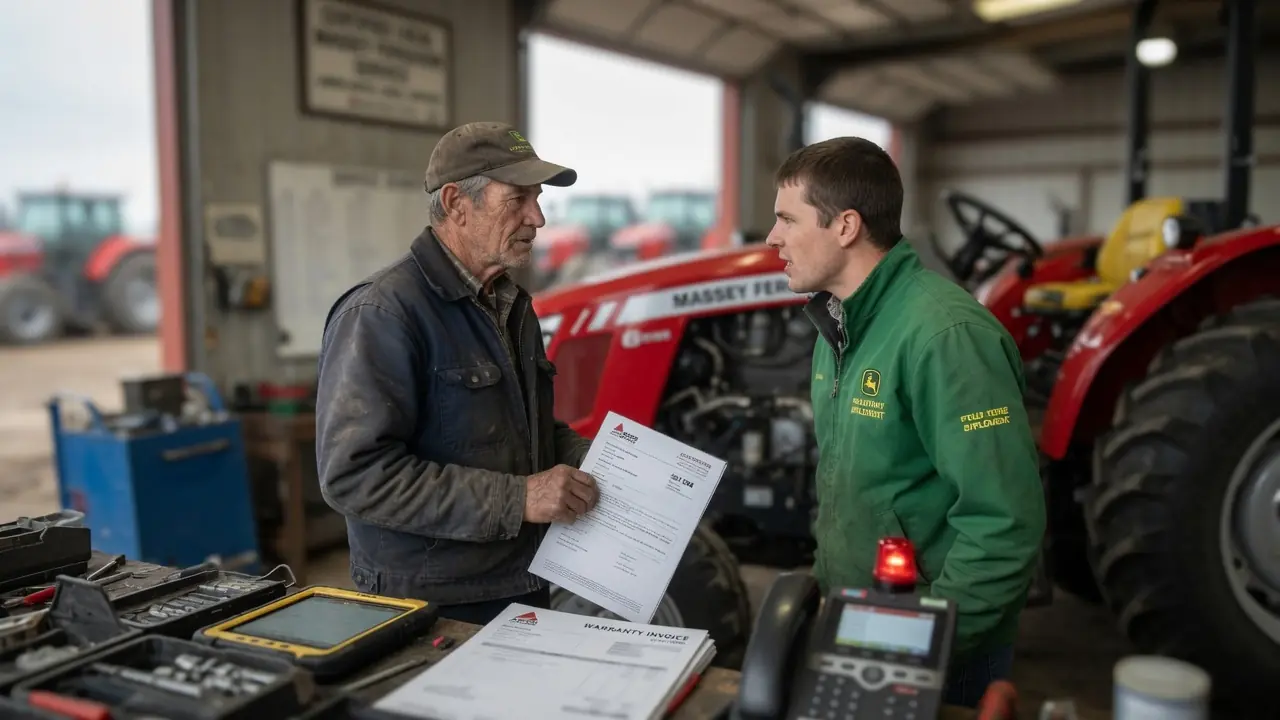
Carl bought his first tractor from Garrett Equipment in Garden City when he was twenty-seven. The dealership had been founded by the Holloway family in 1971, and Carl’s father had purchased parts there before Carl ever owned land of his own. As the Brennan operation grew, Carl returned for tractors, combines, planters, tillage machines, precision upgrades, filters, hydraulic fluid, and nearly every other expensive necessity modern farming required. By 2021, he had purchased nine tractors and two combines through the same dealership.
Garrett Holloway took control of the company from his father in 2004. He and Carl were not personal friends, but they had what Carl believed was something nearly as valuable in agriculture: a dependable professional relationship. They spoke at farm shows, negotiated major purchases, and shook hands after every transaction. Carl believed three decades of loyalty would matter when a serious problem finally arrived.
The problem came through a 2019 John Deere 8R 340.
Carl had purchased the tractor new for $384,000, more than he had ever paid for one machine. He maintained it carefully, keeping every service invoice and fluid record inside a dedicated binder organized by date. Oil changes were completed on time, filters were replaced before their limits, and every maintenance interval was documented. Carl treated machinery the way his father had taught him to treat land: take care of it before it forces you to.
At thirty-two hundred hours, the hydraulic pump failed.
The tractor lost pressure while Carl was moving a heavy field implement across the north quarter. Warning lights appeared, the hydraulic controls weakened, and the implement began lowering without command. Carl stopped immediately before the failure caused greater damage. The next morning, Garrett Equipment transported the tractor to its service department.
The technicians confirmed that the hydraulic pump required replacement. Carl submitted the warranty claim with the confidence of a customer who had done everything correctly. He expected questions, inspection, and perhaps several days of waiting. He did not expect a denial.
The answer arrived two weeks later.
John Deere’s warranty department had found one service entry from 2021 showing that Carl used a cross-brand hydraulic fluid rather than fluid carrying the John Deere label. The product met the required technical specifications, and its manufacturer provided written confirmation that it was compatible with the tractor’s hydraulic system. Carl had documented the substitution himself because he never hid service details. That honesty became the reason the company used against him.
The warranty department claimed the cross-brand fluid violated the terms. The pump replacement would cost Carl $51,000.
He read the denial twice at his kitchen table. The paper rested beside the compatibility documents, maintenance binder, and original sales agreement. Nothing in the engineering information explained how the fluid caused the pump to fail. The decision appeared to depend on a technicality rather than the actual condition of the machine.
Carl called Garrett Holloway directly.
“Garrett, I need the dealership to review this,” he said. “That fluid met every required specification, and I have the manufacturer’s documentation.”
“I’ll look into it,” Garrett answered.
Two days later, he called back.
“The dealership supports corporate’s determination,” Garrett said. “The warranty terms are clear.”
Carl remained quiet for several seconds. “I have bought nine tractors from your family.”
“I know.”
“Two combines.”
“I know that too.”
“Thirty years of parts, service, and equipment, and you will not even challenge a decision that makes no mechanical sense?”
Garrett’s voice became formal. “The dealership cannot override corporate engineering.”
“I did not ask whether you could override them. I asked whether you would advocate for me.”
Garrett did not answer immediately.
Carl continued. “Do you personally believe that hydraulic fluid caused the pump failure?”
“It is not my place to second-guess the assessment.”
That sentence ended the relationship more completely than an argument would have.
Carl thanked him for his time and ended the call. He paid the $51,000 repair bill from the farm’s operating account. The payment reduced the money available for seed, fertilizer, fuel, and unexpected planting repairs to a level that made him uncomfortable. Still, he paid without protest because the tractor had to return to work.
He did not call Garrett again.
For four months, Carl researched.
He contacted Massey Ferguson operators in Kansas and Colorado and asked them direct questions about reliability, fuel use, transmission performance, electronic systems, and dealer support. He listened more carefully to complaints than praise. Farmers rarely agreed about equipment brands, but their repeated experiences revealed patterns. Carl wrote everything inside a yellow notebook.
He then drove to Dodge City and spent two days with Massey Ferguson dealer Doug Patterson. Doug had operated his dealership for fourteen years and answered every question without pretending the machines never failed. He showed Carl the parts inventory, introduced him to technicians, explained field-response times, and discussed warranty claims from the previous three years. Carl appreciated that Doug spoke about problems as things to solve rather than things to hide.
Carl tested three tractors.
The Massey Ferguson 8S 265 was the nearest practical replacement for his primary John Deere. It felt different inside the cab, and several controls required adjustment after decades of green equipment. Yet the tractor handled well, delivered the power he needed, and provided access to systems Carl believed he could maintain. He returned to Finney County ready to make the largest equipment change of his career.
In February 2022, Carl traded his three primary John Deere tractors through Garrett Equipment. The transactions were professional and almost painfully ordinary. Garrett asked why Carl was changing his fleet configuration, but Carl offered no speech about loyalty or disappointment. He simply said the new arrangement suited his operation better.
Carl purchased a Massey Ferguson 8S 265, a 7S 210, and a 6S 155 from Doug Patterson. When the machines arrived, neighbors slowed their pickups along the county road to stare at the unfamiliar red tractors. Some farmers asked whether Carl had received an unusually low price. Others assumed he had made the decision in anger.
Carl had not acted from anger.
Anger could begin a decision, but it could not responsibly purchase nearly a million dollars of agricultural equipment. Carl switched because he had spent months studying the alternative. He believed the machinery could do the work. The question was whether he could support it from fifty miles away.
Garrett Holloway publicly answered that question at the Garden City Farm Show in April.
Carl attended the show every year to speak with seed companies, equipment manufacturers, and other farmers. Garrett Equipment occupied a large corner display backed by four decades of sponsorship history. Carl exchanged a polite greeting with Garrett and then moved toward a neighboring booth. He remained close enough to hear Garrett speaking with another exhibitor.
“Some farmers think changing to Massey Ferguson solves everything,” Garrett said. “But there is no service infrastructure for it out here.”
The other man laughed.
Garrett continued. “When something breaks at two in the morning during harvest, they’ll be calling a dealer fifty miles away. Good luck with that.”
Carl knew the comment was about him.
He did not turn around. He did not defend his decision or list his mechanical qualifications. He walked through the remaining exhibits, returned to his pickup, and drove forty minutes home. Garrett’s words followed him across the open Kansas road.
There was no service infrastructure.
For several days, Carl considered the statement. Garrett was correct about the present situation. The Dodge City dealership could provide excellent service, but distance still mattered when a machine failed during a narrow planting or harvest window. Local farmers considering another equipment brand would hesitate for exactly that reason.
What Garrett had misunderstood was the difference between something that did not exist and something that could not exist.
Carl had maintained agricultural machinery since he was nineteen. His father once operated a repair shop in Garden City before farming demanded his full attention. During summer breaks, Carl learned to rebuild transmissions, overhaul engines, diagnose electrical failures, fabricate hydraulic fittings, and repair machinery using whatever knowledge and tools were available.
The Brennan farm shop was not an ordinary storage shed.
It contained a thirty-two-ton press, full electrical diagnostic equipment, MIG and TIG welding systems, hydraulic test instruments, and the heavy lathe that had belonged to Carl’s father. Carl had rebuilt machinery that commercial shops declared too expensive to save. He understood how systems worked, not merely how parts were replaced. What he lacked was formal Massey Ferguson certification and access to the manufacturer’s electronic diagnostic platform.
Garrett’s insult gave him a plan.
Throughout the winter of 2022 and 2023, Carl studied through AGCO’s technician-development program. He completed coursework after finishing farm responsibilities, often working at the kitchen table until midnight. The material covered electronic control systems, hydraulic circuits, transmission diagnostics, calibration procedures, service documentation, and brand-specific repair protocols. Carl treated every lesson as seriously as a crop decision.
In January, he drove to Wichita for the practical assessment.
The examination lasted two days and required candidates to diagnose actual faults rather than repeat information from a manual. Carl worked methodically, beginning with symptoms, verifying measurements, and refusing to replace anything until he understood the failure. The assessor watched him trace one electronic problem through a wiring harness and asked how long he had worked as a technician.
“I farm,” Carl answered.
“That was not my question.”
Carl smiled. “Almost forty years, if working on my own equipment counts.”
“It counts.”
Carl passed on his first attempt. The final evaluation described his diagnostic process as systematic and his mechanical execution as professional. The assessor wrote that Carl performed like an experienced technician rather than someone new to the brand. Carl folded the document carefully and placed it inside the same filing cabinet that held his farm records.
He ordered the AGCO diagnostic laptop and software required to connect with Massey Ferguson systems. He registered as an independent authorized service provider and purchased additional specialty tools. During February, he expanded the shop by building a second service bay. He also created an initial parts inventory covering filters, sensors, seals, hoses, belts, and common wear components.
By March 2023, Brennan Farm Service was ready.
Carl did not buy advertising or place large signs beside the highway. He told four farmers that he was certified, properly equipped, and willing to service Massey Ferguson machines for rates roughly forty percent below the Dodge City dealership. His lower prices were not an attempt to damage Doug Patterson. Carl simply had no showroom, sales department, marketing budget, or expensive commercial property to support.
The first customer arrived within two weeks.
Wallace Reed came from Gray County with a Massey Ferguson 7S 180 suffering from a persistent telematics fault. The Dodge City shop had examined the machine twice, but the warning continued returning. Wallace was tired of losing system data and even more tired of paying diagnostic charges without a final repair. He parked the tractor inside Carl’s second bay and asked when Carl might have an answer.
“An answer comes after I find the cause,” Carl said.
Four hours later, he found a damaged section inside the wiring harness. The earlier technician had followed most of the diagnostic tree but stopped before opening the final branch. Carl repaired the harness, tested every operating condition, and ran a complete cycle until the fault failed to return. Wallace looked at the cleared display and remained silent.
“How much?” he finally asked.
Carl handed him the invoice.
Wallace read it twice. “This is sixty percent of what I expected.”
“It took four hours.”
“I have been fighting that warning for eight months.”
“I’m glad it is fixed.”
Wallace told two farmers.
Those farmers told others at the cooperative, grain elevator, feed store, and church parking lot. By June, Carl had repaired eleven different Massey Ferguson machines belonging to nine farmers across Finney, Gray, and Haskell counties. Word traveled quickly because farming communities discussed equipment failures with the same seriousness as weather.
Customers repeatedly praised the same things.
Carl explained what he found before beginning expensive work. He gave a clear estimate, returned replaced parts, and never surprised anyone with unexplained charges. He tested the repair under operating conditions instead of assuming a cleared fault code meant success. To Carl, those habits represented the basic requirements of good service.
His customers told him good service was no longer basic everywhere.
In September 2023, Doug Patterson called.
Carl expected concern because several farmers who once drove to Dodge City were now bringing machines to Finney County. Doug did not accuse him of stealing customers. He asked how the operation worked, whether Carl planned to expand, and which repairs he intended to accept. Carl answered every question honestly.
“If you reach something beyond your capacity, call me,” Doug said. “We can create a referral arrangement instead of leaving the farmer trapped between us.”
Carl respected the response.
Competition had not made Doug hostile. It made him practical. The two men understood that no independent shop or dealership could handle every problem during the busiest seasons. A repaired tractor mattered more than pride when crops were waiting.
Garrett Holloway called one month later.
Carl was rebuilding a hydraulic cylinder from Terry Lawson’s Massey Ferguson 6S 155 when his phone rang. He wiped one glove against a shop towel and answered. Garrett skipped ordinary conversation.
“I hear you are running some kind of service operation.”
“I provide certified Massey Ferguson service.”
“I also hear you are undercutting established dealers.”
Carl looked toward the diagnostic laptop, organized parts shelves, and second machine waiting inside the shop. “I charge rates based on my cost structure.”
“Your rates are below what a properly operated dealership can charge.”
“I do not have a showroom, sales staff, or equipment floor plan.”
“You are creating unfair competition.”
Carl set down the seal he had been inspecting.
“That is an interesting complaint from someone who supported a $51,000 warranty denial over a fluid that met the correct specification.”
Garrett became quiet.
“That is a separate matter,” he said.
“I agree. We can discuss the warranty decision and service competition separately, in as much detail as you want.”
“I have said what I needed to say.”
“I understand.”
The call ended.
Carl returned to the hydraulic cylinder.
He did not increase his rates to comfort Garrett or reduce them to provoke him. He continued charging what the work required. Farmers continued coming because the shop solved problems, communicated clearly, and stood close enough to reach during urgent failures.
By the spring of 2024, Brennan Farm Service had worked on twenty-three Massey Ferguson machines. Six farmers used Carl for all routine maintenance and called him first whenever something failed. Three had previously purchased John Deere equipment through Garrett. They changed brands only after Carl’s shop removed their greatest concern about local support.
One of them was Dennis Walker.
Dennis farmed twelve hundred acres in Finney County and had done business with Garrett Equipment for twenty-two years. He had considered Massey Ferguson before but feared depending on a distant service department. He called Carl directly and asked whether the independent shop was stable.
“I intend to keep operating it,” Carl said.
Dennis visited the following week. He spent three hours inspecting the diagnostic equipment, certification, parts supply, and service records. Carl removed customer-identifying details before showing completed repair reports. Dennis asked difficult questions, and Carl answered without attempting to sell him anything.
Two weeks later, Dennis ordered a new Massey Ferguson 8S 265 from Doug Patterson.
“Your shop decided it,” Dennis told Carl. “Without local service, I would have stayed green.”
The sale was one of Doug’s largest transactions with a Finney County farmer in several years. After it became final, Doug called Carl again. This time, he proposed a formal overflow agreement for the harvest season.
Carl considered it for a week before agreeing.
Between June and August, Doug sent four service jobs to Brennan Farm Service that otherwise would have waited nearly three weeks. The farmers received their machinery sooner, Doug reduced his backlog, and Carl gained additional work. The arrangement succeeded because both men treated service as a shared practical problem instead of a territorial battle.
By the end of 2024, Carl’s shop had serviced thirty-one different machines.
He expanded the parts inventory to cover five equipment families and hired Brandon Hayes, an agricultural-mechanics student from the community college in Garden City. Brandon worked two days each week under a formal training arrangement. Carl taught him the way his father had taught him decades earlier.
“Do not replace a part because the screen names it,” Carl said one morning. “Ask what made the part fail.”
Brandon looked toward the fault code on the laptop. “The code says pressure sensor.”
“The code tells you where the system noticed the problem. It does not promise that is where the problem began.”
They traced the circuit and found a damaged ground connection rather than a failed sensor.
Brandon smiled when the warning cleared. “A new sensor would not have fixed it.”
“No,” Carl said. “But somebody would still have sold one.”
The shop produced $42,000 in net revenue that year after parts, wages, and operating expenses. It would never replace the farm, and Carl did not want it to. The money mattered, but the operation’s greater value appeared in the machines running through harvest, the young technician learning a trade, and the farmers gaining another choice.
Garrett did not call again.
He did not need to.
His salespeople heard about longtime customers considering Massey Ferguson because Brennan Farm Service existed. They heard about Dennis Walker’s tractor purchase and Doug Patterson’s overflow agreement. They saw red equipment appearing in fields where service distance once made the brand impractical.
One cold December morning, Garrett finally drove to Carl’s farm.
He parked beside three Massey Ferguson tractors waiting outside the shop and entered without announcing himself. Carl stood near Terry Lawson’s 6S 155, reviewing diagnostic readings while Brandon completed an oil-and-filter service in the second bay. The building was clean, heated, organized, and busier than Garrett expected.
He looked around slowly.
“You have built quite an operation.”
Carl closed the diagnostic screen. “It does the work.”
Garrett glanced toward the certification displayed near the office door. Beside it hung the framed evaluation from Wichita and the original $51,000 warranty invoice. Garrett recognized the invoice immediately.
“You kept that?”
“I keep records.”
Garrett walked toward the counter. “Two of my customers are asking about changing brands because of you.”
“They asked whether local support existed.”
“And you told them it did.”
“I showed them.”
Garrett looked through the open bay door toward the machines outside. “You are still charging less than any full dealership can match.”
“I am not a full dealership.”
“You understand how this appears.”
Carl met his eyes. “I understand how it works.”
Garrett’s face tightened. “You built this because of what I said at the farm show.”
Carl considered denying it.
Instead, he answered honestly. “You said the service infrastructure did not exist.”
“It didn’t.”
“You were right.”
Garrett appeared surprised.
Carl continued. “You were wrong when you assumed that was the final condition.”
The telephone rang on the workbench.
Carl answered. A farmer from western Finney County described a Massey Ferguson transmission warning and asked whether Carl could inspect the machine before the next storm. Carl listened, asked several questions, and scheduled a visit for the following morning.
When he ended the call, Garrett was staring at the crowded service calendar.
“You think one farmer can replace an entire dealer network?” Garrett asked.
Carl shook his head. “No.”
He placed the phone beside the old warranty invoice.
“I built the network you said could never exist.”
Garrett looked at him for a long time.
The confrontation Carl might once have imagined never came. Garrett did not apologize for the warranty decision, and Carl did not demand that he do so. Some choices could not be undone through late regret. Their consequences had already become tractors, tools, customers, and a second service bay.
Garrett left without another argument.
Carl returned to Terry’s machine and asked Brandon what the pressure readings suggested. The young technician studied the numbers before answering. Outside, winter wind moved across the bare Kansas fields, rattling the shop doors but failing to enter the heated workspace.
By noon, both tractors were finished.
Carl sent Brandon home, cleaned the tools, and locked the parts cabinets. He then walked through the two service bays his father would never see. The old lathe remained near the back wall, still carrying marks from decades of use.
Carl rested one hand on it.
Thirty years of loyalty had ended through one warranty decision. Yet the loss had not destroyed his operation. It pushed him toward skills he already possessed, a certification he could earn, and a need his county had never filled.
Garrett Holloway had been correct about one thing.
Finney County did not have a Massey Ferguson service infrastructure.
Then Carl Brennan built one.